
Bodleian’s treasures on display: paradise as a library

Share

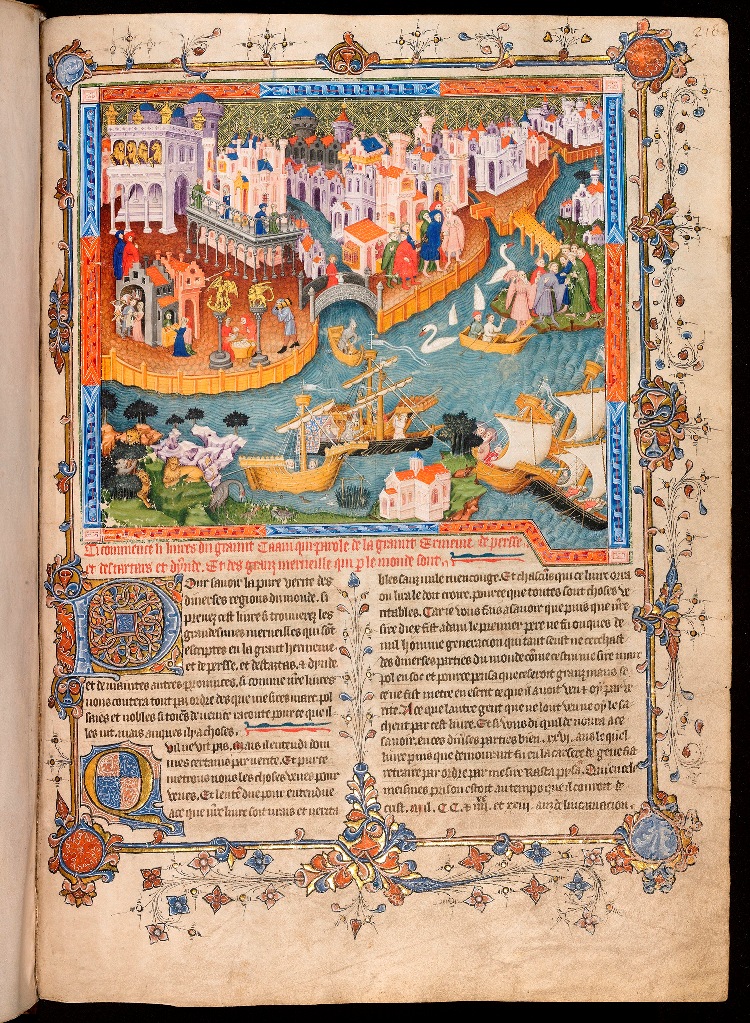
"Marco Polo's Travels," 14th century. Copyright Bodleian Libraries,University of Oxford

As you enter the darkened room,  a 1623 Shakespeare First Folio is to your right.  Enigmatic scraps of a poem by Sappho, circa 2nd century A.D., are to your left.  And all around you the wonders of the world: weighted with heavy seals, a 1217 “engrossment” of the Magna Carta is nearby (it was reissued under Henry III); so is a 1455 Gutenberg Bible.  In the corner of one glass case –  an exquisite 18th-century miniature scroll of the Bhagavad Gita, which shines like a cache of jewels, somehow pressed and rolled into paper.
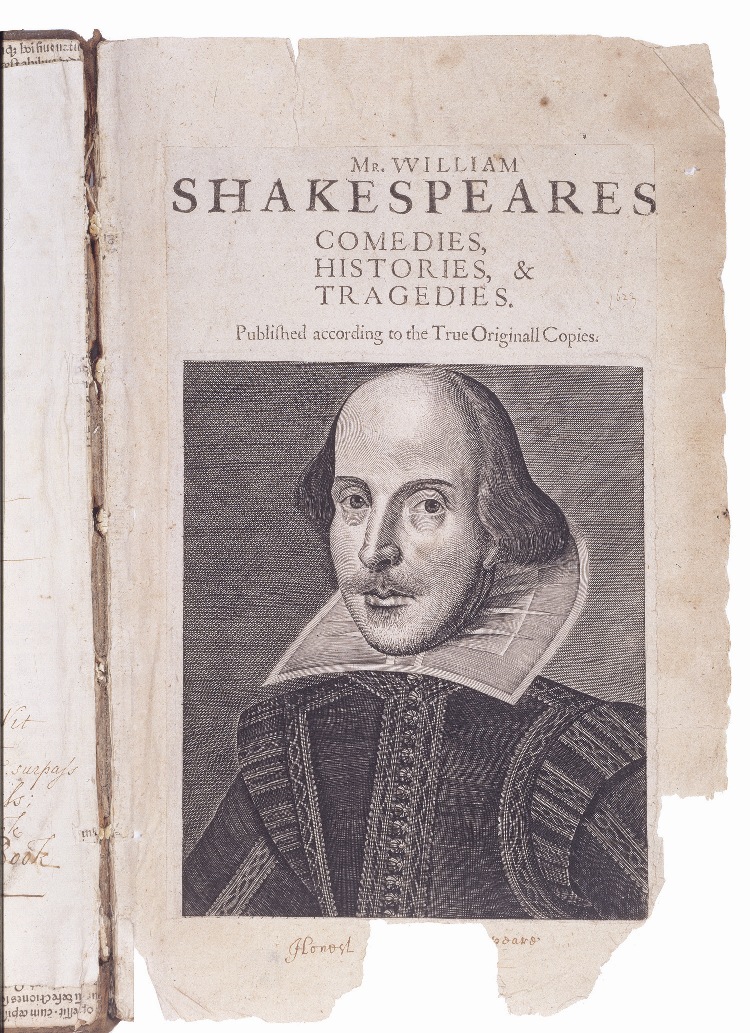
William Shakespeare, First Folio,1632. Copyright Bodleian Libraries,University of Oxford

“I have always imagined that Paradise will be a kind of library,” Jorge Luis Borges famously said. And here, in the Bodleian Library’s current exhibition, “Treasures of the Bodleian,” 30 Sept. – 23 Dec. 2011, everyone could see that, well, he had a point.  The exhibition anticipates a permanent gallery in the Weston Library in 2015.  The exhibition shows some of the Bodleian’s rarest, most important, and most evocative rarities.

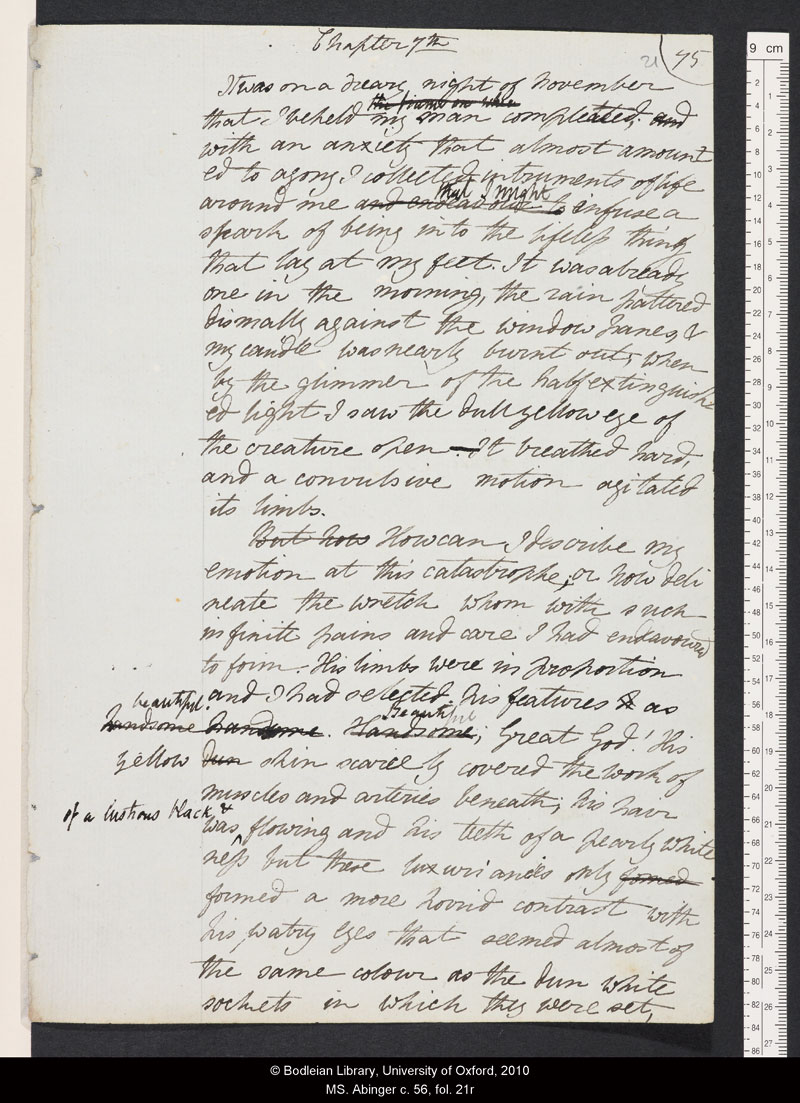
To wit:  In a corner, a single page of Mary Wollstonecraft Shelley‘s Frankenstein describes the ominous night of the creature’s creation. Her scrawled text is corrected and amended by her husband, the poet Percy Bysshe Shelley.  Other handwritten manuscripts are the work of Jane Austen, John Donne, and Gerard Manley Hopkins.  Others are the work of a brush rather than a nib: an exquisite 17th-century picture scroll of the sad Tale of Urashima, a classic Japanese fairy tale which I had read as a child.

For Sir Thomas Bodley, who basically created the museum that opened its doors in 1602, the Shakespeare first folio did not seem like the greatest find. According to the exhibition guide, he “would likely have dismissed this as one of the ‘idle books, and rife raffes’ that had not place among the Library’s predominantly theological collections.”

The volume left the library under mysterious conditions in 1674, and resurfaced only in 1905.  By that time, “the Bodleian was prepared to pay the unheard-of sum of £3,000 to buy back ‘its original long-lost copy of the First Folio of Shakespeare.'”
William Shakespeare,First Folio,1632. Copyright Bodleian Libraries,University of Oxford

I visited the exhibition in the company of my friend, Oxford’s Eliza Tudor, and we gravitated towards our favorites.  Hers seemed to be J.R.R. Tolkien‘s brilliant golden watercolor of Bilbo Baggins, rendered invisible by a magic ring, as he converses with a dragon.  She also took a liking to the Selden map of China, from the Ming era – the earliest Chinese map to show not only shipping routes, but also to depict China as part of a greater East and Southeast Asia. And for me … well, what a choice!  Perhaps I’ll plump for one of the earliest editions of Dante‘s Divine Comedy, fully illustrated, made within decades of his death (see video below).

But there are littler treasures, too – Mohandas Gandhi wrote to his friend, the Anglican missionary Charles Andrews, in a 1932 prison letter exhibited in the collection: “I can therefore never say beforehand what will occupy my attention exclusively or for the most part at a given moment and since a civil resister bargains for the punishment he receives for his resistance, he must not fret over it. Therefore and to that extent I am content with my lot.”
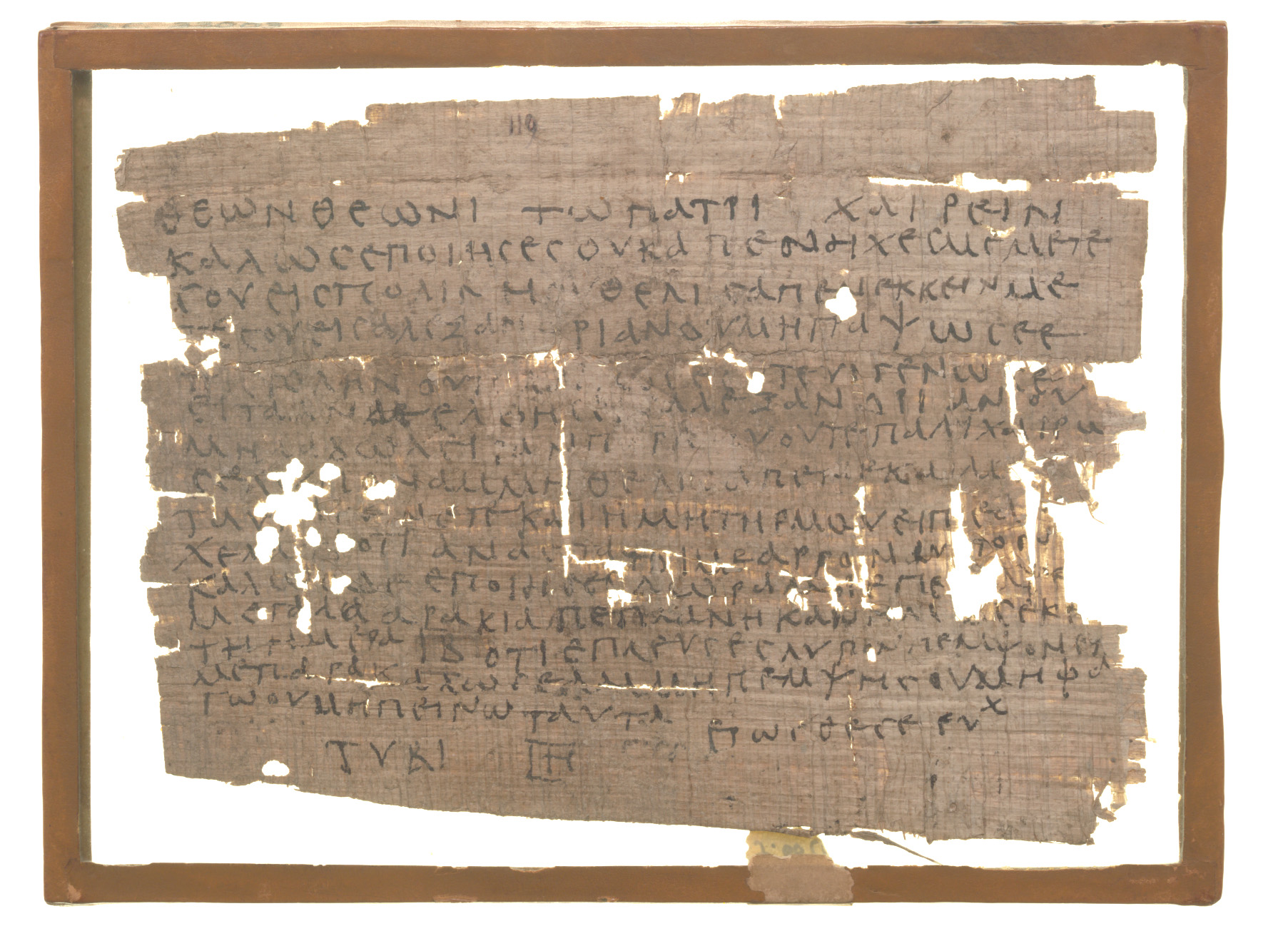
Letter from an Egyptian boy to his father, 2nd or 3rd century A.D. Copyright Bodleian Libraries, University of Oxford

Eliza arrived with her young son Fabian, who was mildly ill and did not attend school that day. His own choice was no surprise.  The exhibit that intrigued him the most was one of the earliest – about the same era, perhaps a little later, as the Sappho fragments: on a sheet of papyrus, an Egyptian schoolboy Theon complains to his father:

Theon to his father Theon, greetings. A nice thing to do, not taking me with you to the city. If you refuse to take me with you to Alexandria, I shall not write you a letter or speak to you or wish you good health. So: if you go to Alexandria I shall not take your hand or greet you ever again. If you refuse to take me, this is what happens. And my mother said to Archelaos, “He’s upsetting me, take him away!” A nice thing to do, sending me these grand presents, a hill of beans. They put us off the track that day, the 12th, when you sailed. Well then, send for me, I beg you. If you don’t send for me, I shan’t eat, I shan’t drink. There! I pray for your health.
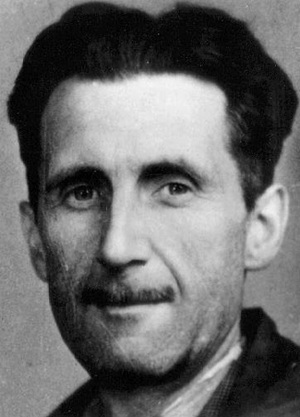
George Orwell: Love, sex, religion, and ghosts

Share

Aaaaa–choo!

I have to confess that I’d never had a thought, one way or ‘tother, about George Orwells views on anything supernatural. Frankly, I didn’t know that he had any – that is, until Dave Lull sent me a link for the following piece, Robert Gray‘s “Orwell vs. God,” from the most recent edition of The Spectator.

It probably won’t strike many as too much of a surprise that Orwell (a.k.a. Eric Blair) had a nearly allergic reaction to religion.  But that’s far too simple a characterization of a complex, intellectually tortured, relationship.

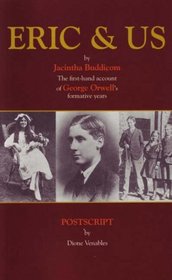
Yet as Orwell approached death, his intolerance of religion seemed to relax. In his last year he was delighted to receive a letter from Jacintha Buddicom, whom he had met at the age of 11, and who had become, during his teenage years, the first girl seriously to attract him — though his urgent desire was never returned. In her memoir, Eric and Us (1974), Jacintha Buddicom recalled how the young Eric Blair had loved ghost and horror stories, and how — jokingly, of course — he had given her a crucifix to keep away the vampires. Half the people walking the streets, he had speculated, were ghosts.

As long as his appetite for horror had been confined to imaginary worlds, he had been able to retain a capacity for joy in the real one. Jacintha Buddicom remembered him as a notably happy boy, and her memoir shows him full of kindness and fun, vastly different from the image he later purveyed of the miserable schoolboy at St. Cyprians, and still further removed from the misanthropic cynic who emerged at Eton.

But then in his first year at Eton Orwell had suffered a severe trauma. Infuriated by the bullying of an elder boy called Philip Yorke, brother of the novelist Henry Green, Blair and his friend Steven Runciman had constructed a wax model of their persecutor, and torn off one of the legs. Shortly afterwards Yorke broke his leg; a few months later he died of leukaemia. Sheer coincidence, no doubt, but deeply disquieting for the boys who had created the model. Runciman remained all his life an enthusiast for the occult; Eric Blair, perhaps more profoundly shocked, thenceforward shied away from any suggestion of the supernatural. Evil was clearly rampant, whereas ‘the good and the possible never seem to coincide’. It was at about 14, he later confessed, that he had abandoned his belief in God.

But that’s not all.  Gray continues:

Thanks to Animal Farm...

Yet seven months before Orwell died, he wrote to Buddicom, insisting that there must be some sort of afterlife. The letter, unfortunately, is lost, but Buddicom remembered that he had seemed to be referring not so much to Christian ideas of heaven and hell, but rather to a firm belief that ‘nothing ever dies’, that we must go on somewhere. This conviction seems to have stayed with him to the end: even if he did not believe in hell, he chose in his last weeks to read Dante’s Divine Comedy. [I wonder which translation – ED.]

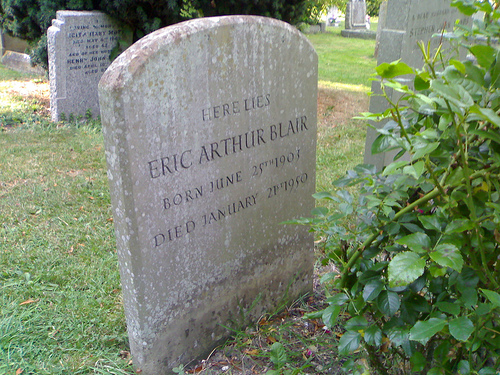
In his will Orwell had left directions that he should be buried according to the rites of the Church of England. Of course no one was better qualified to appreciate the beauty of the Book of Common Prayer; nevertheless the request surprised some of his admirers. A funeral was duly held at Christ Church in Albany Street; and David Astor, responsible for the arrangements, asked if his friend’s body might be interred in a country churchyard, at Sutton Courtenay, in Berkshire.

There was, however, a hitch. One of the churchwardens at Sutton Courtenay, a farmer, seemed doubtful that permission should be given. Had this fellow Orwell, or Blair, or whatever, really been a sound Christian? Fortunately the vicar had the inspired idea of showing the agricultural churchwarden a copy of Animal Farm. It was a title which instantly removed all scruples.

And that’s where he remains.

There’s lots more to the story – check out The Spectator article.

By the way, Jacintha Buddicom was the recipient of more than distant yearnings – John G. Rodwan’s  fascinating, and very well-informed, discussion of hot, steamy sex … well, the desire for hot, steamy, sex, anyway… under the stuffy title, “George & Jacintha: On the Limits of Literary Biography,” is here.

Postscript on 6/14:  Dave Lull wrote to add a note on a parallel theme, a review of David Lebedoff’s The Same Man: George Orwell & Evelyn Waugh in Love and War – it’s reviewed briefly in “A Study of Two Masters of English Prose,” by John P. Rossi.  The thought extends a passage from The Spectator article:  “Perhaps Evelyn Waugh divined something of Orwell’s buried spirituality when he wrote to congratulate him on Nineteen-Eighty-Four, and subsequently visited him in the nursing home at Cranham in Gloucestershire. On the other side, one of Orwell’s last attempts at writing was to draw up notes for an essay on Waugh, who, he considered, ‘is abt as good a novelist as one can be (i.e. as novelists go today) while holding unacceptable opinions’.”

Peter Dale Scott’s “J’aime mais j’accuse”

Share

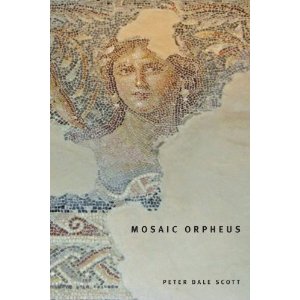
Poetry reviews are hard to come by in our increasingly distracted world, so Peter Dale Scott wrote me yesterday to say that he is understandably chuffed with John Peck‘s hefty, megawatt review for his  Mosaic Orpheus in the current Notre Dame Review. (If you scroll way down to the bottom of the screen here, you can download the 15-page pdf, which is certainly a clumsy way for NDR to do things.)

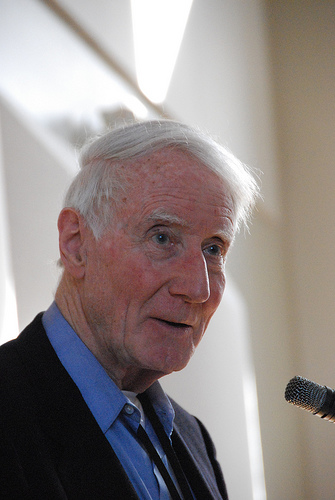
Peter, a former Canadian diplomat, is one of the few to tackle political poetry in a way that is gritty and specific, rather than the more commonplace attempt to commandeer politics to give oneself unearned gravitas via airy and politically correct generalities.  Robert Hass called Peter’s 1988 Coming to Jakarta: A Poem About Terror “the most important political poem to appear in the English language in a very long time.”

Peck’s discussion opens with the 1988 “contemplative epic”: 

“Coming to Jakarta, his attempt to contain distress over the blocked publication of his investigative research findings comes up against ‘mosaic darkness’—not familiarly seamless obscurity, but kaleidoscopic stuff—while in the poem’s later books Dante’s civic grief and wrath, with his loyal love for a dead woman, make him an Orphic brother-father to Scott, in that Alighieri’s existential defeat folds out into contrary visionary assurance. Such is not regulation Orphism, particularly as invoked collegially against American amnesiac indifference toward a largely occulted, webby congress of state terrorism, proxy mass slaughters, off-the-books funnelings of the sluice from international drug cartels to black ops, economic decline and the management of fear by debt, false-flag events, assassinations, and greasy resource wars.”

Shovel ready

Peck’s writing style is dense, but often rewarding.  And while I hadn’t been terribly looking forward to a long gaze at the nastiest sides of American policy — other than that proffered by the daily news — I must say that Peck’s review has heightened my interest.  Of Scott, Peck writes:

“He must be the only poet now writing who can say that Czesław Miłosz, peace-studies scholar Ola Tunander, various prominent vipassana teachers, and certain unnamed informants in government service deceased in mysterious circumstances, equally have nourished his effort. This span, together with an iron stomach for the forensics and catharsis of difficult findings, spell his personal equation. His poetics therefore will likely be neither a standard Orphic affair nor a canonical Buddhist one, although the poetry plainly arises in order to square those canons, and that personal equation, with a civics obdurately impersonal and malign.”

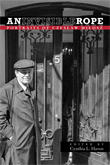
Peter, one of Miłosz’s earliest translators, describes his up-and-down relationship with the Nobel laureate — the two parted over politics, but reconciled much later — in my  An Invisible Rope: Portraits of Czesław Miłosz.

Peck concludes:

“The spirit of research in this our dump needs every acolyte who carries a shovel. My Ketman-meter, its needle pushing into the red zone, tells me that our bitched order forces doubleness into both zones, out behind the vast oligarchic scrim and down into the crannies of palimpsested authority.  Scott has done us the honor of adopting this country as his own. Shall we read his voluminous J’aime mais j’accuse with due attention? His vade mecum, Mosaic Orpheus, reminds us that this labor has been one of hopeless, yet justified, love.”

By the way, Clive Wilmer called Peck, a Pittsburgh-born psychotherapist, “the outstanding American poet of his generation–as well as one of the most difficult.” As a young man he studied under Yvor Winters, and earned his Stanford PhD with doctoral thesis on Ezra Pound, supervised by Donald Davie.  Some of Peck’s poems are at the Poetry Foundation here.