

Medieval plays in modern times: Dickens, Dante, and La Pastorela

Share
elteatro

El Teatro Campesino’s “La Pastorela” (Photo: Lora Schraft/Morgan Hill Times)

Once a year our family, or various subsets of it, makes the trek to the town of San Juan Bautista to see El Teatro Campesino’s annual Christmas play. This year it was La Pastorela. Here’s the cool part:  it’s part of an ancient tradition of pastorelas, or shepherds’ plays, introduced into Mexico by Spanish monks centuries ago.  The program notes described its relationship vis-à-vis the medieval morality plays: “there are vague similarities betwen the Mexican and old English traditions, the Wakefield master’s version is more decidedly irreverant.”
The ghost of Christmas forever.

The first production took place in 1966, when the company, which was born in Cesar Chavez‘s historic grape strike, improvised before a live audience in a Christmas Eve performance with farm-workers as performers. Then, in 1976, after artistic director Luis Valedez relocated the group to the mission town south of San Jose, the company received an old dog-eared typed manuscript of La Pastorela from the mother of one of the young performers. Longina Montoya offered the company the script she had performed as a girl in her hometown of San Luis Potosi, Mexico, and she sang all the songs a cappella into a portable tape recorder. A tradition was reborn (see photos here). So now in Silicon Valley we have an opportunity to taste the medieval, via these old morality plays, often bawdy and funny, where good meets evil and good inevitably triumphs. Could there be more?  Yes!

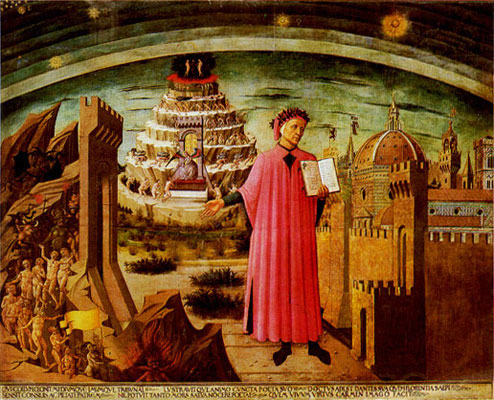
I’ve never seen anyone link Dante and Charles Dickens  before, but over at the blog “Through a Glass Brightly,” blogger Kathryn (she doesn’t seem to have a last name)  finds a few parallels. Did Dickens, in fact, write a medieval morality play?  And was he inspired by Dante?  The evidence is intriguing.  Dickens may have written A Christmas Carol while he was touring Italy, where the Florentine poet is inescapable. She pulls together a few parallels:

First of all, both main characters begin in a dark wood—vividly illustrated as such in the Comedy and similarly rendered in chimney tops, alleyways, and dense fog in the Carol. The Pilgrim and the Miser have lost their way. Hence, they are taken on a mystical journey for the sake of their reclamation: Dante through Hell, Purgatory, & Heaven; Scrooge through the Past, Present, and Future. The three beasts that Dante meets before his journey begins (leopard, lion, and wolf) function similarly to the omens that Scrooge encounters on Christmas Eve: the hearse, the transformed door-knocker, the ringing bell. And when Dante first meets Virgil, the lines run,
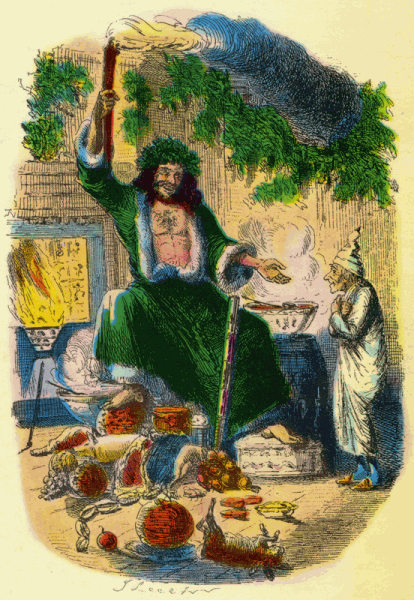
dickensAnd when I saw him standing in this wasteland, “Have pity on my soul,” I cried to him, “whichever you are, shade or living man!” “No longer living man, though once I was,” […]

Virgil explains to Dante:

“But you must journey down another road,” he answered, when he saw me lost in tears, “if ever you hope to leave this wilderness; […]”

Likewise (though in the third person), Marley’s visit to Scrooge goes,

“How now!” said Scrooge, caustic and cold as ever. “What do you want with me?” “Much!” — Marley’s voice, no doubt about it. “Who are you?” “Ask me who I was.” “Who were you then?”  said Scrooge, raising his voice.  “You’re particular, for a shade.”

Her conclusion finds inevitable differences in the spirit of medieval Italy and the spirit of Victorian England: “The Comedy is headed for brightness, aiming at ecstasy—much like the natural world does as it blossoms into spring at Easter. But the Carol turns in from the cold, burrows into warm hearth and good wine and loud laughter.”  Read the rest here. Meanwhile, the BBC offers another possibility for the origins of A Christmas Carol in one of Dickens’s least-read books, The Uncommercial Traveller:
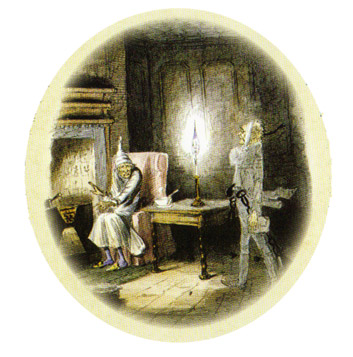
marley“There was a man who, though not more than thirty, had seen the world in divers irreconcilable capacities – had been an officer in a South American regiment among other odd things – but had not achieved much in any way of life, and was in debt, and in hiding. He occupied chambers of the dreariest nature in Lyons Inn; his name, however, was not up on the door, or door-post, but in lieu of it stood the name of a friend who had died in the chambers, and had given him the furniture. The story arose out of the furniture… “

The story Dickens goes on to tell recounts how the failed adventurer finds a heap of old furniture in the cellar of his lodgings. Finding his rooms bare and cheerless, he borrows a writing-table, then a bookcase, then a couch and a rug, and soon has all of the furniture in his chambers. Some years later there is a knock on his door. A tall, red-nosed shabby-genteel man in a threadbare black coat enters the room and, pointing to each item of furniture, mutters: “Mine”.

Read the rest here.

christmas-carolPostscript:  And here’s yet another unusual take on A Christmas Carol, by the remarkable Morgan Meis, writing in The Smart Set a few years back.  He contends “A Christmas Carol isn’t great because it’s a great story. In fact, A Christmas Carol is a flimsy story. The characters are mostly clichés.” He argues for a different assessment of its greatness: “Later in the story, at the appearance of the first spirit, Dickens describes what happens as the ghost approaches Scrooge in his bed. ‘The curtains of his bed were drawn aside; and Scrooge, starting up into a half-recumbent attitude, found himself face to face with the unearthly visitor who drew them: as close to it as I am now to you, and I am standing in the spirit at your elbow.’ The remarkable thing here is not so much that a ghost appeared to Scrooge but that Dickens himself is a ghost appearing to us. Dickens’ authorial voice does come directly into our heads at that moment. In this, the joy of writing becomes the very substance and content of the story. Almost no writer gets away with this kind of playfulness very often. Dickens gets away with it all the time. And A Christmas Carol is utterly charmless without that extra element, without Dickens constantly nipping at the heels of his own story. It makes me think that we ought to reconsider Dickens, to see him more in the light of a Lawrence Sterne than in the light of the straight shooters of 19th-century novel writing.” Read the whole thing here.
Happy 256th birthday, William Blake!

Share

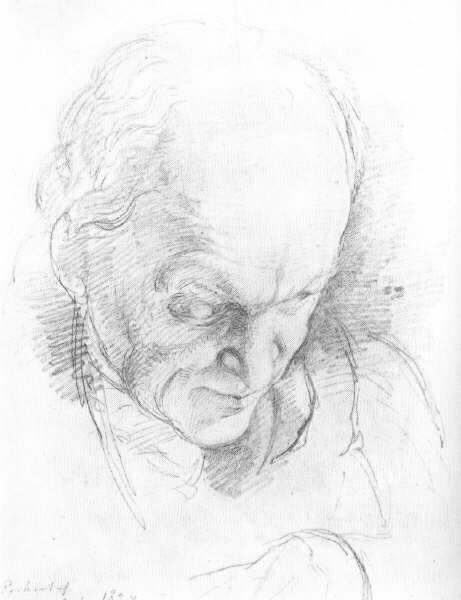
William_BlakeIt’s Thanksgiving, and Hannukah… but who remembers that on this day 256 years ago, William Blake (1757-1827) was born on Broadwick Street in Soho?

A few of us do, and we thought it would be fun to celebrate with a few lesser known images, since he was recognized as an artist and engraver long before he was known as a poet.  We’ll begin with the 1820 portrait at left, by his friend John Linnell.

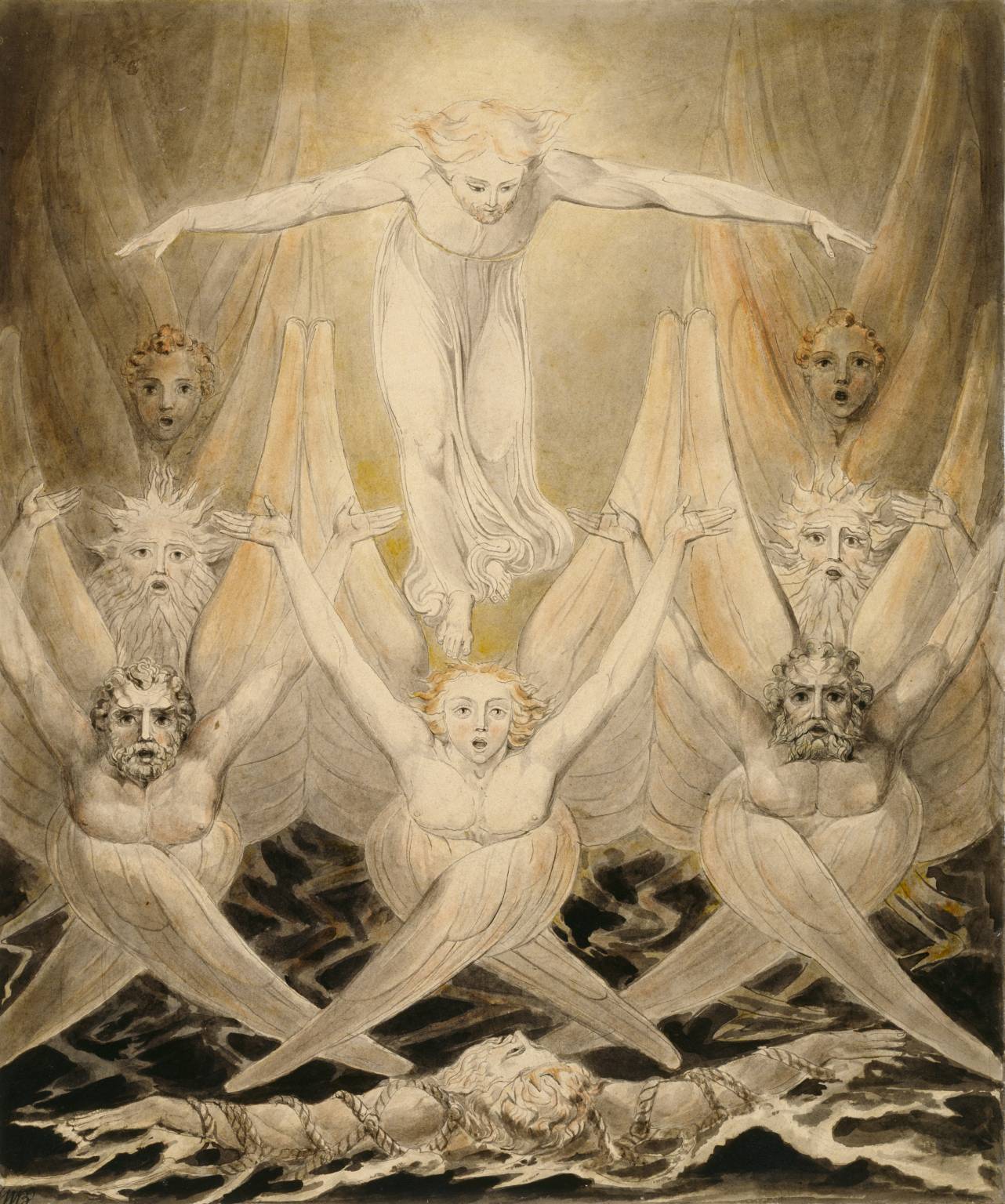
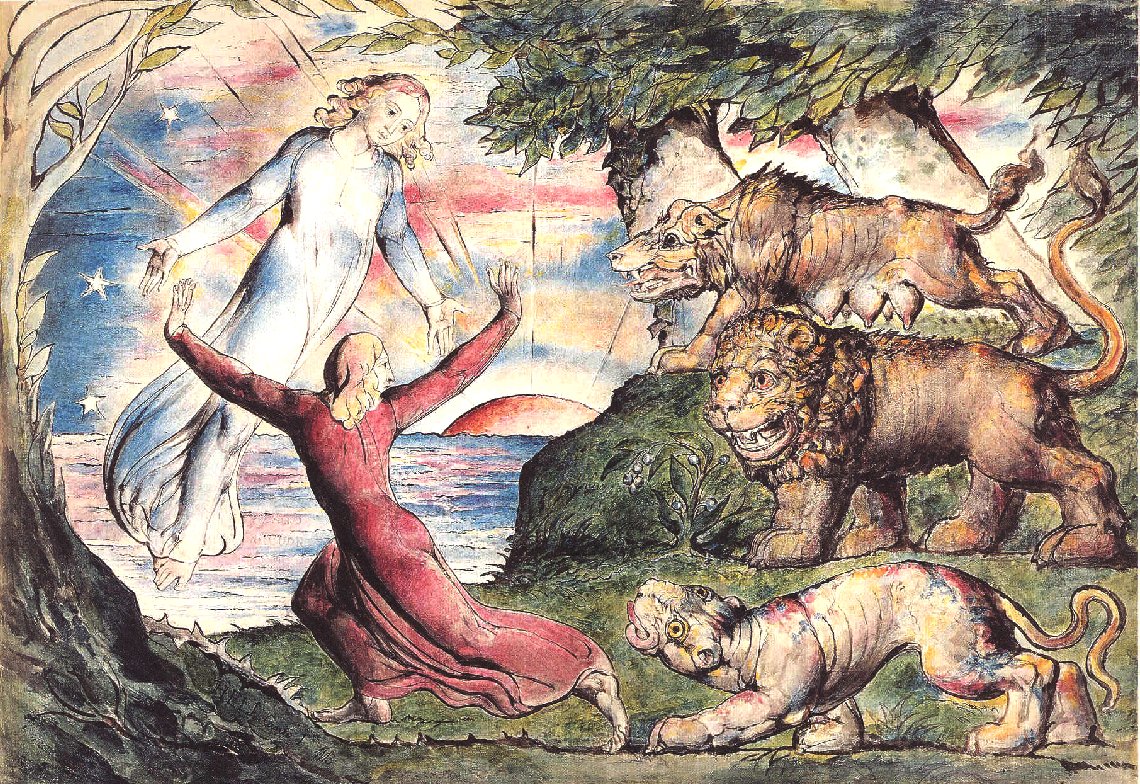
We continue below with Blake’s illustration for Canto I of Dante‘s Inferno.  Why?  Because we like Dante (see here and here, for starters) and, well, we also like lions.  We also include his illustration of “David Delivered out of Many Waters,” because it’s fantastic, in the literal sense of the word, and also because we like seraphims, with two of their six wings crossed underneath them like they’re waiting on a street corner for a bus.  (Blake seems to think they are cherubim, but we know better.)

Meanwhile, Time Out in London hasn’t forgotten the anniversary. Volunteers of Southbank Mosaics artisan studio have created 28 mosaics in tribute to the poet, which visitors can see on Centaur Street in Lambeth. The mosaics, under the tunnels near Waterloo station, show ten years’ worth of Blake’s output, created while he lived on nearby Hercules Road.  Check it out here.

Now go back to your Thanksgiving drinking and eating and belching – but spare a few thoughts, anyway, for the ur-poet of the Industrial Revolution, who, through words and images, showed us the new horrors and timeless possibilities for man in a bold new era.

blake-inferno

David Delivered out of Many Waters circa 1805 by William Blake 1757-1827

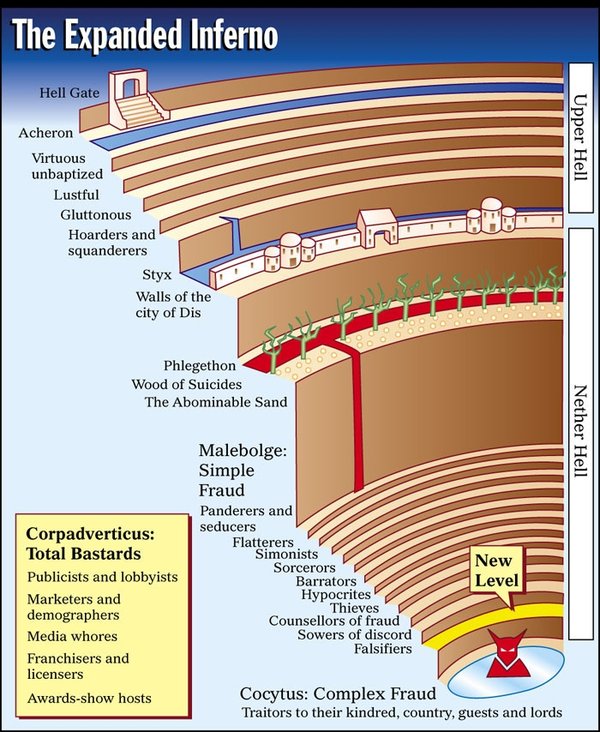
Hell’s future is bright (and hot), thanks to a new circle

Share
hell

You are here. (See yellow ring.)

I’ve long had a fantasy of rewriting Dante Alighieri’s Divine Comedy, casting the three realms with characters from our own era.  I have the imagination – all I need is Dante’s genius.  But I had not envisioned adding a new circle, to accommodate hell’s population explosion.

Someone else beat me to it:  “After nearly four years of construction at an estimated cost of 750 million souls, Corpadverticus, the new 10th circle of Hell, finally opened its doors Monday.”  According to Inferno Antedeus, in recent years  a majority of the new arrivals possessed souls far more evil than the original nine circles could handle. “Demographers, advertising executives, tobacco lobbyists, monopoly-law experts retained by major corporations, and creators of office-based sitcoms–these new arrivals represent a wave of spiritual decay and horror the likes of which Hell has never before seen,” Antedeus said.

Frigax The Vile, one of the most vocal supporters of the new circle, agreed:  “In the past, the underworld was ill-equipped to handle the new breed of sinners flooding our gates–downsizing CEOs, focus-group coordinators, telemarketing sales representatives, and vast hordes of pony-tailed entertainment-industry executives rollerblading and talking on miniaturized cell-phones at the same time. But now, we’ve finally got the sort of top-notch Pits of Doom necessary to give such repellent abominations the quality boilings they deserve.”

It seems to be working:

“In life, I was a Salomon Brothers investment banker,” one flame-blackened shade told reporters. “When I arrived here, they didn’t know what to do with me. They put me in with those condemned to walk backwards with their heads turned all the way around on their necks, for the crime of attempting to see the future. But then I sent a couple of fruit baskets to the right people, and in no time flat, I secured a cushy spot for myself in the first circle of the Virtuous Unbaptized. Now that was a sweet deal. But before long, they caught on to my game and transferred me here to the realm of Total Bastards. I’ve been shrieking for mercy like a goddamn woman ever since.”

birthday cakeRead the rest here.

Postscript:  This post is a birthday present for fellow Dante-lover, Chris Bunje Lowenstein.  Read about her magic deck of Dante cards here.  Meanwhile, we’ve baked her a little cake.


Our birthday card for Petrarch: “his deepest torments are shockingly foreign”

Share
petrarch1

Where would we be without both of them?

sainte-claire-avignon

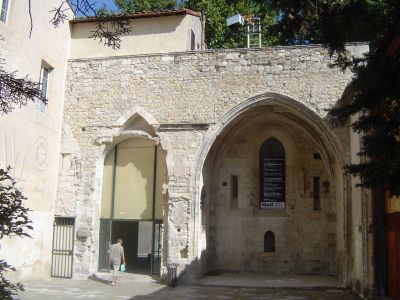
Met and buried here.

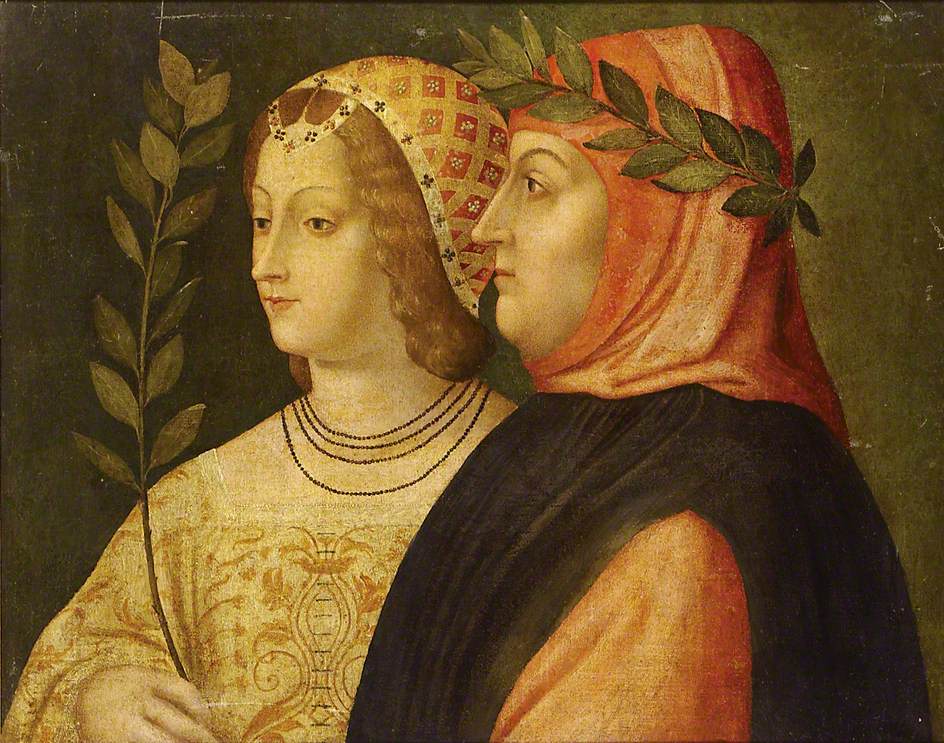
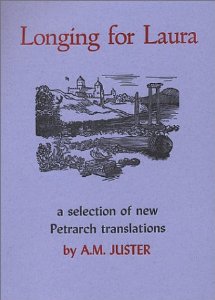
Happy birthday, Francesco Petrarca (a.k.a. Petrarch), born this day in 1304. What better way to celebrate the Tuscan poet’s birthday today than with this Venetian painting, circa 1510, which portrays him with the lady who rejected him in life, Laura de Noves? She rebuffed him for good reason; she was married with children at the time of their first meeting.  As Samuel Maio writes in his foreword to A.M. Justers translations, published by Birch Brook Press (2001), it was “a longing intensified by the cultural, religious, and moral fates that have deemed her unreachable. Perhaps this is the reason for our age’s attraction to Petrarch, that his deepest torments are shockingly foreign and mysteriously antiquated compared to our culture’s insistence on immediate (if not satisfactory) gratification of our every whim and concupiscent impulse.”

But I have become intrigued with both figures for other reasons, for I am in love with Avignon.

That small Provençal city is where the poet first encountered Laura.  She was born in Avignon during the Babylonian Captivity, when the city was the hub of Western Christendom.  Petrarch summed their relationship this way:

Laura, illustrated by her virtues and well-celebrated in my verse, appeared to me for the first time during my youth in 1327, on April 6, in the Church of Saint Claire in Avignon, in the first hour of the day; and in the same city, in the same month, on the same sixth day at the same first hour in the year of 1348, withdrew from life, while I was at Verona, unconscious of my loss…. Her chaste and lovely body was interred on the evening of the same day in the church of the Minorites: her soul, as I believe, returned to heaven, whence it came.

Plaque_dépossée_sur_la_façade_du_Couvent_Sainte-Claire_Avignon_by_JM_RosierOr, as he expressed it in his Canzioniere, in Juster’s translations:

Love, just when hope,
the yield from all my faith, had bloomed,
I lost the one whose mercy I assumed.

She died at the age of 38 in the year 1348, on April 6th, another Good Friday, and 21 years to the hour that Petrarch first saw her.  One biographer wrote that we know little about her except that she possessed great beauty. I rather doubt we know even that. I’ve known too many men to see extraordinary charm in ordinary faces, and enough of a Jungian to know that we project much of ourselves into the beloved. I suspect he saw in her, as his father’s chum Dante saw in another woman: grace and dignity and proportion and (let’s hope) a profound spiritual dimension that made her worthy of attention, though not inclined to be silly if she was ever aware of the rapture she had inspired. 

Recalling, perhaps, the Paschal associations with their meeting and her death, Petrarch wrote:

justerHe did not grace Rome when he came to Earth,
but chose Judea, for above all traits
it pleased Him to exalt humanity.

And so to show that He appreciates
both nature and my Lady’s place of birth,
a village sun becomes his legacy.

So let us celebrate both today, in the remaining hours of the day.  Were it not for her, we would not have Petrarch’s Canzoniere – and without the Canzoniere, I doubt we would be remembering this day with quite so much veneration.

Digging history

Share


hugo3


The problem with most of my gardening efforts is that when I get excited about growing flowers or herbs, I go out and buy some books about the subject, and that satisfies the impulse entirely, and soon it goes away. I rarely get to the messy business of actually digging around in the dirt with my fingernails, what with worms and bugs and all.

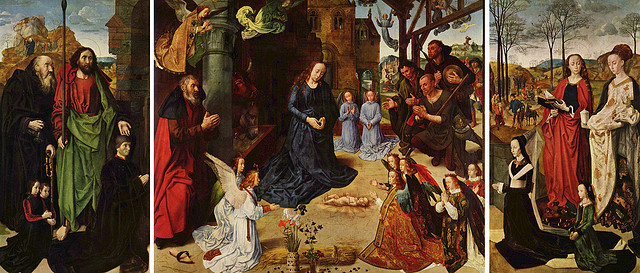
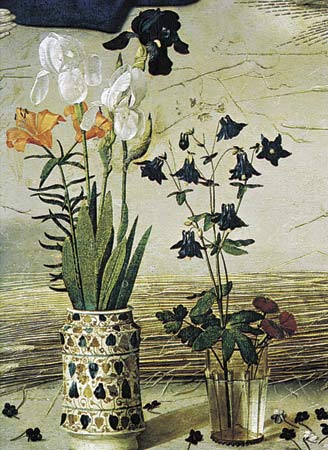
belfryThis time I’ve gone so far as to actually get some seeds, thanks to Nora Munro over at The Belfry.  I met Nora through one of my favorite medievalists, Jeff Sypeck, over at Quid Plura.  His link to “où dort la mélancolie” enchanted and intrigued me. Nora is trying to grow as many authentically medieval plants as she can – but the mid-Atlantic weather isn’t helping.  “I still love the flowery fields in mediaeval paintings, and it pleases more than is probably reasonable that this columbine is exactly the same as the ones in Hugo van der Goes‘ Portinari altarpiece of 1476,” she wrote.  Yes, it’s that Portinari family.  The altarpiece was commissioned by Tommaso Portinari, an agent for the Medici bank in Bruges, and he’s somehow related to Dante‘s beloved Beatrice.

Can you see the flowers in the altarpiece above?  I thought you wouldn’t.  Try looking at the photograph from Nora’s garden left.  Then compare with the enlargement from the Portinari altarpiece at right.  Pretty cool.  So I was thrilled when the envelope arrived from Annapolis a few hours ago with … my own seeds.

columbinesNow, I had thought columbines are supposed to symbolize folly, as in the “Columbine” character in commedia dell’arte.  But Nora corrects me: “During the Middle Ages, the flower was associated with the Holy Spirit (columbine < L. columba, dove).  In the Portinari Altarpiece, the detail I linked above with the columbines is in the central panel, as part of a depiction of the nativity, with lilies and irises, both of which were associated with the Virgin.”

The Enclopedia Britannica has yet another version: “The scattered violets indicate Christ’s humility; the columbine flowers represent the seven gifts of the Holy Spirit with which Christ was endowed at birth. The flowers in the albarello (pottery jar) are in royal colours, for Christ was of the royal line of the Israelite King David.”

But the big queston is: will they grow?  I’ll let you know how it goes…

“Corduroy-vested academics” and others consider Mary Jo Bang’s Inferno

Share
Luca Signorelli's masterpiece in Orvieto Cathedral

.

Stopped mid-motion in the middle
Of what we call a life, I looked up and saw no sky –
Only a dense cage of leaf, tree, and twig. I was lost.

                                                                 –  Canto I, Inferno (trans. Mary Jo Bang)

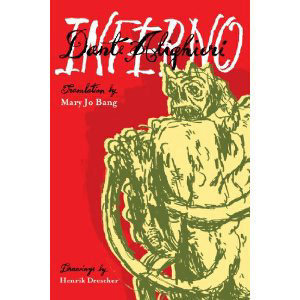
I’d heard a bit of the  current buzz over Mary Jo Bang‘s new free-verse, free-wheeling translation of Dante‘s Inferno, published by Graywolf Press.  The commentary I’ve read to date seemed bemused, mostly admiring.  However, Vanity Fair‘s Elissa Schappell warns me that “Bang’s Inferno already has some corduroy-vested academics tugging on their beards with indignation and beetle-browed translators jabbing at their eyes with pencils.”  She offers more hepped-up writing than she does insight about the “thrillingly contemporary translation of the first part (the juiciest part) of Alighieri’s 14th century poem…”  Why is the Inferno considered “the juiciest part”?  Anna Akhmatova kept Doré’s engravings of it on the walls of her Fontanka apartment – but then, she was living in Soviet Russia, a place where the Inferno had a special resonance.  I’ve always taken a shine to the hopeful, redemptive, and comparatively underrated Purgatorio.

I also read  Alexander Nazaryan‘s “What Fresh Hell is This?” in the New York Daily News.  He admits that Bang  “does sacrifice some of the musicality of the original,” but defends her choices:  “Bang has sacrificed some of the faithfulness to Dante’s rhyming structure (which sounds too much like sing-song in English, anyway) and has ditched many, though not all, of Dante’s allusions, in order to preserve something more important: Dante’s meaning.”

Ummm… A good translation of Dante’s terza rima shouldn’t sound like “sing-song,” and I don’t see why I should be restricted to a bread-and-water poetry because some modern readers can’t handle meter.  Poetry, after all, is supposed to be “memorable speech,” and not just because of what the words say, but the means used to say them. And don’t the allusions illustrate the meaning?

He continues:

Bang’s hell is our culture, the numbing proliferation of texts, images, meanings, interpretations. For her, the perfervid busyness of our culture leads to a deadening akin to spiritual numbness. Hence the allusions to everything from Woody Allen‘s “Crimes and Misdemeanors” to the Boy Scouts to frozen Jell-O to the Hotel California – these are the fragments that have shored up against our ruins, to borrow from T.S. Eliot, who knew a thing or two about Dante, and death, and fittingly appears several times in these pages.

Isn’t “spiritual numbness” the same as deadening and not just “akin”?  Editor, please!  Also, Eliot knew much more than “a thing or two” about Dante.

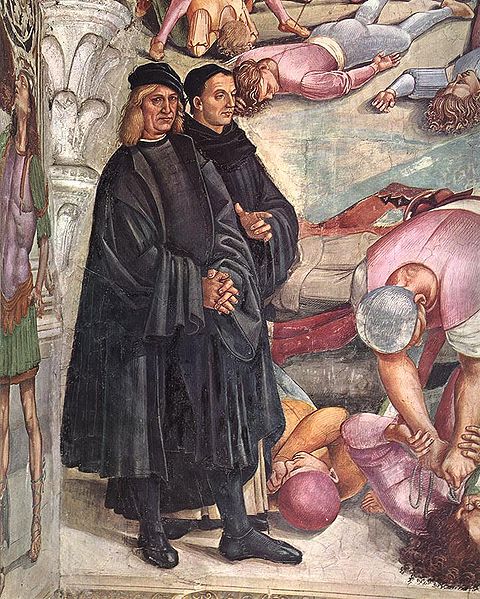
Signorelli’s self-portrait. Fra Angelico has the short hair.

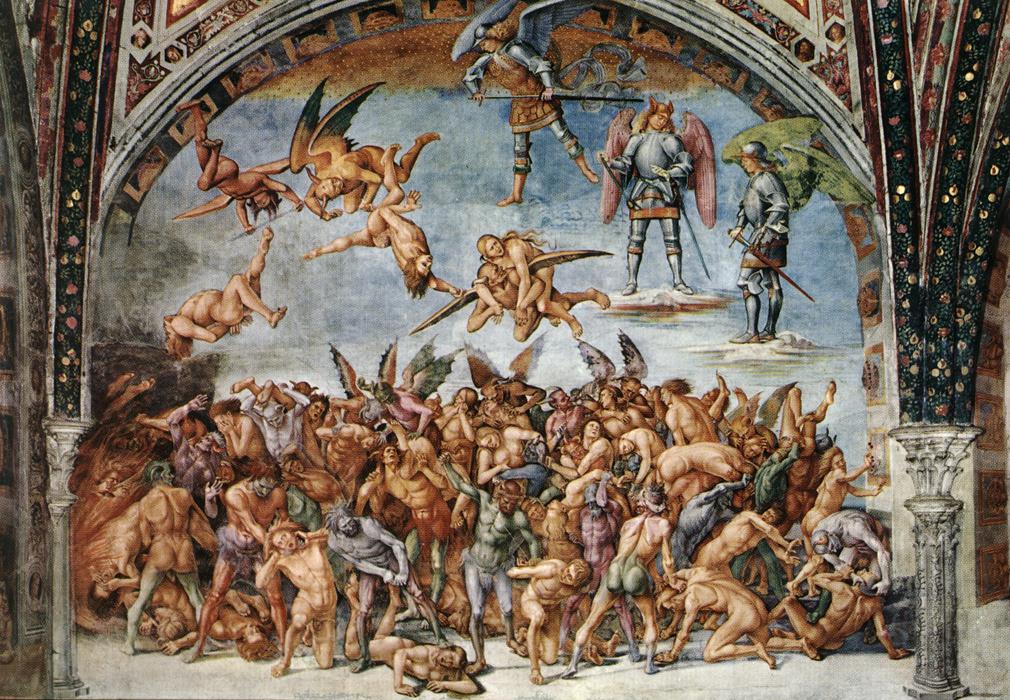
Then David Sanders‘s “Poetry News in Review” in Prairie Schooner alerted me to Arlice Davenport‘s thoughtful and provocative review, A Season in Hell,”  in (of all places) The Wichita Eagle. Davenport begins his review in Luca Signorelli‘s (not Luco, as written in the review) Brizio Chapel in the Orvieto Cathedral, with the artist portraying himself at the Apocalypse, “staring back at us, as if to say: Do you understand the meaning of my masterpiece, that I am painting your destiny here, among the damned and the saved?”

Nazaryan’s review begins: “All translation is modernization. Otherwise, we would have only one Homer, one Cervantes. However subtly, the translator is also an interpolator, making a world far away or long ago familiar to contemporary readers.”  This of course ignores the translation of our contemporaries – do Italo Calvino or Eugenio Montale need “modernization”?  Also, he overlooks the need to triangulate among translations to recapture the achievement of the original.  Similarly, Bang writes:  “Translation is a method of bringing the past back into the present . . . and sharing what is common to all.”

“No, that is history,” Davenport responds. “Translation is not about making the old new, but about creating a spirited equivalency of a literary work in another language.” He continues:

A great translation must contain the original, to be sure, but it must also reshape it into a fresh, artistically integral whole that speaks to the reader directly, powerfully, profoundly in his or her own language. It must enact, in foreign words, the closest approximation of the original it can muster. It must be beautiful, compelling, ensouled.

Translation doesn’t need contemporary bells and whistles to pull this off. It doesn’t need pragmatic theories of art. It genuinely aspires to the heavenly exchange of language, even if it must descend to Hell to get there.

Anything less leaves us feeling cheated, still lost in a dark wood, facing our fears, facing death, facing eternal punishment, and praying for a luminous guide to come our way.

Davenport asks:  Is the spiffy new translation a translation at all?  Then he considers other issues:

As with so many knee-jerk postmodernists, Bang’s poetics hinge on the belief that the “distinction between high culture and popular entertainment has all but ceased to exist.” So she’s free to throw in references to John Coltrane, “South Park,” Emily Dickinson, Andy Warhol, John Wayne Gacy, Stephen Colbert and Woody Allen, whenever it suits her purposes. Her Dante dwells in a pluralist’s paradise, even if he is in Hell.

But to say that contemporary culture no longer recognizes the difference between high and low art is not to say that there is no difference. It simply means that our culture has given up making the effort to sustain the difference. It is (again, ironically) a form of sour grapes.

Let’s look a little closer at Bang’s big idea. Doesn’t the fact that she, an award-winning poet, has to dig 700 years into the past to find a poem worth laboring over ultimately indict the vacuity of contemporary poetry?

Doesn’t her need to focus so intensely on Dante simply reinforce the unshakeable distinction between high and low art? Contemporary poets still idolize the author of “The Divine Comedy” because his grand, celestial achievement overreaches the centuries. His aim is sky high and heart deep: Divine Love and human love, reflected in the radiant visage of Virgil, and fulfilled in the heavenly reunion with Beatrice, his beloved.

Art doesn’t get much higher than that.

I worry about how we review poetry nowadays, and how much reviewers know about poetry at all, and what body of knowledge, experience, and understanding they bring to what they write.  Or do they simply go by their gut?

Postscript 8/20:  From the matchless Jeff Sypeck:  “I find it maddening that in 2012, Vanity Fair can’t provide us with a simple link so we know which ‘corduroy-vested academics’ are supposedly ‘tugging on their beards with indignation’ and which ‘beetle-browed translators’ are ‘jabbing at their eyes with pencils.’ It’s summer, and the book’s was out for a only week when the Vanity Fair blog post went live. Few academics, and certainly not the stereotypes who stumbled into Schappell’s article from early 1950s New England, have even read the book yet.”