
Remembering poet Robert Mezey (1935-2020): “brilliant, mercurial and often rebellious” – with a “great tragedy,” too.

Share

He encouraged students to burn their draft cards. (Photo courtesy the Mezey family)

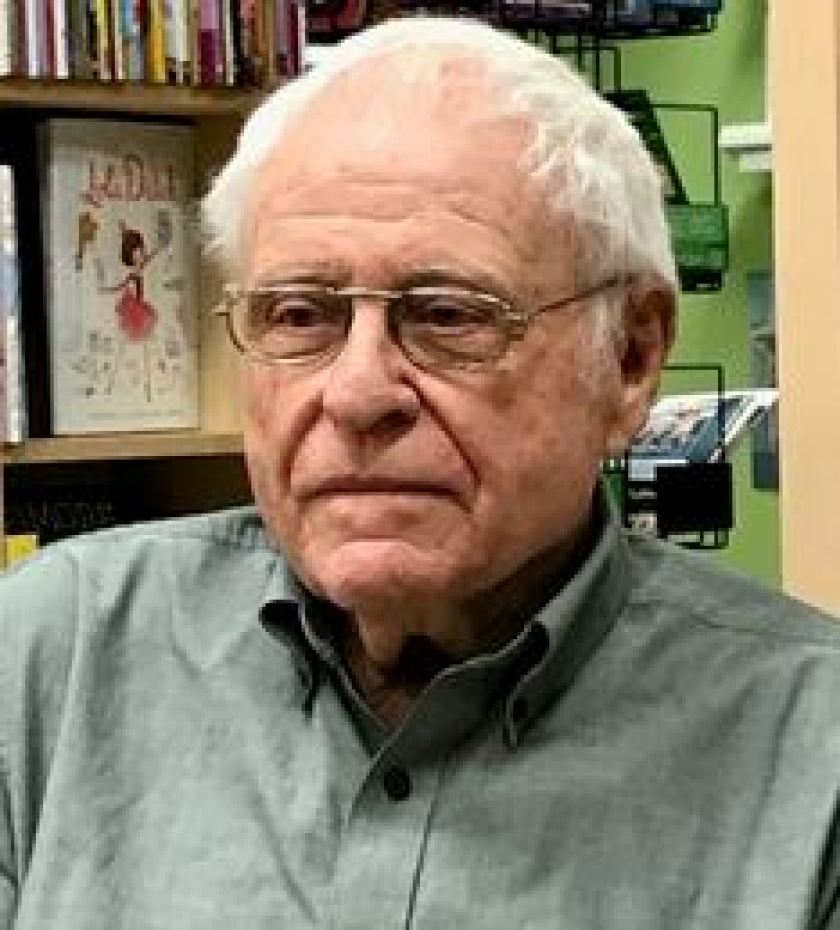
The poet Robert Mezey is dead. According to his daughter Naomi Mezey, the former Stanford Wallace Stegner fellow died on April 25 of pneumonia in Maryland. The award-winning poet, anthologist, and Pomona College professor was 85. “Brilliant, mercurial and often rebellious, Mezey came to artistic maturity in the 1960s. His footloose early career embodied the challenges and changes of that dramatic period in American letters,” former California poet laureate Dana Gioia writes in the Los Angeles Times. The obituary offers an excellent and punchy summary of his rather unconventional life. Read it here.

Mezey entered Kenyon College at 16, where he studied with poet-critic John Crowe Ransom, but dropped out after two years. He was in the U.S. Army, but discharged as a “subversive.”

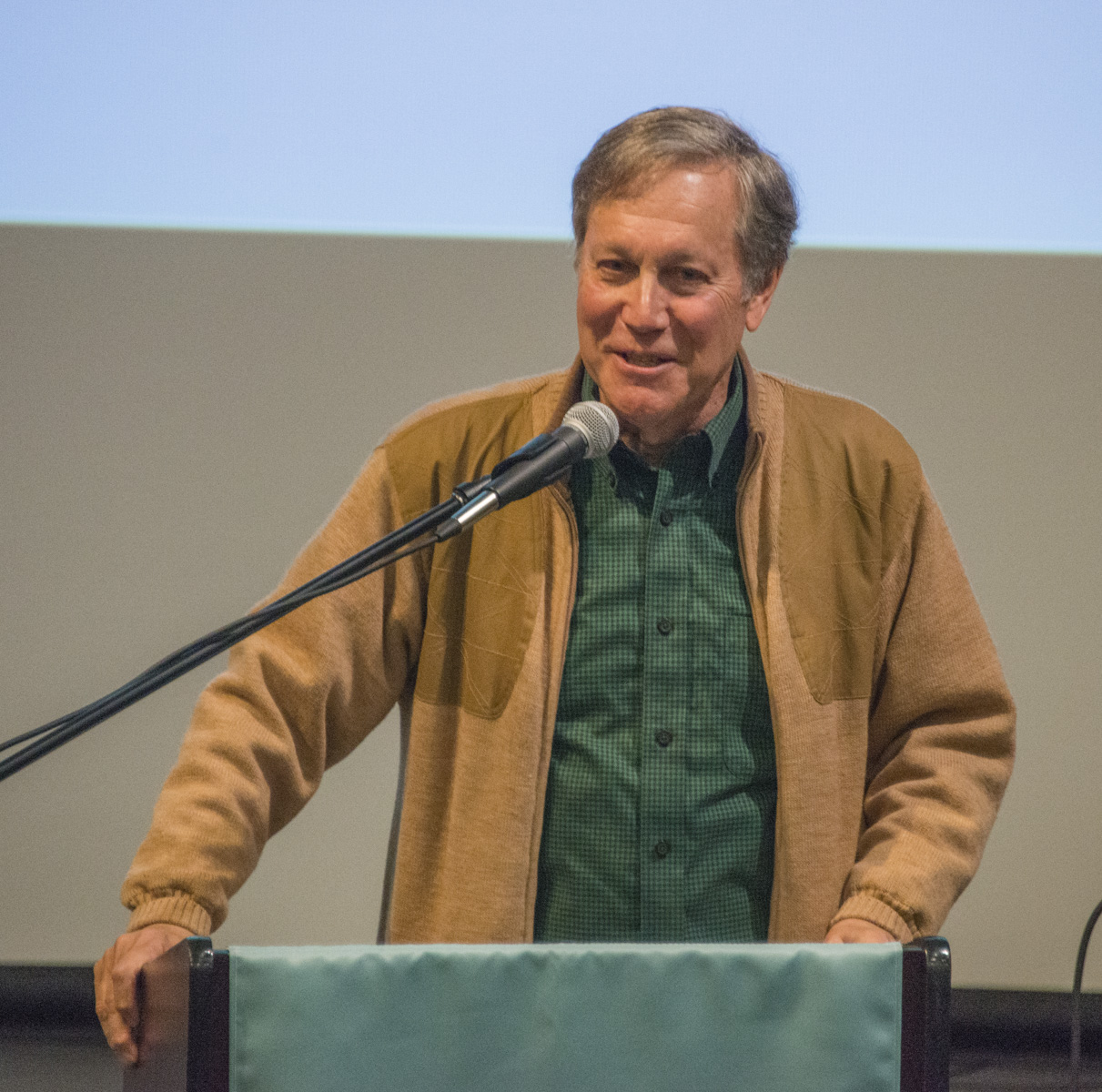
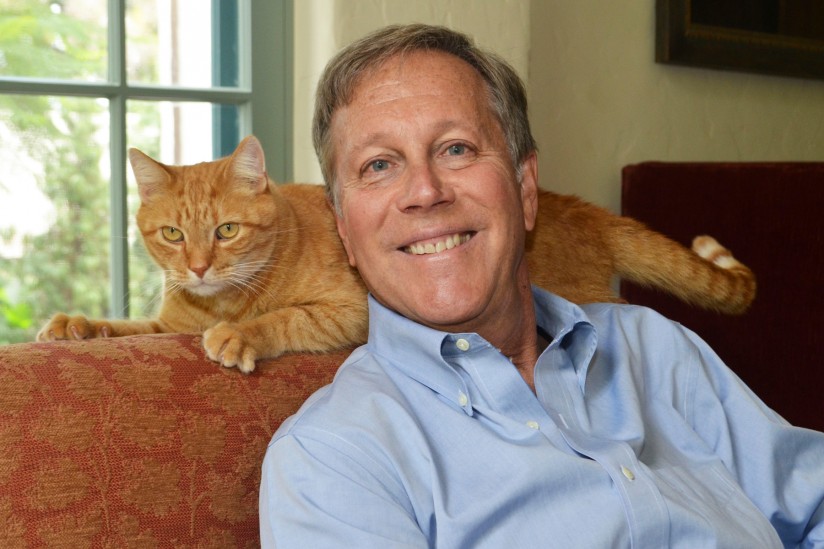
Former state poet laureate & Stanford alum. (Photo: Starr Black)
From the L.A. Times: “Encouraged by poet Donald Justice, who became a lifelong friend, Mezey began graduate studies at the Iowa Writers’ Workshop. Once again, he dropped out — but for a happier reason. His first book, “The Lovemaker” (1960) had won the Lamont Poetry Prize.

“On the basis of that debut volume, Mezey received the Stegner Fellowship at Stanford, but the start of the fall semester found him in Mexico rather than Palo Alto. His new mentor, the rigorously formalist poet Yvor Winters, had to send him money to travel back to the U.S. Their relationship soon soured,” Dana wrote.

Poet and Stanford Professor Ken Fields recalled in an email: “”He and Winters did not like each other, though Bob may have changed later in a delightful clerihew on him.” He knew him later in his career, through his friends Don Justice and Henri Coulette. “Bob eulogized Henri (Hank) and my first teacher, Edgar Bowers.”

From the Los Angeles Times:

Although he still lacked a graduate degree — a situation that would not change until Kenyon awarded him an honorary doctorate in 2009 — Mezey taught briefly at several universities. His departures were sometimes abrupt.

At Franklin and Marshall College in Pennsylvania, Mezey urged his students to burn their draft cards. Offered his full year’s salary, he made an early exit.

Meanwhile Mezey’s poetic style changed; he followed the zeitgeist into free verse. “When I was quite young,” he wrote, “I came under unhealthy influences — Yvor Winters, for example, and America, and my mother, though not in that order.”

He eventually returned to metrical forms and translation towards the century’s end.
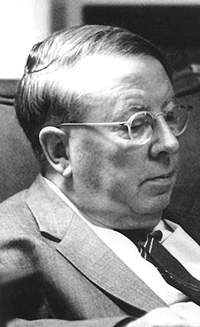
He sent the money.

“Anyone searching out his Collected Poems 1952-1999 ought to be impressed by the breadth and depth of a modern poet they probably have never heard of, wrote Ken. “‘Terezín’ is a great and moving poem on a watercolor by thirteen-year old Nely Sílvinová in a German concentration camp for children headed for Auschwitz. Among many others, I think of ‘To a Friend on the Day of Atonement’ (the phrase, ‘Jewless in Gaza’) and ‘The Wandering Jew.'”

“He could also be funny and small, as in his praise of minor poets, among whom, I think, he would include himself.” Then Ken cited this one:

To My Friends in the Art

Flyweight champions, may you live
The proverbial thousand years
To whatever smiles and cheers
Flyweight audiences may give.
Ounce for ounce as good as any,
Modest few among the many,
Swift, precise, diminutive,
Flyweight champions, may you live.

Dana Gioia describes “his greatest tragedy” as the unpublished Borges translations, but this misfortune that still can be amended (we hope):

Meanwhile Mezey had been drawn to poetic translation. His Selected Translations (1981) contained compelling versions of Spanish, French, and Yiddish authors. His greatest undertaking, however, was to prove a disaster.

With his Pomona College colleague Dick Barnes, Mezey undertook a translation of the poems of Jorge Luis Borges. After some initial encouragement from the Argentinean author’s widow, the two poets spent years crafting suave translations that replicated Borges’s original metrical forms.

Then the pair discovered they could not obtain the English-language rights. Mezey’s finest translations remained unpublished except in a few copy-shop collations circulated among friends.
He has the translations.

Ken says he has a copy of the “wonderful” translations somewhere; let’s hope others do, too. “We do have the great ‘A Rose and Milton,’ and a couple of others. Somewhere I have the manuscript.”

Dana notes that Mezey was a religious skeptic, who did not believe in the afterlife. “Instead he offered a gentle vision of death”:

Blessed oblivion, infinitely forgiving,
Perpetual peace and silence and complete
Absence of pain. Now that’s what I call living.

Ken Fields remembered another Mezey anecdote (I expect there are many floating in the world at large): “A few years before my time, Mezey was awarded a Stegner Fellowship. … In those days the fellows got all the money at once, and Bob absconded with the stipend. Phil Levine, his friend at the time, said he had no problem with Bob taking the money, but he also took the Levine’s babysitter, and that was a serious offense. When the Collected Poems came out, Bob sent me a copy, with the understanding that I would send him twenty dollars. I neglected to do it, not deliberately, and it stayed on my mind on and off for years. Time to call it even.”
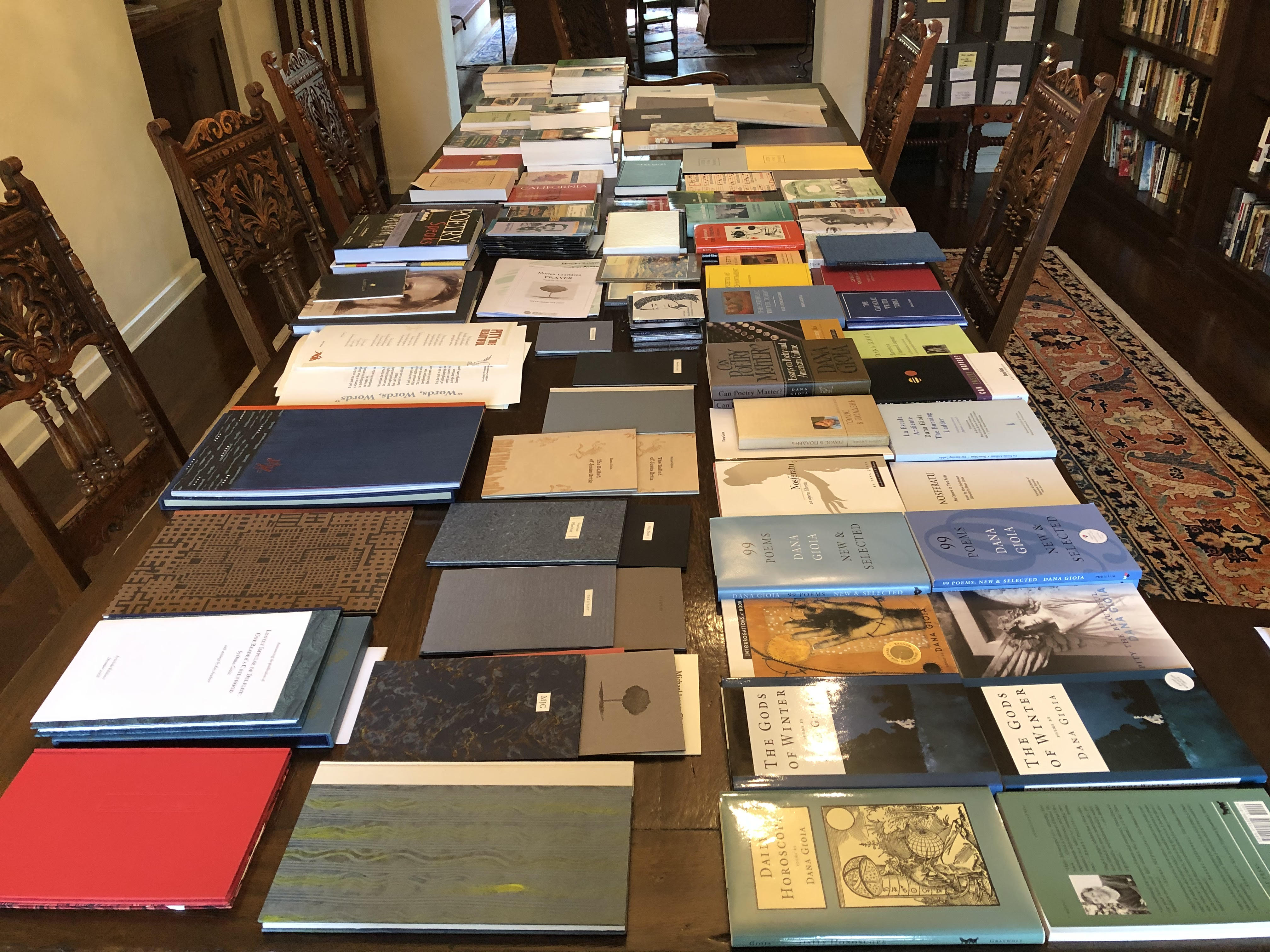
Dana Gioia’s archives go to Huntington, Stanford – including “tens of thousands” of letters!

Share

Dana Gioia’s books, manuscripts, libretti are now at the Huntington Library.

Dana Gioia is a man of letters in the time-honored sense of the term, influencing our culture as a poet and essayist, but also as a translator, editor, anthologist, librettist, teacher, literary critic, and advocate for the arts. His correspondence was extensive, and it went on for decades. Hence, his archive is a treasure trove, and though he has had offers from other institutions to acquire it, he wanted his papers to stay in California. Now they will. He has donated his substantial archive to the Huntington Library, Art Museum, and Botanical Gardens, which announced today it had acquired the papers of the poet and writer who served as the chair of the National Endowment for the Arts from 2003–09 and as the California Poet Laureate from 2015–19.

Dana Gioia in L.A. with friend, Doctor Gatsby (Photo: Starr Black)

It is the second large donation he has made in the last year. Last August, he gave to Stanford the large archive of Story Line Press, which he co-founded. The papers are the central archive for the New Formalism movement. The archive includes a number of people who have spent time at Stanford, including Donald Justice, Donald Hall, Christian Wiman, Paul Lake, Annie Finch, and of course Dana himself, among others. Stanford Libraries already holds the archive for The Reaper, so this is a natural pairing with that irreverent journal.

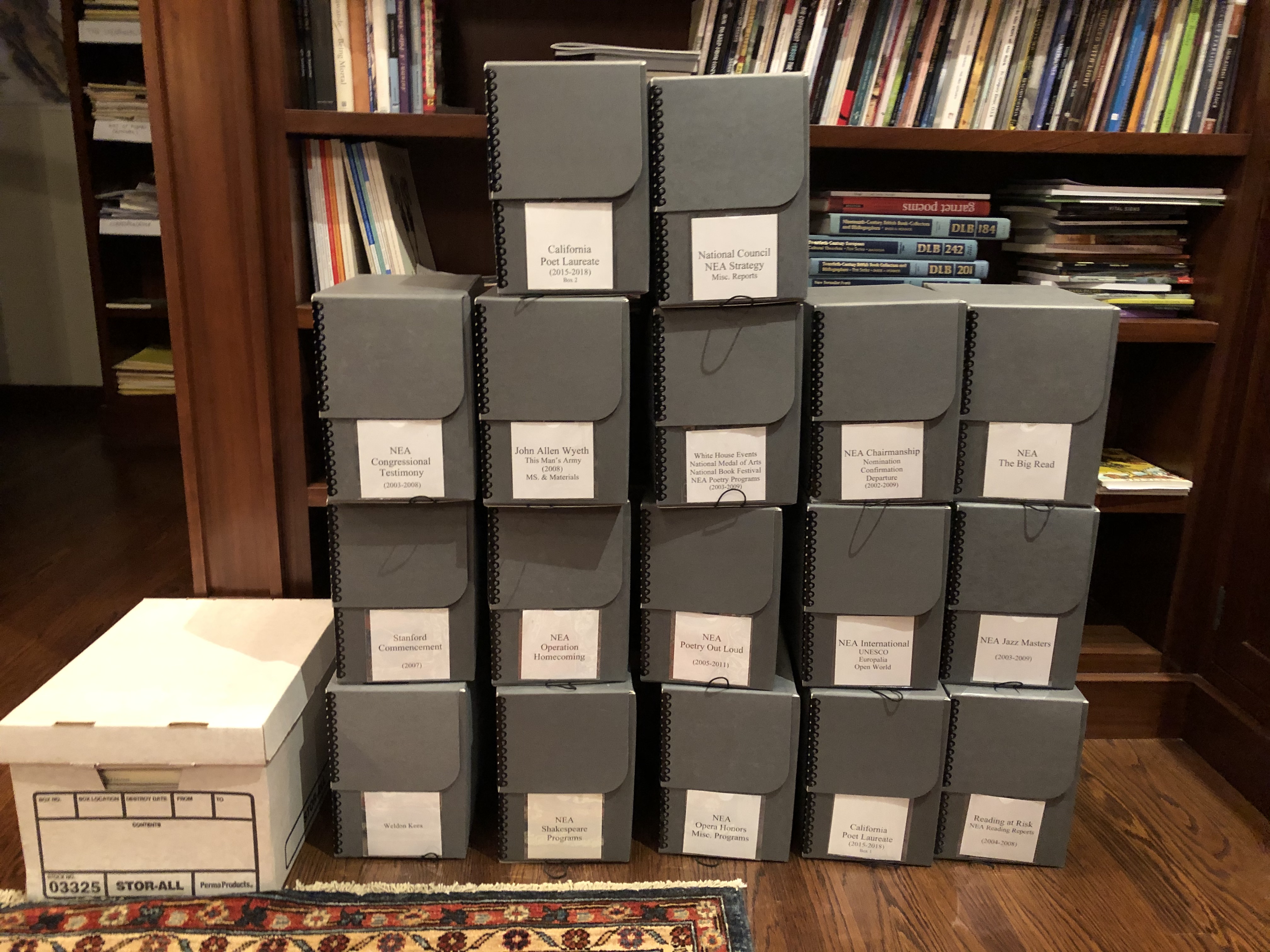
The larger Huntington archive includes correspondence with many of the major poets and writers for the last several decades, including Elizabeth Bishop, Anthony Hecht, Richard Wilbur, Ray Bradbury, Rachel Hadas, Jane Hirshfield, William Maxwell, Thom Gunn, Edgar BowersKay Ryan, Robert Conquest, Julia Alvarez, Thomas Disch, Cynthia Ozick,  Donald Davie, Anthony Burgess, John Cheever, J.V. Cunningham, and even some musicians, such as Dave Brubeck. It also includes his own books, manuscripts, and libretti. “Even after I pruned my correspondence, there is a lot of letters – in the tens of thousands,” said Dana.

“When I told my brother Ted that I had made the donation, he commented that I wanted my papers to be at the Huntington because our mother took us there as children. ‘You’re probably right,’ I said. I  still remember seeing the elegant manuscript of Poe’s ‘Annabel Lee’ there nearly sixty years ago. It was my first glimpse into that enchanted kingdom by the sea called poetry.”

The Huntington picked up 71 archival boxes last December – the first part of his donation. Then Dana Gioia had a more urgent task: the next day he flew back to northern California home, which sustained fire damage during last year’s Kincade wildfire.

From the Huntington release:

The archive documents Gioia’s work as a poet through fastidiously maintained drafts of poems and essays from his books, which include five books of poetry and three books of critical essays. He is one of the most prominent writers of the “New Formalist” school of poetry, a movement that promoted the return of meter and rhyme, although his arts advocacy work situates him in a broader frame.

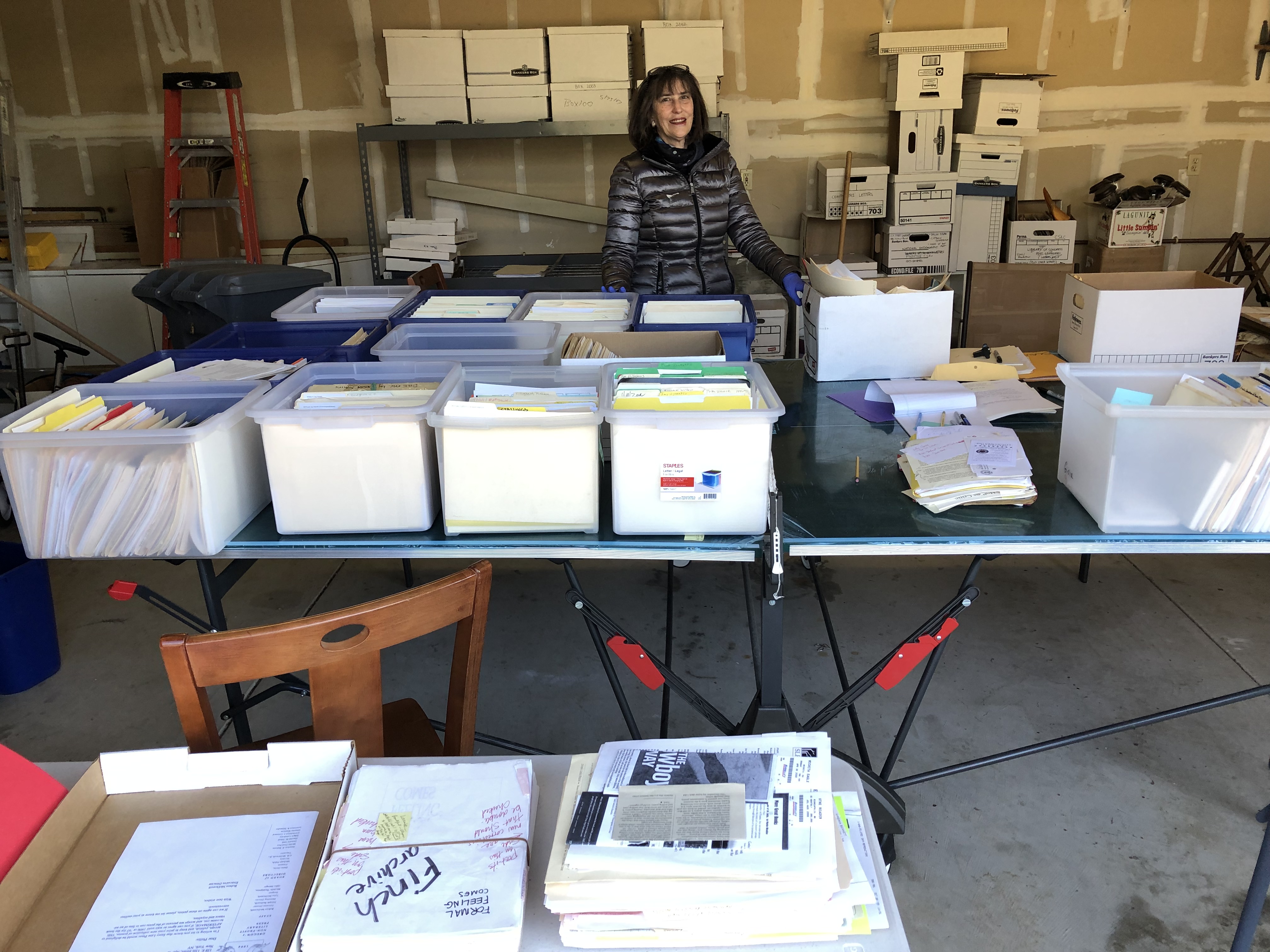
The archive en dishabillé, as Mary Gioia helps organize.

“In his correspondence, you see a writer who has been willing to engage the young and old, the esteemed and emergent—anyone who wants to critically discuss poetic form, contemporary audiences for poetry, and the importance of literary reading during decades when popular culture has become increasingly visual and attention spans have fractured,” said Karla Nielsen, curator of literary collections at The Huntington. “We are delighted that Dana has entrusted his papers to The Huntington, where his collection fits perfectly. He is a local author—he grew up in a Mexican/Sicilian American household in Hawthorne—and even as he attained international recognition as a poet and assumed the chairmanship of the NEA, he remained loyal to the region and invested in Los Angeles’ unique literary communities.”

“I’m delighted to have my papers preserved in my hometown of Los Angeles, especially at The Huntington, a place I have loved since the dreamy days of my childhood,” said Gioia.

While the range of correspondents in the collection is broad and eclectic, the sustained letter writing with poets Donald Justice, David Mason, and Ted Kooser is particularly significant.

Gioia’s work co-editing a popular poetry anthology textbook with the poet X. J. Kennedy from the 1990s to the present will interest scholars working on canon formation during those decades when the “culture wars” were a politically charged issue.

A portion of the materials represent Gioia’s work as an advocate for poetry and the arts at the NEA and as the California Poet Laureate. This work is integral to his career and will be important to scholars interested in the place of poetry and the role of reading for pleasure within greater debates about literacy and literary reading at the beginning of the 20th century. … At The Huntington, Gioia’s archive joins that of another businessman poet, Wallace Stevens; that of a very different but also quintessentially Los Angeles poet, Charles Bukowski; and those of two other New Formalist poets, Henri Coulette and Robert Mezey.

Tens of thousands of letters and much more – now at the library his mother Dorothy Ortiz took Ted and Dana Gioia to visit as children. Dana remembers the Poe manuscript of “Annabel Lee.”

Dana Gioia on the late Scott Timberg: a bitter symbol for those who have been marginalized by our “creative culture.”

Share

A society-assisted suicide. He leaves behind a wife and son.

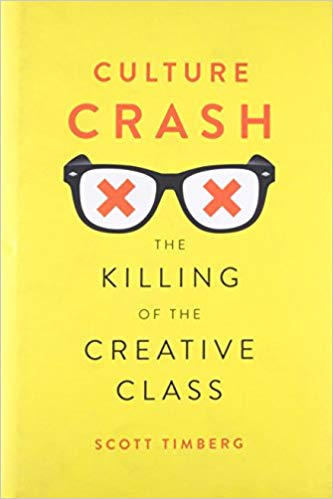
The Los Angeles Review of Books has a long piece on gifted cultural journalist Scott Timberg, who killed himself last week. He was 50. I wrote about it here, and my supposition was correct. He was killed by the “gig economy” he deplored in his 2015 book, Culture Crash: The Killing of the Creative Class, which discussed how digital technology and economic polarization were damaging American cultural life.

The LARB piece ends with a range of tributes, one of them from from a close friend, Dana Gioia, California poet laureate and former chairman of the National Endowment of the Arts:

I knew Scott Timberg for over 25 years. He was not only a close friend and colleague — he was a constant presence in my life. For many years he emailed or phoned me nearly every day to discuss what he was reading or writing. In 2003 we edited a book together on the new literary Los Angeles for which Scott came up with the perfect title, The Misread City.

Scott was determined to give Los Angeles the careful reading that it deserved. I don’t think anyone covered LA culture so prolifically or omnivorously. He wrote about everything happening in the Southland — rock, poetry, fiction, film, theater, jazz, classical music, and the visual arts. He produced hundreds of articles, which had the special Timberg quality of being simultaneously open-minded and opinionated.

Dana Gioia: “something wrong with our culture”

In an age of cultural specialization, Scott’s range was invaluable. His commentary reflected the needs of the general reader who explores the arts with curiosity but finds little intelligent guidance in the media. Scott provided this animated coverage for nearly thirty years at a variety of publications, mostly notably The Day in New London, New Times LALos Angeles Times, and Salon.

Thousands of musicians, artists, writers, publishers, and presenters profited from Scott’s meticulous attention and advocacy. He was not so fortunate.  His professional career was slowly eroded by the economic and technological changes that transformed the contemporary media. Despite his immense productivity, he struggled to earn a living for himself and his family.

Scott combined his difficult personal experiences with his capacious knowledge of the arts and media to create a brilliant study, Culture Crash: The Killing of the Creative Class (2015). This underrated volume remains the best diagnosis of our current cultural dilemma in a society where “information” corporations have become as large as nation states while the writers and artists whose work they exploit can no longer make a living.

Scott’s suicide was a tragic act. He was so greatly loved and so conspicuously talented. No one can truly know what despair or temporary madness motivated it. But his death makes at least one thing obvious to any attentive observer. There is something wrong with our culture when Los Angeles, which now has more artists than any other city in North America, including New York, cannot provide a living wage for such a hard-working and gifted critic.

In his death, Scott Timberg becomes a representative figure, a bitter symbol for thousands of other writers and artists who have been marginalized by our much-touted “creative culture.” I mourn him personally and publicly. His passing diminishes the California culture he did so much to honor.

Read the whole thing here.

A postscript from Dana’s brother, the jazz scholar Ted Gioia, on his Facebook page (we also quoted him in our earlier post here):

Los Angeles Review of Books has published a collection of heartfelt tributes (from me and 18 others, including my brother Dana) to our friend Scott Timberg, a brilliant arts & culture journalist who took his own life last week, leaving behind his wife Sara and 13-year-old son Ian.

I feel compelled to add a few more comments here—because Scott seemed like surrogate member of my family at times, and his passing has left such a mark on me (as it has on so many others—I note that around 600 people have donated to the GoFundMe campaign for his family).

When someone you know commits suicide, the first reaction is disbelief. More than almost any other human act, suicide resists attempts to find meaning in it. Even so, in this case a kind of larger significance has been attached to Scott’s death by many who knew him well—and it started happening almost within hours of his passing. To many of us, his death seemed to have uncanny and disturbing connections with his professional life over the last decade, when he emerged as our leading chronicler and champion of the many people who have lost their bearings in the “culture business”—a group that, for Scott, included everyone from artists and arts journalists like himself all the way to the film lover who once worked at the local video rental store (before it closed) or the minimum-wage clerk at the indie bookstore.

Scott had lost his job at the Los Angeles Times shortly before he turned 40. As an outsider, I was mystified by this turn of events, because Scott was one of the finest arts and culture writers in the country, smart and passionate and capable of delivering insightful articles at short notice on almost any subject. He never recovered his bearings after leaving the Times. Thrust into the turbulent freelance economy, he continued to do outstanding work, but with fewer opportunities and smaller rewards.

He increasingly focused his attention on others like himself who had been squeezed and displaced in the shrinking arts economy. He drew on his own experiences in writing a book on the subject, the harrowing (even more so after his death) Culture Crash, published by Yale University Press.

A different person with Scott’s talents would have reinvented himself in a different career or setting. But Scott loved journalism—he believed it was the highest possible profession, almost a kind of priesthood—and he loved Los Angeles too. He loved them too much perhaps. It may seem like a gross simplification to say that losing his position at the L.A. Times caused his death, but there’s some truth in that. I believe he would still be alive today if he had been able to do the work he was destined to pursue in his adopted hometown.

The narrative that has emerged in the last few days presents Scott as a martyr to the cause he chronicled in his writing. From this perspective, he is the patron saint of the suffering culture professional in the gig economy—and his own death has turned into a commentary on his life. It’s easy to criticize this way of packaging a tragedy that (for me and others) will never lose its sting. But there’s a large dose of truth in it too. All the pieces fit together, almost too well.

More to the point, it gives some small circumference of meaning to something otherwise so meaningless. And, frankly, I suspect Scott would have no disagreement with such a framing of his life and death. He saw the challenges he faced echoed in the lives of so many others, and he cared deeply about all those who suffered in this way. The notion that his abbreviated life might serve as potent symbol for the compassion owed to those squeezed by the shift in our culture, would have given Scott a small bit of gratification. I know it gives me some consolation.

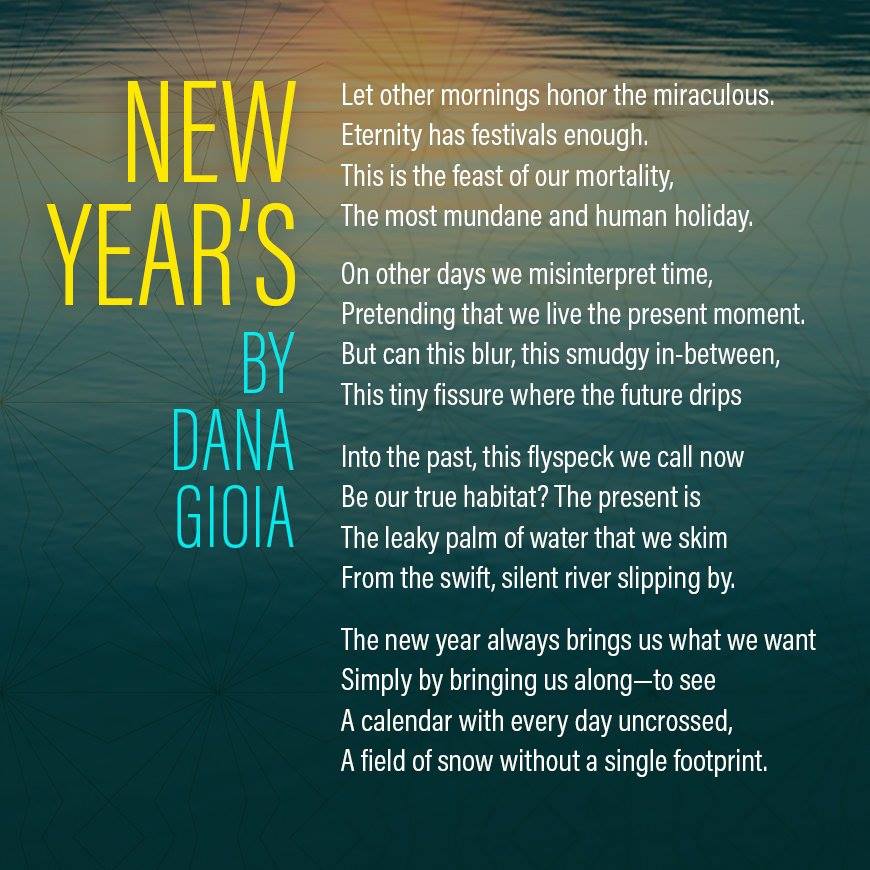
A fan of the Beach Boys? Here’s a poem and video for you: “Every lovesick summer has its song.”

Share

In his year as state poet laureate, Dana Gioia was determined to speak, read, and hold a literary event in every one of California’s 58 counties. And so he did. But that meant a lot of lonely hours on the road for Santa Rosa-based California guy.

Dana chilling in L.A. with Doctor Gatsby (Photo: Starr Black)

Perhaps that’s what brought this poem to mind for one of his newest in the Blank Verse Films series. It’s one of his poems that was driven by sound, which is appropriate for the subject.

“I imagine it already needs footnotes for the young, but I like to think that the experience is nearly universal in our era of entertainment,” he told me. There’s a personal link not mentioned in the poem: he shares a hometown with the Beach Boys outside L.A. – Hawthorne, California, before a freeway ran through it.

Cruising with the Beach Boys

So strange to hear that song again tonight
Travelling on business in a rented car
Miles from anywhere I’ve been before.
And now a tune I haven’t heard for years
Probably not since it last left the charts
Back in L.A. in 1969.
I can’t believe I know the words by heart
And can’t think of a girl to blame them on.

Every lovesick summer has its song,
And this one I pretended to despise,
But if I was alone when it came on,
I turned it up full-blast to sing along –
A primal scream in croaky baritone,
The notes all flat, the lyrics mostly slurred.
No wonder I spent so much time alone
Making the rounds in Dad’s old Thunderbird.

Some nights I drove down to the beach to park
And walk along the railings of the pier.
The water down below was cold and dark,
The waves monotonous against the shore.
The darkness and the mist, the midnight sea,
The flickering lights reflected from the city –
A perfect setting for a boy like me,
The Cecil B. DeMille of my self-pity.

I thought by now I’d left those nights behind,
Lost like the girls that I could never get,
Gone with the years, junked with the old T-Bird.
But one old song, a stretch of empty road,
Can open up a door and let them fall
Tumbling like boxes from a dusty shelf,
Tightening my throat for no reason at all
Bringing on tears shed only for myself.

Tired of angst? Here’s a poem about a happy marriage.

Share

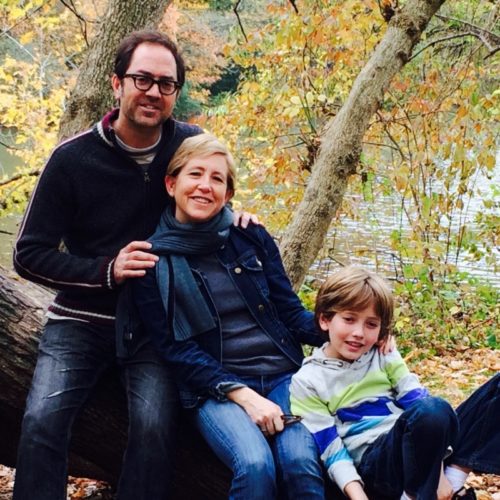
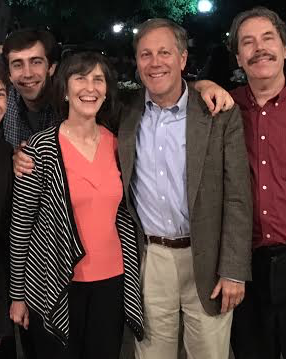
A family reunion at Stanford – with jazz scholar Ted Gioia at right.

Dana Gioia, former National Endowment for the Arts chair and former California poet laureate, met Mary Heicke in the staples department of Stanford Bookstore circa 1977. They have been together ever since – a long marriage indeed, and one of the happiest I know. He commemorated their union recently in a poem, “Marriage of Many Years”:

Most of what happens happens beyond words.
The lexicon of lip and fingertip
defies translation into common speech.
I recognize the musk of your dark hair.
It always thrills me, though I can’t describe it.
My finger on your thigh does not touch skin—
it touches your skin warming to my touch.
You are a language I have learned by heart.

This intimate patois will vanish with us,
its only native speakers. Does it matter?
Our tribal chants, our dances round the fire
performed the sorcery we most required.
They bound us in a spell time could not break.
Let the young vaunt their ecstasy. We keep
our tribe of two in sovereign secrecy.
What must be lost was never lost on us.

In an era that celebrates sturm und drang, poets write of abusive relationships, and the anguish of unrequited love, or the torments of triangular love – but how many write of long and happy fidelity? The late great Richard Wilbur, notably, mocks the romantic conventions and instead praises (read the whole thing here) his marriage

… which, though taken to be tame and staid,
Is a wild sostenuto of the heart,
A passion joined to courtesy and art
Which has the quality of something made,
Like a good fiddle, like the rose’s scent,
Like a rose window or the firmament.

The Gioia marriage has an eyewitness to commemorate it – their son, Mike Gioia – who added it yesterday to his new youtube poetry series, “Blank Verse Films.” (You can subscribe here.)