
Is it really a wonderful life? Hmmm…

Share

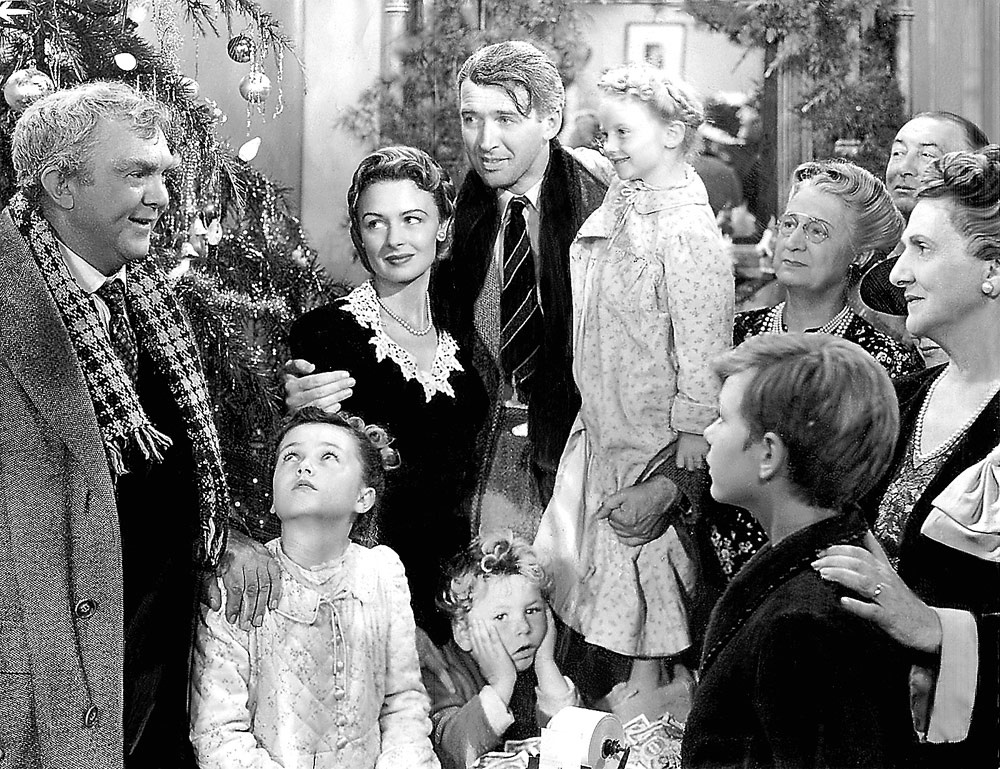
Tonight, on Christmas Eve, the Stanford Theater on University Avenue is showing Frank Capra‘s It’s a Wonderful Life, as usual.

I will not be going.  You have to book ages in advance, long before you have sorted your plans out – or had any thoughts about Christmas at all – otherwise it is sold out before you arrive at the ticket counter.  After all, it is an annual ritual, a “heart-warming Christmas film,” “a sentimental favorite” … or is it?

I’m reminded of the New York Times article, by Wendell Jamieson, of a few years’ vintage:

A terrifying, asphyxiating story?

“It’s a Wonderful Life” is a terrifying, asphyxiating story about growing up and relinquishing your dreams, of seeing your father driven to the grave before his time, of living among bitter, small-minded people. It is a story of being trapped, of compromising, of watching others move ahead and away, of becoming so filled with rage that you verbally abuse your children, their teacher and your oppressively perfect wife. It is also a nightmare account of an endless home renovation.
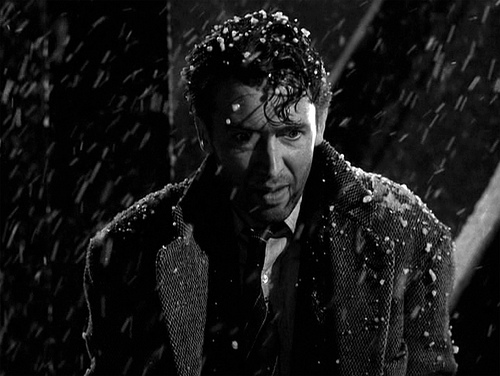
Jamieson has it wrong on some points:  relinquishing dreams is an inevitable part of growing up.  You can’t be a brain surgeon, a stand-up comedian and a playboy with a yacht. You won’t be 6’4″ if you’re destined to be 5’5,” and you can’t marry all the handsome men who ask you out.  Making one choice necessarily means sacrificing others, and there are worse choices than George Bailey’s marrying a pretty, adoring girl, keeping his dad’s business going, and dutifully being a kind father and a good citizen.

Jamieson’s general theme seems to be catching on, however. In a critique of modern Christmas films, “Too Many Turkeys from Tinseltown,” Mike Shaw in London’s Independent also discusses  “the ‘feel-good family favourite’ and regular winner of polls to find the public’s favourite Christmas film”:

Picture the scene: It’s a wild and snowy night. A man stands on a bridge, staring into the icy river rushing below him and contemplating his life. We have already been witness to extortion, fraud and domestic abuse. Over the next hour, this man’s little brother will drown, and our character will plunge into depression, assault a police officer and crash his car while drunk. …

The fact that It’s a Wonderful Life is a tad downbeat is nothing new. For decades, the film has attracted as many humbugs as it has admirers, by virtue of it being “too depressing”. Love it or hate though, there is no denying that by the end of Frank Capra’s film that elusive warm fuzzy feeling is well and truly kindled.

"Business! Mankind was my business! Their common welfare was my business!"

However, if a good Christmas movie can be judged by how Christmassy it makes you feel (Christmassy being a complex scientific measurement best described to the layman as “happy, hopeful and harmonious with a slight tinge of sadness”), then modern festive films fail on almost every count, and I know why.

Simply put, they’re just not miserable enough. By playing it safe and desperately trying to not upset or offend anyone, Christmas films today miss the key element required for success: despair and salvation – the light at the end of the tunnel.
Maybe.  But this week’s Yahoo poll on the favorite Christmas film of all time has me questioning public taste. 137,444 voted, and came out with It’s a Wonderful Life pulling 44 percent of the votes, Miracle on 34th Street with 30 percent, and A Christmas Carol coming out with a mere 26 percent.  Perhaps no surprise, considering the crappy screen versions of the Charles Dickens classic.

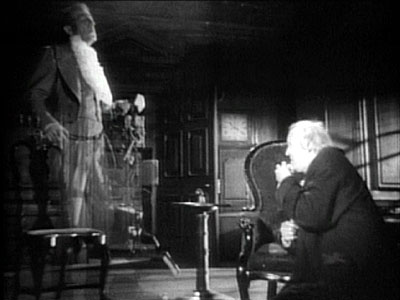
For all-out scariness, I’ll still plump for A Christmas Carol, the (admittedly stagey) 1951 English version, with Alastair Sim as Scrooge and a very young Michael Hordern as a Marley.  Hordern’s eerie howling and chain-shaking will frighten the bejeebers out of any smarmy kid. And Sim is the best Scrooge yet.

Better yet, try the book.

Postscript:  CNN has an op-ed on the Capra film today, here.
Oprah Winfrey, cheese, Mother Teresa, and the homeless of Haight Street

Share

Too easy a target

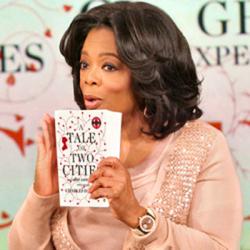
I was shocked, shocked during the holiday season when a friend told me he had never read Charles Dickens.  So, motivated by, of all things, Oprah Winfrey, I made sure  A Tale of Two Cities was among his Christmas presents.  No, no, not Oprah’s cheesy edition, but the annotated Penguin one.

Cheesy edition… that’s just it, isn’t it?  Many of Oprah’s endeavors justly inspire ridicule.  She is too easy a target.  So The New Republic’s lambasting her for choosing Great Expectations and A Tale of Two Cities as her December Book Club selection was, well, a bit cheesy in itself.  Hillary Kelly explodes:

“On December 2, as Oprah Winfrey stood on the stage of her TV show, tightly clutching her newest Book Club selection to her chest so that no one could see its title, she proclaimed in her singular, scale-climbing voice, ‘Dickeeeens for the hooolidaaaays!’ Oprah declared that she has ‘always wanted to read Dickens over the holidays,’ and ‘now [she] can.’ Never mind that she could have read Dickens whenever she wanted, seeing as his books have been popular for more than a century. Never mind that Oprah hadn’t chosen A Christmas Carol, The Chimes, or any of Dickens’s other Christmas tales. Never mind that neither Great Expectations nor A Tale of Two Cities, the books she did choose, have anything to do with the holidays. Our shepherd has spoken, and we must blindly follow.

Kelly is concerned that Oprah Winfrey’s “sentimentalized pitch” will result in “a frightening number of purchases.”  Winfrey, you see, admits she has never actually read Dickens.  Kelly continues:

“She has asked millions of people to follow her into some of the more difficult prose to come out of the nineteenth century—prose she knows nothing about. Put simply, a TV host whose maxim is to ‘live your best life’ is not an adequate guide through the complicated syntax of Dickens, not because she lacks the intelligence—she is quite clearly a woman of savvy—but because her readings of the texts are so one-dimensional.”

She’s not done:

“Even more confusingly, Oprah’s comments about Dickens making for cozy reading in front of a winter fire misinterprets the large-scale social realism of his work. It stands to reason that her sentimentalized view of Dickens might stem from A Christmas Carol—probably his most family-friendly read and one of his most frequently recounted tales. But her quaint view of Victoriana, as she’s expressed it, belies an ignorance of Dickens’s authorial intentions. Indeed, both A Tale of Two Cities and Great Expectations are dark and disturbing, with elaborate ventures into the seedy underbelly of London and the bloody streets of Paris. How can we trust a literary guide who, ignorant of the terrain ahead, promises us it will be light and easy?”

I am glad I did not have Kelly around in my own adolescence.  As a girl of about 10 or 11, I picked up (you guessed it) Tale of Two Cities. Undaunted by its “complicated syntax,” I read it straight through to the scaffold. And I expect from the little I know of Winfrey’s background, she might have a better grasp of a work that is “dark and disturbing” than Kelly herself.

I was gratified to see the readership of the New Republic nailed the implicit elitism of Kelly’s remarks:

“Wow. ‘Cadres of women from around the globe’ will discover that Dickens can be tough sledding. I imagine that more than a few, however, will muddle through on their own and actually get something more out of it than a cup of hot cocoa. And it’s really this, I suspect, that you find so ‘appalling.'”

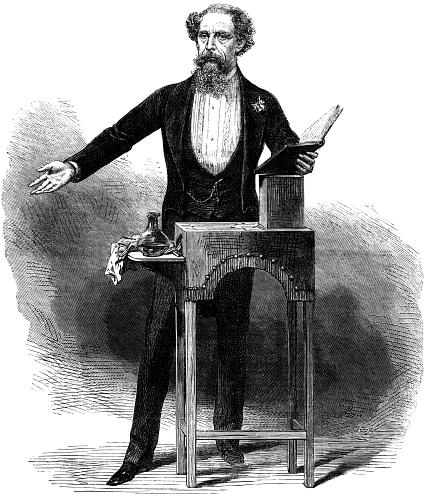
Dickens at the podium

Another writes:

“This article strikes me as deeply wrongheaded. So what if Oprah has a silly, narcissistic view of literature? If she gets her fans in their thousands and millions to go out and buy books, some of them authentically great literature, I say more power to her in this age of illiteracy! And by what right does Ms. Kelly sneeringly dismiss all those book-buying fans as dunderheads who could not possibly understand a “great book” unless it is spoon-fed to them by a Certified Literature Professor? Surely some of them are capable of reading and thinking for themselves, and possibly even having insights that have never occurred to Hillary Kelly! If the Western canon is to have any claim to universality, it must be that it is potentially accessible to everyone–that is the great lesson I took away from my immersion in the University of Chicago’s Robert Hutchins-inspired “core curriculum” in the humanities. Or are we to lock the gates of the Temple of Literature to all who do not have a Ph.D. in literary theory? That, surely, would be a far worse catastrophe for the human spirit than Oprah telling people to have a cup of hot chocolate while reading Charles Dickens!”

And I’m not sure today’s world is so very far from the one Dickens describes.  A couple years back, Rush Rehm and I were discussing people’s general reluctance to engage in volunteer work.  I had recently tried to help out at the Stanford Hospital, and been given forms to fill out and asked to sign on to a training schedule — impossible then, and even less possible now.  Rush extolled the organization of Mother Teresa and her nuns.  He told me that if you show up on the doorstep, her nuns will stick a broom or mop in your hands, no questions asked, no names taken.  It’s not grandiose stuff.  Washing a few dishes at the AIDS hospice in Pacifica may not be making the world safe for democracy, but I think Dickens would approve.  They use you while you are there, and welcome you back whenever you return.  That might be one of the most remarkable features of the whole outfit.

So, on a very rainy Christmas morning, I made my occasional trek to the Golden Gate Park, where they feed the homeless, with several bundles of new socks for the dispossessed.  They go through them so quickly living in the San Francisco chill.  I never found the nuns yesterday, but I did notice that the homeless seem to be everywhere this Christmas — not only in the park, but up and down Haight Street, and Oak Avenue, and everywhere hunkered under makeshift cardboard, broken umbrellas, and stolen shopping carts.

A quick stop in Pacifica delivered the socks, and the nuns greeted their wet and slightly manic visitor with their usual unruffled and unhurried calm and friendliness.

I also delivered my Christmas greetings to the gray and magnificent Pacific, my touchstone — and returned to my modest Palo Alto life that is, by any world standard, and particularly the by the standard on Haight Street, unquestionably luxurious.

David Lang’s postmodern passion: “It is not a pretty story”

Share

Just in time for Christmas (Photo: Peter Serling)

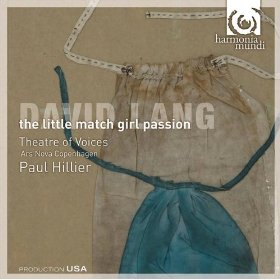
I’m not always au courant with the latest musical offerings —  so I missed David Lang‘s Little Match Girl Passion when it won the Pulitzer in 2008.  Only when I interviewed and wrote about Lang did I familiarize myself with this stunning composition.  A friend of mine, Tim Page of the Washington Post‘s said of it, “I don’t think I’ve ever been so moved by a new … composition” and that it was “unlike any music I know.” It’s in keeping with the darker side of the season, a postmodern take on the Hans Christian Andersen story that inspired it.

“It is not a pretty story,” says Lang, who wrote the text.  True. It’s always surprised me that the tale — all of two-and-a-half pages in my 1906 edition published by J.M. Dent & Co. in London — is viewed as something to be read to children.  Lang rightly observes that “it has that shocking combination of danger and morality that many famous children’s stories do.”  And in Lang’s sensitive hands, the story comes shockingly alive once again: a poor young girl tries unsuccessfully to sell matches on New Year’s Eve, fears returning to the impoverished home where she is beaten by her father, and freezes to death while having visions of her grandmother, “the only person who had ever been kind to her,” as Andersen explains in the story.

Knew poverty from the inside out

“Through it all she somehow retains her Christian purity of spirit,” Lang writes.  You can hear the whole Passion on Lang’s website, here.

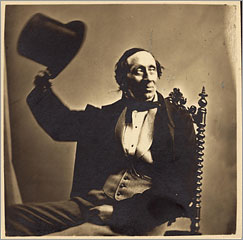
Andersen knew what he was talking about: “When Hans Christian Andersen was a child, he was almost as poor as the ‘little match-seller’ in one of his own tales,” Ernest Rhys writes in an editor’s note to my edition.  He “almost starved” as a teenager in Copenhagen, and his early poem “The Dying Child” earned him lasting fame.

Lang writes in the notes that accompany the CD, “What drew me to ‘The Little Match Girl’ is that the strength of the story lies not in its plot but in the fact that all its parts—the horror and the beauty—are constantly suffused with their opposites. The girl’s bitter present is locked together with the sweetness of her past memories; her poverty is always suffused with her hopefulness. There is a kind of naive equilibrium between suffering and hope.”

In other words, Andersen’s work demands a return to radical innocence.  That dark insistence is at the heart of this short, incomprehensible work.   Other Industrial Revolution writers – William Blake in his poems,  Charles Dickens in his stories – would have understood.  Without it, the story is mere pathos and sentimentality. Radical innocence is a to-the-death imperative,  as Andersen knew, as Blake knew.  (That tenacious survivor, Czesław Miłosz, tries to recover it in “The World” cycle of poems. Clearly, it was the Eden he longed to return to.)

“A Passion,” of course, is about suffering — typically, the passion not only tells the story, but also comments upon it, giving the tale a “powerful inevitability,” said Lang.   It also includes texts from other sources to tell its story (Lang borrows from Genesis, the Song of Songs, and Ecclesiastes). It embraces different p.o.v.s — the reactions of the crowd, penitential thoughts, statements of general sorrow, shock, or remorse, as well as other texts altogether.  These tools place us in the middle of the action, rather than allowing us the emotional as well as temporal distance of bystanders.

Lang modeled his own Passion on Bach’s Saint Matthew Passion — “what has always interested me, however, is that Andersen tells this story as a kind of parable, drawing a religious and moral equivalency between the suffering of the poor girl and the suffering of Jesus. The girl suffers, is scorned by the crowd, dies, and is transfigured. I started wondering what secrets could be unlocked from this story if one took its Christian nature to its conclusion and unfolded it, as Christian composers have traditionally done in musical settings of the Passion of Jesus.”

Merry Christmas to all.

(Listen, at least, to the opening “Come, Daughter” piece here.)