
Barbara Gruszka-Zych, a Polish author currently working on a book about Nobel poet Czesław Miłosz, visited the Nobel poet’s old haunts earlier this year. We wrote about the visit here. After her Berkeley tour, we worked across two continents for the front-page article that appeared this week in a leading Warsaw newspaper, Rzeczpospolita.
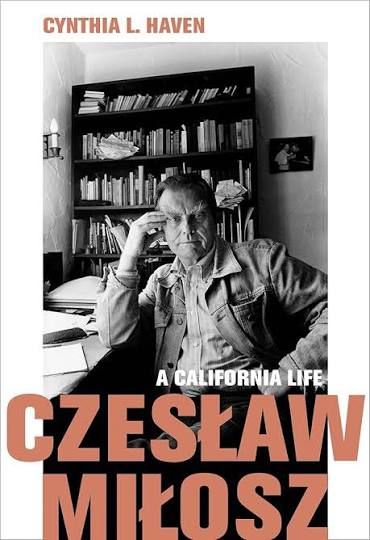
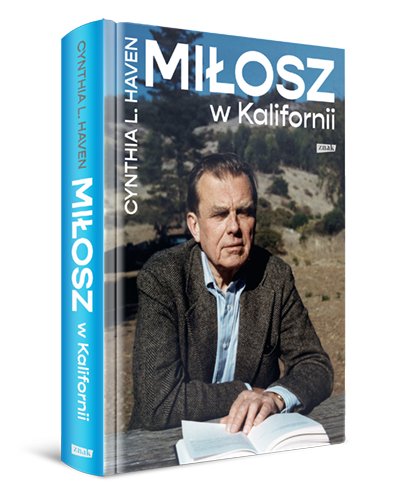
So here’s the Q&A with Basha Gruszka-Zych. The book covers below are from Czesław Miłosz: A California Life (with Berkeley’s Heyday Books) and farther below, the Polish edition, published by Miłosz’s favored publisher, Znak. Hope the conversation gives you as much as it gave me:
Dear Cynthia, You know very well what an important book you have written. Reading it, I come to know the secrets of my poet’s life in California, but also California itself. It is a hero of your work as well. I always addressed Czesław Miłosz as “Pan Czesław.” I have found in you a woman who, like me, is fascinated by him, and that brings me joy.
Below are a few questions: How did you discover that there was someone in the world like Czesław Miłosz? Did your meetings with him matter to you more, or rather his work?
I studied with Joseph Brodsky at the University of Michigan. He was a pivotal influence for me. When he died in 1996, I began rereading some of his essays. You’ll remember he famously said Miłosz was “one of the greatest poets of our time, perhaps the greatest.” I wondered where this paragon lived. To my surprise, I learned that he lived just across the Bay from me. Why not find an excuse to interview him? So I did. Twice, in the year 2000. My Q&A turned out to be his last interview in the United States, before he returned to Poland forever.
Which meant more to me? Hard to say. Knowing someone firsthand fixes the dye, so to speak. It makes the connection more than a name on a page, more than someone you read about in a newspaper article.
You say repeatedly that he is the greatest American poet, although he writes in Polish. So are you convinced that the place where he lived for so many years and the influence of thinkers and fellow scientists who affected him while he taught at Berkeley created his poetry? In other words – did America create him?
You can’t live forty years in a place and not be of that place, and not have it sink into your bones. The redwoods created his poetry, the lights along the San Francisco Bay did, too. The hills and the Golden Gate Bridge had a role, and so did the mighty Pacific. And so did the rowdy, free-wheeling Berkeley students in the classroom, who appalled and transfixed him at once. America made him a world poet, not a niche poet who spoke in “some unheard-of tongue,” as he put it.
Let me correct the record, however: there are some other contenders for the “greatest” American laureate. Walt Whitman, for one. T.S. Eliot emigrated to England; W.H. Auden emigrated to America. Are either of them “American”? Are both of them “American”? It’s all rather tangled. My take is a dissident one, to be sure. But my point remains: we should embrace him as an American poet. He should be taught in American classrooms. We were lucky to have him for so many years.
And yet, as Heidegger wrote, “Language is the house of Being,” and Miłosz wrote in Polish. What did a man – a poet who left his native cities burning in the conflagration of war and found the Magic Mountain in Berkeley – give to American poetry, vast as that country?
He gave us the whole world, and he made Polish an indispensable world language, one that gave America a deeper, wider, and more profound and universal vision. Keep in mind that this was the era of self-involved “confessional” poetry in America.
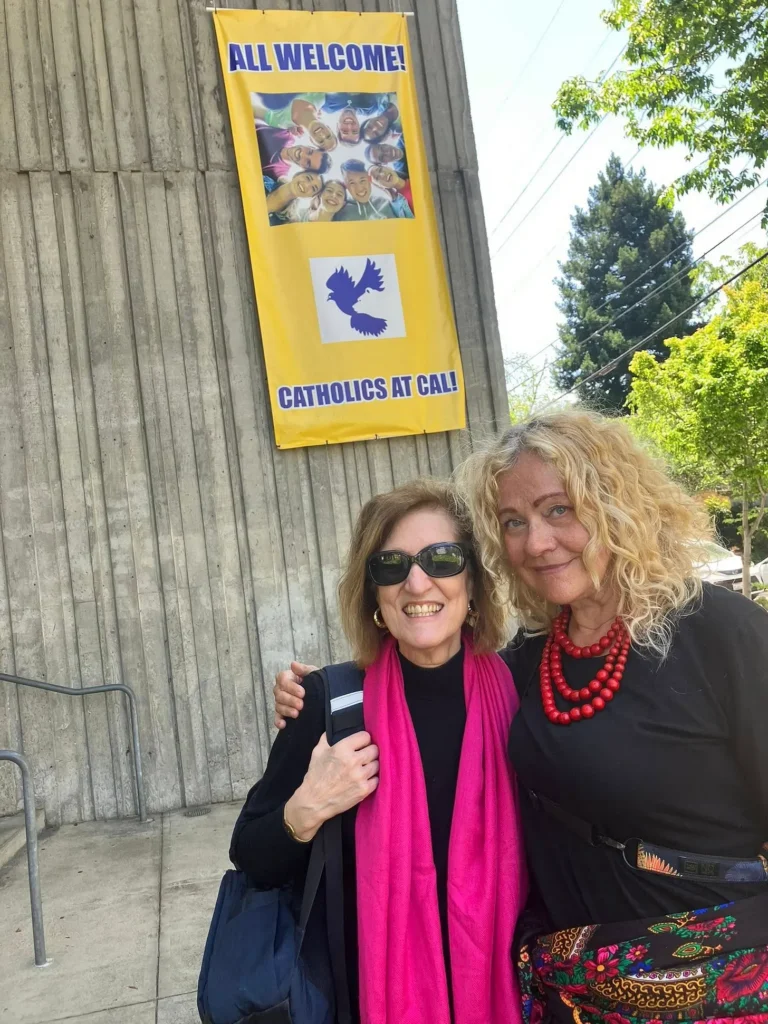
America gave Miłosz a place to think and write on the edge of the world, sheltered from the crises of Europe that made him an exile and eventually an American citizen. And he was prolific! My goodness, he was prolific! (At left, Barbara Gruszka-Zych in Berkeley.)
Which poem or poems of Miłosz guide you through life? Does poetry take part in your writing life and in your daily life? Does it help you or sustain you?
Absolutely! This from “Winter”:
Waters close over us, a name lasts but an instant.
Not important whether the generations hold us in memory.
Great was that chase with the hounds for the unattainable meaning of the world.
And like him,
… now I am ready to keep running
When the sun rises beyond the borderlands of death.
He belongs to all of us in this migratory, fad-ridden nation. He gave us a taste of eternity.
In your book you draw attention to his words about an important esse: “In my opinion it is a deadly thing to lose oneself in movement, in becoming,” Miłosz said. “One must have some basis in being, in esse, in the Latin root of the English word essence.”
What, in your opinion, constitutes the esse of his poetry?
Nature, certainly. It was his first calling. He wanted to be a naturalist. His lifelong consideration of the notions of être and devenir, the dance between them.
He fascination with time and history. His tireless effort to retrieve memory from oblivion. The esse is him, himself.
In one of his first letters from Berkeley, Miłosz wrote that his life was “badly tangled”. Do you think so, too? Could this great poetry have come into being without that tangledness?
Probably not. It was a lonely time for him, and he forged himself in it.
Oh, I keep going back to “Magic Mountain.” That magnificent metaphysical view.
The tangledness of the poetry or the tangledness of the man? We will never be able to untangle all of it. The fun is trying.
When you describe the lives of your subjects, do you think about how much of it is truth and how much is invention?
Would we have it any other way? We think of the past as a rock, but we are endlessly recreating the past. And the past is still in us. D.H. Lawrence wrote in a letter: “The dead don’t die. They look on and help.” It’s still true. Miłosz … dead? What an odd idea!
Often we ourselves do not know what our life looks like, because it is better seen from a distance. In writing biographies, do we not create new people?
Certainly, we create new people when we write a biography. How could it be otherwise? Consciously or unconsciously, we bring parts of ourselves to the subject of our writing – how could we not? We couldn’t possibly capture or create everything. There’s too much of it! There’s too much world!
We’re not honest. The attempt to clean up the record is irresistible. Can we remake the past?
What do you like about Miłosz as a human being?
His restless intelligence. His endless curiosity. His charm and humor. At one point, in his eighties, he began to teach himself Lithuanian, the language of his birthplace. Robert Hass, the poet who translated so much of Miłosz’s work, asked him why he was bothering to study it at such at late age. Miłosz’s reply? “I think it might be the language of heaven.”
Do you ever talk with him?
I only had those two magic afternoons on Grizzly Peak. They were his last interviews in America, in the year 2000.
I notice you inadvertently put your question in the present tense: ‘Do you ever talk with him?’
I didn’t think of it, but … Yes, yes, I think I will!