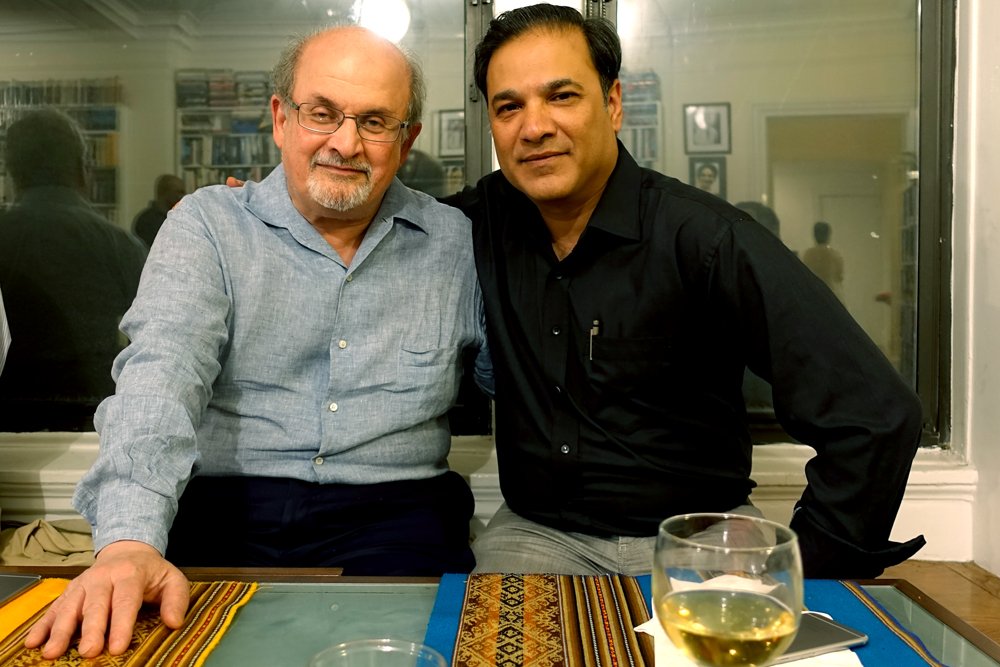
Salman Rushdie before the attack, with friend Abbas Raza in Brixen, in the Italian Alps.
It was the worst Valentine’s Day present ever: on 14 February 1989, the Iranian leader AyatollahKhomeinicalled for the novelist Salman Rushdie‘s death. The author’s crime? A brilliant book written with his characteristic wit, erudition, and playfulness called The Satanic Verses. Blasphemy, said the grim and fanatical ayatollah. Rushdie went into hiding, but as the years went by, he inevitably relaxed his guard and began to live more openly, appearing at speaking engagements, parties, P.E.N. meetings, and universities. It seemed he would beat the rap, until last August 11, when an rootless nobody named Hadi Matar attacked him at a speaking engagement in Chautauqua, NY. This month, a fascinating article in the New Yorker, “The Defiance of Salman Rushdie” byDavid Remnick, discusses his life under a fatwa, his injuries in last year’s attack (he’s lost an eye and the use of a hand), his books, and his indefatigable courage.
Excerpts:
Did he think it had been a mistake to let his guard down since moving to New York? “Well, I’m asking myself that question, and I don’t know the answer to it,” he said. “I did have more than twenty years of life. So, is that a mistake? Also, I wrote a lot of books. The Satanic Verses was my fifth published book—my fourth published novel—and this is my twenty-first. So, three-quarters of my life as a writer has happened since the fatwa. In a way, you can’t regret your life.”
***
Whom does he blame for the attack?
“I blame him,” he said.
***
At this meeting and in subsequent conversations, I sensed conflicting instincts in Rushdie when he replied to questions about his health: there was the instinct to move on—to talk about literary matters, his book, anything but the decades-long fatwa and now the attack—and the instinct to be absolutely frank. “There is such a thing as P.T.S.D., you know,” he said after a while. “I’ve found it very, very difficult to write. I sit down to write, and nothing happens. I write, but it’s a combination of blankness and junk, stuff that I write and that I delete the next day. I’m not out of that forest yet, really.”
He added, “I’ve simply never allowed myself to use the phrase ‘writer’s block.’ Everybody has a moment when there’s nothing in your head. And you think, Oh, well, there’s never going to be anything. One of the things about being seventy-five and having written twenty-one books is that you know that, if you keep at it, something will come.”
Had that happened in the past months?
Rushdie frowned. “Not really. I mean, I’ve tried, but not really.” He was only lately “just beginning to feel the return of the juices.”
How to go on living after thinking you had emerged from years of threat, denunciation, and mortal danger? And now how to recover from an attack that came within millimetres of killing you, and try to live, somehow, as if it could never recur?
He seemed grateful for a therapist he had seen since before the attack, a therapist “who has a lot of work to do. He knows me and he’s very helpful, and I just talk things through.”
The talk was plainly in the service of a long-standing resolution. “I’ve always tried very hard not to adopt the role of a victim,” he said. “Then you’re just sitting there saying, Somebody stuck a knife in me! Poor me. . . . Which I do sometimes think.” He laughed. “It hurts. But what I don’t think is: That’s what I want people reading the book to think. I want them to be captured by the tale, to be carried away.”
Many years ago, he recalled, there were people who seemed to grow tired of his persistent existence. “People didn’t like it. Because I should have died. Now that I’ve almost died, everybody loves me. . . . That was my mistake, back then. Not only did I live but I tried to live well. Bad mistake. Get fifteen stab wounds, much better.”
A first, incandescent review for Dana Gioia‘s brand new collection, Meet Me At The Lighthouse(Graywolf). Seth Wieck‘s write-up, “Dana Gioia’s Bright Twilight,” is in included the newest issue of The Front Porch Republic, a blog (and book publisher) launched in 2009 with contributors, known as “porchers,” focusing on concepts of community, place, decentralism, and conservation. And sometimes they talk about poetry.
Poetry is a profession that bears well into the seventh decade of life and beyond – better than being an astronaut or Olympic gymnast, or pretty much any other non-literary profession. Dana is playing the long game, and he isn’t missing a beat, metrical or metaphorical. As Wieck writes, “Rather, he’s heeding Eliot’s warning. Don’t turn aside. Take up your lantern and charge into the darkness. Sing all the way into the afterlife. Gioia does not linger on the threshold of death; he wants to be our guide through the Inferno and beyond.” (Please be reassured, gentle reader, Dana is in the best of health.)
An excerpt:
“The book closes with the 14-page poem “The Underworld,” giving it a weight no other poem in the collection receives. The 17 seven-line stanzas return us to the afterlife with which the book opened. However, instead of a lively jazz club, now the ‘you’ is seated on a silent train commute to the Underworld. It flips the tropes of those ancient epics where a hero interviews a long train of shades, hoping to garner wisdom. In Gioia’s Underworld, ‘You’ speak to no one. There are no fantastical creatures, ‘no triple-headed dogs…no Titans bound in chains.’ There are no malebolges stuffed with squirming sufferers. There is only the commute full of dead-eyed passengers isolated from one another, turned to stone as if the Gorgon had gazed back from their morning mirrors, or the screens in their palms.
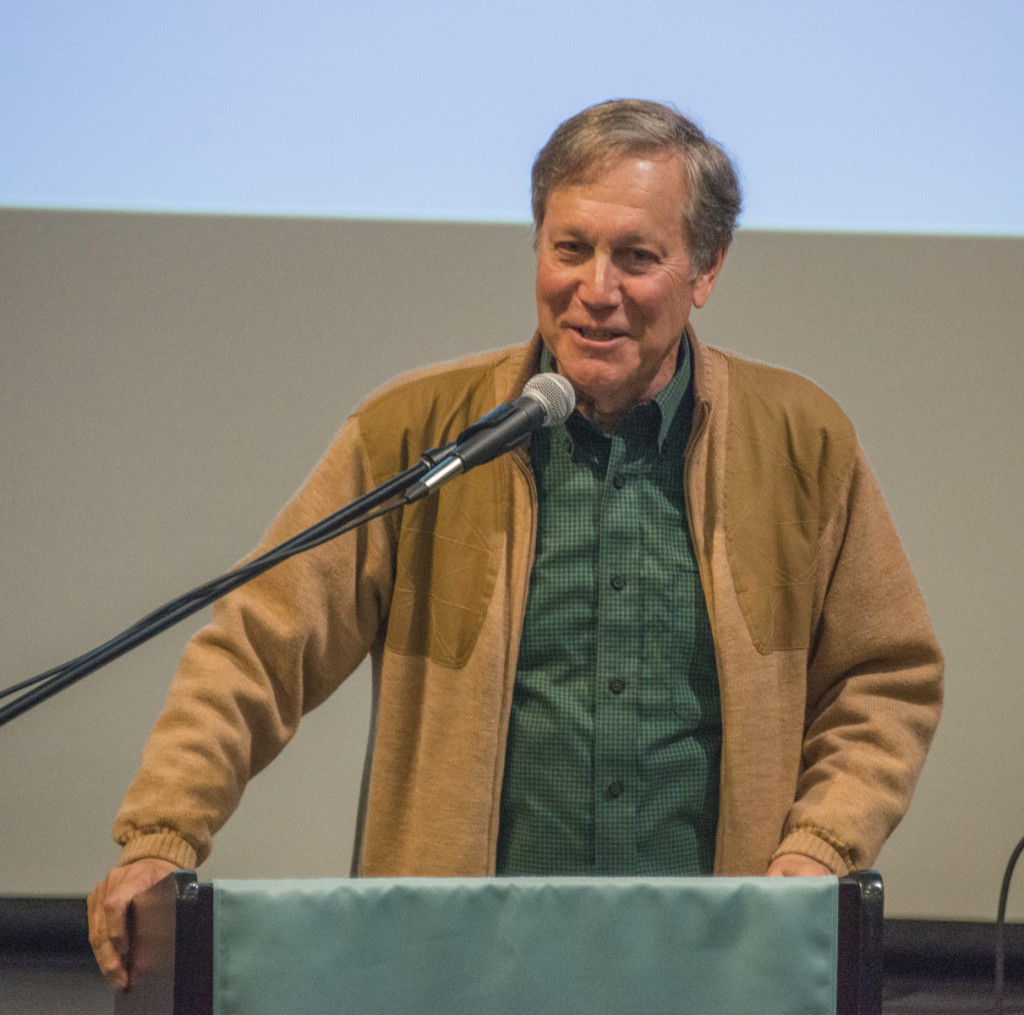
Gioia at the Sierra Poetry Festival (Photo: Radu Sava)
The train never quite arrives anywhere, yet all the passengers are anxious to get there. For those people like Tennysonand Baudelaire—like me on the days I get off work and succumb to sitting vacantly in a room with my family, each with a face to a respective screen, absence substituting absinthe—for those, the Underworld, Hell, is already here. As Gioia reminds us in the poem’s epigraph, quoting The Aeneid, ‘Descending into Hell is easy.’ The sentence doesn’t stop here, however. If we were to heed Gioia’s guidance and work our way back through the poets, the tradition, the wisdom handed down to us through the ages (with no lack of God’s providence in the process), then we’d arrive back at Virgil and finish the line: ‘Descending into Hell is easy / But to return, and view the cheerful skies, / In this the task and mighty labor lies.’”
“As I mount midlife—Tennyson’s rocky walls—and attempt to gather my bearings for what’s coming in the next 40 years, I find fewer and fewer people have been able to run the long race. The energy and ambition and love I had in my youth is running low. Wouldn’t it be easier to fold my hands, to repeat the catch phrases and sound bites, to laugh at the canned cues and teach my children to? Whose woods these are I think I know. Then out on the wrinkled sea, the high notes come shimmering over the cold waves, and 72-year-old Dana Gioia says, ‘Meet me at the Lighthouse.’”
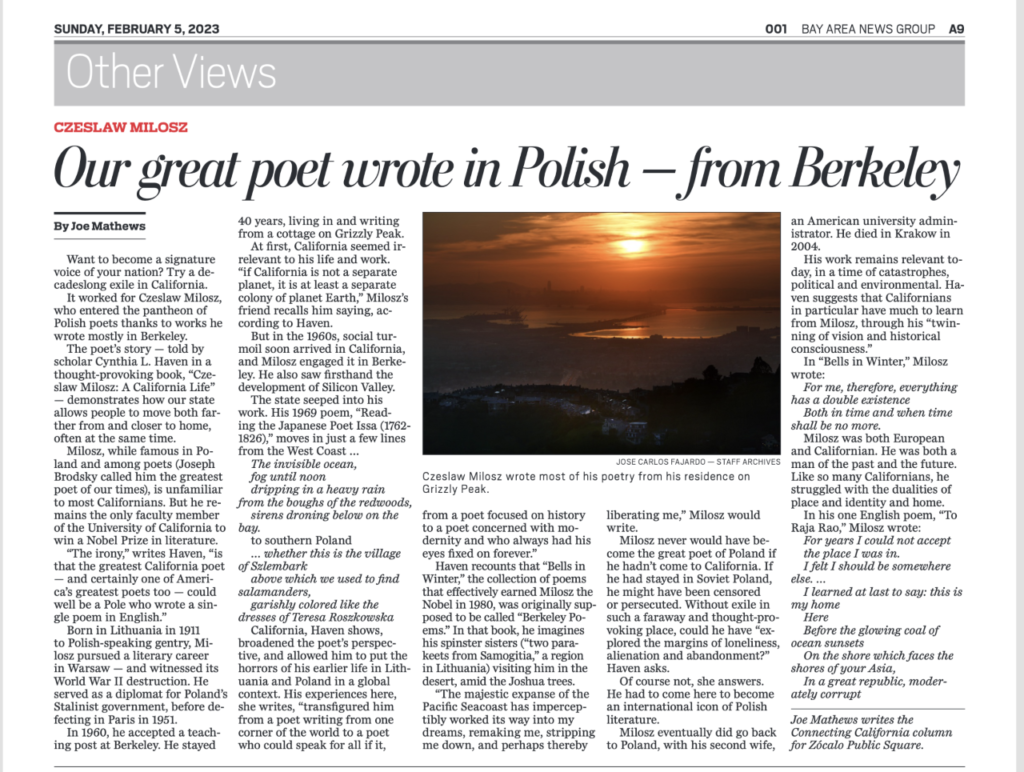
It’s been a spectacular few days for Czesław Miłosz: A California Life. Over the weekend, an opinion piece about my book and the poet who inspired it, written by Joe Mathews, was featured on page 9 of The San Jose Mercury News here. Then The San Francisco Chroniclehere. The East Bay Timeshere, Zócalo Public Square here, and southern California’s Ventura County Star here. It also went out on Yahoo News here, and that means it went everywhere. We’ll add any more links that come along. [Feb. 8 postscript: Here’s another one! The Bakersfield Californian here. And finally, a Feb. 12 postscript: we were featured today on the estimable 3QuarksDaily website here.)
His essay summarizes the book this way: “His experiences here, she writes, ‘transfigured him from a poet writing from one corner of the world to a poet who could speak for all if it, from a poet focused on history to a poet concerned with modernity and who always had his eyes fixed on forever.'”
Thanks to Elizabeth Conquest for the heads-up (we’ve written about her here and here). The whole thing might have passed us by, since proof pages and revisions are dominating the week.
Here’s the downside: Czesław Miłosz: A California Life sold out at Amazon. However, you can order directly from Heyday in Berkeley on website here: Or directly from Bookshop here.
Please do. I want you to enjoy the marvels of this remarkable poet, and let his astonishing life absorb you as it has me for almost a quarter century, since I first interviewed him on Grizzly Peak in 2000 – his last interview in America before he returned to Poland forever.
Amazon is out of books! Order from Heyday’s website here or Bookshop here until Amazon gets its act together.
A small correction: The article refers to Miłosz’s sisters. He had none. The two elderly spinsters (“Samogitian parakeets”) are women he knew in Vilnius. He describes them in section 12 of “City Without a Name”here.
Philip Hoy has been in the service of literature for decades, and I’ve been privileged to know him as a publisher and friend for the last 18 years of them. He’s the founding publisher of Waywiser, one of the leading poetry publishers in Britain. (My a book-length conversation with British poet Peter Dale was published by Waywiser in 2005, and I interviewed L.A. poet Timothy Steelefor Three Poets in Conversation in 2006.)
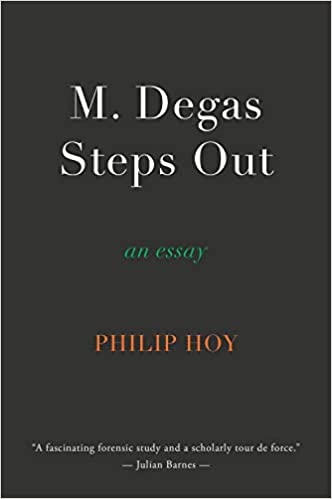
Now it’s Phil’s turn for literary accolades for his own writng, with his new acclaimed book, M. Degas Steps Out.
The book-length essay is based on a 9-second 1915 film clip of the octogenarian painter Edgar Degas on the sidewalks of Paris. Author Julian Barnes called it “a fascinating forensic study and a scholarly tour de force.”
Phil begins his story this way:
In the autumn of 2011, I went to see Degas and the Ballet, an exhibition which had recently opened at the Royal Academy in London’s Piccadilly. Long an admirer of Degas’s art, I cherished this opportunity to see so many of his works – not far short of one hundred paintings, sculptures, pastels, drawings, and prints, as well as a number of the photographs he had taken in his later years. Although the exhibition was everything I could have hoped for, and more, my most vivid memory is not of the works on display, but of a grainy sequence of black and white film which was being shown in the exhibition’s last room. The sequence was very short, running for a mere nine seconds, but it was being played on a continuous loop, and I sat and watched it again and again, totally mesmerized. A notice to one side explained that the central figure in the sequence – a bowler-hatted man walking along a busy Parisian street, accompanied by a much younger woman – was the artist whose exhibition we had just visited. I don’t recall if it said anything else.
According to Matthew Reisz, writing in The Guardian, Phil Hoy was so mesmerized by the film clip of the elderly painter that he downloaded it onto his computer, slowed it down and broke it up into 250 stills – 42 of them are included in the book. Reisz continues: “Just before the screen fades to black, we witness what he describes as a ‘beatific’ moment as a passing young woman turns towards us, ‘we register how beautiful she is’ and she ‘positively beams at [the camera], and in so doing beams at us as well’ – and ‘the more than one hundred years which separate us are wholly annulled.’
“By subjecting this tiny sequence to intense analysis, Hoy shows how it reflects a tragic turning point in French life. Early in the first world war, the actor and playwright Sacha Guitry put together a short propaganda film showcasing leading figures in French culture. Friends such as Sarah Bernhardt and Claude Monet were happy to perform for the camera, but when Degas grumpily spurned his approaches Guitry was obliged to film him surreptitiously.”
Prof. Sherod Santos of the University of Missouri claimed, “I haven’t read a stranger, more original book in a very long time. It’s a wonder. I suspect that M. Degas, lover of privacy that he was, would have been delighted by the book, which it’s an understatement to call an ‘essay,'”
It is what writers everywhere ask, submitting their work to journals and editors, risking rejection or, arguably worse … dead silence. Writer and philosopher Chris Fleming asks the eternal question in faraway Sydney, Australia: Dear Editor, why did you reject my piece? And he gets a few answers … kind of.
Dear Author, Thank you very much for the submission of your piece for our consideration. You can be certain that we receive many submissions – too many, in fact. We’ve discussed at some length how we might cut down on these, but to no avail. (Few besides the successful know the true cost of success, but it would be in unnecessary – and perhaps in poor taste – to rehearse here these reasons, to you.)
Needless to say, we don’t write back to most submitters, which would be impossible in any case, but even if we could, we wouldn’t. And yet we write to you! That is the good news; please enjoy it, as instructed.
The bad news is that we will not publish what you have sent. While your argument is coherent and original and your knowledge of the literature sound, we have been forced to reject the piece on certain grounds, even if the precise nature of those grounds is not yet clear. How to account for this? Do you believe in intuition? It’s too easy to be mysterious about this word, which all sorts of mumbo jumbo is wont to hide behind.
But intuition is the better part of taste, even judgement. We decide first and later rationalize our responses, dignifying them with things we call “reasons,” which gives the impression – most of all to ourselves – of them being causes of a decision; they never are. They are articulations after the fact, fragments collected from a crime scene, momento mori, post-hoc generalizations which answer to some grasping for the explicit.
We could offer such to you, but we desire, above all, to be honest. Needless to say, we have rejected your essay intuitively. To put this another way, you have been rejected on the basis that we couldn’t publish what you have written. We rejected it unanimously. We were in no doubts about it. You had nobody speaking on your behalf: “No,” one of the editors said, after reading your piece, and moved onto something else; “no thanks,” another said. I chimed in, “agreed.” Only one editor spoke on your behalf, although the content of her intervention has been lost and was, in any case, immaterial.
Talmud, Levinas, and unanimity. (Photo: Bracha L. Ettinger)
Thank you, and best luck in your future endeavours. ~The Editors
*** Dear Editors, Thank you for your letter. I must admit I’m at a loss, however. On the one hand you say that the piece was rejected “unanimously” and then say that an editor spoke on my behalf. This seems inconsistent with any reasonable sense of the term “unanimously.” ~ Author ***
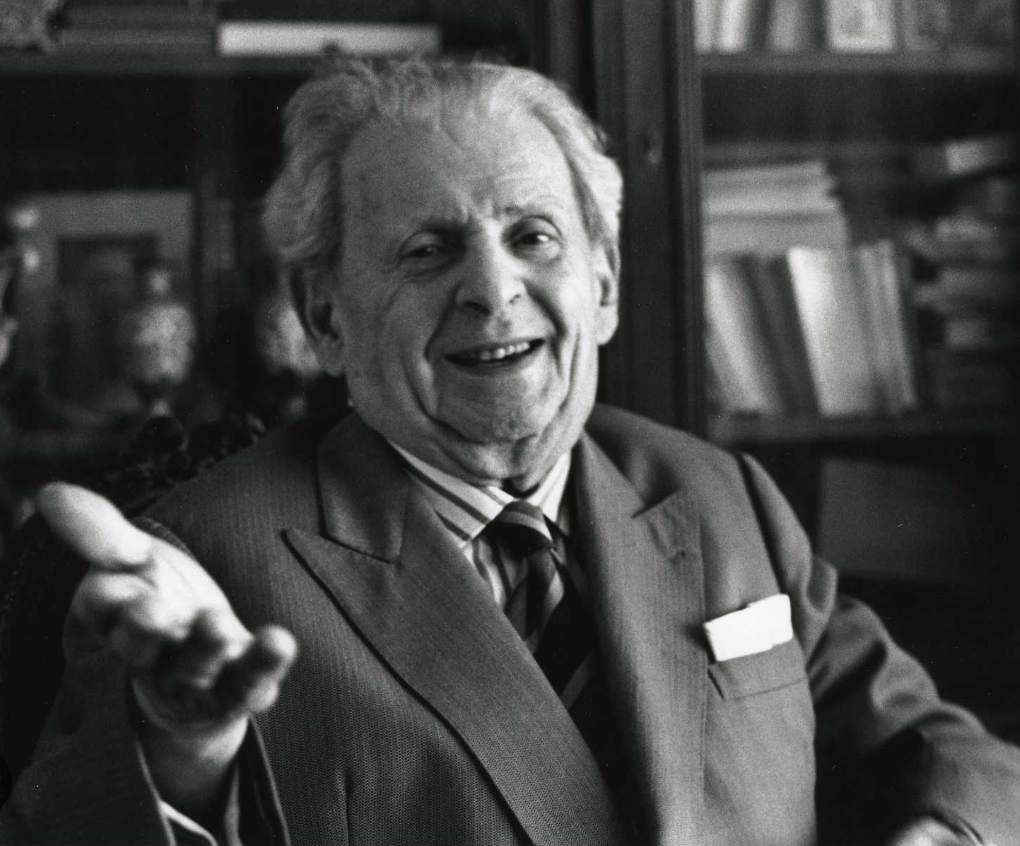
Dear Author, To be honest, it is not our habit to get involved in these sorts of drawn-out tête-à-tête, but we will make an exception here. It is partly a matter of dignity – not ours, but the correspondent’s. While of course the term “unanimity” in a mathematical sense entails an “all in” with respect to numeration, I was using the term in its ethical sense. In Emmanuel Levinas’s readings of the Jewish wisdom texts he speaks at one point of the Talmudic principle that in a case before a court, a truly unanimous verdict against the accused would, in fact, attest to the defendant’s innocence – whereas a majority decision, a 9 or 8 or 7 or 6 out of 10 in favour of convicting would suggest guilt. Why? – because a mathematical unanimity is less an indication of sincere judgement than a mindless piling on. That a majority convicted the person, and yet not a mathematical unanimity, attests to their guilt. Were we to all have found your piece wanting, it might have suggested that we were merely drones, bloodthirsty fashionistas looking for a scapegoat. If anything, the single voice who advocated for you in fact corroborates the deficiencies in your submission, rather than any evidence of its worth.
Ethically, The Editors
***
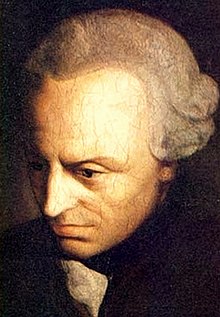
Does Kant get a mention?
Dear Editors, As far as I can tell “mathematical unanimity” refers to nothing whatsoever. What you are referring to here is simply a “majority decision,” and so your choice of terminology is misleading. That you choose to then turn this into a lesson about Jewish ethics seems entirely beside the point. And that you refrain from citing either the original Talmudic source or Levinas’s commentary adds little confidence in your judgement. Further, numerous majority decisions in courts of law have proved wrong and unjust. In any case, as a writer who is interested in improving their work I’d be interested in what feedback you might have. It may well be the case that not all things are capable of explication – but that nothing at all is simply doesn’t follow.
Regards, Author *** Dear Author, We fear the Levinas reference may have been lost on you. And your request for further details is, however psychologically comprehensible, still undignified. You are like a lover who, after the relationship is terminated, continues to look for “reasons,” to “understand” – and yet all these pleas amount to is a lack of acceptance. You understand perfectly well, but maybe what is needed here is not explication of propositions, but an image or figure that would assist in your process of overcoming denial. To this end, perhaps, for the sake of comprehension, you should imagine an out of focus and long-faded polaroid of a decaying organic object of uncertain provenance.
Yours patiently, The Editors *** Dear Editors, I’m afraid this helps little. Perhaps it is my powers of imagination that have failed me, and this is the reason why my piece has been rejected. But what sense can be made of a decaying polaroid. Not only is this a poor justification; it is terrible poetry.
Regards, Author
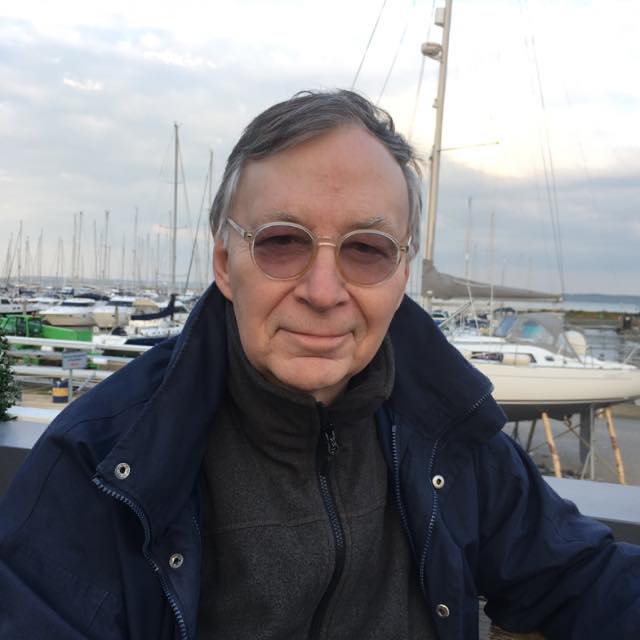
Chris Fleming in Turkey!
*** Dear Author, We do believe you may be onto something here, although nothing to do with us, this case, or your rejection. Needless to say, we think you might want to pursue it in your own time.
Yours advisingly, The Editors *** Dear Editors,
Why did you reject my piece? ~ Author
*** Dear Author, Thanks for your question. We wish you’d asked it sooner. We are unsure ourselves. We have speculated – and then discounted, and then speculated again – that it may be your relentless use of Times New Roman, your occasional invocation of the perfect present tense, or your unusual abstention from using the word “radical.”
But we already fear we are saying too much. Why this need for reasons? – this ongoing, repressive auto da fé of justification? We resent having to defend ourselves, not only to you, who create so much labour for us, but our shrinking and intellectually dubious readership, our department heads, our wives, our children, our pets, indeed all the children of the earth.
We have problems here. One of the editors refuses to read anything anymore on the grounds that he “smells the jackboot of fascism in words,” while another reads everything but only ever writes a one-line review: “The author has not mentioned Kant.” (This is the case, even when the author mentions Kant.) Further, owing to a certain biochemical imbalance I cannot explain, your article prompted a relapse of several degenerative disorders in those close to me. What can I say? Have you not already done enough harm? Would you like to impose upon us botulism as well? Send us another piece of your writing and you may well get your wish. For now, please leave the editors and our families alone.
Thank you for considering our periodical. We wish you every future success. ~ The Editors
Postscript on January 23: The fun never stops. Read Chris Fleming’s piece in Turkish, “Sayın Editör, yazımı neden reddettiniz?, here.
Award-winning poet and critic Dana Gioia‘s new collection, Meet Me At the Lighthouse, is out with Graywolf Press next month – and you’re all invited to the launch party! Sign up for the event at 6:30 p.m. Thursday, February 16 over at Eventbrite here. The reading and reception will be held at Arion Press/Grabhorn Institute at 1802 Hays Street in San Francisco. (And you can pre-order the book here.)
The poet’s filmmaker son Mike Gioia produced a short Youtube video to honor the occasion. The two-minute spot features Dana reading the title poem of the new collection. (It’s his sixth. His earlier 99 Poems: New & Selected was winner of the Poets’ Prize, and Interrogations at Noon won of the American Book Award.)
Dana Gioia is also former California poet laureate and a former chairman of the National Endowment for the Arts, and appears regularly in the Book Haven. You may have read about him here and here and here. And for that matter, Meet Me At the Lighthouse may strike a familiar chord with Book Haven aficionados. We wrote here about some of the poems in the collection: “The Ballad of Jesús Ortiz, “Psalm and Lament for Los Angeles, “Psalm of the Heights” and “Psalm for Our Lady Queen of the Angels.”
The poet was born in California, and is of working-class Sicilian and Latino descent, as is evident from the poems in this collection. He has degrees from Stanford and Harvard.
More on the title poem, from Dana himself: “Jazz fans will recognize the names of the ghosts sitting in with the Lighthouse All-Stars — Gerry Mulligan, Cannonball Adderley, Hampton Hawes, Stan Getz, Chet Baker, and Art Pepper. Tartarus is the abyss of the Underworld.”
“I should point out that I am the only living person in the poem. It doesn’t matter for the reader to know, but I speak the poem to my dead cousin Phil, my best friend in childhood.” The cousin, Philip Dragotto, died at thirty-nine.
“The first two images show the jazz club, and at the end all of the musicians are shown.” The music is a song by Helen Sung for which Gioia wrote the lyrics.
The February 16 reading starts at 6:30 p.m. followed by a book signing with the poet. Come an hour early for a glass of wine at the reception! (Come say hello to me, too – I’ll be there!)
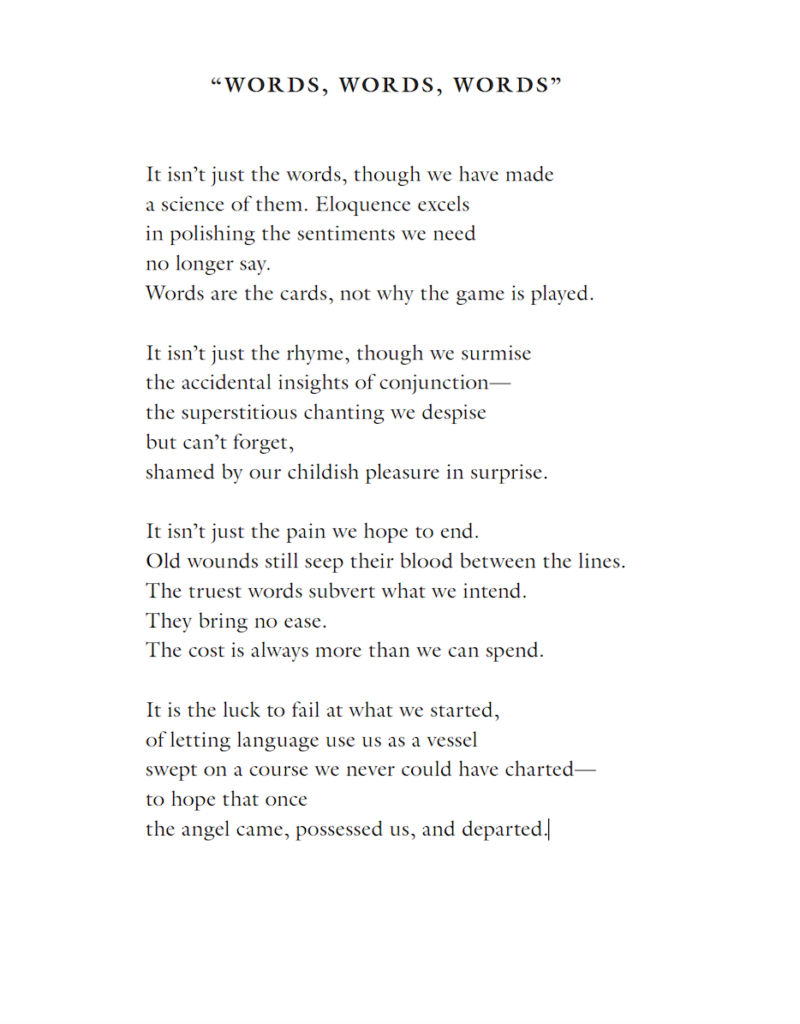
Meanwhile, since both Dana and I spend most of our days writing, what better way to celebratethe occasion of the sixth collection than with a poem about “Words, Words, Words”: