Aliens may be listening to rock and roll singer/songwriter/guitarist Chuck Berry millions of years after our solar system is gone. Think about that.
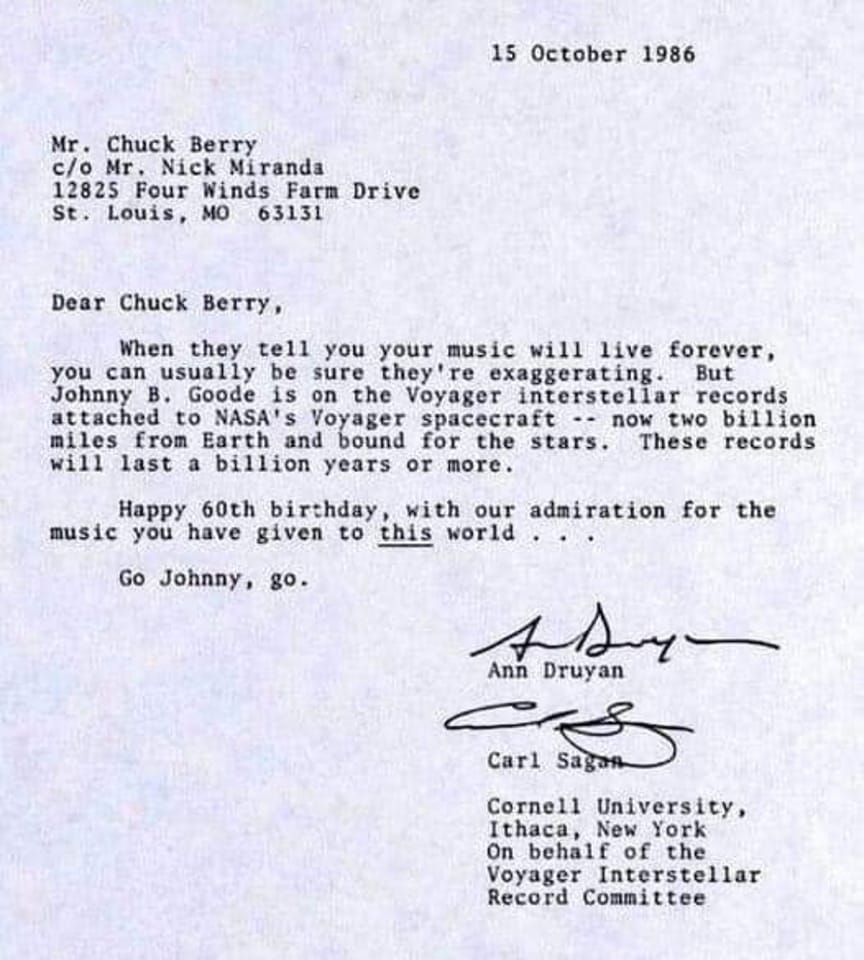
Aliens may be listening to rock and roll singer/songwriter/guitarist Chuck Berry millions of years after our solar system is gone. Think about that.
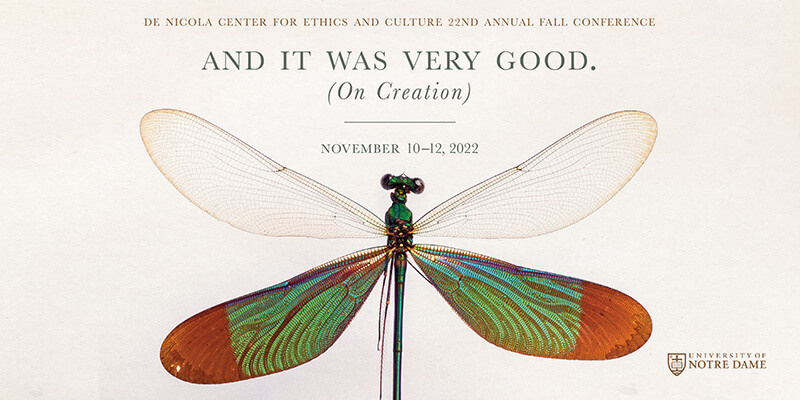
Last week, the University of Notre Dame’s de Nicola Center held a three-day conference on creation, brought together more than a hundred leading thinkers to discuss ethics, culture, and public policy from the points of view of a range of disciplines: theology, philosophy, political theory, law, history, economics, and the social sciences, as well as the natural sciences, literature, and the arts.
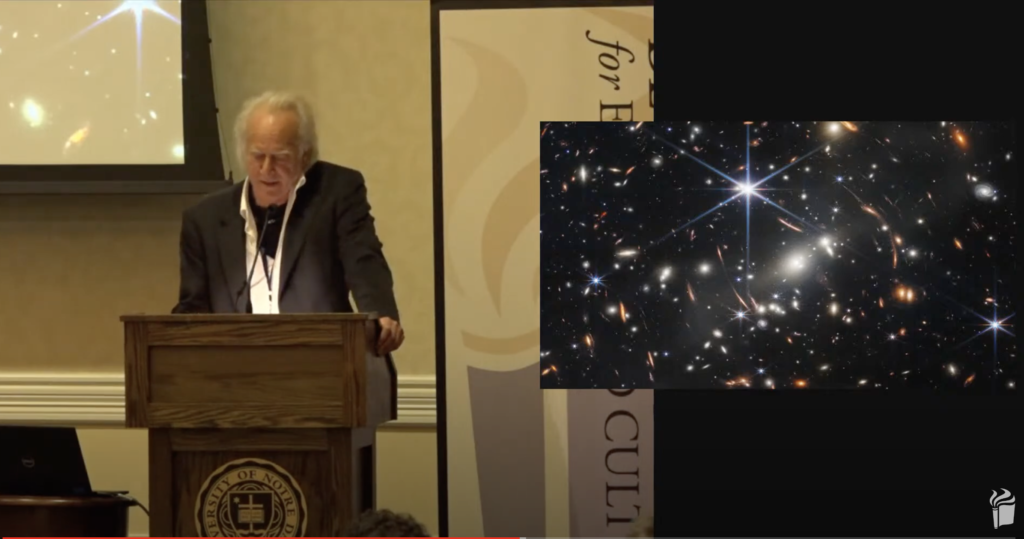
The keynote address that launched the conference was Stanford’s Robert Pogue Harrison, of Entitled Opinions fame, and his talk was entitled, “The Thin Blue Line.” About a thousand people attended in-house, with hundreds more virtually – a big turnout by just about any standards. Artur Rosman, editor of Notre Dame’s online Church-Life Journal (we’ve written about that effort here and here) was glowing about the Stanford professor’s talk afterwards: “‘The Thin Blue Line,’ on what he calls sacramental geocentrism, was perhaps the single best, and most deliciously surprising, conference talk I’ve ever heard. I mean, the whole thing rocks. The whole notion of a sacramental geocentrism blew everyone’s minds. It’s a great provocation.” You’ll hear all about “sacramental geocentrism” during the last ten minutes of the Youtube video here.
For this year’s conference, the De Nicola Center partnered with Stanford University’s “Boundaries of Humanity” project, which seeks to advance dialogue on “human place and purpose in the cosmos, particularly with respect to conceptions of human uniqueness and choices around biotechnological enhancement.”

But back to the talk. Here’s how Robert Harrison began:
“One month after NASA’s Lunar Orbiter 1 took the first photos of Earth from the moon’s orbit on August 23, 1966, Martin Heidegger sat down with two journalists from the German magazine Der Spiegel to answer some pointed questions about his thought and his involvement with the Nazi regime in the 1930s. Late in the interview, which was published after his death in 1976, Heidegger decried modern technology’s deracinating effects on humanity, claiming that technology is not a tool and that humankind ‘has not yet found a way to respond to the essence of technicity.’ That essence, as Heidegger understood it, consists in an unmastered will to master nature by rendering all things orderable, fungible, and reproducible through objectification and manipulation. Somewhat perplexed, the interviewers declared: ‘But someone might object very naively: what must be mastered? Everything is functioning. More and more electric power companies are being built. Production is up. In highly technologized parts of the earth, people are well cared for. We are living in a state of prosperity. What really is lacking to us?’ A perfectly reasonable query, to which Heidegger responded as follows:
Everything is functioning. That is precisely what is uncanny, that everything functions, that the functioning propels everything more and more toward further functioning, and that technicity increasingly dislodges man and uproots him from the earth. I don’t know if you were shocked, but [certainly] I was shocked when a short time ago I saw the pictures of the earth taken from the moon. We do not need atomic bombs at all [to uproot us]—the uprooting of man is already here. All our relationships have become merely technical ones. It is no longer upon an earth that man lives today. (Heidegger: The Man and the Thinker, 1981).
“Whereas the popular imagination at the time saw in those photos a wondrous revelation of our mother planet and cosmic home, Heidegger saw in them stark evidence of modern technology’s deterrestrialization of the human species – its increasing alienation from, and loss of essential relations with, the earth.”
You can watch the whole talk on Youtube, here.
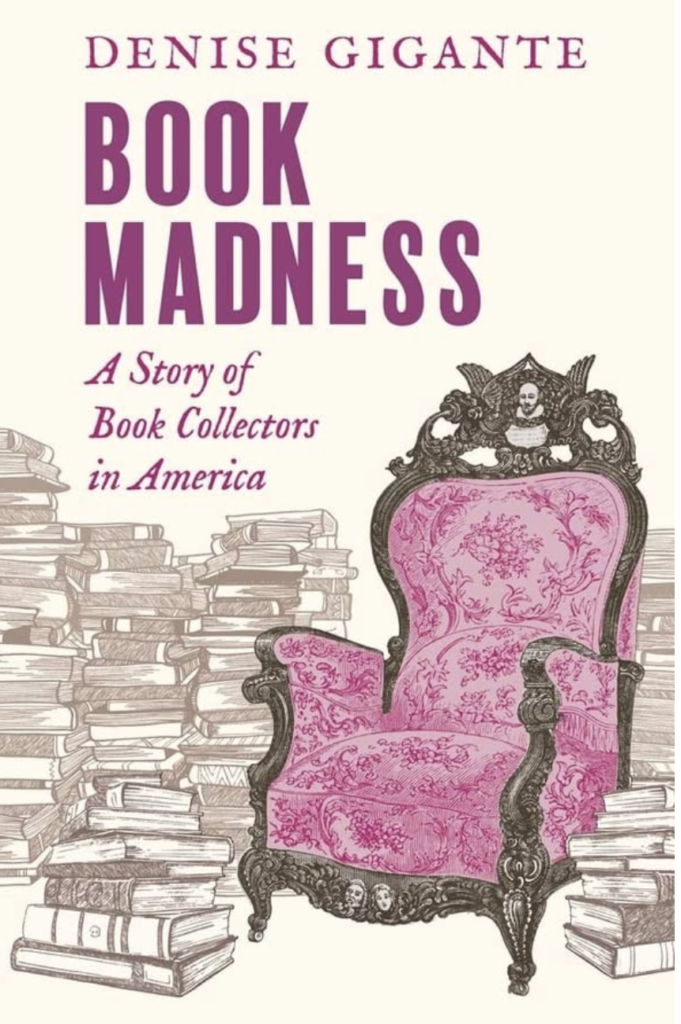
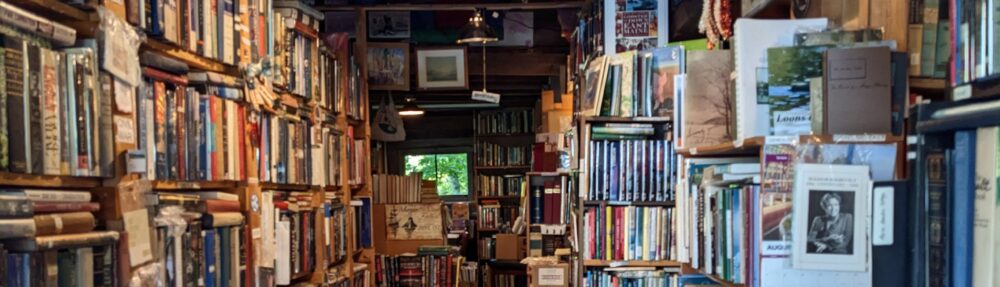
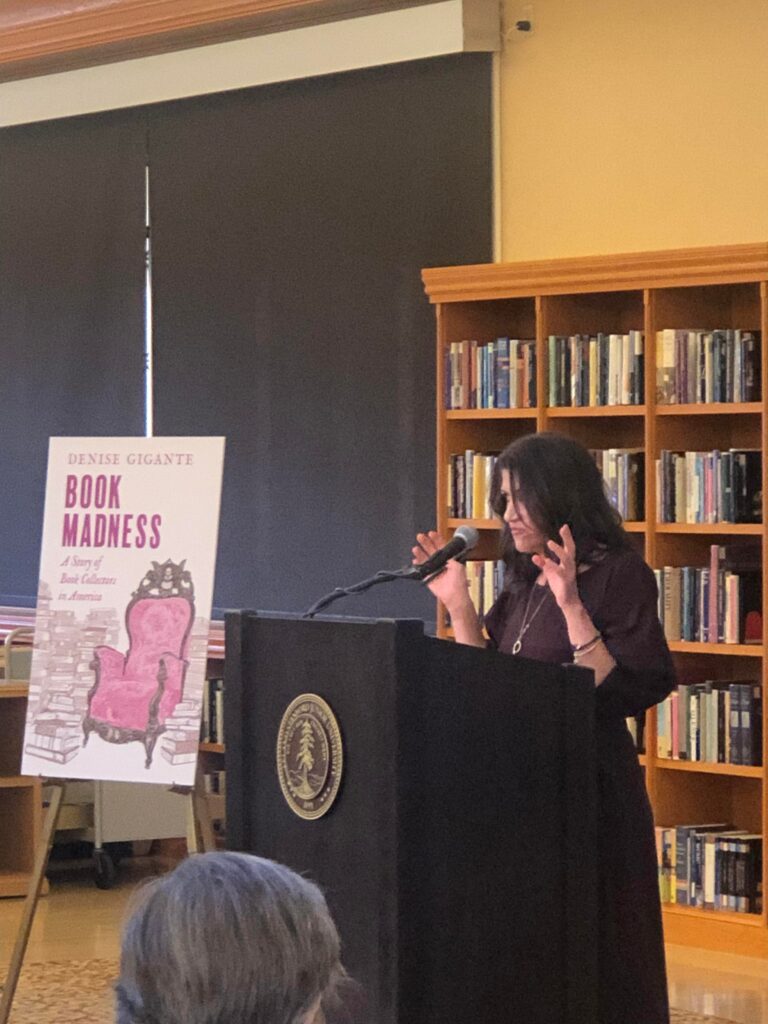
Last month’s celebration for Denise Gigante‘s brand new Book Madness: A Story of Book Collectors in America (Yale University Press, 2022) was the first fête at Stanford University’s Green Library since COVID began, long ago in 2019. What a better way to rejoice than with a book about books? We’ve written about Denise’s earlier book, The Keats Brothers: The Life of John and George, here and here. We haven’t had a chance to dive into her latest yet, but it looks like a great read about reading.
Book Madness is the fascinating history of American bookishness as told through the sale of Charles Lamb’s library in 1848. From the publisher: “The library was a heap of sixty scruffy old books singed with smoke, soaked with gin, sprinkled with crumbs, stripped of illustrations, and bescribbled by the essayist and his literary friends. Yet it caused a sensation.”
“The transatlantic book world watched as the relics of a man revered as the patron saint of book collectors were dispersed. Following those books through the stories of the bibliophiles who shaped intellectual life in America—booksellers, publishers, journalists, editors, bibliographers, librarians, actors, antiquarians, philanthropists, politicians, poets, clergymen—Denise Gigante brings to life a lost world of letters at a time when Americans were busy assembling the country’s major public, university, and society libraries. A human tale of loss, obsession, and spiritual survival, this book reveals the magical power books can have to bring people together and will be an absorbing read for anyone interested in what makes a book special.”
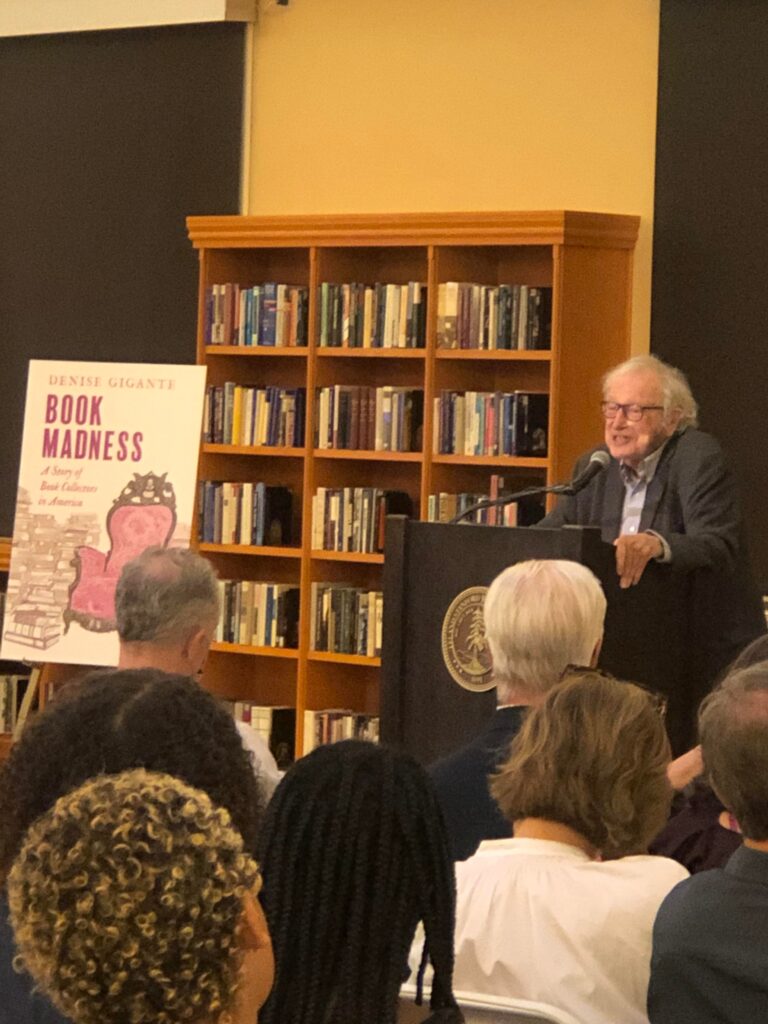
Profs. Gavin Jones and Peter Stansky spoke at the celebration as well – and so did Stanford University librarian Mike Keller, of course. Prof. Elaine Treharne, Benjamin Albritton, Gabrielle Karampelas, and somewhere Roberto G. Trujillo made an appearance, too.

Gavin Jones (we’ve written about him here), made some insightful remarks about “sentimentalism” in America. An excerpt:
Book Madness took me back to my time in graduate school in early 1990s, and my growing awareness of power of Sentimentalism in mid-19th-century American culture. The fraught debate over the sentimental was still in the air – the strong, compassionate outpouring of feeling, usually toward subjects or objects thought to be in distress.
For scholars like Ann Douglas, Sentimentalism was “bad” – impotent, conservative – a mask for middle-class ideologies, rationalization of laissez-faire economics. For scholars like Jane Tompkins, Sentimentalism was “good” – a realm of social power, of salvation through motherly love, an agent of radical transformation toward higher values as religious feeling becomes secular.
I always found Tompkins’s argument more interesting and attractive – and Denise’s book has proven me right through this account of bibliomania, which is also a kind of spin on the complex and powerful role of sentimentalism in the culture of the time, helping us see its significance in new ways.
American bibliomania, as Denise describes it, is an affective relationship with books, based in a texture of sensory and material associations left in a book by each new reading. It becomes another kind of association – one of communal belonging and affective relations in which human lives are lived in books and through the networks they create. Denise’s idea of the book as “relic” becomes shorthand for this transference of religious feeling into the secular domain. Like the promise that Tompkins found in the sentimental, this affective relationship with books becomes the condition for sociality and the potential for transformation into higher orders of being.
Book Madness may perhaps land on one side of this debate over sentimentalism, though what’s more remarkable is how the book breaks down so many categorical distinctions and easy binaries.
Take the idea of “America” itself – that thing I’m meant to be an expert in.
We learn much in Book Madness about the rise of “Americana” at mid-century, the desire for a deep, sedimented, accumulated relationship with national history formed through material associations with books and other artifacts. But here we realize how the fervent nationalism in Young America is enabled by a much broader, transatlantic commerce in books. It’s fascinating to watch a kind of “American” Charles Lamb take shape through his reception in the U.S. For publisher and biographer Evert Duyckinck, one of the key players in this story, Lamb’s books come to possess that most American of powers, a Manifest Destiny to bind the nation together.
I wrote about Denise a decade ago here. As Gavin said then, as chair of the Stanford English Department: “Denise is the rare scholar with the power to tell a story that’s also the biography of an age and an intellectual culture.”
More binary-busting happens at the level of the book’s methodology. Early on, Denise makes a distinction in literary studies between book history, on the one hand, and textual interpretation on the other, only to show how intertwined they really are. Through a kind of “associative literary history” that weaves the content of books into the very fabric of their receptivity to the effects of reading, Book Madness shows how material becomes text for interpretation and how the textual becomes material to be handled and cherished.
Or think of that distinction between History and Antiquarianism – the former invested in a more abstract narrative of events, the latter more interested in moments of material culture found in artifacts, archives, and manuscripts.
This study dynamically questions that distinction by giving us the story of antiquarianism as these books – like relics – dramatically provoke the stuff of narrative. Books create relationships that demand storytelling – and it’s a story that’s part romance, part adventure – be prepared for murders and marriages, hauntings and shipwrecks along the way…. Indeed, there’s so much speed in this book – fast connections, and sudden moments of action as the study moves vertically down into the covers of books, down into those sedimental layers of readings, and then horizontally across time and space to bring books and people into enlightening associations.
I wrote about Denise Gigante a decade ago here. As Gavin Jones, then chair of the Stanford English Department, said then: “Denise is the rare scholar with the power to tell a story that’s also the biography of an age and an intellectual culture.”

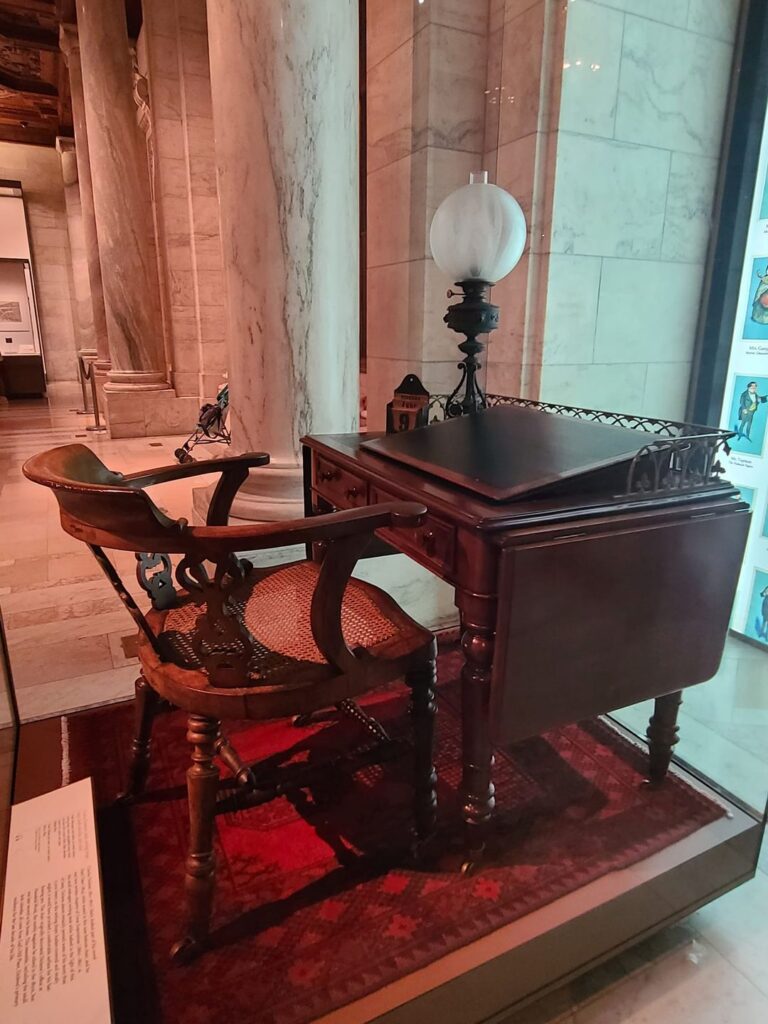
Reason #1 to visit the New York Public Library: Charles Dickens‘ writing desk, chair, and lamp from his home at Gad’s Hill Place. At this desk, this author wrote Hard Times and sections of Great Expectations, and much of his correspondence, too. “As a fan of Dickens, this took my breath away,” says Prof. Martha Reineke of the University of Northern Iowa, who took the photo. There will be a few more reasons to visit NYPL in future posts.