
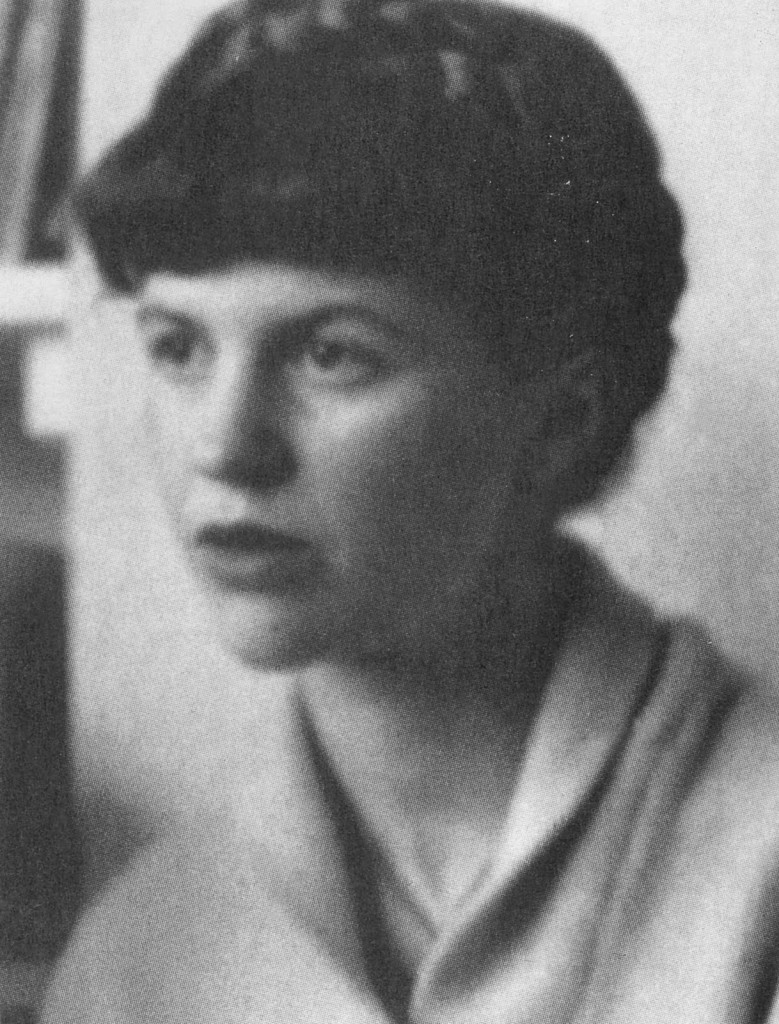
Was Sylvia Plath a battered wife?

Share

The fiercest poet of our times

The short answer? Yes.

Over at Literary Hub, a persuasive and passionate argument by Emily Van Duyne. In a nutshell:

To anyone as familiar as I am with Plath’s life and work, the fact that Ted Hughes was likely abusive—emotionally and physically—is not news. In fact, the only way we can discount the certainty of that abuse is if we choose to disbelieve Plath at her repeated word in her journals, reports to friends and family, and now, it seems, letters to Dr. Ruth Barnhouse, Plath’s therapist-turned-confidante. Paul Alexander’s Rough Magic contains a dramatic account of Hughes attempting to strangle Plath on their honeymoon in Benidorm, Spain—a grim tale supposedly told to the author by Aurelia Schober Plath, Sylvia’s mother, who allowed herself to be interviewed for the book. Plath’s Unabridged Journals, published in America in fall 2000, and edited by Karen V. Kukil, who curates the Mortimer Rare Book Room at Plath’s alma mater, Smith College, are peppered with references to her violent relationship with Hughes.

If Van Duyne’s article has taken the literary world by storm, perhaps it’s because of its obviousness. Didn’t we know it all along? “Why, for instance, did Plath meet Hughes one night at a party, bite him on the cheek when he kissed her, flee to Paris to see another boyfriend with barely a mention of Hughes’s name, and then marry him with no further commentary three months later? What had happened in between?” asks Van Duyne, who is writing a book about Plath.

Yet Van Duyne glosses over that legendary meeting at a party, which is well-known and often recounted. Here’s Maria Popova‘s summary over at Brain Pickings, quoting Plath’s account:

Then, suddenly, Hughes leaned toward her and kissed her “bang smash on the mouth.” As he did so he ripped the red hair band from her head and ravished her with such force that her silver earrings came unclipped from her ears. He moved down to kiss her neck, and Plath bit him “long and hard” on the cheek; when the couple emerged from the room, blood was pouring down his face. As Plath bit deep into his skin, she thought about the battle to the death that Hughes had described in “Law in the Country of the Cats” and the perpetrator’s admission of the crime: “I did it, I.” Hughes carried the “swelling ring-moat of tooth marks” on his face for the next month or so, while he admitted that the encounter and the woman remained branded on his self “for good.”

To talk only about what he did to her is to bathe her in victimhood, which, I think, would have appalled her. We’re tiptoeing around the mysterious link between sex and aggression, sex and violence. I have no special insight to put on the table, but offer the subject for reflection. Plath was clearly familiar with this nexus. It is a delicate topic, given the violence towards women in this culture – any culture, really. Yet whole masses of people have formed in bondage clubs, and S&M clubs – Fifty Shades of Grey had women swooning across the nation. What’s up with that? Who wants to open that can of worms? (A woman once told me, her eyes sparkling with excitement, that when she was attracted to a man she wanted to slap him. Again, what’s up with that?)

The reaction in the days since Van Duyne’s article was published has been telling. Comments on the social media have lamented Plath’s vulnerability, how she was helpless, “sick,” at his mercy. I am offended by the portrayals of Plath as a weepy victim, a basket case, a social liability. She was by many reports lively and smart and witty and a helluva lot of fun to be around – when she wasn’t on the downside of her bipolar swings. The flipside of these comments portray the patient Hughes who put up with this anchor on his career – when, in fact, she taught Hughes discipline and determination, typing his manuscripts and goading him into submissions.

This part of Van Duyne’s argument is well worth reflection and in my opinion beyond dispute:

I want to point out the cultural bias against women’s voices and the domestic truths of women’s lives and the deep role this has played in painting Plath as both a pathetic victim and a Cassandra-like, genius freak. It is only in a culture where these two things be claimed simultaneously that Hughes, a known philanderer and violent partner, can spend forty years botching the editing of, or outright destroying, his estranged, now dead wife’s work, then win every conceivable literary prize and be knighted by the Queen. It is only in this culture that Plath can tell of his abuse, in print, for the better part of the same 40 years, only to have the same reports in a handful of letters recognized as “shocking.” And it is only in this culture that unseen letters detailing abuses as dreadful as a miscarriage induced by beating, and the expressed desire that one’s wife was dead, be described, without irony, as “tantalising.”

Read the whole thing here. Meanwhile, let’s not forget that she was “the fiercest poet of our time.” I just discovered her poem “Mushrooms” at the West Chester Poetry Conference last month. Read it here.
David Yezzi on poet Richard Wilbur: “lines of gemlike endurance”

Share

I’ve spent several onerous days emptying cabinets and boxes in the garage, throwing away many back issues of magazines and journals. It’s a sad business. But it has a few delights and surprises: the occasional rediscovery of a forgotten poem or essay, or the discovery of an article I never read in the first place. This one caught my eye. Poet, librettist, and playwright David Yezzi, a former Stegner Fellow at Stanford (and editor of Hopkins Review), reviewed Richard Wilbur‘s slim collection of poems, Mayflies, in the February 2001 of Poetry. 

An excerpt:

The combination of Wilbur’s self-proclaimed work ethic and his fondness for formal resistance produces lines of gemlike endurance. The poems’ polished surfaces betray very few flaws, each word inexorably, memorably placed, each separate lyric hardened by passionate thought and considered feeling into a vivid object that continues to reflect new shades of meaning.

Wilbur rejects perfection as a description of formal excellence (it suggests “immobility”), preferring instead to “endanger” his chosen forms. Most poets seek a degree of spontaneity, their patterns of utterance meant to seem, as Yeats says, but a moment’s thought. One strategy involves an attempt to capture something of the verve of first-thought-best-thought discovery. Wilbur affects spontaneity of a different kind – one that lies not with the maker in making the poem but with the reader in reading it. He takes pains to ensure that sounds and movements worked deeply into the texture of his poems are not quickly expended but continue to enliven the work, occurring as a series of structural and semantic discoveries. Take the opening line of “Mayflies,” a poem of later life in the vein of “The Wild Swans at Coole”:

In somber forest, when the sun was low,
I saw from unseen pools a mist of flies,
.    In their quadrillions rise,
And animate a ragged patch of glow,
With sudden glittering – as when a crowd
.      Of stars appear,
Through a brief gap in black and driven cloud
One arc of their great round-dance showing clear.

***

Howard Nemerov, who like Wilbur was fond of enigmas, once proposed an ideal for poetry based on the riddle: “1. a poem must seem very mysterious, 2. but it must have an answer (= a meaning) which is precise, literal, and total; that is, which accounts for every item in the poem, 3. it must remain very mysterious, or even become more so, when you know the answer.” Poets who employ opaque and private imagery hope their poems will hold readers with an immediate and cryptic surface beauty. The problem: often no answer to such riddling imagery exists, or none that the poem persuades us to keep looking for. Like Virgil leading us responsibly onward, Wilbur takes great pains – through acute description and careful reasoning – always to let us know exactly where we are. What lends his poems their enduring mystery is the fact that, though we recognize the scenery (it’s straight out of the tradition), we have never been this way before. Like a shudder of déjà-vu, Wilbur’s correspondences return us to remote places completely new to us. It’s a way of possessing our lives, which but for poetry we would never have so palpably again.

I’ve said it before, Dick Wilbur is, in my very humble opinion, America’s greatest living poet. And at 96 years old, we’re lucky to have him with us. David Yezzi’s article is online at Poetry here.*

Postscript on 7/18:  We received an early comment from poet R.S. Gwynn, whose observation was so good we thought we’d share it in this post: “’One arc of their great round-dance’–This is typical of Wilbur’s genius–to associate the Mayflies with both celestial motion and the ’round-dances’ of the Maypole and fertility rites. The adult (imago) mayfly rises for only a single day to reproduce, then dies to complete its own ’round-dance.’”

Robert Conquest’s centenary: Balance? “How do you find balance in mass murder?”

Share


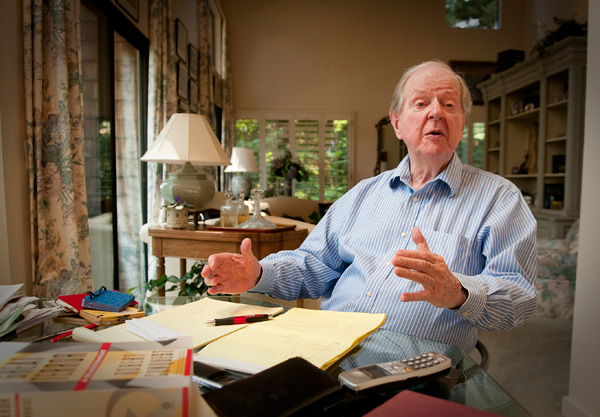
At his Stanford home in 2011, when we met. (Photo: L.A. Cicero)

We’re a day late for the centenary of Robert Conquest, who revealed the extent of Stalin‘s atrocities in his landmark 1968 book, The Great Terror, in addition to being a formidable poet. Somehow I feel fireworks and canons should be going off, but … only the sultry mid-July silence. With the Hoover commemoration of his August 2015 death on January 25, 2016, and the West Chester panel on his poetry in June 2016 (we attended both), the hundredth anniversary of his birth was overshadowed by the past and future. “The future,” because a trio of articles from the  current Hopkins Review is about to appear online, and we’ll be publishing excerpts and a link soon.

But nonetheless, he was born on July 15, 1917, and yesterday was the day. He was with me, at least, in spirit. I was hosting a small family gathering last night, and I discussed Bob’s work. The group of millennials had not heard of him, and so I filled them in, as best I could. They found it odd that anyone was still defending Stalinism in the 1970s, and so opposing Bob’s exposé. How can one explain that blindness to them? As Bert Patenaude, a Hoover fellow and author of The Big Show in Bololand, said after Bob’s death: “Those were the days when most scholars in Soviet studies regarded Conquest’s works on the USSR with skepticism at best, and often outright hostility. In ‘the field,’ The Great Terror was widely perceived as an ideological polemic that would not stand the test of time. Bob loathed political correctness, and he scorned those who professed to seek ‘balance’ in their scholarly publications about Soviet history—’How do you find balance in mass murder?’ He enjoyed dismissing such people as ‘wafflers.’ The collapse of Soviet Communism brought revelations from the Kremlin archives that bore out Bob’s general view of Stalin’s USSR, and he had the great pleasure of publishing a new version of the book in 1990, at the moment of his vindication. The revised version was called The Great Terror: A Reassessment, but most reviewers of the book recognized that it was in fact an emphatic reassertion of the original thesis rather than a revision.”

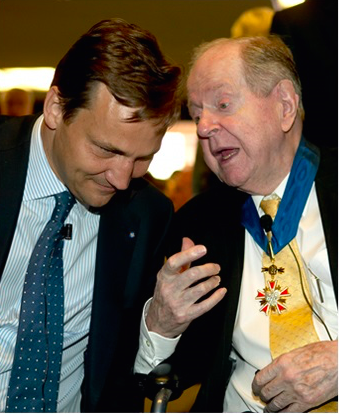
On receiving Poland’s Order of Merit in 2009, with Radosław Sikorski, then Poland’s minister of foreign affairs

Stephen Kotkin, Birkelund Professor of History and International Affairs at Princeton University, called Bob the most prolific and influential Sovietologist ever.  “Two of his books on Soviet history stand out as the most important of the entire cold war,” he said.

The Great Terror (1968) was a blockbuster in all senses.  At a time of doubt and controversy about the menace of Communism, Mr. Conquest massed a mountain of detail and definitively established the vast scale of Soviet terror, and Stalin’s central role in it.  Now this is taken for granted.  Soviet archives were closed and Soviet publications full of lies, yet he was criticized for relying on the large number of émigré memoirs and the unpublished reminiscences in the Hoover Institution Archives.  Mr. Conquest insisted on the validity of the accounts of the victims.  The opening of the archives has shown that by and large he was correct.  He also made meticulous Kremlinological use of Stalin-era newspapers, and systematically combed through the voluminous “thaw” or Khrushchev-era Soviet publications, which were often very revealing.  The leftist slant of Soviet studies in the U.S. limited the acceptance of Mr. Conquest’s scholarly work, even as he dominated discussion among the public and policy-makers.  In the late stages and aftermath of the Soviet Union, The Great Terror, translated into Russian, became the most widely influential Western publication on Soviet history in that country. Mr. Conquest pulled off a similar feat with The Harvest of Sorrow: Soviet Collectivization and the Terror-Famine (1986), written here at Hoover.  Once again, he definitively established the colossal scale of Soviet horrors, correctly identified their source in Marxist ideas and practices, and underscored the legions of Western dupes who retailed Soviet lies, from when Stalin was alive and decades thereafter.

I first met Mr. Conquest in the archive reading room at Hoover, in the mid-1980s, when he was already a legend (I was a Ph.D. student at UC Berkeley).  He had sparkling eyes and a wry smile, and relished chatting about obscure sources and discoveries.  In November 1987, I had the privilege of serving as his Russian language translator at the annual convention of the American Association for the Advancement of Slavic Studies Convention in Boston.  (Mr. Conquest spoke fluent Bulgarian from his service in the British legation in Sofia and one of his marriages, but did not speak Russian conversationally, although he read it fluently).  His interlocutor that day was the writer Anatoly Rybakov, who was enjoying wide acclaim for his novel Children of the Arbat, but effervescing over meeting the great Bob Conquest.  “Is it true,” a spellbound Rybkaov kept asking me, “that he also writes poetry?”

Well, I wrote about the poetic side of Bob last year for the Times Literary Supplement here.

More from Bert Patenaude:

Among his considerable gifts, Bob was a superb conversationalist. He had a wicked sense of humor and he loved to laugh: the look of playful delight that animated his face as he nailed a punch line is impossible to forget. His poems and limericks convey a sense of his mischievousness—and naughtiness—and his late poems chronicle the aging process with sensitivity and, one is easily persuaded, acute psychological insight.

Conquest at work (Photo: L.A. Cicero)

Bob’s final speaking appearance on the Stanford campus may well have been his participation in an annual book event, “A Company of Authors,” where he came to present his latest book of verse, Penultimata, on April 24, 2010. Bob seemed frail that day, and at times it was difficult to hear him and to understand his meaning, but no one in the room could doubt that the genial elderly man up there reciting his poetry could have carried the entire company of authors on his back. Seated next to me in the audience was a Stanford history professor, a man (not incidentally) of the political left, someone I had known since my graduate student days—not a person I would ever have imagined would be drawn to Bob Conquest. Yet he had come to the event, he told me, specifically in order to see and hear the venerable poet-historian: “It’s rare that you get to be in the presence of a great man. Robert Conquest is a great man.” Indeed he was.

And finally from Anatol Shmelev, Hoover Research Fellow and Curator, Russia and Eurasia Collection

Robert Conquest was not only a brilliant scholar, but a true gentleman, who went out of his way to make everyone who visited him for advice, conversation or just an autograph feel welcome. The bearer of a high intellect, Conquest could be very down-to-earth, full of entertaining anecdotes and stories, and always not only willing to hear out his guests, but actively engaging them with questions. His charm was genuine and born of a sense of humility that won over those who knew him. Though he was the recipient of many high awards and honors, including the Order of the British Empire, the title he most liked to recall was that of Antisovetchik nomer 1 (“Anti-Soviet #1”), an appellation bestowed upon him by the Soviet propaganda apparatus. This was, perhaps, because the title cut to the core of who Robert Conquest was: a champion of human freedom and a sworn enemy of oppressive and totalitarian regimes and the ideologies that stood behind the tragedies of the twentieth century.

More friends and colleagues remember Bob here. And read my “Indefatigable Spirit” post, shortly after his death, here. And one friend remembered on my Facebook page. The poet R.S. Gwynn (a.k.a. Sam) said: “I miss Bob and can’t imagine what he’d be saying these days.” I can’t imagine either, Sam.

And below, a film that was made for the Hoover commemoration on January 25, 2016. Think the denial is over? Read the two comments below the film.


Liu Xiaobo, 1955-2017: “Hatred can rot a person’s wisdom and conscience.”

Share

With his wife in happier times.

Liu Xiaobo, who was awarded the 2010 Nobel peace prize while in prison, died today of liver cancer, in a hospital under guards. He was 61. From the New York Times:

.

The Chinese government revealed he had cancer in late June, only after the illness was virtually beyond treatment. Officially, Mr. Liu gained medical parole. But even as he faced death, he was kept silenced in the First Hospital of China Medical University, still a captive of the authoritarian controls that he had fought for decades.

He was the first Nobel Peace Prize laureate to die in state custody since Carl von Ossietzky, the German pacifist and foe of Nazism who won the prize in 1935 and died under guard in 1938 after years of maltreatment.

His cancer announced last month – too late to treat – and while it did offer him parole, it did not offer him freedom or a visit from his wife:

The police in China have kept Mr. Liu’s wife, Liu Xia, under house arrest and smothering surveillance, preventing her from speaking out about Mr. Liu’s belated treatment for cancer.

“Can’t operate, can’t do radiotherapy, can’t do chemotherapy,” Ms. Liu said in a brief video message to a friend when her husband’s fatal condition was announced. The message quickly spread online.

“Hatred can rot a person’s wisdom and conscience,” Mr. Liu said in a statement he prepared for his trial for subversion shortly before he was awarded the Nobel. “An enemy mentality will poison the spirit of a nation and inflame brutal life and death struggles, destroy a society’s tolerance and humanity, and hinder a country’s advance toward freedom and democracy.”

He was not allowed to receive the 2010 award, of course, and was represented by an empty chair. We wrote about that here. We’ve written elsewhere about this peacemaker here and here and here.
.
“Language gets its beauty by making truth glow in the darkness.”

– Liu Xiaobo, 1955-2017


Joseph Brodsky the Artist – now at Hoover Archives

Share

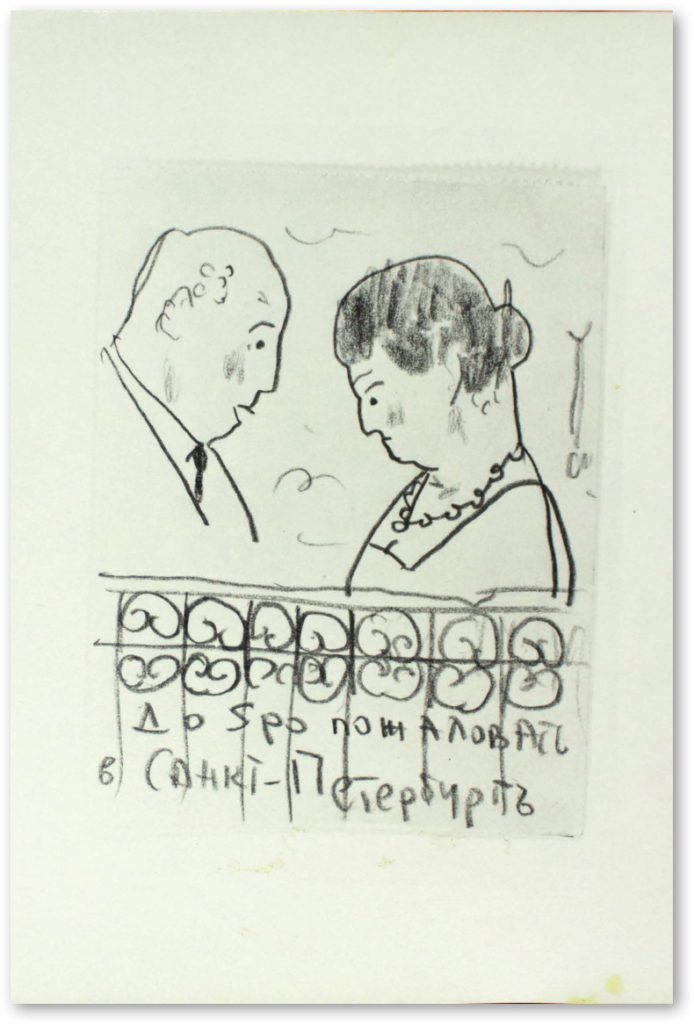
Brodsky’s sketch of his parents in Leningrad. (Hoover Institution Library & Archives)


Last fall, Lora Soroka, archivist extraordinaire at the Hoover Institution’s Library & Archives, told me to come quick, quick, quick to the Hoover Pavilion. She had a surprise for me. Hoover had just acquired an important collection of Nobel poet Joseph Brodsky papers, which had been gathered by his close friend, Diana Myers, the wife of one of the poet’s translators, Alan Myers. It was not only a surprise, it was a wonder – letters, notes, photos, manuscripts, but perhaps most surprising of all, five self-portraits, a landscape, a still life, drawings in ink and chalk, and inevitably doodles.

Brodsky illustrated almost everything he wrote, often with self-portraits in the margin, or cats, which Yuri Leving of Dalhousie University, in an unpublished manuscript, Joseph Brodsky the Artist, called “acts as a metonymic self-representation of the exiled writer, easing the pathos of the message and translating it into a comic register.”  When I spoke to John Wronoski of Lame Duck Books about the collection, the man who is an expert on modern European literature and who has appraised many Brodsky archives said it was “totally exciting”— the letters alone, he said, would be “jewels in any collection.”

I wrote about the Brodsky papers at Hoover here, but I have a longer article up at the current Hoover Digest, “Brodsky and His Muses.” An excerpt:
.

In 1962, the high-voltage poet met a dark-haired artist, a woman of silences. He was almost twenty-two, she was nearly two years older. The rest was destiny. Their love, suffering, and final separation forged a poetic identity for the young poet, who would go on to face trial, internal exile, forced labor, psychiatric prisons, and eventually exile.

For decades after the liaison ended, Brodsky immortalized Marina Basmanova in a series of poems eventually published as New Stanzas to Augusta. And what did she give him? A son. But surely a less-observed aspect of the liaison is this: she fostered the poet as artist.

Basmanova lit the fire, but the kindling had been prepared by others. His father was a photographer, and Brodsky learned early how to compose an image in a viewfinder, to develop a “camera eye.” His own photographs show the influence of the father on the son. Moreover, the classical architectural lines of his hometown, the former and future Petersburg, imprinted themselves on his aesthetics almost from birth and found expression in almost everything he wrote. Brodsky certainly would have known of Pushkin’s similar habit of illustrating what he wrote. His parents particularly prized the drawings of Pushkin, and pored over Pushkin albums—which also must have made an impression on the future poet who had been compared to Pushkin for his restless daemon and poetic equilibristics.

On his last day in Russia, June 1972. (Photo: Lev Poliakov)

The great poet Anna Akhmatova took note of her protégé’s drawings in a1965 letter: “When I see them, I always think of Picasso’s illustrations to the Metamorphoses,” she wrote, recalling the Spanish artist’s deft black lines and the classical motifs that intrigued both Brodsky and Picasso. Other Brodsky drawings have been compared with the work of the French Fauvist painter Raoul Dufy, another painter he admired. 

In America years later, in 1981, Brodsky acknowledged his debt of gratitude to the great love of his early years in “Seven Strophes”:

I was practically blind. 
You, appearing, then hiding,
gave me my sight and heightened it.
 .
 Read the whole Hoover Digest article here.
.

“Love at first sound”: John le Carré makes the case for German.

Share

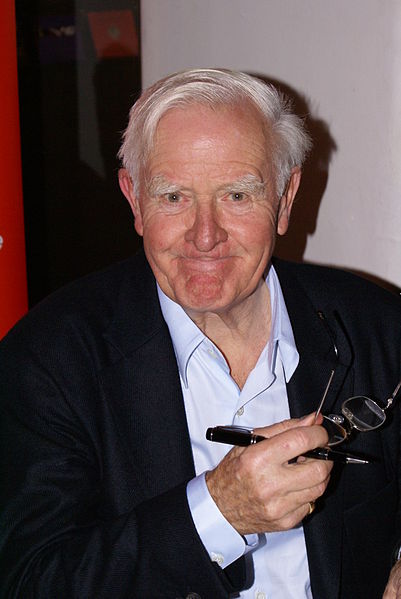
In Hamburg, 2008, enjoying the “language of the gods.”

In The Guardian, John le Carré makes a pitch for the German language, which he learned in wartime England (he received the Goethe Medal in 2011). Since I’m currently reading Le Carré’s Tinker Tailor Soldier Spy (and loving every minute of it), the article naturally caught my eye. But German, more than, say, Italian? Which not only sounds beautiful, but you get Dante thrown in for good measure. Or how about Polish, with its poetry that sounds like a caress?

No dice. He’s loyal to his wartime beloved. He calls it “love at first sound.”

Why was it love at first sound for me? Well, in those days not many language teachers played gramophone records to their class, but Mr King did. They were old and very precious to him and us, and he kept them in brown paper bags in a satchel that he put in his bicycle basket when he rode to school.

What did they contain, these precious records? The voices of classical German actors, reading romantic German poetry. The records were a bit cracked, but that was part of their beauty. In my memory, they remain cracked to this day:

Du bist wie eine Blume – CRACK – So hold und schön und… – CRACK (Heinrich Heine)

Bei Nacht im Dorf der Wächter rief… – CRACK (Eduard Mörike’s Elfenlied)

And I loved them. I learned to imitate, then recite them, crack and all. And I discovered that the language fitted me. It fitted my tongue. It pleased my Nordic ear.

I also loved the idea that these poems and this language that I was learning were mine and no one else’s, because German wasn’t a popular subject and very few of my schoolmates knew a word of it beyond the Achtung! and Hände hoch! that they learned from propaganda war movies.

Even love has its reasons. As he explains:

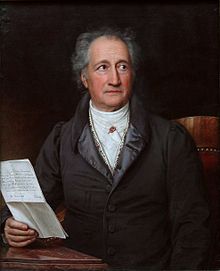
You’ve probably heard the Mark Twain gag: “Some German words are so long they have a perspective.” You can make up crazy adjectives like “my-recently-by-my-parents-thrown- out-of- the-window PlayStation”. And when you’re tired of floundering with nouns and participles strung together in a compound, you can turn for relief to the pristine poems of a Hölderlin, or a Goethe, or a Heine, and remind yourself that the German language can attain heights of simplicity and beauty that make it, for many of us, a language of the gods.

And for all its pretending, the German language loves the simple power of monosyllables.

He would have agreed.

To quote Charlemagne (and he does): “To have another language is to possess a second soul.”

He might have added that to teach another language is to implant a second soul.

Of course, the very business of reconciling these two souls at any serious level requires considerable mental agility. It compels us to be precise, to confront meaning, to think rationally and creatively and never to be satisfied until we’ve hit the equivalent word, or – which also happens – until we’ve recognised that there isn’t one, so hunt for a phrase or circumlocution that does the job.

No wonder then that the most conscientious editors of my novels are not those for whom English is their first language, but the foreign translators who bring their relentless eye to the tautological phrase or factual inaccuracy – of which there are far too many. My German translator is particularly infuriating.

Read the whole thing here. He ends with a George Orwell touch that many will appreciate. (And what became of the Book Haven’s Orwell Watch? the system became overwhelmed, we think, sometime during the last election…)