In defense of the humanities: the joys of critical thinking

Share

Film  Life of BrianLast month, I published an excerpt from Russian poet Joseph Brodsky‘s Nobel speech. Here’s a bit: “If art teaches anything (to the artist, in the first place), it is the privateness of the human condition. Being the most ancient as well as the most literal form of private enterprise, it fosters in a man, knowingly or unwittingly, a sense of his uniqueness, of individuality, of separateness – thus turning him from a social animal into an autonomous ‘I’. Lots of things can be shared: a bed, a piece of bread, convictions, a mistress, but not a poem by, say, Rainer Maria Rilke. A work of art, of literature especially, and a poem in particular, addresses a man tête-à-tête, entering with him into direct – free of any go-betweens – relations.

“It is for this reason that art in general, literature especially, and poetry in particular, is not exactly favored by the champions of the common good, masters of the masses, heralds of historical necessity. For there, where art has stepped, where a poem has been read, they discover, in place of the anticipated consent and unanimity, indifference and polyphony; in place of the resolve to act, inattention and fastidiousness. In other words, into the little zeros with which the champions of the common good and the rulers of the masses tend to operate, art introduces a “period, period, comma, and a minus”, transforming each zero into a tiny human, albeit not always pretty, face.”

On a lesser scale – and I do want to emphasize the qualifier “lesser” – the same holds true for the humanities in general, and critical thinking.  They provide a powerful antidote to the mob, whether in a democratic  election, or the incitement to murder.  Offhand, I can think of no better illustration than the video clip below.

Weekend roundup: John Lennon, W.H. Auden, Geoffrey Hill, Danilo Kiš, and Dana Gioia

Share
Yoko Ono: Passages for Light

Yoko and me in 2009 (Photo: Toni Gauthier)

Today is the somber anniversary of John Lennon‘s assassination in 1980. In tribute, my sister, an indefatigable Beatles fan, posted my photo with his widow Yoko Ono on my Facebook page. I’ll do the same for the Book Haven – at left.

Meanwhile, a few articles culled from the weekend:

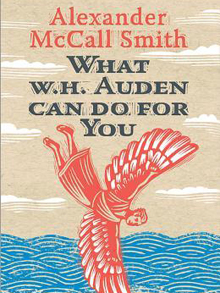
In The Telegraph today here, Alexander McCall Smith, author of What W.H. Auden Can Do for You (I know, I know…a utilitarian approach to the poet) picks out his five favorite W.H. Auden poems.  He has excellent taste. In fact, it coincides largely with my own.

mccall-smith-auden“In Praise of Limestone” and “Lullaby,” two personal favorites, are on his list. He calls the latter “one of the finest love poems in the English language.” I couldn’t agree more. As for the latter, “Who would have thought that there was so much to say about limestone and its merits?” Actually, I find his endorsement of limestone somewhat ambiguous. See what you think in the video below. In any case, I love the lines “The blessed will not care what angle they are regarded from,/Having nothing to hide.”  Joseph Brodsky shuffled over this line with one of his odd smiles, where the ends of his mouth went up while the center stayed down in a sort of suppressed chuckle.  “Tautological,” as I recall he said.

geoffrey-hillGeoffrey Hill isn’t a difficult poet, he is “one nut to crack among many,” according to Jeremy Noel-Tod, reviewing the poet’s latest volume, Broken Hierarchies, over here at The Sunday Times, if you can crack the paywall.  I can’t.

kisThis isn’t a new article, but one I finally got ’round to reading, to my profit: Adam Thirlwell considers the staggering neglect of Danilo Kiš, one of the greatest novelists of the twentieth century, which is “morally and aesthetically, a scandal. It’s also, I think, some kind of literary koan or mystery. The optimist might try to analyse the possible pragmatic reasons for his obscurity – such as that comical bird perching on the final letter of his name; or his reckless savagery towards every ideology, menacing both the Right and the Left; or his political bad luck, to die shortly before the wars in Yugoslavia made the lands of his birth briefly famous, albeit for the wrong reasons. But none of these seems adequate. Or this optimist might then urbanely lament Kiš’s own lack of urbanity, his legendary irritable boredom with the world of social appearances.” One redress is Mark Thompson‘s inventive and erudite new biography-of-sorts, Birth Certificate.  Read about it at the Times Literary Supplement here.

DanaGioiaDana Gioia has always been upfront about his roots: “I think that being proud of your religion, your culture, and your ethnicity is the beginning of revival for Catholic artistic culture. As an individual, I refuse to be ashamed of my faith, my culture, or my family background.” Even more so now:  he’s written about the decline of Catholic culture in an essay entitled “The Catholic Writer Today.”  The article (here) was trapped behind a paywall several weeks ago, but has been officially liberated, and so was picked up this weekend by Andrew Sullivan today here, and has also been picked up here and here and here and here.  Dana has never shied away from controversy – his essay “Can Poetry Matter?” is still a gold standard for controversy, generating a record avalanche of mail after it was published in The Atlantic Monthly.  Looks like he’s about to do it again.


Another note on a remarkable man: Daniel Weissbort remembered

Share
Weissbort2

A gentle spirit and unassuming hero, at the Ars Interpres Poetry Festival in 2006.

If you don’t subscribe to the weekly “Poetry News in Review,” perhaps you should. I get a weekly email notice when the new page goes up on the Prairie Schooner website.  The maestro behind the page is David Sanders – a longtime friend and formerly the director of the Ohio University Press. We met more than a decade ago on Michael Peich‘s back porch at the West Chester Poetry Conference in Pennsylvania…I think.  All I remember was a conversation in the dark, somewhere at some gathering in some state, and the glow of his cigarette, which moved like a firefly as he gesticulated.

From this week’s eloquent “Envoi: Editor’s Notes,” remembering the master translator and poet Daniel Weissbort, who died last month:

There are so many people whose names do not appear on the marquee, even on a marquee as small as that of poetry, that we sometimes don’t think to recognize their achievement in service to the art. Daniel Weissport did have, for some, a recognizable name, but it is through his many contributions as a translator, editor, teacher, and scholar – that is, as a conduit, nearly invisible – by which we recognize him. I remember having breakfast with him once about thirty years ago, when he was a guest of a friend of mine, the translator, John DuVal. What struck me was his engagement and generosity, what seem in retrospect to be common traits among those who are primarily translators. Reading his obituary, I am all the more impressed though not surprised by the connections he fostered, the work he did, and the difference he made.

Read this week’s “Poetry News in Review” here(It also has a nice mention of the Book Haven’s post on Natalia Gorbanevskaya, the Russian dissident poet whose work he translated and championed. She died last week at 77.)

Arendt’s Eichmann in Jerusalem turns 50 – and it’s still controversial

Share

eichmannHannah Arendt‘s Eichmann in Jerusalem was published fifty years ago, in 1963, and it’s still provoking controversy.  The New York Times offers two interesting takes: one from poet-critic Adam Kirsch, the other from author Rivka Galchen, who incidentally, was a recipient of the William J. Saroyan International Prize for Fiction (we wrote about the prize here). Both focus on the use of language.

Kirsch argues that she’s misunderstood. Many objected to the inflammatory tone, but for Arendt, the medium is the message: “It’s not hard to see that for Arendt, this stringency was a form of respect. By holding Jews to what she conceived to be the highest professional and personal standards, she was treating them as full moral persons. For Eichmann, on the other hand, she had only contempt, refusing even to dignify him with hatred: He appears in the book only as a bumbling mediocrity, ‘genuinely incapable of uttering a single sentence that was not a cliché.’ But it’s also easy to understand how this tactic could appear, to readers still traumatized by the Holocaust, as an arrogant inversion placing blame on the victim while minimizing the criminality of the criminal. Eichmann would be a better book, perhaps, if Arendt were not so intent on demonstrating mastery over her material, and could admit that at times the only adequate response to the Holocaust was mute pity and terror.'”

Kirsch points out that the book has been, at times, a litmus test for gentile and Jewish sensibilities. Arendt’s chum Mary McCarthy characterized the book as “a paean of transcendence, heavenly music, like that of the final chorus of Figaro or the Messiah“; Saul Bellow accused Arendt of “making use of a tragic history to promote the foolish ideas of Weimar intellectuals.”  Well, as we pointed out earlier, he didn’t like her much.

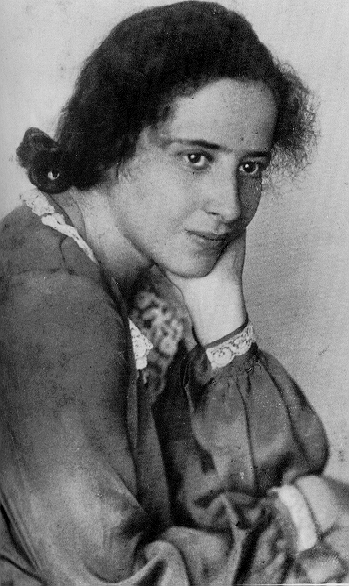
Hannah_Arendt1

She fled the Nazis twice, in 1933 and 1940.

Galchen writes that “Eichmann spoke in a mix of canned speech, officialese and repetitions of his own formulations. Arendt sees this as a symptom and an abettor of his variety of evil. ‘The longer one listened to him,’ she wrote, ‘the more obvious it became that his inability to speak was closely connected with an inability to think, namely, to think from the standpoint of somebody else.’”

She continued: “Nearly 15 years after the publication of Eichmann in Jerusalem, Arendt wrote another long essay for The New Yorker, ‘Thinking,’ in which she tried to clarify and further analyze the ‘thoughtlessness’ of Eichmann. ‘Clichés, stock phrases, adherence to conventional, standardized codes of expression and conduct have the socially recognized function of protecting us against reality; that is, against the claim on our thinking attention which all events and facts make by virtue of their existence,’ she wrote. ‘If we were responsive to this claim all the time, we would soon be exhausted; Eichmann differed from the rest of us only in that clearly he knew of no such claim at all.'”

Buried in the comments section is an unusual reminiscence from Rudy Wein: “I had lunch with Hannah Arendt not all that long after the publication of Eichmann in Jerusalem. I had read the New Yorker article, but was completely ignorant of the controversy. I was no doubt a soothing lunch companion, since I told her that I understood what she had in mind with ‘the banality of evil’ and agreed with her. So let me say, as no one really does in the above, what I think she meant by the banality of evil – that is the banality of Eichmann’s doing evil. And let me do so by pointing to the doing of evil that is not banal. Start with fiction: the baddies in the film Metropolis are explicitly, consciously aiming to kill, maim, undo those underground workers. Not banal. Himmler aimed at rounding up Jews, starving and killing them. Yes, he did what Hitler wanted done, but he was not following orders first and doing evil as a result; he aimed at doing that evil because he wanted it to happen. Eichmann, on the other hand, if anything like Arendt’s depiction is correct, followed orders first or, worse, induced what his superiors wanted done, for the sake of being the kind of bureaucrat that would be praised and, above all, be promoted. If doing good deeds would have accomplished that goal, Eichmann would have done good deeds. The fact of his evil’s banality doesn’t make it less evil or excuse it and, as I recall, Arendt agreed that Eichmann’s death sentence was fully justified.”

Read the whole thing here. And below, Margarethe von Trotta‘s 2012 film, Hannah Arendt, starring Barbara Sukowa, pretty much makes the case for Galchen and Kirsch:

She never sniveled: Natalia Gorbanevskaya (1936-2013)

Share
gorbanevskaya

Free. (Photo: Dmitry Kuzmin)

The Russian poet Natalia Gorbanevskaya declared unequivocally that, for a poet, living in an alien land is “a source of new potency.”

It’s lucky that she thought so, because she really had no choice.  The dissident writer fled the Soviet Union for Paris in the 1970s. And that’s where she died, last night, at 77.  In one of those odd synchronicities, I had been excerpting a poem she wrote for something I was writing – perhaps the first time ever that I had done so. As soon as I finished typing, I clicked to my Facebook page, and the director of the Summer Literary Seminars in Vilnius, Mikhail Iossel, mentioned  her death in the very top post on my screen.

According to her first translator and champion, Daniel Weissbort, writing in 1974, “Gorbanyevskaya has been a leading civil rights activist, one of the seven to demonstrate in Red Square on 5 August 1968 against the Soviet invasion of Czechoslovakia. Because of her infant child, she was not tried along with the other demonstrators, and she continued to agitate on their behalf, compiling an account of their trial, Noon (published in England as Red Square at Noon). In December 1969 Gorbanyevskaya was herself finally arrested, and in April 1970 was declared to be suffering from schizophrenia and placed in a psychiatric prison hospital, first in Moscow, then in Kazan, where a course of drug treatment was administered. There has recently been a good deal of agitation in the West about the misuse of psychiatry in the Soviet Union as a means of dealing with dissenters, and whether for this reason or for some other, Gorbanyevskaya was released in February 1972.” Red Square at Noon included not only Weissbort’s translations of her poems, but a transcript of her trial, papers relating to her hospital detention, and an assessment by a British psychiatrist of her mental condition, based on evidence then available.

“One might suppose that Gorbanyevskaya verse would reflect her political activity,” Weissbort continued. “It is, on the contrary, intensely personal and non-public. It transcends politics, not accusing, but describing the psychic reality of her situation. One generation, has had the capacity of transmute her suffering into a universal image. The staccato pulse of her work, the near-hysterical shrillness, recall the poetry of that other poet of suffering, the great Marina Tsvetaeva. In Gorbanyevskaya’s love lyrics, the old Russian mystique of regeneration through suffering is evoked (this appears, less intensely, in Yuli Daniel’s poetry too). Physical love becomes an ordeal like Christ’s on the Cross. Gorbanyevskaya has had the immense courage to remain vulnerable. Hers is the poetry of pain, of separation, of isolation, of despair, of threatening disaster, of disaster present.”

In Gorbanevskaya’s 1991 interview, the poet had an upbeat outlook on her flight for survival:  “I think that we poets are in general enriched by the experience of emigration or exile. Well, if we don’t snivel … that is if we don’t just start to describe the exotica or just start getting nostalgic – in so far as we are submissive to the language, we bring to it everything that we can beg, borrow or steal from other languages. And the language, in so far as it is grateful to us, has yet more to give us in return.”

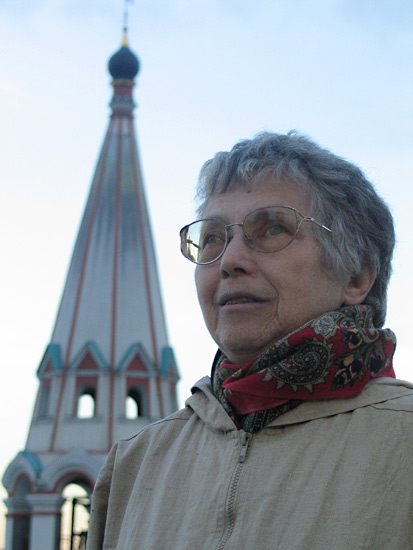
She never sniveled.  I met Gorbanevskaya in Kraków in 2011. As I wrote here:  “The poet, by then in her midseventies, was short and unfashionably dressed, with short, grizzled hair and thick stockings. She held the small stub of a cigarette like a defiant wand, its end glowing in the dying day on a sidestreet in Kazimierz. When she spoke to me, in French (Paris has been her home since 1976), her voice was probing and intelligent, her eye contact unflinching. She seemed tough-​minded, durable, and utterly lacking in self-​pity.”

I didn’t know her well, but Daniel Weissbort, who died a few days ago (I wrote about that here), did.  So I’ll let him speak. From his book, From Russian with Love:  “While I appreciated the opportunity of working with a poetry so different from my own and indeed from the Russian poetry to which I had previously been drawn, I also suspected that I did not have the language adequately to express the agony, even if as a reader I was responsive.” At that time, Joseph Brodsky had just arrived in the West, and Weissbort didn’t realize that he was a friend of the Moscow poet:
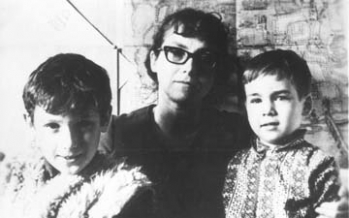
gorbanevskaya2

After her release from prison.

“Anyway, as far as I can remember, we were lingering at the front of the Queen Elizabeth Hall auditorium, just below the stage, perhaps during an interval at the end of that day’s readings, when Brodsky said to me, apropos of the Gorbanevskaya versions (it surprised me that he was aware of them: ‘If you were to die tomorrow, would you want to be judged by these translations?’

It seemed unlikely that this was a simple inquiry! I must have been somewhat shocked. Not only because we had just met, but also because his remark echoed, if more forcefully than I would have put it myself, my own doubts and anxieties about the whole business of poetry translation, as well as about the whole business of poetry translation, as well as about my Gorbanevskaya versions. Although I had read the account of her trial and, in addition to translating her poetry, had also written about her ‘ordeal’, I doubt whether I had much grasp of its significance. I imagine that Joseph was trying to get across the gravity of a situation when art, in a way, was all you had; that is, he was not merely suggesting that my translations left much to be desired. Though I took what he said as a comment on the translations, I may have received the other message too, since I did not respond as defensively as might have been expected. …. my translations were largely the product of a kind of optimism. That they had their moments was perhaps the best that could be said of them. Still, I realized that, though possibly wrong-headed, Joseph was not being unkind or malicious. Certainly he was not mealy-mouthed, but this helped me begin to see that the context was larger than one simply of translation, the translation of words. My first exchange with Brodsky, thus, took the form of a kind of summons to greater personal commitment. What such a commitment might entail, in his view, was not immediately clear to me, although I already suspected that, prosodically at least, it had to do with formal imitation, the point being that this had a moral dimension.”

Here’s my favorite poem from Red Square at Noon, which I bought in the 1970s.  The 1961 poem has remained my favorite ever since.  In fact, it was the poem I was transcribing when I heard that she had died. In English and Russian:
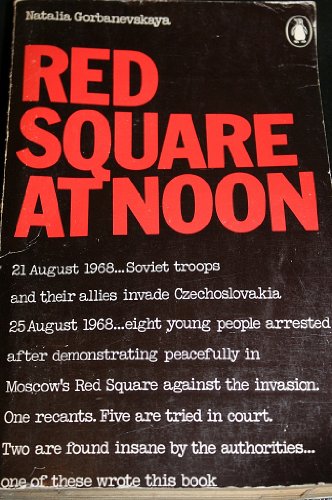
redsquareIn my own twentieth century
where there are more dead than graves
to put them in, my miserable
forever unshared love

among those Goya images
is nervous, faint, absurd,
as, after the screaming of jets,
the trump of Jericho.

В моем родном двадцатом веке,
где мертвых больше, чем гробов,
моя несчастная, навеки
неразделенная любовь

средь этих гойевских картинок
смешна, тревожна и слаба,
как после свиста реактивных
иерихонская труба.

Update on 12/3:  Obituary from Agence France-Presse/The Raw Story here.  New York Times obituary here.