
René Girard, meet Terry Jones, Andrew Sullivan, Christopher Hitchens, and the gang

Share

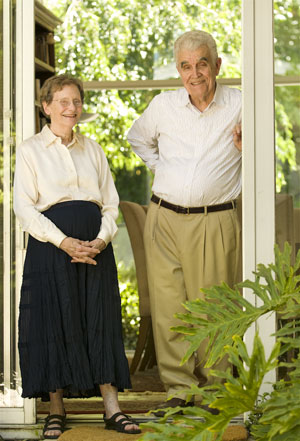
Avoiding crowds (Photo: L.A. Cicero)

A brief conversation with Martha and René Girard brought forth the startling fact that René had made an unaccustomed appearance in Andrew Sullivan’s Dish blog over the weekend.  The subject was, of all things, would-be Koran-burner Terry Jones.

Quietly nestled among his posts on the sex lives and habits of other people is  “What Qu’ran Burning and Crucifixion Have in Common.” Sullivan cites an article by Eric Reitan:

[A]t least one theologian—S. Mark Heim—has taken up Girardian themes to argue that the crucifixion is best understood as a potent repudiation of sacrificial scapegoating… If Heim is right about this, then Jones and Phelps and their respective congregations are symbolically enacting the very thing that the passion stories central to Christianity were intended to repudiate. Where they are called to see the crucified Christ in those who are being symbolically burned at the stake, they instead see a righteous sacrifice to God. Where they are called to identify with the victim of sacrificial scapegoating, they become the practitioners.

Reitan’s article adds:

Some, such as Christopher Hitchens, would see such sacrificial scapegoating as a natural extension of Christian theology—which, after all, has at its heart the doctrine of the vicarious atonement, which Hitchens finds an appalling extension of the idea that wrongs can be righted by sacrificing an innocent scapegoat to God.  But the crucifixion, like book burning, is a complex symbol.

Of course, what Reitan calls Heim’s idea is not Heim’s idea at all.  René Girard himself has written  — for example, in I See Satan Fall Like Lightning — that  “the Gospels are aware of what they are doing. They not only tell the truth about victims unjustly condemned, but they know they are telling it, and they know that in speaking the truth they are taking again the path of the Hebrew Bible.”
But more and more I find myself coming back to the René’s writings about the role of the mob, which seems very apropos  to the discussion at hand:

In a society that has fallen prey to anarchy, the voracious appetite for persecution feeds on victims indiscriminately, as long as they are weak and vulnerable.  The least pretext is enough.  No one really cares about the guilt or innocence of the victim.  These two words, without cause, marvelously describe the behavior of human packs.

W.H. Auden wrote put it this way:

… the crowd rejects no one, joining the crowd is the only thing all men can do.Only because of that can we sayall men are our brothers …
Auden understood

With the inevitable consequences:

All if challenged would reply– ‘It was a monster with one red eye,
A crowd that saw him die, not I. —

Reitan seems to be haunted by the same theme.  He writes that “the nation has, through extensive media attention, conferred on this tiny congregation an enormous power it otherwise wouldn’t have—a power to make their symbolic violence do more actual harm than it otherwise might have done, to make their vicarious scapegoating less vicarious, and so to more effectively reach their intended targets.”

He concludes:

The media rushes to the next dramatic spectacle because to do so will attract ratings. And why does it attract ratings? A congregation of 50 can hardly be blamed for that. All of us in our own ways play the roles of betrayer, deserter, and denier. And while we should not condone the Dove Center’s desire to burn Muslims in effigy—nor should we fail to repudiate it when it becomes a public spectacle—it is important that our response not re-enact on another symbolic level the very pattern of sacrificial scapegoating that we repudiate.

In others words, societies of hundreds of millions of people have many subsets, niches, and off-the-beaten-track pockets.  The scapegoat-maker in one subset becomes the scapegoat of another.  As Girard writes, “Persecutors think they are doing good, the right thing; they believe they are working for justice and truth; they believe they are saving their community.”

On both sides of a discussion, too.
Tracy Kidder, Anne Fadiman, Joyce Carol Oates, and “the enemies of chaos”

Share

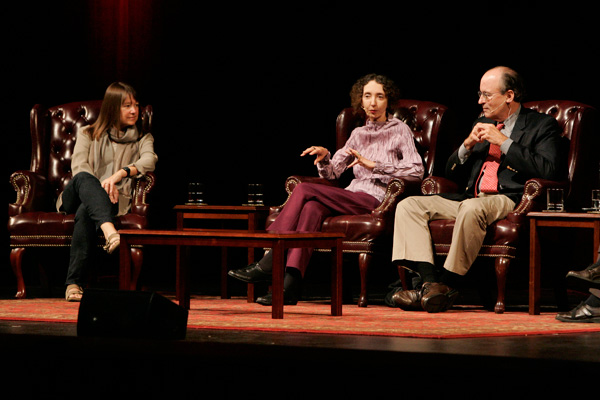
Fadiman, Oates, Kidder ... demonstrating a high tolerance for noise (Photo: Rachel Altmaier)

Goodness, what a sourpuss I sounded yesterday!  Chalk it up to my low threshold for cacophony. The article on yesterday’s event with Tracy Kidder, Anne Fadiman, Joyce Carol Oates is online here.

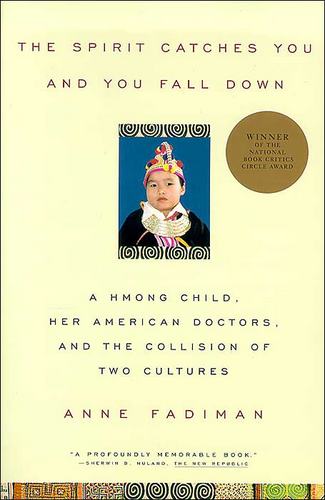
Highlights included New Yorker gossip from Fadiman about the genesis of The Spirit Catches You and You Fall Down:

In the late 1980s, she had prepared a list of four proposals for her New Yorker editor when an old college friend from Merced called to tell her the story of “the tragic conflicts between Hmong patients and their doctors.”

“I thought I’d add that one as number five,” she said. The editor picked it.

Her work took her into a human catastrophe involving an epileptic Hmong girl. Well-meaning Western medical professionals and a loving family with longstanding tribal traditions clashed about the meaning of her condition and what a cure might be.

“Each side underestimated the other. It made me wonder whether we all underestimate each other most of the time.”

Her New Yorker editor left, and the new editor wanted more of a celebrity focus in the magazine’s features.

“The interest in an epileptic toddler was – to put it charitably – modest.” The letter formally killing the story “managed to misspell my first and last name.”

“I could not let the story go,” she said. In the end, she found that writing 300 pages was “so much easier” than disappointing the people who had shared their anguished stories with her.

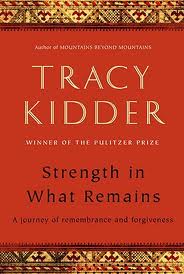
Pulitzer prizewinning Kidder was modest, self-deprecating, often seemingly at a loss for words, as he described Strength in What Remains, featuring the story of “Deogratias,” who fled the Burundi and Rwanda massacres in 1994 for the streets of New York City, where he was homeless. He eventually dropped out of Dartmouth Medical School to open a medical clinic in Burundi. Kidder said that Deogratias is now pursuing medical studies at Columbia University:

“I’m surprised in general when I come across people like this,” said Kidder. Reading the newspaper every day, he said, “Sometimes I think chaos and violence run the world.”

People like Deogratias provide him with hope: “The fact that they’re there, as enemies of chaos, I find extremely reassuring – every morning,” he said.

Describing his book, he said, “It’s a story about courage, it’s a story about the kindness of strangers, a story about war and genocide.”

“What I wanted to do is to make you experience those things again, not as truisms, but as parts of our lives,” he said. “This is what all the writers I most admire do. They make the world new. They make it new again.”

Satz, author and moderator (Photo: L.A. Cicero)

The person most shortchanged by my story was Joyce Carol Oates.  Alone of the three (four, counting Debra Satz, the moderator and author of Why Some Things Should Not Be for Sale (discussed here)  “The Undesirable Table” was a work of fiction, and also a short story, rather than a full-length novel.  As I was quickly putting together a story on deadline, she seemed a little the odd man out.  I’ve never much cared for her work — and can’t claim to have really given it a fair hearing — but I was moved by her discussion of her family origins that were “working class, perhaps below that.”  I was also moved by her generosity towards the other authors — at times it felt as if she were acting as the moderator:

Oates spoke of the role of writers to “bear witness,” and the need to tell the stories of those who are otherwise voiceless.

“It’s up to you to provide the language and allow their stories to be told” … She urged the audience to grab such stories like a rope: “They pull you someplace you never thought you would go.”

Here are a few quotes that didn’t make it into the article:

“I’m more drawn to tragedy, because I think it mirrors the human predicament … and there’s not that much we can do about it, ultimately.  Even if you love your family, you will lose them, one by one.”

“That is what art does, brings formal structural hope to tragic situations … you rise to an occasion of personal courage and selflessness if there’s an emergency … those are the special, selective areas that bring hope to tragic world.”

Postscript: Something else Oates said that fascinated me.  When asked how she could write something like 80 books she said she lives “conventional life of moderation, regular hours.  There’s no need even to organize my time.”  So how does she manage to do that?

Tracy Kidder, Anne Fadiman, Joyce Carol Oates, and thousands of screaming kids

Share

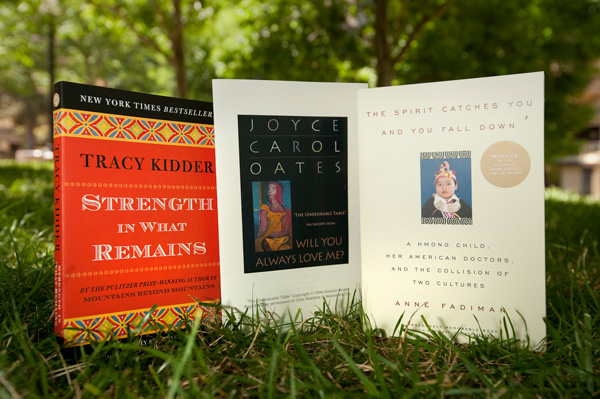
The books, at least, are silent (Photo: L.A. Cicero)

I’m off, or close to being off, for the annual “Three Books” event at Stanford — this year featuring Tracy Kidder, Anne Fadiman, Joyce Carol Oates, and thousands of screaming kids in Memorial Auditorium. The din is truly frightening, as this year’s incoming freshmen try to signal their identification with their future alma mater by yelling, chanting, hooting, whistling, and stomping.

I will be quietly typing in a corner as the three authors answer questions about their books – actually two books and a pamphlet:  2009’s Strength in What Remains by Kidder; Fadiman’s 1997 book The Spirit Catches You and You Fall Down; and Oates’ 1996 short story, “The Undesirable Table,” reprinted in pamphlet form, from her collection Will You Always Love Me?

lt’s usually an interesting show — always a noisy one.  I wonder if Oates’s eminent presence will subdue the mob a little — she’s regularly shortlisted for the Nobel (at least at Ladbroke’s).

More later…

“Dude, you have no Quran!” — Terry Jones, book reviewing, and the sin of sins

Share

I didn’t have many thoughts about the Terry Jones Koran-burning stunt (or is the politically correct spelling “Quran,” nowadays?).  It seemed another of those strange boil-overs that are a regrettable byproduct in a nation that enshrines free speech.

What I didn’t understand was why a guy with — what? — maybe 20 followers gets a huge international spotlight, and a shout-out from a U.S. President, and fiery responses from national and even international leaders.  It seems to me that people like Jones should remain in the obscurity they so richly deserve.  (Surely Bibles are burned every day — why no protests there?)

Once he had become an international figure in the media, Jones responded clumsily and inadequately to his 15 minutes of fame, as one would expect. I doubt he ever met a Muslim.  In confusion, he called off the bonfire.  In any case, 18 Afghan men died in the riots that followed — real people died protesting an event that never happened.  Life gets more and more surreal.  (There’s something to be said for the burqa and female seclusion — it kept the women from the streets on that occasion.)

Then I read this in the Wall Street JournalThis, this is truly unforgiveable:

Pastor Jones, dressed in a dark suit, said at a press conference Friday that he had never read the book he intended to burn. “I have never read the Quran,” he said. His opposition to the book, he said, was rooted in his belief that it doesn’t contain the truths of the Bible.

In short, as Jacob Isom in the video above says, “Dude, you have no Quran!”

In not reading the book he condemns, Jones joins a club that includes a growing number of big-name book critics.  For example, Ana Marie Cox of the Washington Post:

I cannot claim to have completely read Going Rogue — I had to skim the last 150 pages (or more than one-third). I only got the thing into my hands late Monday afternoon with a deadline of early evening. It’s terrible, I know, but if I didn’t read it all, neither can Sarah Palin claim to have completely written it.

It's the thought that counts (Photo: L.A. Cicero)

I was speaking to a friend of the Dalai Lama’s yesterday, and he told me that the Dalai Lama hadn’t exactly penned the books under his name, either.  I wonder how many high-profile people were barely in the same room with their manuscripts before publication.  Are we now freed from having to read their books before reviewing them?  Or burning them, for that matter?  I think of all those conscientious late nights with coffee — I was determined to finish the book before I finished the review.  Am I hopelessly passé?

Nevertheless, the horror of Ms. Cox’s crime — writing a review of a book you hadn’t read — did not shame her out of appearing on MSNBC to discuss the book she hadn’t read.  No more than it kept Terry Jones from wanting to burn one.

I’ve written for the Washington Post Book World; I wonder how the editors would have reacted if I had admitted I had not read the book I was considering — and would they have published the admission?  Some reviewers get caught, of course.  A critic friend told me of a case where a music reviewer (was it for the San Francisco Chronicle?) cut out of a concert at halftime.  In reviewing the program, he didn’t realize that the program had been rearranged at the last minute, and hence he discussed pieces that were never performed.

Crime never pays.

In any case, a Facebook discussion on this topic turned up the Youtube video above.  As my friend Jim Erwin said, “A tiny spark of sensible behavior and a catchy tune.”  The guy in the video, incidentally, is a 23-year-old skateboarder who works in a pizza shop.

Enjoy.  I like happy endings.

More on Molly Norris: Writer, medievalist speaks out

Share

Before she was erased

I’m grateful that yesterday’s post on Molly Norris, the cartoonist irrevocably linked with the Facebook “Everybody Draw Mohammed Day” project that she repudiated, was at least part of the inspiration for this eminently sane rumination, from a guy I never heard of before, an erstwhile cartoonist and current author, Jeff Sypeck.   (PostscriptNew York Times article just posted an hour ago here.)

An excerpt, that doesn’t quite do Sypeck’s whole piece justice (again, read the whole mini-essay here):

As far as I’m concerned, if you’re breaking no other laws, then you can say whatever you want, draw whatever you want, and deface or defile anything that’s your own property, be it a flag, a holy symbol, an effigy, you name it. However, in return, I reserve the right to judge you, denounce you, lobby against you, tell others how wrong you are, and speak vociferously in reply. Speech invites consequences, and I’m open to arguments about responsible, voluntary limits. That said, I’ll always put threats and violence on the far side of that line, and I’ll never suggest that in a free society, an artist or writer was asking to be forced to erase herself from existence.

So yes, despite being a pretty inoffensive writer, I took the news about Molly Norris personally, just as I did in 2008 when I read that Sherry Jones’s publisher was firebombed. I’ve written a book in which Muslims guzzle wine, Jews own slaves, and Christians kill in the name of religion. While nothing about my take on the early Middle Ages is all that wild, what’s to stop some hateful, publicity-seeking pastor from hagriding me, or some Islamic fanatic from registering his disapproval via DaggerGram? If doodles can incite worldwide riots, how can I know that my 20-page depiction of a liberal, even libertine, Baghdad won’t light a madman’s fuse?

Guy I never heard of

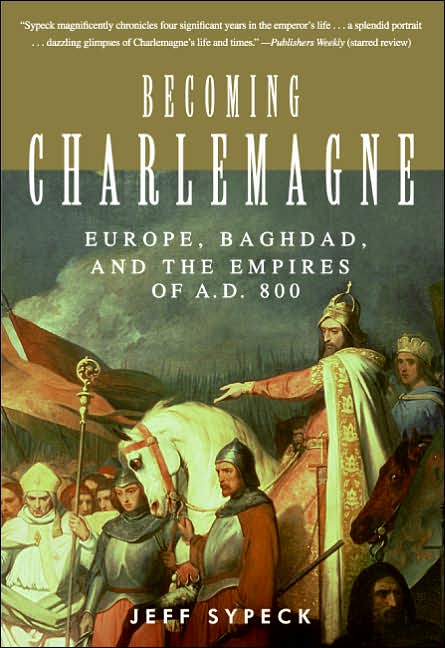
The book (we might as well give it a plug, as a hat tip) is 2006’s  Becoming Charlesmagne: Europe, Baghdad, and the Empires of A.D. 800 (HarperCollins).  Kirkus Reviews said:

“Debunking the myths that surround legendary figures is a tricky business, but Sypeck acknowledges the allure of the ways in which Charlemagne and his era have been romanticized …  Illuminates the shadowy corners of an era shrouded in the mists of legend.”

The author has the distinction of growing up  in a central New Jersey town known for  the nation’s only cat leash law.  Now that’s whacko.

Talented artist goes into hiding: Molly Norris & “Everybody Draw Mohammed Day”

Share

No more Molly

It’s official.

An hour ago, the Seattle Weekly announced:  “You may have noticed that Molly Norris‘ comic is not in the paper this week. That’s because there is no more Molly.”

The talented cartoonist who launched the “Everybody Draw Mohammed Day” on Facebook, and then regretted and withdrew her proposal, has nevertheless had to go into hiding – moving, changing her name, washing out her identity – at the suggestion of the FBI. It’s just like the witness protection program. The government, however, will not be picking up the tab.  She will.

Norris viewed the situation with characteristic humor: “When FBI agents, on a recent visit, instructed her to always keep watch for anyone following her, she responded, ‘Well, at least it’ll keep me from being so self-involved!'”

She joins a growing class of writers, filmmakers, cartoonists, political activists, beginning with Salman Rushdie in 1989 who must be guarded 24/7.  As Paul Berman wrote in The Flight of the Intellectuals:

“And so, Salman Rushdie has metastisized into an entire social class. … who survive only because of bodyguards and police investigations and because of their own precautions. This is unprecedented in Western Europe since the fall of the Axis.  Fear — mortal fear, the fear of getting murdered by fanatics in the grip of a bizarre ideology — has become, for a significant number of intellectuals and artists, a simple fact of modern life.”

Murdered: Theo van Gogh

We’ve written before about Molly, and also urged people to sign the petition backed by cartoonists Oliphant and Garry Trudeau.

Almost more troubling than the announcement is the American reaction — in particular, the youngsters who seem to feel it is incumbent upon us to avoid expressing opinions that distress others, and that Norris herself is at fault for the fatwa that has been brought upon her.  (Yes, yes, I know.  It’s not technically a fatwa.  I don’t care.)  At some point, to have any kind of character at all, one has to decide not to be a coward.

The last time I suggested at a gathering that maybe it was time to reintroduce some old-fashioned First Amendment values into our educational system, I was attending a dinner party with liberal academics.  They acted almost as if I’d burped at the table. Isn’t that a Sarah Palin kind of thing, they asked.

Maybe. But I remember the day when it was a left-wing kind of thing, and I spent a portion of my university years signing letters for Amnesty International, and working in London for Michael Scammell‘s Index on Censorship.

God knows I hear enough offensive things towards my own values, beliefs, religion, etc. – and on a daily basis, too. But freedom of speech begins at the point where you offend me.  Otherwise it has no meaning at all.

Postscript: Medievalist Jeff Sypeck speaks out on the affair here.

Postscript on June 14, 2018: It appears that Dutch politico wants to start his own “Draw Muhammed” day. Perhaps he’s never heard of Molly Norris. Read about that here.