
Robert Conquest is “Getting On”: A great poem after a century of living

Share

.

One of life’s unforgettable moments: a great poet hands you a typescript copy of an unpublished poem.  Its strike-outs and marginalia still mark the page.  It hasn’t found its readers yet, and there is no body of opinion about it to influence your own.

So, sitting in an immaculate Stanford condo on a balmy August afternoon, with the his forebears’ books and maritime paintings as a backdrop (the family goes back pretty much to the Conquest), I felt a quiet thrill when Robert Conquest handed me his latest poem, “Getting On,” which opens:

Into one’s ninetieth year.
Memory? Yes, but the sheer
Seethe as the half-woken brain’s
Great gray search-engine gains
Traction on all one’s dreamt, seen, felt, read,
Loathed, loved…
.              .              And on one’s dead.
-Which makes one’s World, one’s Age, appear
Faint wrinkles on the biosphere
Itself the merest speck in some
Corner of the continuum.
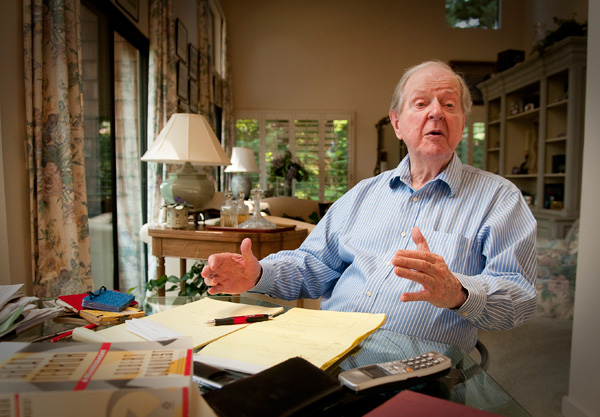
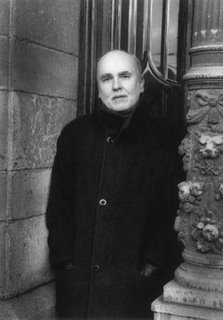
“Great poet and even greater historian" (Photo: L.A. Cicero)

It won’t be quite the same thrill for you, but you can now read the whole poem online — Dave Lull, patron saint of bloggers, tipped me off that it’s finally been published in the October 2nd edition of the British magazine Standpointhere.  “I don’t think any poet has written as well about aging as he has,” said R. S. Gwynn, Bob Conquest‘s friend and fellow poet.

The 93-year-old poet is also the courageous historian who wrote  the landmark books that exposed Soviet Communism in the years when too many were defending it — The Great Terror and Harvest of Sorrows.  He published his seventh collection of poems last year and a book of limericks this year. He and his absolutely charmer of a wife Liddie were fretting about the health of their close friend Christopher Hitchens when I dropped by; Hitchens had just been diagnosed with esophogeal cancer, and cancelled his usual visit in for Bob’s birthday on July 15.  Hitchens wrote in his new memoir, Hitch-22, that Conquest is “great poet and even greater historian.”

Bob finished his 200-line poetic summa about the same time he handed it to me.  I wrote then that this poem might prove to be among his greatest.  See if you agree (though I could have done without the Goldie Hawn reference.)

Not into great poems?  Try a few of his limericks here.
A Swedish award for a Swede? Ladbrokes has spoken…

Share

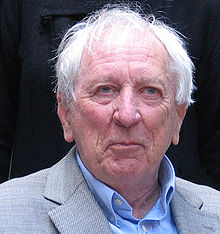
79-year-old perennial Nordic bridesmaid

Tomas Tranströmer is the odds-on favorite to win this year’s Nobel Prize for literature. Ladbrokes has spoken, putting his chances at 5 to 1.  However, Bill Coyle at the Contemporary Poetry Review states the problem this way:

Every year, as the announcement of the Nobel Prize in Literature approaches, partisans of the Swedish poet Tomas Tranströmer hold a collective breath, hoping against hope. A win for their man is unlikely for a number of reasons. One is the residual fallout from 1974 when the Swedish Academy gave the prize to two of its own members, Harry Martinson and Eyvind Johnson. Both were fine writers, but the appearance of nepotism was impossible to avoid. No Swede—no Scandinavian—has won the prize since.

Reuters observes that “Poetry dominates the bookmakers’ list” and that “American writers set to be overlooked again” — unless, of course, you consider perennial American Nobel bridesmaid Joyce Carol Oates, ranked #12, or perennial groomsman Philip Roth, at #15.  Thomas Pynchon is #16.  Note that none of the Americans are poets.  At least not primarily.

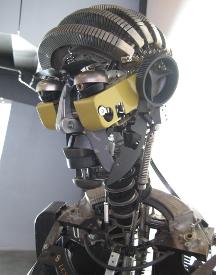
Does Bjørg-the-Cyborg pick the winners?

“Tomas Transtromer must surely be in pole position,” said David Williams of Ladbrokes. “He’s long been mentioned for the prize and we feel his work finally deserves this recognition.”  Probably an indication he won’t get it.  (You can read a few of his poems at The Owls website here.)

There’s an obscure Paraguayan playright — Nestor Amarilla — rumored to be shortlisted.  No one’s ever heard of her, which would be in keeping with recent prizewinners.  Do I sense another wicked Ted Gioia parody coming?  Read his “Shocking Revelation: Nobel Lit Prize Has Been Picked by a Robot since 1994!”  (His slightly more sober “Nobel Prize in Literature from an Alternative Universe” here.

The man in the #2 favorite spot leaves me with divided feelings — it would be nice to see Polish poet Adam Zagajewski bag the prize — but the award has a way of turning lives upside down. (Read An Invisible Rope for some firsthand stories about what it did to Czesław Miłosz in 1980.)  I remember Zagajewski kindly serving as my sherpa in literary Kraków — and, well, I’m selfish.  Which is to say, I would miss his friendship.

I reviewed his book for the San Francisco Chronicle (and no, I didn’t write the headline) — I’m chuffed that it inspired Kay Ryan to write to the newspaper:  “It was a thrill to read Cynthia Haven’s brilliant review the poet Adam Zagajewski’s book of essays, A Defense of Ardor, in this past Sunday’s Book Review. Almost never do I come across something about poetry that has the sting and bite of poetry in it.  Zagajewski comes straight through Haven’s elegant and deeply informed prose.  More of these brainy reviews please; more Cynthia Haven, please.”  I hope they published it.  I honestly can’t recall.  Oscar Villalon sent it to me.  God knows one gets enough slaps and punches.

I also profiled Adam for the Poetry Foundation magazine here — an article that still gets a lot of hits.

I remember meeting Adam for tea in Krakow’s main square, and being thrilled by the squadrons of pigeons.  Adam assured me loftily that they were very stupid creatures.  And, as a newcomer to his town, he showed me the Jagiellonian University,  as the light was fading…

"Only others save us..."

When I asked him about the future of poetry and poetry-lovers in the world of tweets and sound bites he said this (which didn’t make it into the final cut of the Poetry Foundation article):  “We’ll be living in small ghettos, far from where celebrities dwell, and yet in every generation there will be a new delivery of minds that will love long and slow thoughts and books and poetry and music, so that these rather pleasant ghettos will never perish — and one day may even stir more excitement than we’re used to now.”

I keep this on my desk:

Only others save us,
even though solitude tastes like
opium. The others are not hell,
if you see them early, with their
foreheads pure, cleansed by dreams.

— Adam Zagajewski, “In the Beauty Created by Others”

Good news in a hard world: “Borderland” exceeded fundraising goals (by a hair)!

Share

And now, the good news:  Borderland exceeded its fundraising goals, by $20!  Keeping track of the progress on my Apple, hour by hour, was a hair-raising process last night.  This morning brought a great finale to the story of Comics with a cause: “Borderland” warns kids about human trafficking:  $8020 from 157 backers will allow Dan Archer and Olga Trusova to distribute the comic — seven true stories by human trafficking survivors — in Eastern Europe.  Dan, a founder of Archcomix.com and a 2010 John S. Knight Journalism Fellow, and Olga, a Fulbright Fellow from Stanford University, are understandably jubilant.

Heaven knows I don’t get excited about much along these lines — but these two are bristling with energy and drive, and their project is a much-needed one.  As explained a few days ago, they’ve made me into a convert.
This message from Olga:

“We are very grateful to everyone who contributed on Kickstarter! This makes it possible for us to print and distribute the comic in the U.S. and to also reach a wider audience with an interactive iPhone app in order to raise awareness about human trafficking in the West. The Ukrainian version of the book will also be distributed to 136 schools in Ukraine by the International Organization for Migration. Additionally, we are talking with the U.S. Embassy in Kiev about having an exhibit to showcase Borderland as a preventative educational material for youth.

Half of the jubilant team

In terms of fundraising, Dan and I have reached out to our respective communities of educators, journalists, artists, designers, NGOs, activists, students, etc. and it’s been great to see so many people come forth to support the project. Kickstarter placed us in the “Featured” section of the website, which also brought its core audience to learn about Borderland. Overall, we utilized a lot of social media tools and in-person events in our outreach campaign, and have especially seen an increase in support in the beginning and at the end of the pledge drive.”

See more about their story in yesterday’s post.

Comics for a Cause: “Borderland” warns kids about human trafficking

Share

.

ONLY A FEW HOURS LEFT!  This project will only be funded if at least $8,000 is pledged by Tuesday, Sept. 28, 1:45 p.m. EDT — which means 10:45 a.m. PST!!!  Under the kickstarter aegis, they must raise all the money to meet their pledge, or else all the money is returned to donors.  Please donate by clicking here.

Yes, yes, I know.  We’re talking about comics.  Graphic novels.  I considered myself a tough sell when I walked into Stanford’s Institute of Design to hear two kids talk about saving the world through the pages of comic books.  But they sold me … figuratively speaking.

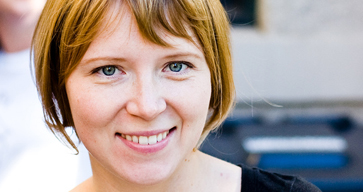
She collected the stories from Eastern Europe

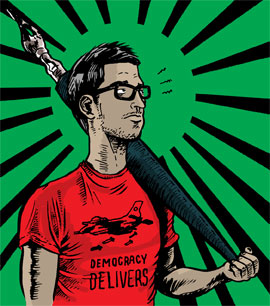
Olga Trusova is a Fulbright Fellow from Stanford University.  The Ukrainian designer and educator spent a year collecting stories told by victims of human trafficking in Eastern Europe. Dan Archer, a comics-journalist from California, a founder of Archcomix.com and a 2010/11 John S. Knight Journalism Fellow, currently co-teaches the acclaimed  graphic novel project at Stanford. He turned Olga’s stories into pictures.  (Video is hereBorderland preview site is here.)

I had arrived late from the Mexican festivities nearby, after Olga had already finished her intro.  Dan was talking about this “visually seductive form with a tarnished history.”

He took pen to Bristol board

“It’s a great way of packaging a lot of information … in a form that can capitalize on the energy.”

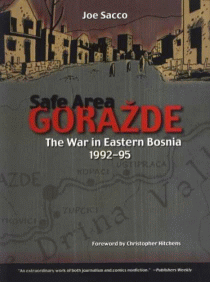
Dan praised the work of pioneering Joe Sacco, creator of the 1996 American Book Award-winning graphic novel Palestine, and his graphic novel on the Bosnian War, Safe Area Goražde. Then he and Olga talked about thumbnails and storyboarding.

They were both appealing. They were both persuasive.  Dan described the discovery of “how I could tell stories in small bite-size chunks.”

Olga’s reportage ensured that this was  “not just seven stories of strangers,” she said.

“The stories are really harrowing,” says Dan. “Reliving these things, and negotiating how much to show — was the most challenging part of the project.”

Not showing is far more powerful,” he concluded. “The readers have to insert their own agency between the panels to make the story come alive for themselves.”

“There’s a lot of potential for artists who want to create comics for social change,” says Olga.

OK, here’s the proviso (you knew it was coming, didn’t you?):  There is nothing here that is not described more immortally in the story of Jean Valjean.

Sacco: Role model

Sontag spoke here about reading as the education of the emotions:

“Reading should be an education of the heart …   Literature is what keeps us from shriveling into something completely superficial. And it takes us out of ourselves, too. … I really do think it’s necessary if you want to have a full life. It keeps you–well, I don’t want to say honest, but something that’s almost the equivalent. It reminds you of standards: standards of elegance, of feeling, of seriousness, of sarcasm, or whatever. It reminds you that there is more than you, better than you.”

That said, Dan and Olga have made it clear that they want to reach kids who won’t be reading Victor Hugo, Emile Zola, or Charles Dickens anyway.  They want to spread a message to kids who have been victims in Eastern Europe: “You are not alone.” So you’re not compromising any literary principles — this is a different gig altogether.

Now here’s the kicker:  The next two days are critical.  This project will only be funded if at least $8,000 is pledged by Tuesday, Sept. 28, 1:45 p.m. EDT — which means 10:45 a.m. PST!!!  Under the kickstarter aegis, they must raise all the money to meet their pledge, or else all the money is returned to donors.  See here for details.

Look at it this way:  a mere 10 bucks will get you a pdf and a hard copy of the comic.  50 bucks will get you the iphone app version.  If you’re too much of an old fogey to get into this … well, you have kids, don’t you?  Go ahead.  I did.  More about donating here.

Mexico, war, genocide, and Richard Rhodes

Share

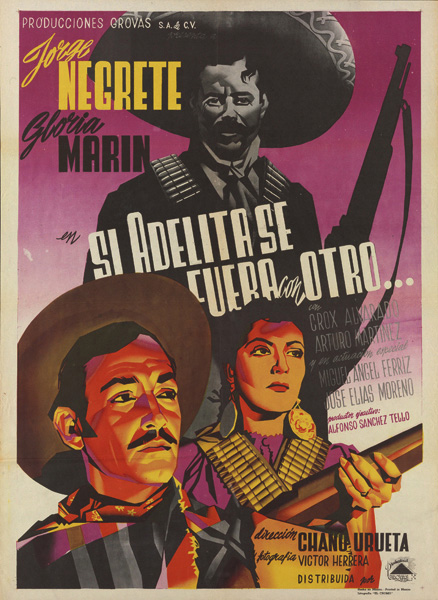
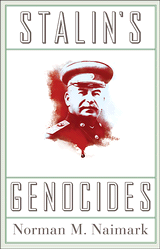
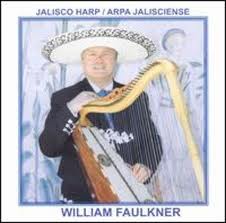
Yesterday, the opening of the Mexico bicentennial exhibition — a true fiesta, with tamales, top-notch horchata, chips and guacamole, and other munchies I didn’t have time to sample, along with a man named William Faulkner playing Mexican tunes on a harp.  I have a personal debt to Mexico, and came to pay my respects — but my conversations tended to turn instead to my article about Norman Naimark and the need to broaden our definition of genocide to include Joseph Stalin‘s millions of murdered people.

Hoover librarian Lora Soroka, who is Ukrainian (land of the Holdomor) and archivist Linda Bernard were particularly pleased that someone was finally nailing Stalin for genocide — the article is featured on Hoover’s home page.  Frankly, I’m surprised there are two opinions about that.  My article on Naimark’s new book, Stalin’s Genocides, left out so many aspects of our discussion. (We spoke on a sunny day on an outdoor patio, overlooking the Bay, at the Center for Advanced Study in the Behavioral Sciences, where it seemed almost indecently incongruous to be discussing crimes against humanity.)

Naimark said, “Intent is very important in genocide.” In the case of the American Indians, more often than not “the intent was to steal land in any way possible” — which makes it an instance of ethnic cleansing, rather than genocide.  And yet, individuals within that context acted with “the intent to wipe out a tribe.”  Hence, that history is one of ethnic cleansing marked by incidents of genocide, he said.  Evidently, the lines of international law are blurry.

One question I would like to see explored more powerfully is the link between technology and genocide.  Clearly, incidents within archaic society — for example, the Old Testament “bans” where every man, woman, child, and even livestock were killed to remove every trace of a people — show genocidal intent.

But technology has magnified our ability to commit genocide — technology enables imitation, which brings us directly into René Girard‘s territory, and also into Hannah Arendt‘s.  She observed in Eichmann in Jerusalem that once an unprecedented crime occurs, it is likely to repeat itself:  “If genocide is an actual possibility of the future, then no people on earth … can feel reasonably sure of its continued existence without the help and the protection of international law.”

Replication occurs through the medium of modern communication, which also enables the event itself.  Could the Rwandan massacres have occurred without national broadcasters egging the murderers on, announcing the victims’ locations and tracking them as they tried to flee?  It would be impossible to murder a million people in 90 days without coordination, moving the murderers and murdered to locations where they can be effective shot or gassed en masse.

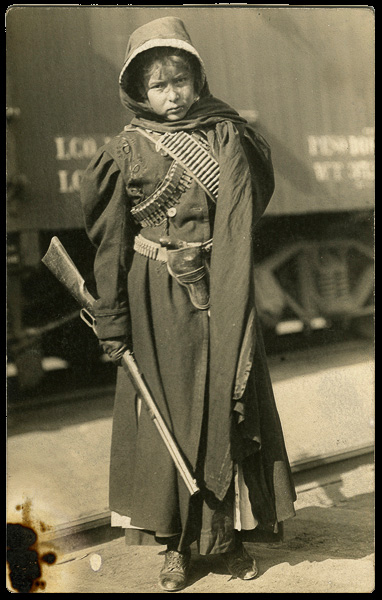
The less glamorous side of revolution: Mexican girl, probably an orphan, on a postcard. (From Stanford collection)

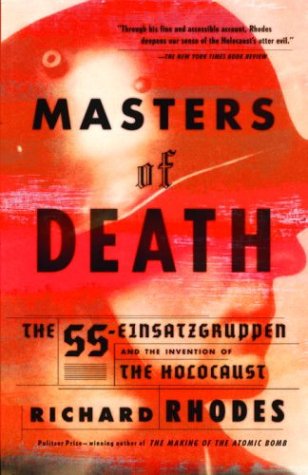
That brings us back to the Mexican celebration.  Andrew Herkovic was barking at me (we were all barking in the din of the gathering) about the work of Richard Rhodes, who wrote 2003’s Masters of Death: The SS-Einsatzgruppen and the Invention of the Holocaust.  His research discovered how murdering people the traditional way, one by one, proved traumatic for the murderers.  The Nazis escalated cautiously, improving mass murder methods; and finally,  “conditioning” the troops, to avoid “disabling trauma.”

The Jerusalem Post notes that Rhodes’s book “graphically and chillingly details the work of the special killing battalions of Himmler’s SS. . . Extremely well-written. . . [A] fine work of gruesome history.”  But I wonder, by detailing the crimes, do we risk their repetition?  By speaking about the unspeakable, do we ensure that it becomes a blueprint?

Coincidentally, Andrew had Rhodes’s cell phone number — he scribbled it down for me.  I’ll try phoning him today.  My reason:  Rhodes will be here for a November 11 talk during our Ethics and War program.  As war becomes more and more total … what do “ethics” mean in war?

A phone call with Julia Hartwig

Share

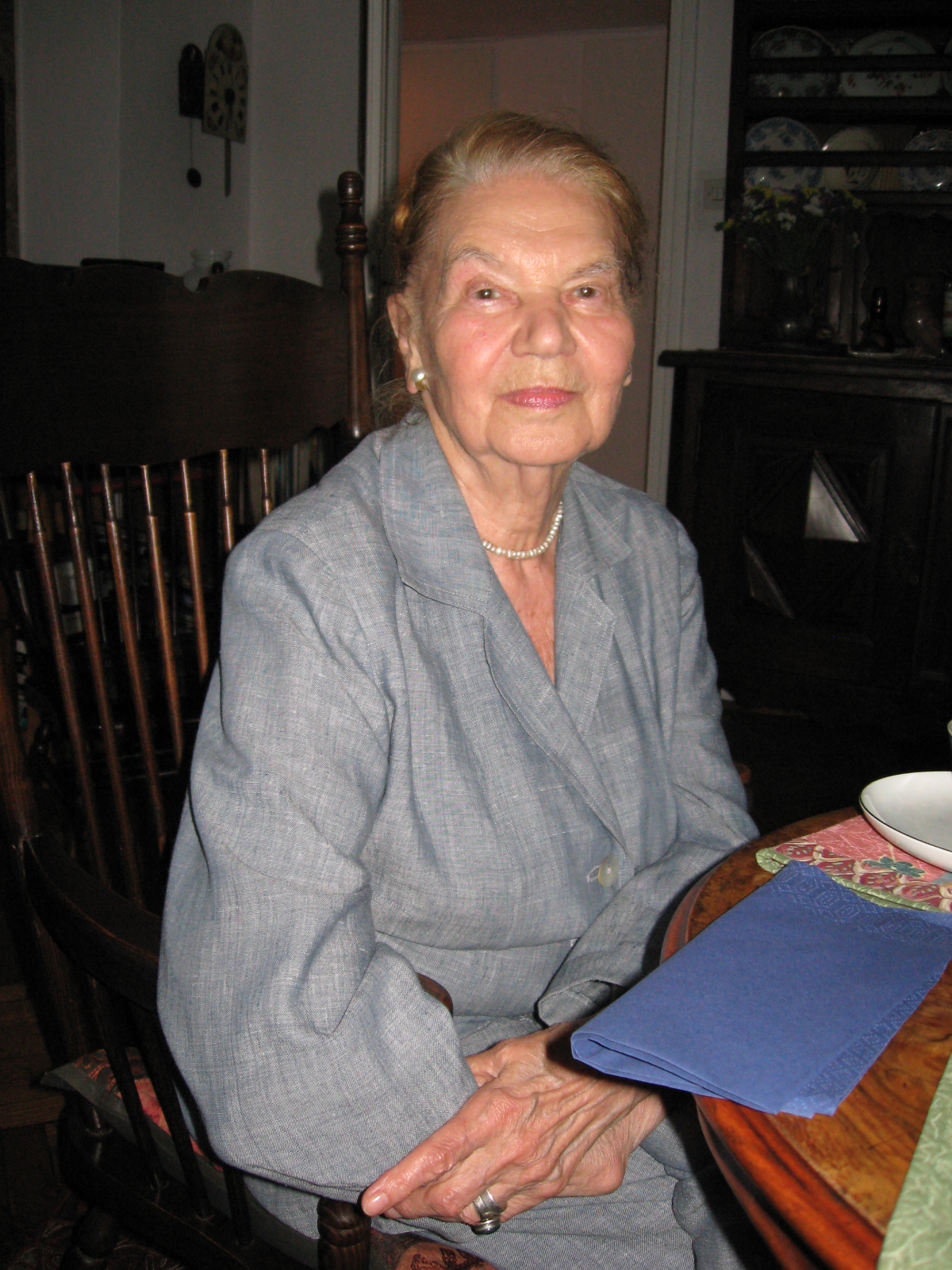
In Warsaw (Photo: C.L. Haven)

I’m an old-fashioned girl.  I still consider an international call a big deal.  I don’t make them frequently, and it always surprises me when you punch a handful of digits and someone like Julia Hartwig picks up the other end of the line in Warsaw.

I hadn’t spoken to Julia Hartwig since my fellowship summer in Poland, and am currently working on a piece about the Polish poet for World Literature Today — that is, I will be when I finish the indexing and proofreading for An Invisible Rope.  In Poland, Adam Zagajewski had encouraged me to meet her — somehow the name had led me to think her a young American woman, the few times I ran across any reference to her at all.  So I was surprised to find an the octogenarian “grande dame” of Polish poetry.

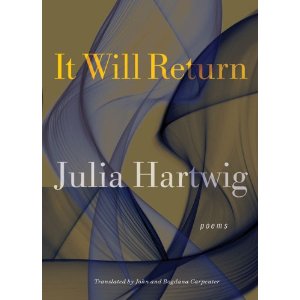
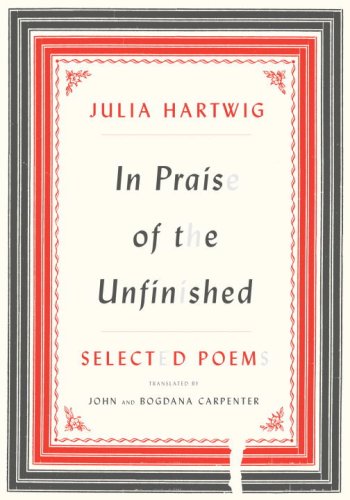
Truth is, Hartwig is too little known in the U.S., though her second book, It Will Return, was published by Northwestern University Press this year.  Her first book in English, Knopf’s In Praise of the Unfinished, received accolades where it was reviewed, but it wasn’t reviewed widely.

She’s received a number of honors, but never the NIKE Award, Poland’s leading literary award, for which she’s been nominated thrice.  She’s up again this year.  Let’s hope the 89-year-old poet takes home the award next  month.

On the phone, I remembered the brusque and throaty voice.  Although she lived in the U.S. for a number of years, her English can seem tentative and uncertain.

I said there was a chance I would be back next year in Warsaw — that unreal, half-fabricated city. I can’t quite remember the words she said, but I had a feeling that she would hold me to that most tentative promise.

Meanwhile, a poem:

Return to My Childhood Home

Amid a dark silence of pines—the shouts of young birches calling each other.
Everything is as it was. Nothing is as it was.
Speak to me, Lord of the child. Speak, innocent terror!
To understand nothing. Each time in a different way, from the first cry to the last breath.
Yet happy moments come to me from the past, like bridesmaids carrying oil lamps.

Postscript:  We got a nice mention from SCOPE Magazine blog here. The magazine launches in January, but the blog is here, right now.  Check it out.