
Breaking news: W.S. Merwin gets email!

Share

Old dog ... new tricks

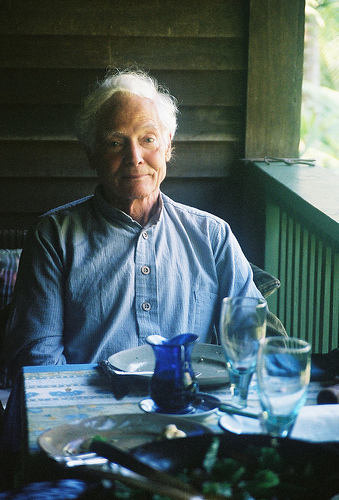
A few weeks ago, I got a short note from Hawaii — our new poet laureate, W.S. Merwin, had a quick  correction to make to his essay in An Invisible Rope.  He hoped he wasn’t too late, he had scribbled, but he only had snail-mail to reach me — he doesn’t do fax or texting.  He barely does phone calls.  The octogenarian poet still didn’t have email, “Thank God,” he wrote.

Last July, I wondered how effective our unworldy pineapple farmer (or former pineapple farmer) would be as a U.S. poet laureate, given these circumstances.  “I do like a very quiet life,” he said by telephone to the New York Times after learning of his appointment. “I can’t keep popping back and forth between here and Washington.”  It all seemed a fairly hopeless affair.

Imagine my surprise, then, when I saw W.S. Merwin’s name in my electronic inbox this morning.  Hell has indeed frozen over.

Although clearly a form letter, he wrote:

Thank you for your kind words.

I was deeply honored and moved by the warmth and generosity behind all the messages. I look forward to serving as your Poet Laureate and I hope our paths will cross over the coming year.

W.S. Merwin

What can we say?  I knew a few late adopters — while working on Joseph Brodsky: Conversations, I communicated with Sven Birkerts via his son’s email account, and Peter Dale acquired one expressly to work on our manuscript for Peter Dale in Conversation with Cynthia Haven — but both those cases were years ago.  Takeaway: Never underestimate the human capacity for change.

Best of luck, Bill — and good luck with the poet laureate thingumme!
12 more hours to the Nobels…Cormac McCarthy now #1

Share

Man of the hour ... perhaps only that

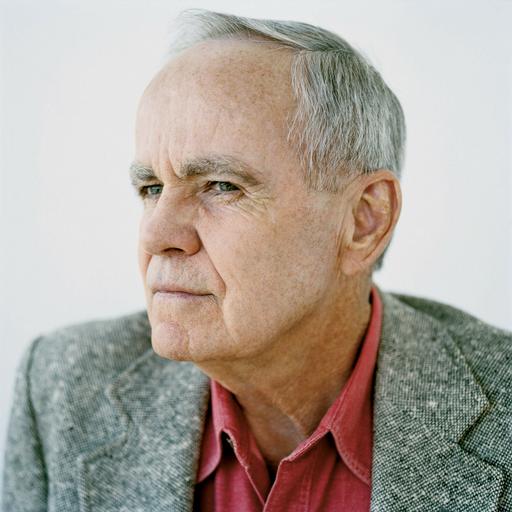
Ladbrokes’ site is up again, and the bets seem to be reshuffling in an inexpicable fashion.  Take a look for yourself.  America’s Cormac McCarthy has edged to the top spot for this year’s Nobel in literature, pushing Kenya’s Ngugi wa Thiong’o to #2.  Haruki Marukami and Swedish poet Tomas Tranströmer remain stable in the #3 and #4 slots.

But Poland’s Adam Zagajewski has now dropped way down to #20, and some of the rest is pure craziness:  Néstor Amarilla (we’ve rather taken a shine to him) is suddenly at the bottom of the list, with the notation “closed.”  What does that mean, if anyone put any money on him at all? Which someone must have done, to give him any ranking at all a few days ago…

In an alternative universe, Unibets, puts the Kenyan Ngugi wa Thiong’o at the top, with Néstor Amarilla as #2.  Huh?  As Literary Saloon points out in its excellent analysis, why wouldn’t someone bet for the Argentinian at Ladbroke’s, where the payout would be higher?  (Maybe because it’s “closed.”) 

Péter Nádas has been added to the list.  Joyce Carol Oates is #9.  Other names have moved up and down the list.  Check it out.  Only a few more hours to go.

Surprise! Ladbrokes has spoken, yet again: Ngugi wa Thiong’o the new favorite

Share

At UCI...

There’s no point in sleeping during Nobel week.  It’s a volatile year.  Ngugi wa Thiong’o has climbed from having a 1 percent chance of winning to a top spot — all in a couple of days.

In any case, this is a disaster for Ladbroke’s, which booked the odds at 75:1:

But it wasn’t long before those odds changed radically. It was, says [Ladbroke’s David] Williams, a “staggering collapse.” Bettors gambled more heavily on Thiong’o than they had at any other time in the history of Nobel betting. Before long, he had pushed  Thomas Transtromer out of the top position.

It also suggests some leaks, and opportunists, at the Swedish Academy. The Ladbrokes site is down for “scheduled maintenance” during Nobel week.

Other shifts: American novelist Cormac McCarthy is now in second place at 6-1, with Japanese writer Haruki Marukami coming in third position at 7-1. Last week’s favorite, the Swedish poet Tomas Tranströmer, is now ranked fourth in the Ladbroke’s odds with a 9-1 chance of winning the award.

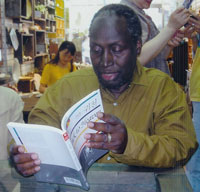
Who is the Kenyan mystery man?  The Nobel poetry drought continues — Ngugi wa Thiong’o is a novelist.  And also, “a post-colonial theorist and social activist.” He is currently the Distinguished Professor of English and Comparative Literature at the University of California, Irvine.

He was born in 1938 into a large peasant family.  He was educated in Kenya, Uganda, and Britain’s University of Leeds.

He launched his writing career in English, but following his arrest and imprisonment without charge at the Kamiti Maximum Security Prison in Kenya after the performance of his critical play, Ngaahika Ndeenda (I Will Marry When I Want) in 1977. In prison also, he decided to switch to his mother tongue, Gikuyu.

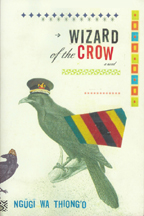
He wrote his novel Caitani Mutharabaini (The Devil on the Cross) on toilet paper while in prison.  He also wrote a childhood memoir Dreams in a Time of War and a satire Wizard of the Crow (Murogi wa Kagogo), which some consider his masterpiece.
Seven-year-old profile at Today@UCI here:
Kenyan writer Ngugi wa Thiong’o describes in his book, Decolonising the Mind, what happened to students caught speaking their native Gikuyu at school: “The culprit was given corporal punishment – three to five strokes of the cane on bare buttocks – or was made to carry a metal plate around the neck with inscriptions such as ‘I Am Stupid’ or ‘I Am a Donkey.’”

Given the dramatic reshuffling of odds this year, I wonder … could someone placing bets  just to deflect attention from the real winner, or is that too Machiavellian?

PostscriptThe Literary Saloon doesn’t think it’s too Machiavellian at all.  And they’re plonking for UCI’s Ngugi wa Thiong’o.

AddendumA writer may bag the peace prize, too.  The imprisoned Liu Xiaobo would be the first Chinese citizen to get the peace prize.

Breaking news from Néstor Amarilla in Asunción: All is forgiven!

Share

Virility and grace

For nimble thought can jump both sea and land.” A few short hours after I posted my apology for inadvertantly giving Néstor Amarilla a sex-change operation, I received this gracious email from Paraguay, under the subject line “Apologies Accepted”:

Señora Cynthia,

My U.S. representative just passed me the link to your blog and I read your apology, which wasn’t necessary, but thank you anyway for bringing back my virility.

Saludos desde Asunción.

Néstor Amarilla

Thank you, Señor Amarilla!  Good luck on the Nobel thingumme!  I very much look forward to reading your plays!  In translation … alas! (I know, “kill me, kill me…“)
.
https://thebookhaven.org/2010/10/nestor-amarilla-the-invisible-man-the-nobels-and-a-quiet-swedish-joke/

Happy birthday, Fulke Greville!

Share

The birthday boy

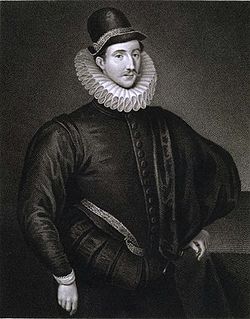
A few more hours to wish a very happy birthday to Fulke Greville, 1st Baron Brooke,  de jure 13th Baron Latimer and 5th Baron Willoughby de Broke, born this day in 1554.

Patrick Kurp has a fine tribute to him at Anecdotal Evidence here:  “He was known not as a poet but as treasurer of the navy, chancellor of the exchequer and commissioner of the Treasury. Only in the twentieth century was his accomplishment as a writer of austerely passionate verse, the peer of Herbert, Donne and Shakespeare, truly weighed.”

Kurp credits the late Thom Gunn, who edited Selected Poems of Fulke Greville in 1968.  Not surprising, since Gunn was a student of Yvor Winters, and no one exalted the obscure poet Greville more than Winters,  who rated Greville more highly than Sidney and Spenser.  Said Winters:

“How great a poet Greville is. It is my opinion that he should be ranked with Jonson as one of the two great masters of the short poem in the Renaissance”
— Yvor Winters, Forms of Discovery: Critical and Historical Essays on the Forms of the Short Poem in English, 1967

Former U.S. Poet Laureate Robert Pinsky compared him with John Donne in imaginative power.  Here’s Pinsky in The Paris Review on the subject of Greville (and Winters):

Pinsky -- a Winters protégé (Photo: Steve Castillo)

PINSKY:  Winters claimed to have read every poem by every poet of any distinction who ever wrote in English; he challenged those of us who disagreed with him to do the same. He certainly seemed able to respond to anything anybody ever alluded to. Winters resurrected Fulke Greville,  a really great poet, I am convinced; and some of the poems he pointed to, like Herbert’s “Church Monuments” and Jonson’s “To Heaven,” were influential to many of us who studied with him, like Thom Gunn, Bob Hass, Donald Justice, Phil Levine, James McMichael, John Peck.

INTERVIEWER:  Some of Winters’s favorite poems seem to have found their way into your own work, as for instance your “Poem with Refrains,” with its gobbets of Fulke Greville.

PINSKY:  Yes, “Absence my presence is, strangeness my grace. / With them that walk against me is my sun.” That’s Greville,  and he is unsurpassed at lines of that kind. What Winters showed me about the English poets of that period gave me an inkling of the level of the art, the quality of seriousness, the principles of musical language that one might hope to attain. I feel that those couple of years when I read poetry intensely with him have served me well, and I’m grateful for that.

He gets the final word

Let’s give Winters the final word on the subject, then.  Try this, from “Problems for the Modern Critic of Literature” from Winters’s 1956 The Function of Criticism:

“The language of metaphysics from Plato onward is a concentration of the theoretical understanding of human experience; and that language as it was refined by the great theologians is even more obviously so. The writings of Aquinas have latent in them the most profound and intense experiences of our race. It is the command of scholastic thought, the realization in terms of experience and feeling of the meaning of scholastic language, that gives Shakespeare his peculiar power among dramatists and Fulke Greville his peculiar power among the English masters of the short poem. I do not mean that other writers of the period were ignorant of these matters, for they were not, and so far as the short poem is concerned there were a good many great poets, four or five of whom wrote one or more poems apiece as great as any by Greville; but the command in these two men is not merely knowledge, it is command, and it gives to three or four tragedies by Shakespeare, and to fifteen or twenty poems by Greville, a concentration of meaning, a kind of somber power, which one will scarcely find matched elsewhere at such great length in the respective forms.”


Néstor Amarilla, the Invisible Man, and Joseph Brodsky’s “quiet Swedish joke”

Share

It’s Nobel week, and the discussion of potential winners is becoming feverish.  At the Stanford News Service, we quietly prepare in case someone from the home team gets the honor.  Each day, we take turns waking up at 2 a.m.

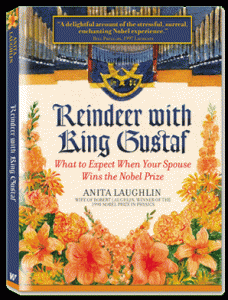
If it’s one of our own, we haul ourselves out of bed, call the others, and ambush the unsuspecting winner in the pre-dawn haze, commandeering his cell phone for the duration.  We begin preparing press conferences, writing a profile, arranging interviews, acting as chauffeur and bodyguard — and, of course, feeding food to the new Nobel laureate, his or her family, the media, and ourselves. (You can read an abbreviated description of the chaos in “Dad, some guy is calling from Sweden,”  recalled by Stanford physicist Robert Laughlin‘s longsuffering wife Anita in Reindeer with King Gustaf: What to Expect When Your Spouse Wins the Nobel Prize.)

I will be waking up for the literature and the peace prizes. But I have wondered, during this sleep-deprived week, whether perhaps they should combine the two:  Ted Gioia alerted me to the possibilities, with the  Dayton Literary Peace Prize.

"Kill me, kill me"

Usually, however, I get to roll over and go back to sleep.  Stanford has yet to bag a Nobel in the humanities.  (Berkeley is ahead with 1 — Czesław Miłosz.)  Unless Tobias Wolff or Eavan Boland get lucky, I will only be suffering minorly from sleep deprivation.

Since Ladbrokes’ announcement on Wednesday, it’s interesting that the discussion in the blogosphere so far has obsessed on the surprising emergence of 79-year-old Tomas Tranströmer as a frontrunner, and then gnashed over the usual American lineup of Oates, Updyke, Pynchon, & co. — see the New Yorker blog piece here.

Everyone seems to be overlooking the equally unexpected development at Ladbrokes: the appearance of Adam Zagajewski in the #2 spot — which we discussed here.

Perhaps the world has grown tired of Polish winners — let’s see, there’s Henryk Sienkiewicz in 1905 (Susan Sontag called him “the worst writer in the history of the world” — but I haven’t read him), adyslaw Reymont in 1924, then Czesław Miłosz in 1980, then Wisława Szymborska in 1996 (the last time, incidentally, a poet was awarded — the Nobel “poetry drought,” too, has been making news).  Not bad for a small nation of 40 million Polish-speakers.

My apologies, Señor Amarilla

The Literary Saloon, however, notes in its interesting discussion here:

“Zagajewski’s leap in popularity is obviously what jumps out here — but another eastern European-linked author (and yet another Polish poet)? Still, this is one of the biggest shifts in odds from one year to the next, and worth noting.”

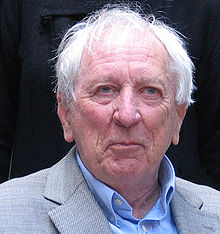
Meanwhile, Tranströmer … I’m not familiar with his oeuvre, but I recall Nobel laureate Joseph Brodsky dedicated a poem or two to him.  I can’t find it in my Collected.  Help me out anyone?  Elena?  Lora?

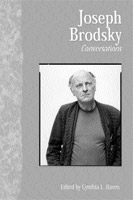
The effort to find it sent me back through my own Joseph Brodsky: Conversations, where I retrieved this nugget from 1975, during a Q&A after a reading in Iowa:

An acquaintance of mine, a Swedish poet, Tomas Tranströmer, who has been, in my view, real botched up by Robert Bly (Laughter), once said that your attitude toward a translator sort of goes through three stages.  First you trust him, and he kills you.  The second time you don’t trust him and he kills you just the same.  The third kind of attitude involves certain masochistic traits in you.  (Laughter) You say ‘kill me, kill me, kill me …’ And he kills you. (Laughter) It’s not my joke… it’s a quiet Swedish joke.” (Laughter)

Mea culpa:  In my earlier post, I had identified Néstor Amarilla as “she.”  This photo contradicts me.  Given the recent choices of Bjørg-the-Cyborg, I still wonder if they’ll award the darkest of dark horses.  Literary Saloon says “there is no way this very young author can take the prize” — calling him “ridiculously young.”  Probably right.  The site suggests Bella Akhmadulina. as a dark horse alternative.