
Hello Dalai! (VIDEO added)

Share

The Dalai Lama has come to town. I will be covering his speech at Maples Pavilion tomorrow morning, and later in the day, “Harry’s Last Lecture” at Memorial Church.  I have already written about why he is returning to Stanford here.  (Clue:  It’s not the palm trees or the ipods.)

(Update on Oct.16:  Coverage on the articles here, here and here.  VIDEO BELOW.)

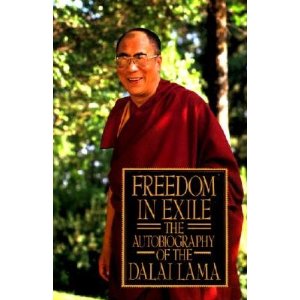
Tonight, I returned briefly to his 1990 autobiography, Freedom in Exile, in which the spiritual, the superstitious, the mythical, and the matter-of-fact are tossed in a uniquely Tibetan salad.

He recalled the summer 1950 earthquake that, to him, was an “omen from the gods, a portent of terrible things to come.” He remembered crashing “like an artillery barrage” a few days before news of the Chinese invasion.  He was 15 years old:

“Some people even reported seeing a strange red glow in the skies in the direction from which the noise came. It gradually emerged that people had experienced it not only in the vicinity of Llasa but throughout the length and breadth of Tibet …

HHDL doesn't think he told "the whole story"

Now from very early on, I have always had a great interest in science. So naturally, I wanted to find a scientific basis for this extraordinary event. When I saw Heinrich Harrer a few days later, I asked him what he thought was the explanation, not only for the earth tremors, but more importantly for the strange celestial phenomena.  He told me he was certain that the two were related. It must be a cracking of the earth’s crust caused by the upward movement of whole mountains.

To me, this sounded plausible, but unlikely.  Why would a cracking of the earth’s crust manifest itself as a glow in the night sky accompanied by thunderclaps and, furthermore, how could it be that it was witnessed over such immense distances? I did not think that Harrer’s theories told the whole story.  Even to this day I do not. Perhaps there is a scientific explanation, but my own feeling is that what happened is presently beyond science, something truly mysterious. In this case, I find it much easier to accept that what I witnessed was metaphysical.  At any rate, warning from on high or mere rumblings from below, the situation in Tibet deteriorated rapidly thereafter.”
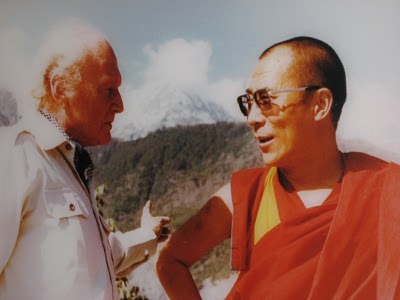
Browsing through the book, what’s remarkable is the equanimity of tone, which blunts the edge of drama at Chinese lies and betrayal, even though he admits to being at times “scared” and “furious.”  He had to slip away to escape, in disguise, to slip the tens of thousands who had gathered to protect him from the Chinese:

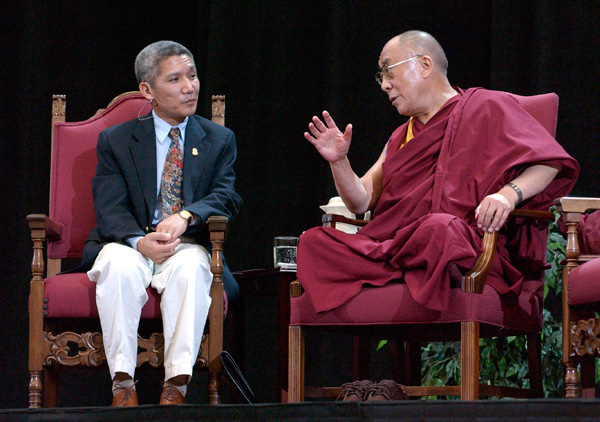
HHDL and his Cambridge-educated sidekick (Photo: L.A. Cicero)

“We left Lhasa at dead of night. It was cold but very light, I remember. The stars in Tibet shine with a brightness I have not seen anywhere else in the world. It was also very still and my heart missed a beat every time one of the ponies stumbled as we made our way stealthily from the courtyard at the foot of the Potala, past the Norbulingka and Drepung monastery.  Yet I was not really afraid.”
In Nepal, in the 1970s, I remember interviewing a monk who had been one of about 2500 in one of Tibet’s monasteries.  When the Chinese attacked, they had four antiquated rifles to defend themselves.  Sipping Tibetan tea as we spoke (and sipping is all you can do unless you’ve acquired the taste for it; it has butter and salt in it), I remember his patient voice and calm smile as he told of the onslaught of the modern Chinese forces.  I also remember sophisticated Tibetan hoteliers who had been shepherds in the Tibetan mountains, alone for days with their yaks.  Tibetan practicality again.

For all of them, the story of their own exile began with the Dalai Lama’s end flight into India, never to return:

“After bidding these people a tearful farewell, I was helped on to the broad back of a dzumo [a cross between a yak and a cow — and no, I couldn’t find a photo on google], for I was still too ill to ride a horse.  And it was on this humble form of transport that I left my native land.”

If you have a romantic image of the Dalai Lama chewing on his pen, scribbling his autobiography, you should know I have it on very sound authority that the Dalai Lama does not actually write his own books.  Who is the culprit?  I suspect Jinpa Thupten, the Cambridge-educated sidekick and translator, now a member of the faculty of McGill University of Montreal.
“I will embrace you with ashes”: Liu Xiaobo, the Writer

Share

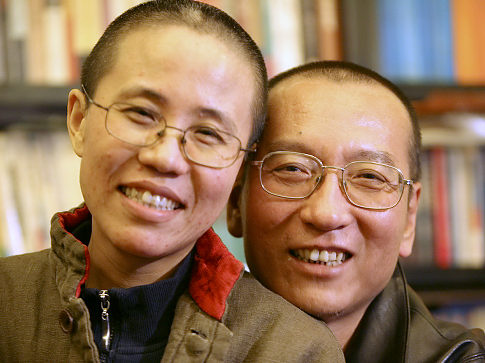
Liu Xia and Liu Xiaobo: "Visible and invisible prisons"

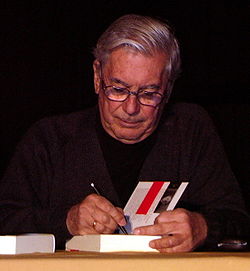
Two writers were awarded Nobel prizes this year — but only one of them won for literature.  In the brouhaha over his Nobel prize for peace, it’s easy to forget that Liu Xiaobo is a writer. Kind of a twofer, with Mario Vargas Llosa.

Liu Xiaobo is a writer, of course, but what kind of writer? From what I could glean on the web, he appeared at first to be a writer in the way all academics are writers.  His essays,  Critique on Choices – Dialogue with Le Zehou and Aesthetics and Human Freedom earned him glory in academia. The former critiqued the philosophy of a prominent Chinese cultural philosopher Li Zehou.

Then I found this from NPR over the weekend:

Mr. Liu is 54, a writer who became a dissident because, as he said, “an honest writer must live by his words.” In his essay, Philosophy of the Pig, he praises ordinary citizens who challenge China’s totalitarian rule, and castigates intellectuals who, he says, “feel brave because the government lets them write about sex, incest and human defects. In China, everybody has the courage to shamelessly challenge morals. Rare are those who have the courage to challenge reality.”

"A hard stone in the wilderness"

He was jailed after saving hundreds of lives in Tiananmen Square.  After his release 20 months later, he said, “I hope to be a sincere Chinese intellectual and writer. This can put me back into prison—which is what happens to people like me in China.”

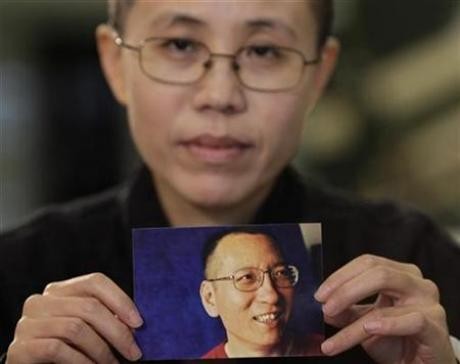
He is, of course, in jail again.  His wife, the painter, poet, and photographer Liu Xia, said to Deutsche Welle:  “I can only visit him, bring him books and write to him. They have allowed him to read and write for a year now. And he’s been allowed to see the sun twice a day for a year and a half. He is also allowed to go outside and move around – one hour in the morning, one hour in the afternoon.”

Liu Xiaobo‘s tireless work for human rights in China has rather overwhelmed his writing.  But I daresay every writer would rather be known for his writing, rather than for doing time.

So this, from NPR.  It’s a letter to his wife, Liu Xia, written last year from prison:

Sweetheart … I am sentenced to a visible prison while you are waiting in an invisible one. Your love is sunlight that transcends prison walls and bars, stroking every inch of my skin, warming my cell, letting me maintain my inner calm, magnanimous and bright, so that every minute in prison is full of meaning.

Given your love, sweetheart, I look forward to my country being a land of free expression, where … all views will be spread in the sunlight for people to choose without fear. I hope to be the last victim.

I am a hard stone in the wilderness, putting up with the pummeling of raging storms, and too cold for anyone to dare touch. But my love is hard, sharp, and can penetrate any obstacles. Even if I am crushed into powder, I will embrace you with the ashes.

(Finally, I found more of his writings here.)

Allen Ginsberg’s “Howl”: More on “Breaking up is hard to do…”

Share

He did not live long enough to see bad lineation

It started with Billy Collins. Now Allen Ginsberg has entered the act, via Publisher’s Weekly.

In July, we discussed the searing, red-hot topic of the day: the e-book and its effect on a poem’s lineation:

Poet Billy Collins has come out decisively against the e-book. The AP story is here.

His reason:  It’s difficult to manage a poem’s line breaks on the electronic screen, which has a disturbing tendency to break lines at awkward places and slide the remaining text onto the next line flush left, as if it were a new line.  Why it’s taken Collins so long to notice this is unclear — he could have seen it in any of his online reviews.

Robert Pinsky is confident the technical problems can be fixed, but that adds that besides the problems with portable e-readers, “most word processors treat verse as though each line were a paragraph. So, for example, typing a Wallace Stevens poem with capital letters at the beginning of the lines can be mildly annoying,” Pinsky says.

Now Craig Morgan Teicher at Publisher’s Weekly is ranting about the eBook version of Ginsberg’s Collected Poems and the screwed-up lineation.  “This is not ‘Howl,'” he howls:

“Ginsberg broke his poem into what he called “strophes,” those long lines that hark back to Whitman.  The indentations you see above are meant to indicate that the line keeps going beyond the end of the page, until the next left-justified line.  Ginsberg was careful in his liniation, and part of the poem’s impact is in seeing that “who” sticking out again and again on the left side of the page.  The digital version pays no mind to this whatsoever.  What we get is not the poem itself, but a kind of poor transcription of it.”

Just like we said.  Now, if we can just get Teicher to spell “lineation,” we’re in business.  He’s setting a bad example.  Galleycat repeated the misspelling.

TV? Don’t waste your time, says Stanford prez

Share

A waste of time? Who sez?

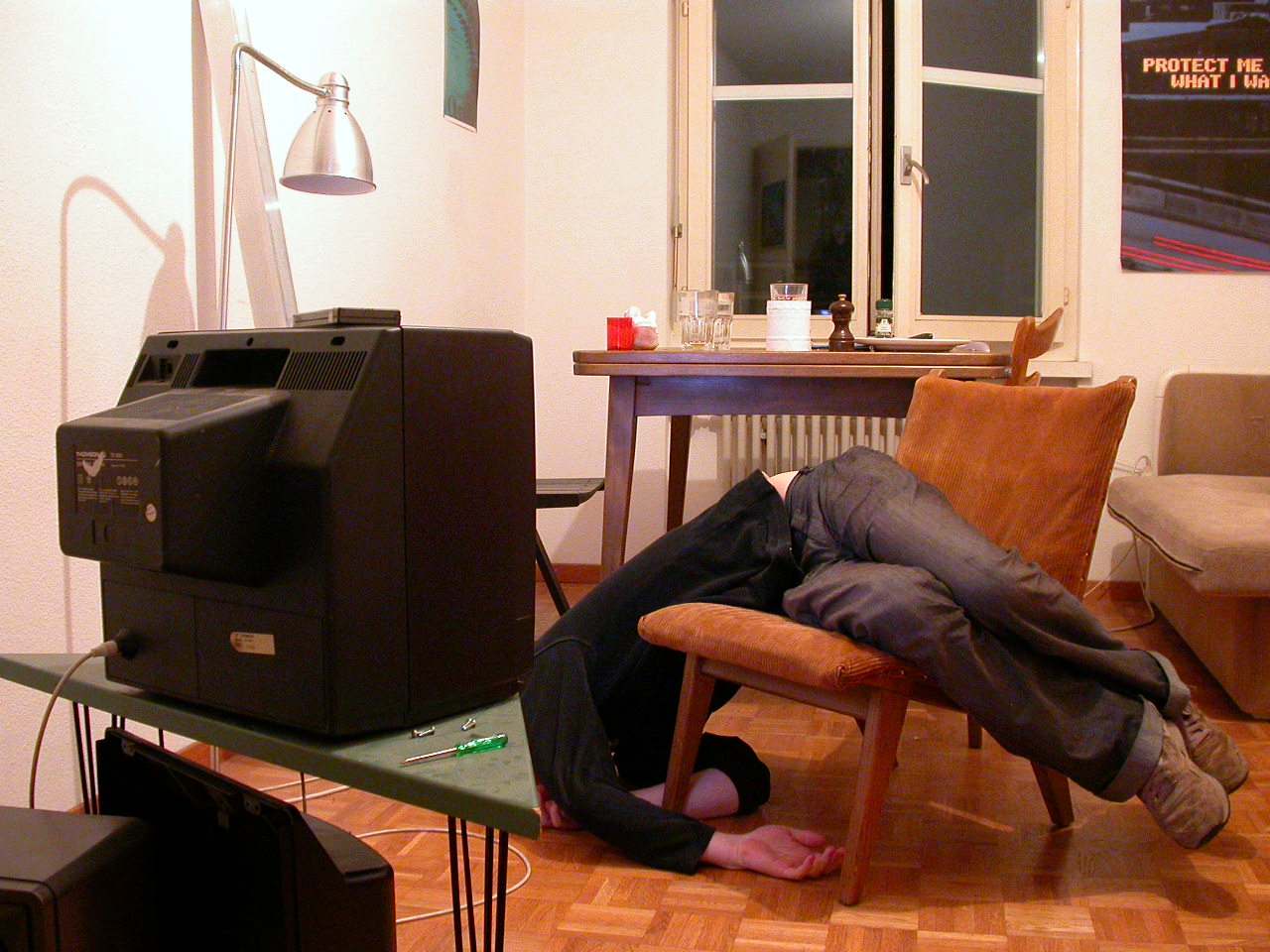
“TV is a waste of time,” said John Hennessy.  The Stanford prez added:

“Let’s face it. No one really loves watching TV, though we may do it occasionally.”

He came to that conclusion when he was interviewing, years ago, for a full-time faculty gig at Stanford. His interviewer was Donald Knuth, the “father of computer science.” Hennessy wondered if he was up to the job.  He asked Knuth how he managed his time.  Knuth confessed that he never watches TV.

“It was a great insight about using your time and doing what you really love,”  Hennessy’s told an audience at the Stanford University’s dedication of the new “Jen-Hsen Huang” Engineering building.  His comments were picked up by the Forbes blog here.  And boy, did they hit a pocket of resistance.

This, from Kym McNicholas of “Kym’s Faces of Tech”:

Those of you who bash television, you may talk about books on Picasso or Gauguin with people you want to impress. You may make sad sounds when people talk about the decline of the newspaper industry.  But no one is pulling the plug on TV stations. They’re thriving.  And guess what? We’re thriving online, too, on Hulu, YouTube, and Netflix. People love video! …

I also know of several Stanford graduates and Harvard graduates who never miss an episode of “Family Guy.” I hear it’s now preferred over the “Simpsons” for techies looking for a little humor as they decompress after a long day of programming. But are they any less intellectual because of that? No. Everyone needs an outlet. …

And one more thought. If television is such a waste of time, why are some of the largest companies such as Google, with Google TV, and Apple, with Apple TV, investing so much money it? Yes, to make it better. And yes, to make it more relevant for today, in terms of our Internet-centric world – a world that brilliant Stanford, Harvard, MIT, and other University graduates (or drop-outs) are helping to create.

So, I can imagine that the argument that “TV is a waste of time” is only going to get harder to defend.

Whew!  I guess John Hennessy really stirred the pot with this one. I caught “Family Guy” for the first time while waiting for my sons at their apartment about five years ago. I didn’t know what I was watching, but I was astonished at the crudity of the animation and appalled by the sexism and stereotypes. Do people really “decompress” with this stuff? The episode I watched included a veiled, seductive Arab woman snatching the father away from the mother in some sort of polygamous arrangement, in which the husband was mindlessly acquiescent.  Talk about stereotypes!

As someone who learned to “manage my time” the same way, many years ago, I can only say yes, John, yes, yes, yes, yes!

Joumana Haddad is killing Scheherazade

Share

Articulate, passionate, energetic

I was warned that the first twenty minutes or so of Joumana Haddad‘s presentation at Stanford on Oct. 4 would demolish the stereotype of the Arab woman.  But I arrived late from another appointment, and so I missed the Lebanese journalist and author’s presentation of the stereotype that, to me, seemed a straw man … or a straw woman.

I know, I know … the cowering Muslim woman, wearing a burqa, submissive to her husband, her son, her houseplant.  Anyone seen one of these around lately?  Raise your hand.  Anyone?

I thought not.  I don’t have that stereotype, and I doubt that many educated people do.  And it’s partly because the distinction was blurred — even in my invitation to this event, sponsored by the Stanford Center for Innovation and Communication, which is interested in fostering conversations about women’s rights in “the Arab and Muslim worlds” — about who, exactly, we are talking about.  Not all Arabs are Muslim; not all Muslims are Arab.

D'accord

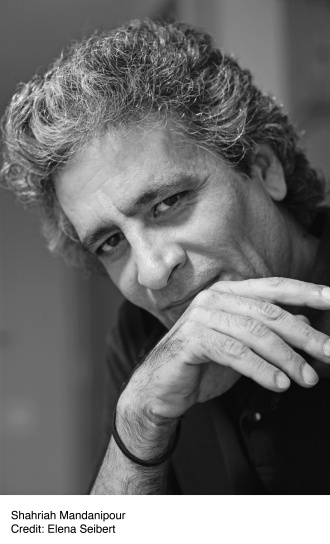
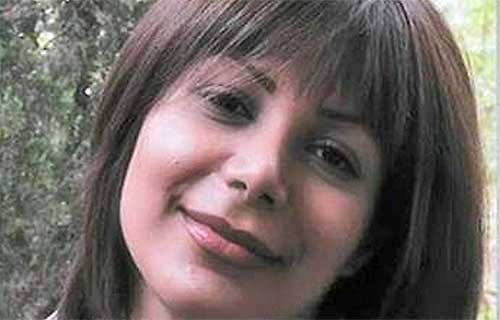
I was joined at the event by  a  high school friend, the elegant Turkish-American Erën Goknar — who is far from cowering, and even farther from burqa’ed.  Erën is one of my notions of the modern Muslim women, but I also think of Neda Agha-Soltan and all the determined women of Iran’s Green Revolution.  I think of Shahryar Mandanipour’s comment last year about them:

“He also thought of those who were still fighting — ‘brave students beaten with bottles,’ facing interrogation and torture in their struggle for human rights. ‘There are times the Iranian women are braver than the men. I think so,’ he said softly.

I think of Ayaan Hirsi Ali, too — even though she has forsworn Islam. Even though she’s been rejected by the politically correct.

And I also, too, think of the Iranian Sakineh Mohammadi-Ashtiani, sentenced to be stoned to death, a political event which Haddad seemed to think gets too much focus, at the expense of the modern face of Islamic women.  True, true, but there’s the old journalistic saw: If you passed ten houses, and one of them was on fire … which one would you go back to the newsroom and write about?

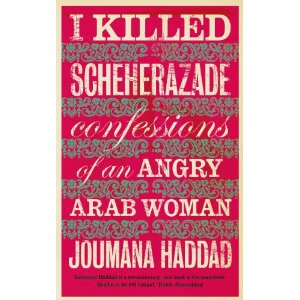
None of these thoughts represents Haddad fairly, or justly represents her book, with the admittedly catchy title, I Killed Scheherazade: Confessions of an Angry Arab Woman. (Scheherazade, incidentally, is a legendary Persian queen, not an Arab one — so our confusion is understandable.)

The face of modern Islam

For balance, then, here’s what our new Nobel laureate, Mario Vargas Llosa, had to say about her book:

“A very courageous and illuminating book about women in the Arab world.  It opens our eyes, destroys our prejudices and is very entertaining.”

Haddad spoke eloquently of the need for increasing not only literacy in the Arab world, but the practice of reading.  Beyond the skill of reading, she plugged for the wide availability of literature and magazines, reviews, newspapers.  Too much cannot be said on the topic.

Haddad (she was reared as a Catholic, not Muslim, and now calls herself an agnostic, “thank God … whoever He is”) is an appealing and very attractive figure.  The 40-year-old poet and journalist spoke about her creation, Jasad magazine, which wikipedia described as “a controversial Arabic magazine specialized in the literature and arts of the body.” She calls it “erotica.”  Not surprisingly, it is banned in Saudi Arabia.

For someone taking on the subject of stereotypes, I was disturbed by her reliance on cliché (especially troubling for a woman who considers herself a poet).  She spoke of the “free and emancipated” woman.  She spoke of how the internet “teaches you that the personal is universal” and that it’s “connecting the world together — I really believe in the power of that.”  She spoke of “empowerment.” So I wasn’t terrifically surprised when she said,  in answer to a question, “I never function by ‘outcomes,’ I function by fashions, needs, anger.”

She spoke of the goal of religions to “control” sexuality — but seemed to ignore that all archaic societies have extensive laws governing sexual behavior, as a way of preventing social chaos.  You will have a tough time finding an exception.  (Naomi Wolf’s now notorious 2008 article asserted that “Muslim attitudes toward women’s appearance and sexuality are not rooted in repression, but in a strong sense of public versus private” — it’s a point worth considering.)

She spoke of the dreadfulness Barbie with a burqa, but I think it’s also dreadful to have a “doll” with the equivalence of a 50″ bust as a “toy” for girls.  Far be it from me to defend the burqa, but I have wondered if it’s any more imprisoning than a string bikini, with the attendant starvation and head-to-toe waxing and worrying and body obsession.  If that puts my thinking in line with Osama Bin Laden & co. (as someone on a website pointed out vis-a-vis Wolf’s article), so be it.  Every word that proceeds from a criminal and terrorist is not necessarily crime and terrorism.  That’s where thinking should kick in.

She spoke of Scheherazade and the title of her book. Evidently, Haddad is agin’ her, because she has “negotiated her basic rights — one of the things we have to stop doing is negotiating basic rights.  We are equal to men — we don’t have to ask for that.”  True, true … we are equal.  But we still are the ones who get pregnant.  Access to universal, quality child care is still a more pressing concern for women than men.  Maternity leave, as well.  You simply can’t unhook the welfare of women from the welfare of children.  In the sense that we create life, we are more than equal; we are also less free.  Anyone who has been a single mother can tell you that.

In the larger picture, Scheherazade represents not only a female heroine, but a universal hero — precisely because we are all negotiating the terms of our existence, every single day.  She’s speaks not only to other women, but to the whole human family.  She is speaking to the power of the word, and the endurance of the story.  Those things exist beyond “fashion, needs, anger.”

So what does it mean when Haddad wants to “kill” her — even in a flippant, symbolic  way, for a catchy book title?

As the much much-maligned Naomi Wolf wrote, “it’s worth thinking in a more nuanced way about what female freedom really means.”  Maybe we need some kind of “empowerment” that goes even beyond “erotica.”

Quiet coup: Peruvian Mario Vargas Llosa wins the Nobel

Share

A bride at last...

By now everyone has heard what I learned at 4.30 this morning: sometimes even perennial bridesmaids catch the bouquet.  Mario Vargas Llosa has been on the lists for so long that no one even noticed him somewhere midway on the betting lists of Ladbrokes (on Sept. 29 he ranked 40th in a field of 75).

This is a safe, uncontroversial choice for the Nobels —  an eminent, 74-year-old writer with a lifetime of acclaimed work behind him.

This means Ladbrokes can pay all its bets now.  It means that Ted Gioia probably won’t be penning his Nobels from an alternative universe.  And Néstor Amarilla, the 30-year-old Paraguayan who had an unexpected international spotlight thrown on him for reasons we have yet to fathom (he is, in everyone’s opinion, far too young for the Nobel, despite the excellence of his work), returns to his pen in peace.  And Bjørg-the-Cyborg gets a well-deserved rest this year.

And Amazon.com wins, too:  I’ve ordered two books by Tomas Tranströmer‘s The Great Enigma: New Collected Poems; Saved by a Poem, the only book in English by Néstor Amarilla, and Seamus Heaney‘s Stepping Stones and Human Chain for good measure.

Meanwhile, the Nobel poetry drought continues.