
Ian Morris: The man who has an answer for everything

Share

Ian Morris has an answer for everything.  And you’ll be able to hear it all tonight at Kepler’s at 7 p.m.  Or, for the Cliffs Notes version, see my video interview above.

I wrote about Ian some time ago, well before the launch date of his new book, Why the West Rules — For Now — which is out this month.  In a world of cautious scholarship, Ian is going way, way out on a limb with his grand récit, a story about how everything came to be in the history of the world.  Remember crazy James Burke in The Day the Universe Changed, the man who could somehow connect the drift of continents with the invention of spaghetti?  Ian Morris grabs the other end of the telescope.

It’s an unusual publishing choice for Farrar, Straus & Giroux, who usually publishing premiere literary works.  I understand the top publishing house wants to expand its repertoire.

Friedrich Keyl's painting of Looty. The collar with bells in the foreground is the only remant of his earlier royal life.

When I wrote my own article, I began it with a small dog that has a big story:  a yapping Pekingese named Looty.  (It guaranteed me a readership among Pekingese fanciers.)

I wrote:

After the sacking and destruction of Beijing’s summer palace in 1860, the Chinese empress’ Pekingese – the appropriately named Looty – was whisked to the royal family at Balmoral, bringing the previously unknown breed to the West.

But why Looty to Balmoral, instead of the other way around, with Queen Victoria’s beloved Skye terrier, Islay, going to the emperor in Beijing?  Why was it the British, and not the Chinese, who dominated?

Stanford Classics and History Professor Ian Morris puts forth some bold answers in his ambitious new 750-page book, Why the West Rules – For Now (Farrar, Straus & Giroux).  And that places Looty in a longer story going back to the last ice age.

Looty’s story is sadder than I made it sound.  Though he lived a long and contented life in Victoria’s lap, after an initial period when he was beat up by the British dogs, here’s his unexpurgated story, as told in Jolee magazine:

One British soldier who arrived too late to share in the plunder of the Palace, discovered in a corner of the Garden of Clear Ripples four little dogs and their attendant, a lady of the Court who had committed suicide rather than be taken prisoner by the barbarians. Gathering up the four little dogs, he put them in his gunnysack and later whilst rejoining his regiment at muster prior to embarkation on Her Majesty’s ship “Odin” for the return to England, the four dogs would not stay still. One of the officers noticed movement in the soldier’s gunnysack, and was ordered to disgorge the contents of his sack – and out poured the four dogs which were immediately confiscated from the aberrant soldier by his officers.

The dogs should have been returned to the Summer Palace but were not.  One dog and a bitch were taken by Lord John Hay and later given to his sister the Duchess of Wellington. The other dog and bitch were taken by Sir George Fitzroy and given to his cousin the Duchess of Richmond. And of course “Lootie” was given to Queen Victoria by Captain Dunne.

After reviewing my own paragraphs, copyeditor Barb Egbert came back and cheerfully corrected me, “Shouldn’t we say the last ice age?”  Silly me.  I was confusing the last ice age with all those other ice ages.

Now that’s an editor.

Barb Egbert took away the 800-page book (with index) — otherwise I would include an excerpt.  Soon she will know everything about everything.  Sometimes I think she already does.
A word about Yoko Ono, and then we return to our regular programming…

Share

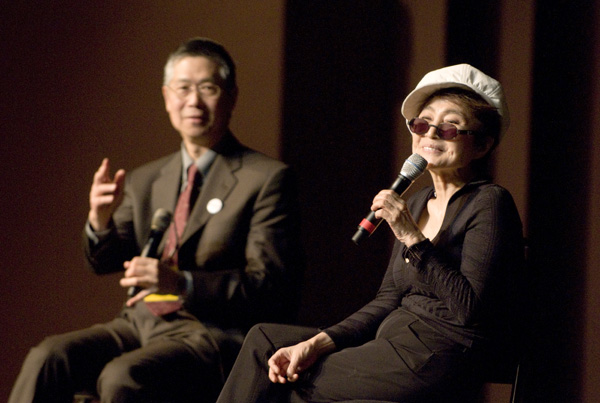
Yoko and historian Gordon Chang (Photo: L.A. Cicero)

The Dalai Lama, Condi Rice, now Yoko Ono.  What has gotten into us? Okay, okay, a quick word about Yoko, and then we return to our regular programming.  Maybe a word or two about Leszek Kołakowski, or maybe a thought about Fulke Greville‘s influence on Thom Gunn and Robert Pinsky.

Tonight’s CNN interview headline: “Ono: ‘I was used as a scapegoat’ in blame over Beatles breakup.”

This is not news.  I interviewed Yoko in January 2009 here.  An excerpt:

HAVEN: You’ve gone from one of the most reviled public figures—the one that was blamed for breaking up the Beatles—to a celebrated international icon. How did you weather the storms?

ONO: I think that I was very lucky. I went through the most horrible situation where I could have been killed. There were people who really wanted me dead. I don’t know how I survived that. You can’t advise people. It’s such a severe situation when people go through it, I don’t know what they can do. All we can do is do our best, whatever that is—our best to survive.

Kołakowski anyone?

HAVEN: Of course, when you burst on the world stage with John Lennon in the 1960s, World War II was only two decades in the past, and the women’s movement had not yet been launched.

ONO: Exactly. [laughs]

HAVEN: Do you feel sexism and racism played a role in your treatment?

ONO: Definitely. It was very upfront, very clear. I think maybe I was used as an example of something—to make people understand what one goes through. Maybe in that sense it was beneficial—beneficial to society, maybe.

You heard it first here.

Whew!  We’re glad we got that out of our system.

Condoleezza Rice praises “Extraordinary, Ordinary People” at Stanford Bookstore

Share

Back at Stanford ... applause and protest (Photo: L.A. Cicero)

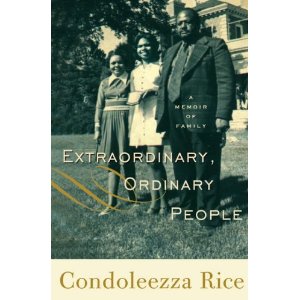
Three Stanford police were outside the Stanford Bookstore at 4 p.m. today.  Book theft?  No, a book signing.  Condoleezza Rice, professor of political science and Hoover fellow, made a rare appearance — sans secret service or personal bodyguards — to promote her new memoir, Extraordinary, Ordinary People.

One student held a sign outside the glass doors: “Condi’s signature is dripping with blood.”  He was remonstrating with a swarthy man in a suit who seemed to be holding a photographer’s camera lens … no, it was a full Pepsi Cola bottle.  I had arrived a few minutes late, and didn’t have a chance to see the playing out of that little drama.

Fortunately, Prof. Rice was a few minutes later than I was.  I waded towards the basement “textbook area,” where students were crowding the balustrades and peering downwards.  I elbowed my way downstairs, mildly squashing myself beside two Asian students, who were speaking in Chinese and thumbing through the first pages of her book.

It’s diplomatic to say someone “hasn’t changed” in decades — but Condi Rice really hasn’t changed.  I remember her as a young associate professor of political science in the mid-80s.  A couple of decades and thousands of hours of workouts later (hers, not mine), she really does look the same, wearing a sleek brown jacket and trousers.

She didn’t talk about the controversial Bush years:  Everyone expects “the obligatory secretary of state memoir,” a policy memoir with names and insider’s details, she said.  “Indeed I have started and will finish that book.”

Instead, she wanted to talk about “extraordinary, ordinary people” John and Angelena Rice.  Her mother taught English and was one of Willie Mays’s early teachers.  She had told him, recalled Rice, “Son, you’re going to be a ball player, and if you have to leave class a few minutes early…”  The rest of her remark was lost in laughter.  Her father had been a Presbyterian minister and founder of Westminster Presbyterian Church.

Part of what makes extraordinary people, she said, is extraordinary times.  Birmingham, Alabama, was “the most segregated city in America,” she said, a place where “racism was quite hard-edged.”  For the Stanford students who formed most of the crowd, it was a description of the lost and unimaginable reality – for some, a world that died before even their parents were born.

Rice recalled the “horrors of Birmingham,” where she lost a childhood friend in the 16th Street Baptist Church bombing that killed four young girls in 1963, during the time the city was called “Bombingham.”  Nevertheless, in the close-knit neighborhood of Titusville where she grew up, the children were taught “We could not have a hamburger at Woolworth’s, but you could become president of the United States.”

In addition to the secretary of state, the community produced the president of the University of Maryland at Baltimore, two Pulitzer prizewinners, and a host of other luminaries who flew by my ear faster than my pen could write.

Rice said she was taught: “There are no victims.  You cannot control your circumstances, but you can control your response to circumstances.  You will have to be twice as good.”  Adversity would give them an armor to defend themselves against “them.” “’They’ will have to respect you.  That was the mantra,” she said.  Education was the key.

Studying in Denver

She recalled her grandfather, a sharecropper who was determined to get an education.  After one year at Stillman College he was out of money and told he could not continue.  He asked how the other kids could stay.  They have scholarships, he was told; on the other hand, if he wanted to become a Presbyterian minister…  “That was exactly what I had in mind,” her grandfather decided on the spot.  His son adopted the same calling.

Rice remembered the collapse of Jim Crow and the passage of the Civil Rights Act.  She and her parents watched The Huntley-Brinkley Report announce the passage of the act, which the local news called “the so-called Civil Rights Act.”

The Rice family was anxious to find out the truth.  They went to a movie theater, and then a restaurant.  As they entered the restaurant, “People looked up, suddenly realized it wasn’t illegal, and went back to eating.”

However, a few weeks later she was served a hamburger that tasted odd.  Where’s the beef?  She showed her parents:  it was  onions, not hamburger.

She had trained as a pianist – but changed her mind when she faced a future of “teaching 13-year-olds to murder Beethoven.”

The default mode was international relations.

Her mother died of cancer in 1985. Her father died on Dec. 24, 2000 – a week before his daughter went to Washington as national security advisor.

Titusville kids valued education -- here she's in Boston

She admitted she misses them both, when she travels and still wishes to send them snapshots, or when she walked in the Holy Land she thought of her Presbyterian father, or when she went to Aïda, the first opera she had attended with her mother.

“But when you’ve been that close, your mother and father never leave you,” she said.  Her father would tell her, “You’re God’s child, and you are prepared for what is ahead of you.”

“There’s no better gift that they can give you – that sense that you are prepared for what is ahead of you.”

She started her brief talk after Stephen Krasner’s fulsome introduction, and was finished by 4.20 p.m.  The next hour and a half was reserved for book signing – row by row, to prevent chaos.  The crowds at the balustrades had doubled.

Outside, the Stanford police still lingered.  I asked one of them who the swarthy man was – not suprisingly, he was another policeman.

No protests?  The officer indicated about ten people, milling and languidly talking among themselves.  It didn’t look like much of a demo.  “They were doing the megaphone about 10 minutes ago,” the officer reassured me, and they had been passing out leaflets.  It was quiet now.

“That’s the way we like it,” he said. “Nice and peaceful.”

Iran? “We need a new paradigm,” writes Abbas Milani

Share

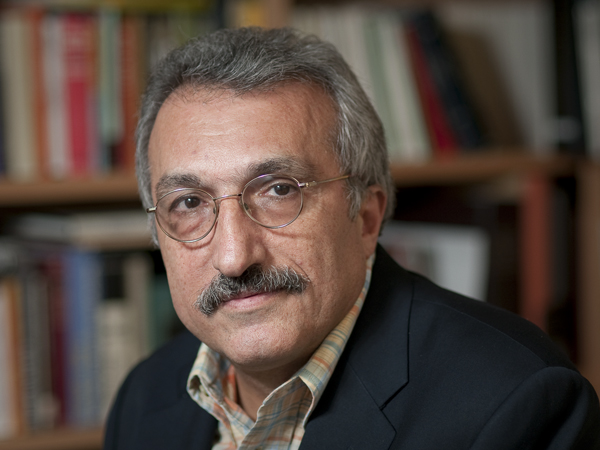
He fights for democracy in Iran (Photo: L.A. Cicero)

In a friendly chat with Iraqi Prime Minister Nouri al-Maliki, who is trying to drum up support for his leadership,  Iran’s Supreme Leader, Ayatollah Ali Khamenei, offered these words of wisdom:

“The Iraqi nation is vigilant and aggressors cannot dominate this country again,” Mr Khamenei told Mr Maliki, according to a statement put out by his office. “May God get rid of America in Iraq so that its people’s problems are solved.”

Solved for which people? I doubt it will improve much for women, if Iran is to be held as a role model:  Sakineh Mohammadi-Ashtiani‘s former lawyer said, after he legged it to Norway, “In Iran, unfortunately, one could say women are in a real situation of slavery.”

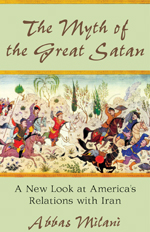
So much remains to be “solved” — her fate, and the fate of others like her.  And nukes.  And “fuel swaps,” and … and…and… Will any of it work?  This, from Abbas Milani‘s new book, The Myth of the Great Satan:

“Of the many problems plaguing U.S.-Iranian relations in the last thirty years, the most elemental problem is the one most easily overlooked or ignored: the United States plays by the normal rules and logic of diplomacy while the clerical regime plays by its own idiosyncratic rules.  Trying to deal with the regime only through traditional channels of diplomacy is akin to fighting an agile terrorist insurgency with the ponderous might of a regular army.  While it is clear that there is no military solution to America’s ‘Iran problem,’ it is no less clear that a new paradigm, equipped to counter the Iranian regime’s self-serving rules of conduct, needs to be developed.  The Iranian regime’s agility is rooted in its despotism; the ponderous pace of American policy is the price society pays for democracy.  The challenge is to match Iran’s agility without sacrificing the principles of democracy.”

Milani writes that a number of factors have resulted in a “diplomatic disparity between the regime, with its double talk and outright lies, and the United States, trying to play by the traditional rules of diplomacy.  Tagiyeh, a Shiite concept allowing the faithful to lie in the service of faith, provides clerical leaders with a theological cover for their lies and obfuscation.”

We’ve written about Milani before here and here — and did a Q&A with him a while back here.  He is a relentless advocate for Iran’s Green Revolution, and says the solution to our problems is to back democracy in Iran.

Joseph Brodsky, Shirley Jackson, and the “no-fault Holocaust”

Share

Literature as “moral insurance”

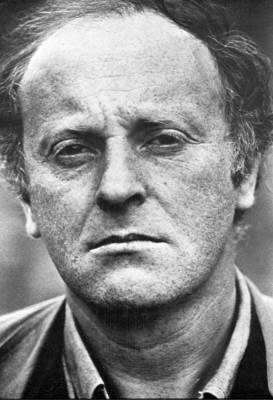
“As a form of moral insurance, at least, literature is much more dependable than a system of beliefs or a philosophical doctrine. Since there are no laws that can protect us from ourselves, no criminal code is capable of preventing a true crime against literature; though we can condemn the material suppression of literature – the persecution of writers, acts of censorship, the burning of books – we are powerless when it comes to its worst violation: that of not reading the books. For that crime, a person pays with his whole life; if the offender is a nation, it pays with its history.” — Joseph Brodsky, 1987 Nobel lecture

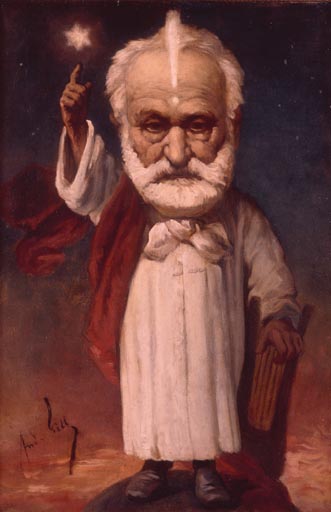
At the time, I had reservations about Joseph Brodsky‘s absolutist view of literature as “a kind of moral insurance.”  I am less ambivalent now.  I was reared … or rather, I reared myself … on the novels of Charles Dickens, Victor Hugo, and the Brontës; I suppose the great heart of the 19th century formed much of my moral and political education.

Great-hearted Hugo

As Susan Sontag said, “Reading should be an education of the heart.”  In a world where offline reading is occurring less and less, I wonder where and how such a shaping of the heart will occur.  (The graphic novel is a promising form — but, as in the case of “Borderland,” I think it is better as an appeal to pre-existing values, and lacks the nuance required for “the education of the heart.”)

Yesterday, I ran across this 1997 article, “A No-Fault Holocaust,” in U.S. News and World Report:

‘In 20 years of college teaching, Prof. Robert Simon [of Hamilton College] has never met a student who denied that the Holocaust happened. What he sees quite often, though, is worse: students who acknowledge the fact of the Holocaust but can’t bring themselves to say that killing millions of people is wrong. Simon reports that 10 to 20 percent of his students think this way. Usually they deplore what the Nazis did, but their disapproval is expressed as a matter of taste or personal preference, not moral judgment. ‘Of course I dislike the Nazis,’ one student told Simon, ‘but who is to say they are morally wrong?’

She refused punditry

The article also discusses a Chronicle of Higher Education piece by Kay Haugaard, a writer who teaches at Pasadena City College, about Shirley Jackson‘s famous 1948 story, ‘The Lottery,’ which used to be a staple of high school reading lists.  The story:  A sunny small-time American town that gathers every year to implore an unnamed force to grant a good corn harvest. Annually, the citizens draw slips of paper from a wooden box to select a victim for human sacrifice. A young mother draws the losing card, and is stoned to death by the community.

“Until recently, she says, ‘Jackson’s message about blind conformity always spoke to my students’ sense of right and wrong.’ No longer, apparently. A class discussion of human sacrifice yielded no moral comments, even under Haugaard’s persistent questioning. One male said the ritual killing in ‘The Lottery’ ‘almost seems a need.’ Asked if she believed in human sacrifice, a woman said, ‘I really don’t know. If it was a religion of long standing. . . .’ Haugaard writes: ‘I was stunned. This was the woman who wrote so passionately of saving the whales, of concern for the rain forests, of her rescue and tender care of a stray dog.’ …

“The search is on for a teachable consensus rooted in simple decency and respect. As a spur to shaping it, we might discuss a culture so morally confused that students are showing up at colleges reluctant to say anything negative about mass slaughter.”

Jackson refused to explain “the meaning” of her story, except to tell the San Francisco Chronicle a month after the story was published in the New Yorker:

Explaining just what I had hoped the story to say is very difficult. I suppose, I hoped, by setting a particularly brutal ancient rite in the present and in my own village to shock the story’s readers with a graphic dramatization of the pointless violence and general inhumanity in their own lives.

According to one critic, Jackson intended “a sensitive and faithful anatomy of our times, fitting symbols for our distressing world of the concentration camp and the Bomb.”  But what to do when readers are tone-deaf to “symbols” and even meaning?

Mind, Jackson’s story was written at a time when anyone’s stoning seemed unthinkable and archaic, and not part of the daily news — today?  different story.  Think of Sakineh Mohammadi Ashtiani, among others.

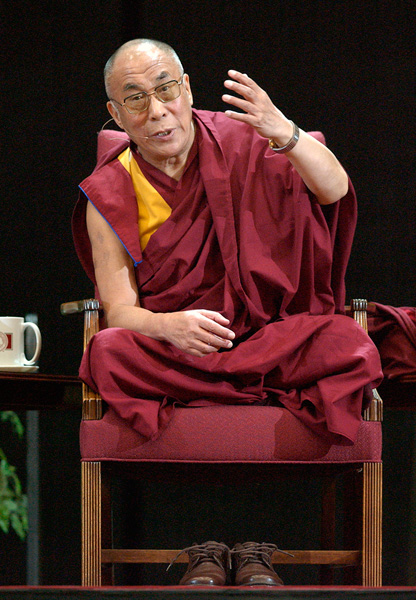
Undoubted courage (Photo: L.A. Cicero)

So I wonder at the popular appeal of the Dalai Lama last week, and the euphoria at his teaching, which suggests that our compassion should be motivated by the universal search for happiness, and also by the knowledge that compassion contributes to our own physical well-being — it lowers our blood pressure, releases endorphins, etc., etc., etc.  Is compassion motivated this way compassion at all — or just an extension of endless cycle of self-help routines? Is that the only common denominator left? And how will such a self-serving compassion help one when the Nazis bang on the door, looking for the Jews? Or when the NKVD asks for names during a Lubyanka interrogation?  The most immediate response — to lower one’s blood pressure, reduce one’s heartbeat — is to hand them over.

What bugs me is that the Dalai Lama — the man who faced off bloody Mao Zedong, one of the last century’s immortal genocidaires — is a man of endless courage.  He knows this stuff.  It’s a peculiar reverse case of our current malaise — he walks the walk, but why doesn’t he talk the talk?

Without a compensatory virtues of independence of mind, and, beneath that, courage — which the ancients believed is the foundation of all virtues — is there any compassion at all?