
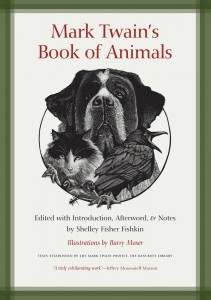
Last-minute gift for animal lovers … and Twain fans, too

Share

twain“Of all the animals, man is the one who is most cruel,” wrote Mark Twain.  According to Shelley Fisher Fishkin, a leading Twain scholar, the 19th century author isn’t well enough known for his positions on animal welfare. She’s setting the record straight.

Her new book, Mark Twain’s Book of Animals, a compilation of 50 years of Twain’s writing about animals (and illustrated by Barry Moser), is  humorous and jaunty, dark and upsetting — sometimes all at once:  For example:  “Cats are packed full of music — just as full as they can hold; and when they die, people remove it from them and sell it to the fiddle-makers. O yes indeed. Such is life.”
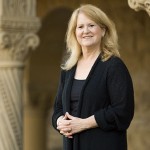
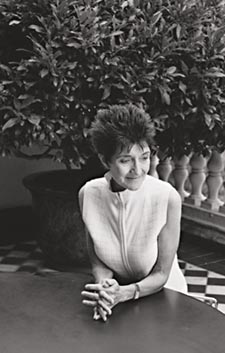
fisherfishkin

Fisher Fishkin (Photo by L.A. Cicero)

Twain’s kindness sprang from remorse.  His mother had “pleaded for the fishes and birds and tried to persuade me to spare them.” The killing of a bird provided a conversion:  “I had not needed that harmless creature, I had destroyed it wantonly, and I felt all that an assassin feels, of grief and remorse when his deed comes home to him and he wishes he could undo it and have his hands and his soul clean again from accusing blood.” Twain put his own moment of conscience in the words of Huck Finn:

“…I see a bird setting on a limb of a high tree, singing, with its head tilted back and his mouth open, ad before I thought I fired, and his song stopped and he fell straight down from the limb, all limp like a rag, and I run and picked him up, and he was dead, and his body was warm in my hand, and his head rolled about, this way and that, like his neck was broke, and there was a little white skin over his eyes, and one little drop of blood on the side of his head, and laws! I couldn’t see nothing more for the tears; and I hain’t never murdered no creature since, that wasn’t doing me no harm, and I ain’t going to.”

Listen to Shelley’s podcast:  Would Mark Twain go Bare for PETA?)
“A great writer needs your help”

Share
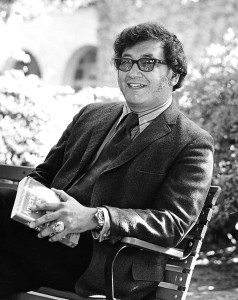
Momaday

Momaday as a Stanford prof in the 1970s. (Photo credit -- Chuck Painter)

On Monday, the Native News Update of “News from Indian Country” announced that the Pulitzer-prizewinning novelist N. Scott Momaday is in ill health and uncertain financial circumstances. According to the TV station, the 75-year-old Kiowa writer is suffering from the debilitating side-effects of diabetes and “now requires 24/7 home health care that has drained his personal finances as well as those of the caregiver organization that had been subsidizing those services for some time.”  You can hear the news towards the end of the broadcast here.

My former editor at the Georgia Review, ASU’s Terry Hummer, posted a letter on his Facebook page from Holly YoungBear-Tibbetts:  “A Great Writer Needs Your Help.”  The letter is being circulated within the Native American community, urging support for one of its “Living Treasures.” She added, “It will be some time before Mr. Momaday is fully recovered and able to resume his work and that is why I’m writing to ask you to consider making a personal contribution to the care-giver service Coming Home Connection, a nonprofit Santa Fe based home health care service provider.”

Personal checks to Coming Home Connection, designated for the N.Scott Momaday Fund, should be mailed to: Coming Home Connection, 418 Cerillos Road, Santa Fe, NM 87501. Or donate online at the Coming Home Connection website.

Momaday spoke memorably at Stanford two years ago — I quoted him here:

Momaday said the Kiowa stories he told had never been written down prior to his own efforts. Over the years, he has come to realize “how fragile some of these stories are—and how important they are.”

“I believe they need to be told,” he said, responding to a query about the need to continue telling stories even after they are already in print. “Poetry needs to be told and it needs to be heard. I have lived with certain poems all my life, and I still haven’t come to the end of them.” The page is just “one way of getting them out,” and not necessarily the most interesting, he said.

Momaday noted that some critics had called Rainy Mountain his “spiritual autobiography.” He added, “The more I think about it, there’s something to it.” The stories “made me who I am, and will make my children who they are.”

One student found Momaday’s approach difficult and fragmented, and claimed he had a hard time understanding Kiowa culture from it. He asked what Momaday’s purpose was. The author answered, “I wanted to tell the story of the coming of a people to the full realization of their destiny.”

Responding to a question about how he knew when his story was coming to an end, Momaday answered, “I didn’t have a sense of it coming to an end. It’s a wheel: Myth becomes history becomes reminiscence becomes myth. All stories are contained in other stories.”

What becomes a legend most?

Share

Nearly two years ago, I followed winding LaHonda and Skyline roads through the fog and driving rain of a California winter.  It was a trip that would have been stunning in the sunlight — but was downright terrifying on that day of  wind and rain and unearthly mists, with any momentary skid potentially fatal along the treacherous hilltops stretches. But the several hundred people making that journey into the Woodside hills had a somber determination.

diane

Diane in London (Photo: Amanda Lane)

The occasion was the memorial service for legendary biographer Diane Middlebrook at the Djerassi Resident Artists Program — in a spacious wooden building up amid the mists and treetops on that cold January day.  And the chilly rain did not dampen the gathering as Diane’s husband Carl Djerassi, stepson Dale Djerassi, daughter Leah Middlebrook, and others spoke of the warmth and spirit Diane had brought into their lives.

In addition to being the acclaimed author of Her Husband: Ted Hughes and Sylvia Plath, Anne Sexton: A Biography, and Suits Me: The Double Life of Billy Tipton, Diane was enormously popular and enormously loved — so it’s no surprise that her friends wanted to create a lasting memorial.  They are well on their way to doing so, with the Diane Middlebrook Memorial Writers’ Residence on the Djerassi Program campus.

According to her daughter, Leah Middlebrook:  “The new residence for writers was a dream of Diane’s, and we can’t think of a more fitting memorial to her spirit.  This facility will increase the capacity of the Djerassi Program to host artists by 50 percent. At the same time, it will strengthen the discipline that was Diane’s own.”

Groundbreaking is planned for spring 2010, with a fall occupancy.  Organizers are still raising the remaining $200,000 of the $750,000 to complete the residence (Carl  contributed $400,000, Sue and John Diekman donated an additional $100,000).

Those who wish to contribute can do so at www.djerassi.org, clicking on “support” and then on “Diane Middlebrook Building Fund.”  Click on “donate now” to open a secure donation service — make sure you add “Diane Middlebrook Building Fund” in the gift acknowledgment box.


resized2

The Diane Middlebrook Memorial Writers' Residence will provide five new structures and a solar collection canopy. Additional artists will occupy four personal studios for living and working. (Courtesy of the Djerassi Resident Artists Program and CCS Architecture, San Francisco)

Iranian writer speaks of “the insanity of censorship”

Share
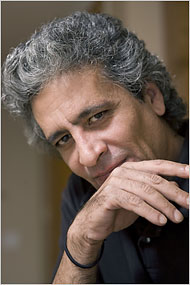
kaku190

Mandanipour (Photo by Elena Seibert)

Shahryar Mandanipour’s debut at  Stanford this week was decidedly understated:  about 70 people gathered in Lane Hall, most of them apparently Iranian.

His topic was, perhaps, the obvious one: censorship.  The chief symptom of censorship is the “corruption of language,” he said, echoing Orwell. He noted that his  “poor language” has been commandeered to tell “thousands of lies.”

“It’s not important to write a political story, but it is important that you write an artistic story,” he said. In such circumstances, the job of the writer is to remind readers that “the word tree means tree.”

What he called “the insanity of censorship” was not always his topic of choice: Mandanipour recalled that the subject was raised so often that his interviews in America became bland and predictable.   He waited, in vain, for the question he wanted to hear:  “What is this literature, and what has it achieved?”

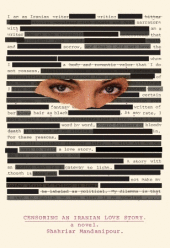
His own has achieved a great deal already:  his novel was accepted for publication by Knopf on the basis of only 50 submitted pages.  Censoring an Iranian Love Story has been  named one of the New Yorker‘s top books of the year.  No mean feat for the writer who arrived on this side of the Atlantic only three years ago.

The novelist from Shiraz cut an appealing figure:  a ruggedly handsome man in a black shirt and jacket, with a shock of frizzled gray hair.  Another shock: a surprisingly light, breathy voice that was often inaudible, sometimes incomprehensible,  in its heavily accented English.

Occasionally, as his English faltered, he would turn tentatively and murmur, “Help me, Doctor,” to the man sitting in the front row.  Abbas Milani, head of the program in Iranian Studies, reminded Mandanipour of his youth in Teheran, he said, when Milani was “the youngest and best teacher in political science.” The program Prof. Milani directs is too little known — it’s startlingly top-drawer. I’ve written about its visiting scholar Dick Davis here, and its Bita Prize for Literature and Freedom, which honored eminent poet Simin Behbahani, here.

Following Mandanipour’s reading, the question-and-answer period took an interesting turn when one man observed that fundamentalist regimes reserve their www.randomhouse.comheaviest artillery for literature, since  these religions preach certainty, and the novel thrives on doubt and uncertainty within its characters, motifs, and plots.
Mandanipour warmed to this theme.  These regimes, whether or religious or political, share an underlying fallacy: that “people are the same, there is no difference, no individuality.” The work of authors is an obvious target because “literature tries to show that there are many points of view in the world.”

“Democracy, the novel — they both come together.”

Nevertheless, Iranian literature, with its “layer of dark, bitter humor” is “complicated, personal,” he said. “For this reason, it’s not easy for this literature to have a dialogue with the world.”

He spoke movingly of writer’s block in his early days in the U.S., looking at the flowers whose names he did not know, and his mind would return to those who had “burned their memories so that only the flames would read them.”  He also thought of those who were still fighting — “brave students beaten with bottles,” facing interrogation and torture in their struggle for human rights.

“There are times the Iranian women are braver than the men. I think so,” he said softly.

An early Hanukkah present

Share

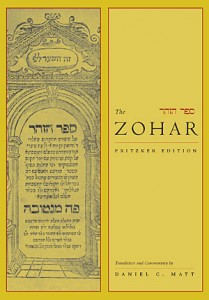
I received an early Hanukkah present yesterday when I returned from a late lunch:  Volume 5 of Daniel Matt’s translation of The Zohar was on zoharIV_covermy chair.  A bit of Castilian magic has entered my holiday season with that enigmatic work, whose provenance remains controversial (I’ve written about it here).  Its purveyor, the late 13th century Spanish Jew named Moses ben Shem Tov de León, claimed it was a second century work from Galilee.  However, the ornate and exalted version of Aramaic, unlike anything that exists anywhere else, suggests the author was Moses de León himself.
Geoffrey Burn, director of Stanford University Press, offered the most definitive comment about its origins: “The work stands on its own. It’s a work of revelation—its provenance is less important. I don’t care if it was written yesterday by Carlos Castaneda.”

In any case, the work has certainly been influential: it fostered the Kabbalah craze that has drawn in Madonna, Dolly Parton, and others.  Take heed: The Zohar is said to prepare the unprepared reader mad.

This unprepared reader is warned, but nevertheless likes its weird but contemplative prose, which works if you empty your mind and let its strange passages roll over you.  Like this one, picked more or less at random, and in an odd way in keeping with the season — make of it what you will:

“When the blessed Holy One wanted to establish the world, He threw a stone into the waters, engraved in the mystery of seventy-two letters, and from there the stone began to move and found nowhere to be established other than the Holy Land.  Water flowed after it until that stone reached the spot beneath the altar, where it sank, and there the whole world was established.

“Now, you might say, ‘If it is so that life dwells in that place, then why wasn’t the Temple built there to give life to its inhabitants?’ Well, here in this place, existence endures because of one letter hovering over it.  In the Temple all of the letters abide, and by them it alone was created, resembling the whole world.

“Furthermore, the Holy Land gives life and atonement to her inhabitants in that world, while this place is not so, giving life to that place in this world and not for the world that is coming.  The Temple is the opposite, for Israel has a share in that world and not in this world; so the Temple exists to atone for sins and render Israel worthy of the world that is coming.”     (p. 386)

Guilty

Share

katchadourian_herant_main

One wouldn’t expect a discussion of guilt to be entertaining. But it was.

In a talk this week to several hundred people, psychiatrist Herant Katchadourian noted that guilt has been getting a bad name since Nietszche wrote that morality is slavery and offered instead the alternative of the Übermensch — however, Katchadourian noted, these are “not the kind of people you’d like to have dinner with, so it looks like a dead end.”

Katchadourian, author of Guilt: The Bite of Conscience,  is not against guilt — quite the contrary. He thinks it is “hardwired into us through evolution” and one of the ways of “maintaining ties with other people”:  “Excessive guilt is abnormal, but inadequate guilt makes you into a psychopath,” he said. “You shouldn’t overdo it, but there has to be an internal policeman.”

He called guilt “a weapon of the weak.”  “Genghis Khan does not need to make you feel guilty — he cuts off your head.”  He speculated that that’s why, throughout history, it’s been the ready tool of mums everywhere.

“Ultimately, it drives people away — you can only milk a cow so much,” he said.

Guilt is an equal opportunity employer:  it exists in all six major religions.  “This is not a monopoly — nobody has cornered the market.”0804763615

If Buddhists appear sometimes to be against guilt, he said, it’s because “they’re very sensitive to the fact that wallowing in guilt is of no use,” he said. “Just feeling guilty doesn’t help anybody.”

He dismissed a question about Jewish guilt, noting that “Armenian mothers are exactly the same,” and also that “there are no Jewish mothers in Israel — only in the diaspora.”

“This is the short of it,” he said at end of his talk.  “For the long of it, see my book.”  Then he invited questions:  “There’s no such thing as a stupid question, only a stupid answer — and I will provide those myself.”

During a book signing, Katchadourian remarked on his confused origins:  his Armenian family is from southwestern Turkey, but he was born in French-occupied Syria and educated in Lebanon.  Now he’s here, and several listeners appeared to be grateful:

“I feel surprisingly upbeat now,” said the man next to me, getting up to leave after the applause had died down.

(Katchadourian speaks for himself in guest spot last month on the Washington Post “Short Stack” blog here.)