
The visionary behind the Library of Alexandria

Share
Serageldin (Photo courtesy Sadat Museum)

Serageldin (Photo courtesy Sadat Museum)

“The most intelligent man in Egypt.”

That’s the way Stanford librarian Michael Keller introduced Ismail Serageldin, director of the Bibliotheca Alexandrina.  Keller reassured us that he’s not the first to say so.

Alexandria-4

Photo: Ibrahim Nafie, Courtesy Bibliotheca Alexandrina

Within a few minutes, the audience of about 150 last week at Stanford didn’t need any reassurance:  Serageldin began to prove the title.  (Keller mentioned that Serageldin had 22 honorary degrees — Serageldin corrected him: as of this week, it’s 26.)  It’s hard not to warm to a man who says, like Borges, “I think paradise is some kind of library.”

For those who don’t know, the ancient Library of Alexandria was a legend – certainly the largest and most remarkable in the ancient world.  The Ptolemaic center for learning was launched sometime after the death in 323 B.C. of that “megalomaniac young man” who was a student of Aristotle – Alexander the Great.  Serageldin emphasizes that it was destroyed in successive stages, finally succumbing sometime after the murder of Hypatia in 415 A.D. and the final Arab sacking in 642 A.D.  Then the current revival.

A huge statue of one of its founders, Ptolemy II, was fished out of the Nile, and now presides over the entrance of library, stressing continuity between new and old – but how much continuity is there, really?  As Serageldin himself admitted:  “The library of the future will not be a replication of the library of the past.”
a01

Photo: Ibrahim Nafie, Courtesy Bibliotheca Alexandrina

Today’s avant-garde library must accommodate “new forms, of knowledge, new forms of storage.”

The plans, in short, are staggering, and my meager attempt to take notes fell behind the pace of the slides, and my ability to believe what I had written.  Here’s the easy part:  The library already receives 1.2 million visitors and sponsors 700 events annually, including concerts, conferences, book fairs.  The website gets 300 million hits a year.  A list of some of its goings-ons is here.

Alexandria-8

Photo: Ibrahim Nafie, Courtesy Bibliotheca Alexandrina

He began to speak of a “world digital library.”  He said that, through the library’s technology, no book will ever go out of print.   The library will be a venue for eminent intellectuals – already has been, for the likes of Umberto Eco and Nobel laureates.  It will sponsor research.  It will reissue “the classics of humanistic Islam.”

The goal is “access to all the information, for all people, at all times.”  Serageldin showed a dizzying succession of maps, diagrams, charts, bullet points, acronyms and spoke of  a “universal networking language.”

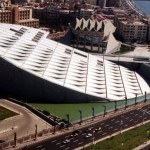
The library itself – stunning, modern – reminded me a bit of the sets of alien ships for the television series V.

“Visionary” is a label thrown about too quickly, too easily, perhaps —but for Serageldin, it’s another title that fits.  The superlatives rolled over me:  Bigger.  Fastest.  First.  Universal. Better – no, best.
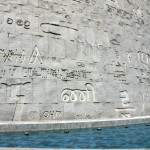
a01 (07)

Photo: Ibrahim Nafie, Courtesy Bibliotheca Alexandrina

It’s a cliché to note that man’s technological achievements have not been matched by changes in human greed, avarice, and cowardice.  But the tables occasionally tip toward spiritual attainment, too. My mind began to turn to another story I was writing, one about a 28-year-old writer who faced death by firing squad, who nevertheless went on, after a Siberian sentence, to write The Brothers Karamazov, Crime and Punishment, and The Idiot.

Both the technical achievements of man’s ingenuity and the ambiguous fruits of human suffering were with me as I left Dinkelspiel Auditorium and stumbled into the unrelenting California sunshine.

Daily dose of René Girard

Share

Not everyone gravitates instantly to the ideas of René Girard, one of the 40 members of the Académie Française, the highest honor France bestows on its intellectuals.  Many people find him hard to fathom, even though I’ve written easy articles about him here and here.

Girard, interviewed Dec. 1

So here’s another chance:  The Hoover Institution’s Peter Robinson has interviewed René for his series, “Uncommon Knowledge.”  The whole shebang will be on Youtube here.

The series consists of five short segments of about six to eight minutes apiece.  The opening segment discusses Girard’s concept of “mimetic desire” and how “example is the key to bad as well as good behavior.”  The second segment discusses how the scapegoat has traditionally kept mankind from being in “total conflict all of the time.”

More segments to come for one of the greatest minds of our times — who, by the way, turns 86 this Christmas …

Happy birthday, Eudora!

Share

Eudora Welty, who died in 2001 at 92, would have turned a hundred this year.  Although Stanford’s celebration last Wednesday was a little late (her birthday was April 13), the readings by Rush Rehm, Aleta Hayes, and Courtney Walsh, as well as the lively and insightful talk by Welty’s friend and biographer, Suzanne Marrs, were welcome opportunities to revisit Mississippi’s Pulitzer-prizewinning novelist and short story writer.

Rush recounted Welty’s support for the Civil Rights movement — not as an activist, but as a sympathizer and most especially as a writer.  Rehm, an actor as well as a drama prof, did a powerful reading of Welty’s 1963 story, “Where Is the Voice Coming From?” written after the assassination of NAACP’s Medgar Evers, which took place in Welty’s hometown, Jackson.

Welty had wrote the story within a week of the assassination, and it was published in The New Yorker.  She later said of this story:

“Whoever the murderer is, I know him. … not his identity, but his coming about, in this time and place. That is, I ought to have learned by now, from here, what such a man, intent on such a deed, had going on in his mind”(Preface to Collected Stories 1980)

“I thought, I know how bad this man is, and I’m just going to try to imagine what it would be like to be in his skin, because I ought to know … It was a story writer’s challenge.” (More Conversations, p. 68).

When the murderer, Byron De La Beckwith, was eventually convicted, in his third trial more than three decades later, on February 5, 1994, Welty was interviewed, and in response to the statement “I guess Beckwith reminds everybody of Mississippi’s grim past,” she answered, “Just be glad Mississippi also does produce a Medgar Evers.”

Welty also said, when warned of the threats that “Where Is the Voice Coming From?” might attract:  “The people who burn crosses on lawns don’t read me in the New Yorker.”

A new leaf

Share

Has Robert Pogue Harrison turned over a new leaf?  The author whose professorial terroir is the Italian lyric, Renaissance Humanism, Dante, Pirandello, Vico, and the Baroque,  has written two pieces for New York Review of Books this year, but the topics are rather a surprise:  “The Ecstasy of John Muir” (March 12, 2009) and “A Great Conservationist, by Jingo” (November 5, 2009).  Blustering Teddy Roosevelt and the Sierra Nevada’s conservationist Muir?

It’s not as far-fetched as one might think, Harrison says, noting he is the author of Forests: The Shadow of Civilization, The Dominion of the Dead, and last year’s Gardens: An Essay on the Human Condition.

“The fact is that my work – Forests, Dominion of the Dead, Gardens – is a trilogy united around theme of earth, humus, nature and culture,” he said.

“Thoreau actually figures quite prominently in Forests and Dominion of the Dead.  My interest in the  American

Harrison as DJ (Photo by L.A. Cicero)

idea of nature was well-known to them” — that is, to the editors at the NYRB.  “It’s not completely out of the blue.”

In any case, Harrison thinks scholars in the humanities should have more than one string in their lute: “I know a lot more than Italian literature.  We have to know whole story – we’re not scientists with just a sliver of knowledge.  If you know Dante, you know the whole damn story.”

From his November 5 piece:  “…how long it took for many Americans to consider America’s nature as their own, to see it as a gift to be received and not as a wilderness to be feared or a resource to be plundered. One of the hardest lessons for Americans to learn is how to receive, perhaps because we believe so fervently in earning, or perhaps because we have a long history of merely taking, if not grabbing. Perhaps Robert Frost had it wrong in his poem, ‘The Gift Outright’ when he wrote: ‘the land was ours before we were the land’s.’ What if you first have to feel that you belong to the land before you can feel that the land belongs to you?”

(By the by, Harrison has launched a new season of his weekly radio talk show, Entitled Opinions, on Stanford’s radio station KZSU FM 90.1.  All the programs are available on the website. You can listen online at noon on Tuesdays by going to the KZSU website and following the link to “listen live.”)

Naughty nonagenarian

Share

Robert Conquest has had a distinguished career – and the honors aren’t ending for the British historian, who turned 92 in July.  He’s already a member of the American Academy of Arts and Sciences (as well as receiving the American Academy of Arts and Letters Award in 1997), a fellow of the Royal Society of Literature, and a recipient of the Presidential Medal of Freedom in 2005.  Then, on a sunny morning last August, he got one more feather.

In my work on the forthcoming An Invisible Rope: Portraits of Czesław Miłosz, I had noted that several of my contributors had received Order of Merit – including the NYC Polish poet Anna Fralich, the former diplomat John Foster Leich.  So, curious about the honor, I accepted the invitation to see the Hoover Institution ceremony in which John Raisian, director of the Hoover Institution, and the writer Robert Conquest were to be lauded — though I had not read Conquest’s books about the murderous terror of life under totalitarianism.

Conquest gets standing ovation (Photo courtesy Stanford Visual Arts)

Conquest was in delicate health, and did not stand to receive his award from Poland’s up-and-coming foreign minister, Radosław Sikorski. (Audio recording of the event available here.)

Sikorski and Conquest meet after the ceremony. (Photo courtesy Stanford Visual Arts)

In presenting the award, Sikorski said that as a Solidarność activist in his youth, Poles knew they were not alone, “because we had at least one great teacher”:

“At a very young age, Mr. Robert Conquest saw through that riddle wrapped in a mystery inside an enigma, as Winston Churchill characterized the Soviets. And once he had understood it, he dedicated his life to revealing the diabolic logic hidden under the facade of propaganda and deception. His works, especially his monumental books, The Great Terror and The Harvest of Sorrow, brought to light a whole host of unimaginable tales of human suffering. He told the story that many did not want to hear, and stood for truth when it was not easy and fashionable. He gave a compelling testimony about the atrocities committed by the Soviets, which undermined the legitimacy of the Soviet rule and its ideology alike.

His books made a huge impact on the debate about the Soviet Union, both in the West and in the East. In the West, people had always had access to the information about Communism but were not always ready to believe in it. In the East, most of us did not harbor illusions about the utopian ideology under which we lived. We knew that the design – not only its execution – was flawed. Nevertheless, we longed for confirmation that the West knew what was going on behind the Iron Curtain. Robert Conquest’s books gave us such a conformation. They also transmitted a message of solidarity with the oppressed and gave us hope that the truth would prevail.”

Sikorski concluded by noting that Conquest was born in the year of Russia’s October Revolution: “he has outlived the Evil Empire and continues his mission of telling the true story about it.”

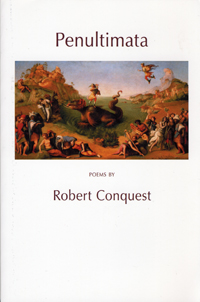
It’s not the only story he’s telling.  A few weeks later in London, I was visiting with my publisher Philip Hoy of Waywiser/Between the Lines.  As I was leaving, Phil handed me Waywiser’s newest book of poems:  Penultimata.  Phil advised me they were written by a nonagenarian, and that they are rather sexy.

The volume got quite a bit of praise:  Clive James said “In poems about love, the subversive, lyrical proof that desire goes on into old age is alive in every conquestcadence and perception. As ever, he makes many a younger writer look short of energy.” My own editor at the Times Literary Supplement, poet Alan Jenkins wrote: “the whole of Penultimata is about what’s left of love and beauty, after a long life and 3,000 or more years of western civilization: to be recovered in memory, in a Roman figurine, in sharp sensuous delight, or in speculation on that nature of the universe.”

The sexy nonagenarian poet is Robert Conquest.  Here are two of his offerings, chosen not for prurience, but for their wit.

The first is “Philosophy Department,” from a series called “All Things Considered”:

Such knotty problems! Check your lists:
How come the universe exists?
How does consciousness, free will,
Match up with brain cells? – Harder still:

Employing what we use for peeing
To penetrate another’s being,
And in her complementary hole
Surrendering one’s self, one’s soul.

Yes, the eternal paradox
Of hearts and minds and cunts and cocks.
That solved, it will be time enough
To tackle all the cosmic stuff.

Then there’s “This Be the Worse” — the poem, of course, is a take-off on friend and colleague Philip Larkin’s poem of the same name (find Larkin’s version here):

They fuck you up, the chaps you choose
To do your Letters and your Life.
They wait till all that’s left of you’s
A corpse in which to shove a knife.

How ghoulishly they grub among
Your years for stuff to shame and shock:
The times you didn’t hold your tongue,
The times you failed to curb your cock.

To each of those who’ve processed me
Into their scrap of fame or pelf:
You think in marks for decency
I’d lose to you? Don’t kid yourself.