
The worst dinner party ever: Czesław Miłosz, Zbigniew Herbert, and the lady who watched the fight

Share

Poet

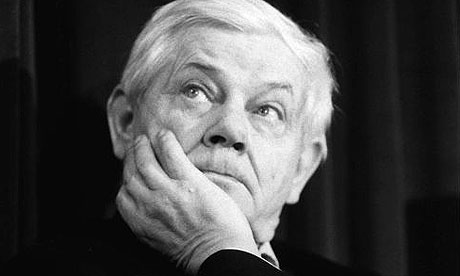
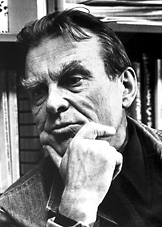
Poland’s biggest postwar literary fight  erupted not in Warsaw or Kraków, but in an otherwise quiet Berkeley home one evening in the summer of 1968, after some serious drinking.

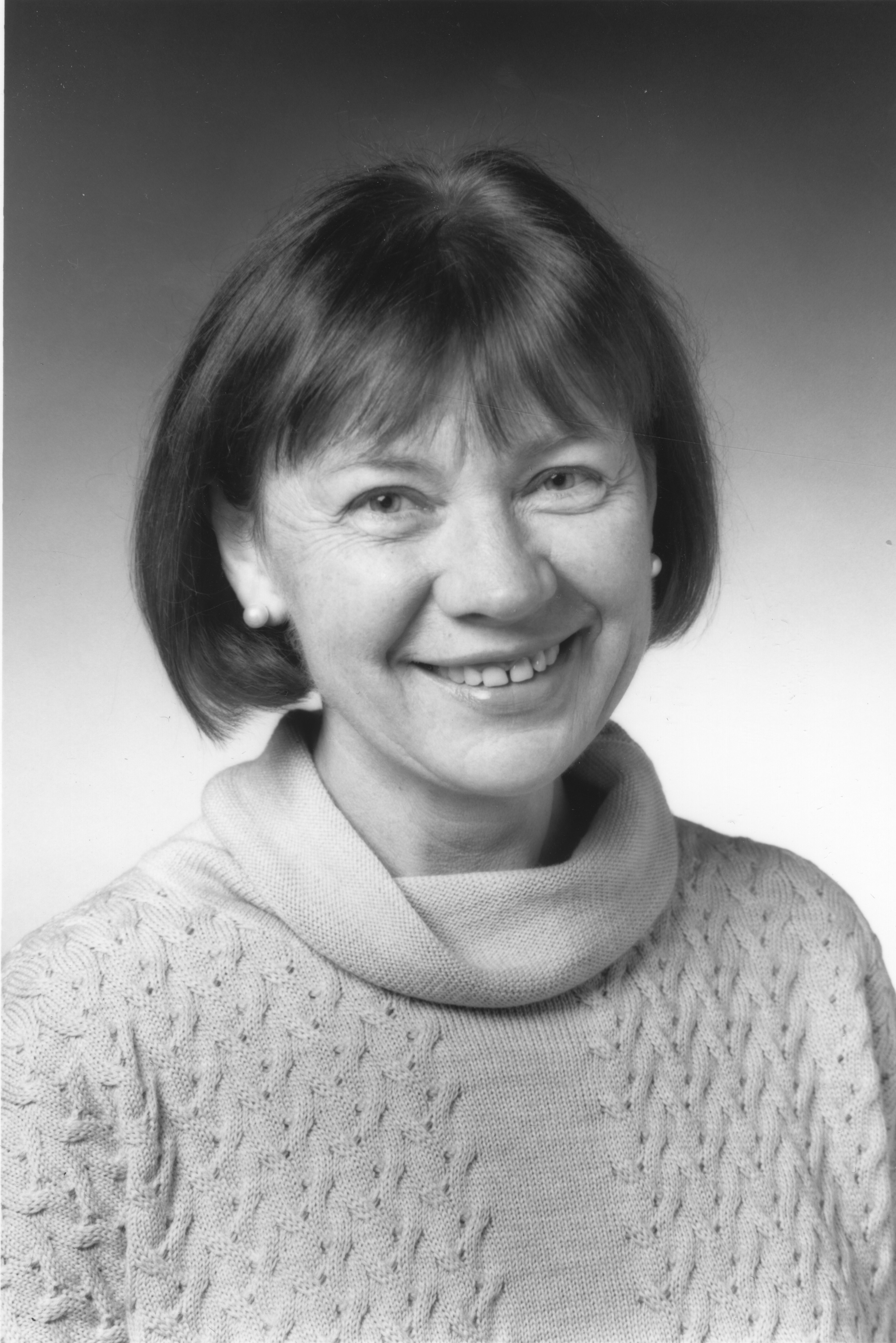
During the Columbia University launch for An Invisible Rope: Portraits of Czesław Miłosz on Monday night, noted translator and scholar Bogdana Carpenter departed from the planned script to break her silence on the event – for the second time ever.

She ought to know.  She was not only there, she and her husband and fellow translator John Carpenter hosted the dinner, which included poets Czesław Miłosz and Zbigniew Herbert. She said distorted versions of the event that have left the Polish intelligentsia bickering ever since.
vs. poet

“It started out happy and gay,” she recalled of the evening — a pleasant, spicy meal with plenty of wine. After dinner, Herbert’s tone became “harsher and harsher,” Bogdana recalled.  “When he was drunk he tended to be aggressive – and this time it was too late.” Herbert’s thoughts turned to the German occupation of Poland during World War II.

“He viciously attacked Miłosz – he reproached him for his lack of participation in the Polish resistance,” said Bogdana.  The evening was so acrimonious that Janina Miłosz forbade Herbert ever to enter the Miłosz abode again.

However, “it’s become known in a distorted version,” Bogdana said of the story.  Typically, it is claimed that Miłosz provoked the incident by suggesting that Poland be added to the Soviet Empire as the 17th republic. Bogdana said this comment never happened. The provocation was invented by Herbert twenty years after the event, she said.
Correcting the record

For Miłosz, questions of patriotism were always sensitive – both because of his position with the Communist government as a cultural attaché, and then again because of his 1951 defection in Paris, which meant he was barred from Poland until the 1980s.

The basis of the dispute, said Bogdana, was the two poets’ notion of homeland, and what it required from them.

Herbert believed one should be willing to “sacrifice one’s own happiness and life,” she said.  While some have attributed Herbert’s position to the “Polish Romantic paradigm,” Carpenter said its roots are “further back – in the Hellenistic tradition.”

“Miłosz differed diametrically.”  For Miłosz, loyalty had its limits – “when the price was other people,” she said, he could be “scathingly critical.” His position was that “loyalty is not enough – one seeks logical justification” for self-immolation. Miłosz’s defined his “homeland” as the Polish language.  “Miłosz’s chosen weapon was the word, not the sword,” said Bogdana. “Language defined him.”

Bogdana Carpenter pointed out that “Herbert was not in Warsaw in 1939, 1942, or 1944.”  Milosz witnessed the destruction of Warsaw firsthand. Patriotism was not the question.  She pointed out that during Nazi occupation, Miłosz compiled an anthology of anti-Nazi poetry – An Invincible Song (1942) – “for which he easily could have lost his life.”
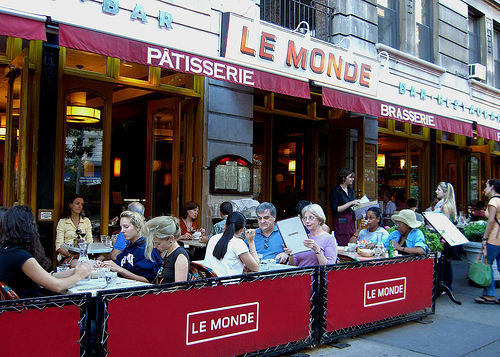
Lunch at Le Monde with Philip Fried in NYC

Share

This week in New York City has been drenched in Polish literature (see posts here and here) – so my visit with poet Philip Fried, founding editor of the 30-year-old Manhattan Review, may at first seem like something of an anomaly.

Until, that is, you realize that the quiet Manhattan Review was the first American journal to publish an interview with Polish poet and dissident Stanisław Barańczak in 1981. The review began to publish the work of Chinese dissident poet Bei Dao as early as 1990. And, according to its website, in 1994 it launched an unprecedented nationwide campaign that increased the number of poetry reviews in The New York Times.

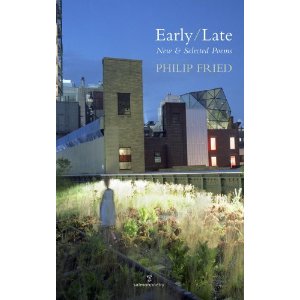
I discovered the review when I was unearthing a rare, early interview with Zbigniew Herbert, by his translators John and Bogdana CarpenterThe Manhattan Review was among the first reviews to devote a whole issue to the renowned poet in the mid-1980s – and I initially contacted Philip to get more than the snippets I found online.  (I also, on this visit, received a copy of his Early/Late: New and Selected Poems, published last month by Salmon Poetry.)

One would think that the Manhattan Review, which has two new poems by Les Murray in its current issue, would be better known.  But Philip and the Manhattan Review are as quiet as it namesake island is named is noisy.  We nevertheless had a pleasant and talkative lunch at Le Monde, an amiable bistro that “celebrates the cuisine of the Loire Valley” near Columbia University.  Besides Polish poetry, we discussed the upheaval in the book industry and the dwindling presence of poetry on the American scene.  What, after all, is a poet to do?  The attempts to “reach out” to the public via April Poetry Month are usually farcical.  Poet celebrities are often, well… not really poets at all.  Pulling up the drawbridge and sticking to one’s own tiny audience has resulted in a situation Philip compared to polar bears on ever-shrinking ice floes – an image that will stay with me for some time to come.

Postscript on 3/28:  Philip just wrote to tell me he got a nice notice in Publishers Weekly — a publication we rate highly since it put humble moi and  An Invisible Rope: Portraits of Czeslaw Milosz one of the top ten books for the spring, in the “Belles Lettres and Reflections” category.  Here’s what it said about Philip’s latest collection:

This skillful and memorable first selection can seem like the work of three or four different poets, though wit and civility hold it together. First comes a bevy of poems about God, often comic, and often spoken in His assumed voice: often in stand-alone prose sentences (like the Book of Proverbs) they mix the language of elevated salvation with the debased terms of business and politics: “I regret to inform you that, in the purview of immutable discretion, it has now become necessary to downsize the elect.” Verse from Fried’s Mutual Trespasses (1988) also looks at–or speaks for–a divine Creator, wittily juxtaposing His omnipotence with human foibles and emotions: “He seemed to sink/ into Himself, a collapsing/ mountain.” Big Men Speaking to Little Men (2006), making up most of the last half of this collection, casts aside divinity for carefully ironized versions of family history: nostalgic at times, more outwardly conventional, these pages may nonetheless hold his strongest work. The New York-based Fried (who edits the Manhattan Review) closes with supple, formally acrobatic excerpts from a recent set of sonnets: “I’ve cornered the market on me, but I’ll sell you the shimmer./ When the bubble has burst, volatility is tender.” (Apr.)

Meet you in Manhattan!

Share

I’m off!  Or at least I will be in a few hours.

I’m on my way to a week of gigs honoring the Czesław Miłosz centenary in New York City — with a side order for Zbigniew Herbert.  I posted about them a while back here.

Come up and say hello if you see me — otherwise, prepare for a few logistical delays, but I expect to be posting about Clare Cavanagh, Robert Hass, Edward Hirsch, Adam Zagajewski, Anna Frajlich, Bogdana Carpenter, James Marcus, and many others in the coming days.

See you there!

Join me in NYC for the Czesław Miłosz Centenary!

Share

There’s a swirl of events March 21-28 honoring the Czesław Miłosz centenary in New York City (and one event for Zbigniew Herbert).  Join me in celebrating, if you’re in town!  It’s certainly a rare event for me — at least a decade since I’ve been in New York at all, sedentary little West Coaster that I am.

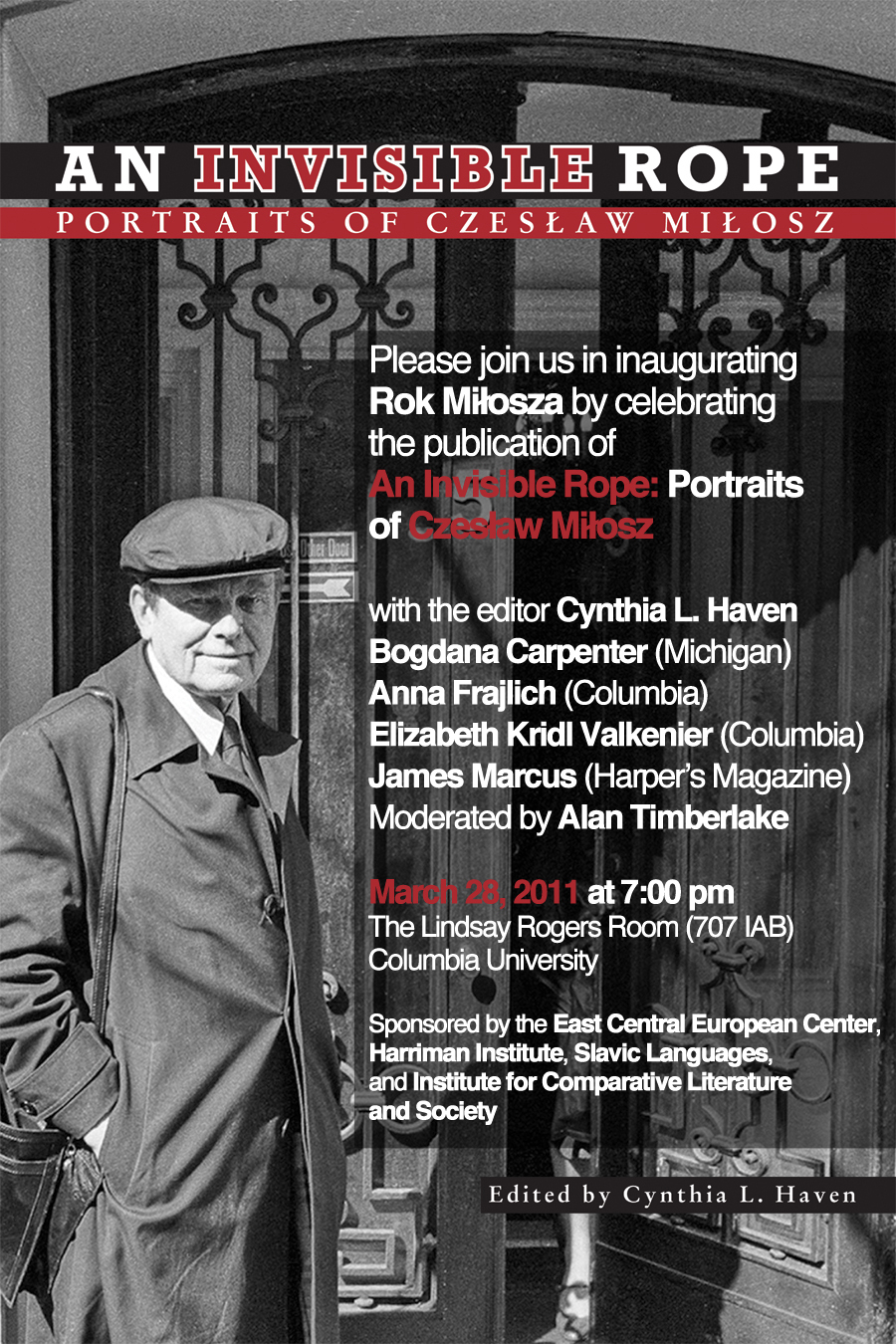
I will be speaking at Columbia University (see poster at right) on the 28th and at the Brooklyn Central Library on the 27th.

Ann Kjellberg at Little Star has blogged about some of the other events here.

They include:

March 21 — 8 p.m., Kaufman Concert Hall, 92 Street Y: “A Celebration of Czesław Miłosz with Robert Hass, Adam Zagajewski and Clare Cavanagh

March 22 — 7 p.m., Music Building, Queens College: “A Centennial Celebration of the Work of Czesław Miłosz” — Clare Cavanagh, Robert Hass, Edward Hirsch, Adam Zagajewski

March 24 — 7 p.m., Poets House: “A Poet’s Prose: The Poetic Vision of Zbigniew Herbert,” Edward Hirsch, Charles Simic, Alissa Valles, Adam Zagajewski

March 27 — 1.30 p.m., Brooklyn Central Library, “An Invisible Rope: Portraits of Czesław Miłosz,” Cynthia Haven, Adam Zagajewski, Anna Frajlich, Elizabeth Valkenier and Zygmunt Malinowski

March 28 — 7 p.m., The Lindsay Rogers Room, Columbia University, “An Invisible Rope: Portraits of Czesław Miłosz,” Cynthia Haven, Anna Frajlich, Elizabeth Valkenier, Bogdana Carpenter, James Marcus, and Alan Timberlake


The forests of Katyń

Share
katyn

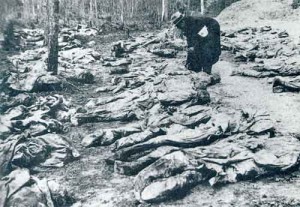
Germans discover 4,500 Polish officers buried in mass graves, April 1943

The airplane crash that killed Poland’s President Lech Kaczyński and first lady Maria Kaczyńska — along with Poland’s deputy foreign minister and a dozen members of parliament, the chiefs of the army and the navy, church leaders, the president of the national bank, and others — dominated the news over the weekend (my interview with European historian Norman Naimark here).  The plane was en route to a commemoration for the victims of Katyń.

For many in the West, it was the first time they had heard of the forests that hid the mass graves following the 1940 Soviet massacre of about 22,000 people.  Most press accounts describe it as a massacre of Polish officers, but the list of the murdered included doctors, professors, lawmakers, police officers, public servants, and others in the intelligentsia — the kind of people Poland needed to function as a nation.

The Soviets denied the massacre for decades, blaming the Nazis for the atrocity.  And the Soviets controlled Poland — hence, it was not possible to speak openly about Katyń.  Any mention of the atrocity was dangerous; government censorship suppressed all references to the massacre.

herbertAs I wrote elsewhere: ‘Imagine, for a moment, an American equivalent: a world where we were not allowed to speak of 9/11 and could not remember the victims in any public way. A world, moreover, in which our nation was ruled by the terrorists who did the killing. The comparison misses the enormity, still: Poland was a much smaller country with a prewar population of 30 million, and the number of those murdered 5-7 times as great as those who died in the World Trade Center.”

In Year of the Hunter, Nobel laureate Czesław Miłosz, who survived the destruction of Warsaw, wrote: “The Soviet state went to great pains to convince the world of its innocence, and its allies took it at its word, or pretended to, so that the Poles were left to stand alone—with the truth, but with a truth proclaimed by the German enemies. And who would have believed them, since they were known for their anti-Soviet ‘complexes’?” Reading a book by an American correspondent in Moscow, Miłosz wrote, “I found the excerpt that reports on the trip by Western diplomats and journalists to Katyń; I read it and almost threw up.”

In 1981, Solidarność erected a memorial with the simple inscription “Katyń, 1940,” but it was dismantled by the police, to be hunterreplaced with an official monument “To the Polish soldiers—victims of Hitler’s fascism—resting in the soil of Katyń.”

Writers found ways to remember it:  Zbignew Herbert, still living in Poland with all the constraints that situation implied, made an oblique reference to Katyń in his poem “Mona Lisa,” when he refers to the “executed forests,” and also in his,”Report from a Besieged City,” using the 1981 imposition of martial law to make oblique comparisons to Poland’s recent past:

Wednesday: cease-fire talks the enemy interned our envoys

we don’t know where they are that is where they were shot