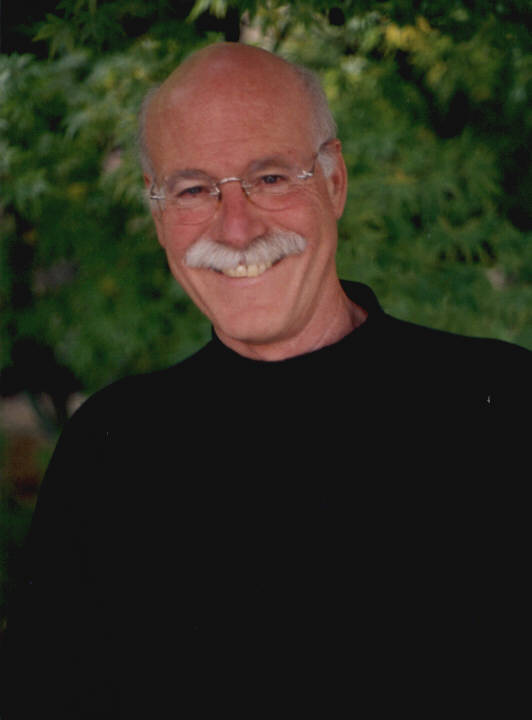

Tobias Wolff: “Literature is a theater of choices, values”

Share

TobiasWolffOver at The Boston Review, Stanford student Quyen Nguyen has a fascinating interview with award-winning author Tobias Wolff on vocation and morality – I kept wanting to yell “right on!” as I was reading it, but as I was alone in my house, the impulse seemed rather silly. (We’ve written about Toby before, here and here and here and here, as well as a zillion other places.)  Read Quyen’s interview over here – meanwhile, a few excerpts below:

TW: There’s a certain kind of book that when I read it, I feel like I have company in the world. I wish I had had, when I was younger, a book like This Boy’s Life to read, to know that there were other kids living the kind of life I lived, this oddball existence. So there is a way in which writing can become a companion for people. It has been for me, and I hope that my work does that for others. There’s no doubt that if you parse out my motives, there’s probably a great deal of pure ambition, vanity, competitiveness, all that sort of thing, which does not mean the effects cannot be positive.

He didn't mean to do it.

He didn’t mean to do it.

You used an expression in your email, “conscience-laundering,” and I thought about that. I don’t want to award a kind of nobility to the decisions I’ve made because they’ve probably, in some way or other, been self-serving. But let’s take the case of somebody like Mozart. He probably didn’t intend to change the world, yet can you imagine the world without that music? Can you imagine the world without Chekhov‘s short stories? …

QN: The phrase “conscience laundering” was taken from Peter Buffet’s article, “The Charitable-Industrial Complex.” He defined “conscience laundering” as “feeling better about accumulating more than any one person could possibly need to live on by sprinkling a little around as an act of charity.” Do motives behind this sort of feel-good charity matter?

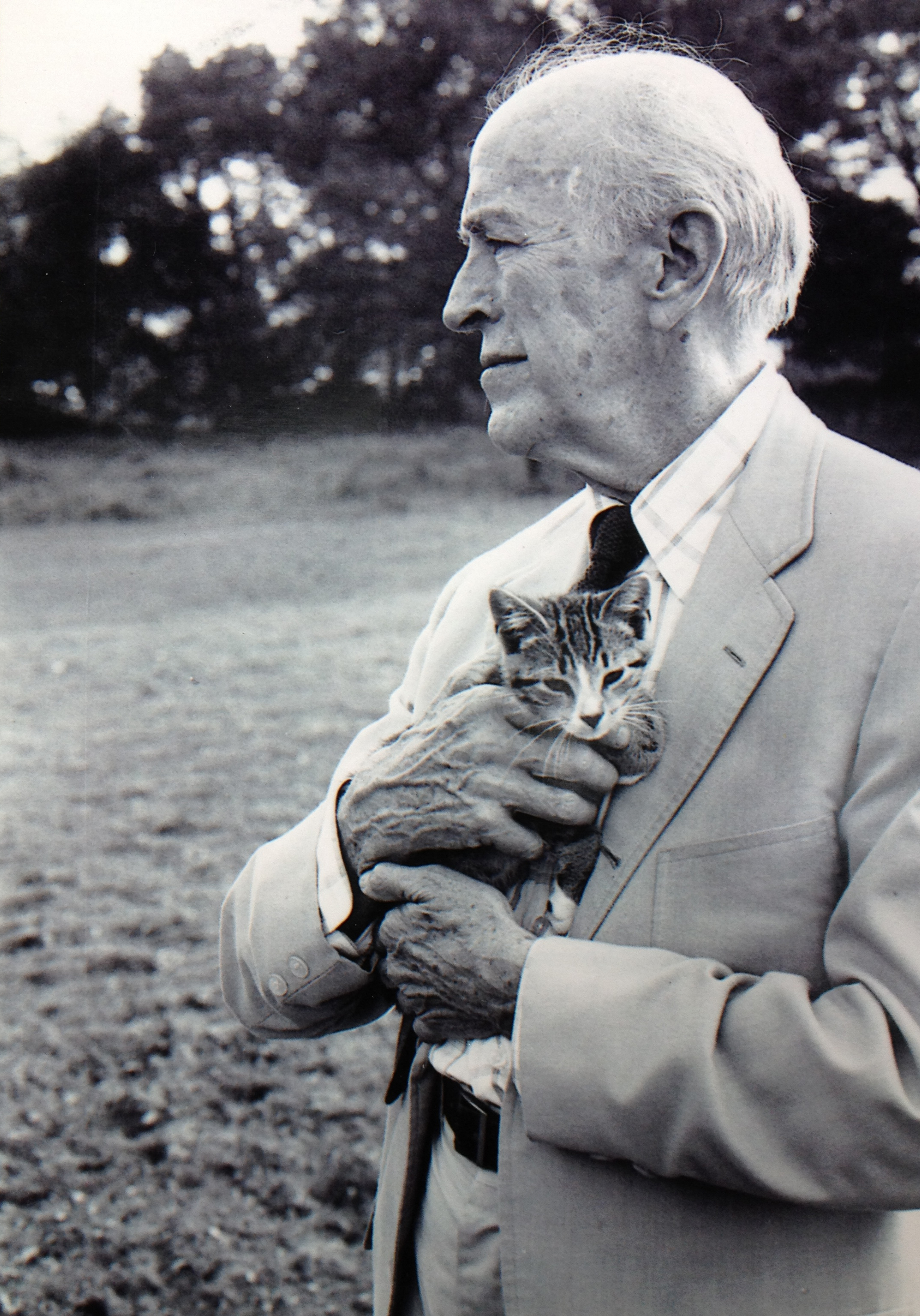
TW: If you are talking about a single human being rather than a corporation, I don’t think that it’s possible for a human being to be disinterested. But we have to try, obviously. Have you heard of Joyce Maynard? Joyce Maynard is a novelist. When she was seventeen or eighteen, a freshman at Yale, she wrote a brief memoir in the New York Times Magazine. Precocious, one might think, looking backwards so early. J. D. Salinger read it and wrote her a fan letter. He ended up moving her in with him, persuaded her to give up a scholarship at Yale, used her, discarded her, all with this great theater of purity. He considered himself a very “pure” soul who believed that if you do good, you’re really doing it just to flatter yourself. So he did no good, certainly safe from that sin. You might read a recent Times article by Joyce Maynard, “Was Salinger Too Pure For this World?” in which she writes about this continual exercise, this question of “Is this good thing you’re doing really for yourself?” “Can you escape self-flattery in doing what others would conventionally call a good thing?”
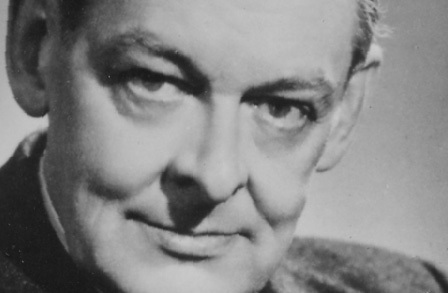
t-s-eliot

“All manner of things shall be well.”

It is a political act to force someone to enter the mind, the spirit, the perspective of another human being.

And I would suggest that if you give food to someone who’s hungry, they don’t give a shit whether you’re doing it for yourself or them. But if Carnegie is working kids at ten cents per hour and then building libraries, well, though the libraries are a good thing we still have to hold him accountable for the exploitation of children.

But it’s a complicated issue and I think we have to live with a little conscience-laundering if that’s what it takes to try to do something that benefits other people. If there’s a sense of self-congratulation for some good we do for others, then we have to live with that. This idea has obviously vexed people forever, this tension between the deed and the motive. In the Four Quartets, Eliot writes, “And all shall be well and / All manner of thing shall be well / By the purification of the motive / In the ground of our beseeching.” So he’s obviously grilling himself in this way too. I don’t know if it ever goes away.

***

Wolff

“It is a political act to force someone to enter the mind, the spirit, the perspective of another human being.” (Photo: Sonia Lee)

TW: …Mozart, in what way is he useful? In measurable terms, he is not useful. You can’t even say music uplifts or purifies the soul. As we know, the officers at Auschwitz and other concentration camps liked to make the inmates play Beethoven to them and they would weep while the music was being performed. So you can’t even say that music is necessarily transformative, though it can be.

What I do think is that it’s hard for us to live with ourselves if we don’t feel useful in some way or another. Have you seen that movie The Hurt Locker? There’s a guy who disarms bombs, a highly dangerous job. When he comes home, there is a striking scene of him standing in an American super market, looking at this dazzling array of goods, and he just wants to go back to Iraq. He reads about a bomb going off in the newspaper and he thinks, “I could have saved those people.” He has experienced actually being useful. People like him have this rare experience of having their usefulness made dramatically apparent to them, so they keep going back to give support to others even in this violent, terrible context. We all have a hunger for that sensation of usefulness. It’s a little harder to experience that as a writer, maybe a little easier as a teacher. No doubt society and the cultures we grow up in all elicit this need to be useful, but it’s also something that’s hardwired in us. It’s not necessarily a divinely inspired thing, it may well be an evolutionary adaptation, but it’s there.

***

QN: We are reading bell hooks’ chapter about “Engaged Pedagogy.” What is your pedagogy?

TW: I certainly wouldn’t keep teaching if it’s just recitation of what I know. It’s a cooperative process. When I’m lecturing in the Thinking Matters course, I don’t allow laptops in my class, so people have to look at me. They can write things down. But I’m not giving out information. It’s a conceptual exercise. I’m really trying to get people to challenge me and question me. And I do that sort of thing because I care. I don’t teach literature as a collection of movements, “okay, now we move to the Augustan age.” Literature is a theater of choices, values, and the way in which one’s character takes shape and in turn shapes one’s life. Those are the questions that literature brings to dramatic life, and, I hope, awakens something in my students. Again, I don’t want to award myself a merit badge. It seems natural enough to want to have a kind of communion with others, challenge other people and have them challenge you. It’s more fun to live that way.

***

TW: If this makes any sense, we’re called to different things, in different ways. By saying that, I guess I’m implying a caller. Nature, if you will, calls us to different kinds of things.

Again, read the whole thing here.
Tobias Wolff on race: “None of us would admit to a prejudice—why should we? we didn’t have any.”

Share
Wolff

Toby explores race and illusion. (Photo: Sonia Lee)

With chaos and curfew in Ferguson, Missouri, race has been everywhere in the news this weekend. A few wise words are welcome, so please don’t miss award-winning author Tobias Wolffs “Heart of Whiteness,” his powerful piece on race in this week’s New Yorker. It opens with Toby going through stacks and stacks of old correspondence, including letters from writer Raymond Carver – “the tone so immediately and unmistakably his that I felt almost as if he were reading them to me.” Funny, that’s exactly what I felt about reading Toby’s own words. We work together on Stanford’s “Another Look” book club  (I’ve written about it tons – try here and here and here and here and here), and I could hear his voice behind every phrase.

He continues: “Then I put the file aside and began glancing through some of my own. And I was disheartened by what I found there. Clumsy, effortful wit. Vulgarity. A racist joke. Sitting there alone, reading my own words, I felt humiliatingly exposed, if only to myself; naked and ashamed.” He recalls his early gifts as a clown and satirist, with “plenty of company in this line of banter.”

None of us would admit to a prejudice—why should we? we didn’t have any—and the atmosphere of right-mindedness could become so absolute, so cloying, that one was sometimes compelled to say the unsayable just to break the spell, make some different music. But this was always done with a dusting of irony. After a black family bought a house on Ray’s block, an unredeemed neighbor complained to him that “a certain element” was taking over, and the word “element” immediately entered our lexicon as an irresistibly sublime piece of swamp-think. So, too, the word “Negro,” as if delivered by an out-of-touch white alderman seeking votes from that highly esteemed, if underserved, corner of his ward.

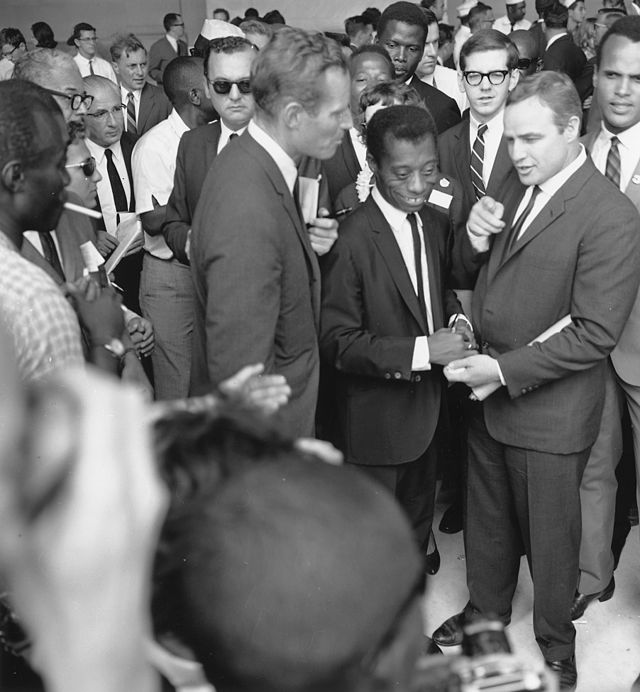
Could I have played with these words if I had been a racist? No—I couldn’t be a racist. Even as a boy I had been shocked by what happened in Little Rock, the spectacle of pompadoured thugs and women in curlers yelling insults and curses at black kids trying to get to school. With my brother, I joined the March on Washington. We were there.

When I joined the Army, at eighteen, I was trained by black drill instructors, marched and pulled K.P. and showered and bunked and jumped out of airplanes with black troops. If it hadn’t been for a black sergeant I served with in Vietnam, I doubt that my sorry ass would’ve gotten shipped home in one piece.

Baldwin

James Baldwin with Charlton Heston and Marlon Brando at the 1963 Civil Rights March on Washington, D.C. Sidney Poitier and Harry Belafonte are also in the crowd.

I read Ralph Ellison and Langston Hughes and, especially, James Baldwin—“Jimmy” to my brother, Geoffrey, who was his friend when they both lived in Istanbul. I even almost met Baldwin! He was supposed to drop by the apartment in New York where Geoffrey and I were staying, Christmas of 1963. We waited all night, drinking, talking nervously, but he never showed up; one of the great disappointments of my life. It turned out that he’d been stopped by the white doorman.

Yet there was that joke. And a couple of other cracks.

I didn’t like meeting the self I had been when writing these letters—still playing the rake, tiresomely refusing to toe the line and speak the approved words in the approved way. Mostly I didn’t like the sense of exertion I found here, the puppyish falling over myself to amuse and impress another man. The result was coarse and embarrassing. I wanted to think that this wasn’t really me, just some dumb, bumptious persona I’d adopted, which, to some extent, it was.

But I had, after all, chosen this persona rather than another. And I had to wonder why. When we speak with a satiric voice, in mimicry of the unredeemed neighbor, aren’t we having it both ways? Allowing ourselves to express ugly, disreputable feelings and thoughts, under cover of mocking them? I didn’t want to believe that there was anything of me, the real me, in this voice, but, given the facts of my past, looming in piles around me, how could there not be?

It’s a beautifully written piece. Please do read the whole thing here.


Happy birthday, Tobias Wolff! A few of his words on writing…

Share
toby

Birthday boy.

birthday cakeHappy birthday to one of our favorite people, the award-winning novelist and short story writer Tobias Wolff:

“Writers are superstitious. I don’t mean knock on wood, throw salt over the shoulder—let me try to explain. I began this whole writing enterprise with the idea that you go to work in the morning like a banker, then the work gets done. John Cheever used to tell how when he was a young man, living in New York with his wife, Mary, he’d put on his suit and hat every morning and get in the elevator with the other married men in his apartment building. These guys would all get out in the lobby but Cheever’d keep going down into the basement, where the super had let him set up a card table. It was so hot down there he had to strip to his underwear. So he’d sit in his boxers and write all morning, and at lunchtime he’d put his suit back on and take the elevator up with the other husbands—men used to come home for lunch in those days—and then he’d go back to the basement in his suit and strip down for the afternoon’s work. This was an important idea for me—that an artist was someone who worked, not some special being exempt from the claims of ordinary life. But I have also learned that you can be patient and diligent and sometimes it just doesn’t strike sparks. After a while you begin to understand that writing well is not a promised reward for being virtuous. No, every time you do it you’re stepping off into darkness and hoping for some light. You can be faithful, work hard, not waste your talents in drink, and still not have it happen. That’s what makes writers nervous—the sense of the thing being given, day by day. You might have been writing good stories for years, then for some reason the stories aren’t so good. Anything that seems able to jinx you, to invite trouble, writers avoid. And one of the things that writers very quickly learn to avoid is talking their work away. Talking about your work hardens it prematurely, and weakens the charge. You need to keep a fluid sense of the work in hand—it has to be able to change almost without your being aware that it’s changing.”

From “Tobias Wolff: The Art of Fiction,” Paris Review, no. 183. (See him on the Colbert Report here.)

Tobias Wolff on the Colbert Report

Share

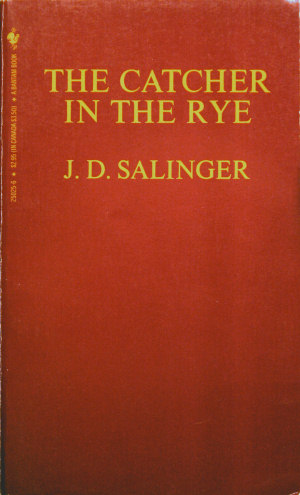
TobiasWolffOkay, I’ll admit it’s a tiny little square below. But it’s worth watching. The backstory:  Stephen Colbert admits that J.D. Salingers Catcher in the Rye is his least favorite book, “the most important American novel I don’t get.” He prefers the Glass family stories. So he invited Tobias Wolff, author of This Boy’s Life, to convince him otherwise. “You will never convince me,” he warned on the Colbert Book Club.  Toby agreed it shouldn’t be taught to kids as mandatory high school reading:  “Part of the experience of finding that book is that it felt really subversive reading it.” The adult world is unmasked as “a nest of hypocrisy and phoniness. That’s something you want to find on your own. You don’t want your English teacher to be introducing you to the hypocrisy of adults.” So why doesn’t he, too, prefer the Glass family stories? Toby relaxed back in his chair and presented a rhetorical question: “You like to read sermons all day?” Colbert responded in a beat: “I like to give them.”  Who can argue with that?

See it all for yourself:

Catcher-in-the-rye-red

Remembering William Maxwell: “He used a pause better than most of us use a paragraph.”

Share
Maxwell

Sophisticated? He didn’t think so. (Photo: Brookie Maxwell)

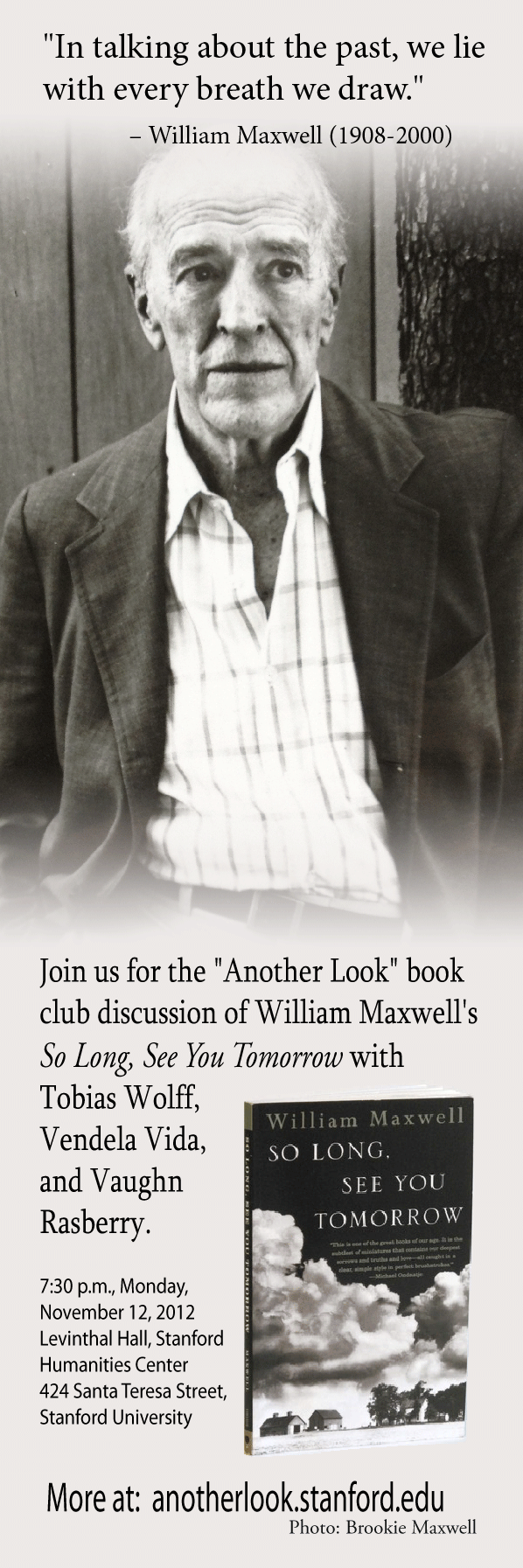
In preparation for Stanford’s “Another Look,” a new book club launched by the English department at Stanford, I wrote a retrospective on author William Maxwell, whose  masterpiece, So Long, See You Tomorrow, will be the inaugural book for  “Another Look”  on Monday, November 12.   The book will be discussed by award-winning author Tobias Wolff, with Bay Area novelist, journalist, and editor Vendela Vida and Stanford’s lit scholar Vaughn Rasberry, to be followed by an audience discussion.  More on “Another Look” here

***

“I never felt sophisticated,” the erudite and elderly Midwesterner explained to NPR’s Terry Gross in 1995.  His modesty is certainly one reason why William Maxwell remains a connoisseur’s writer, never achieving the wider recognition he deserves.

Yet Maxwell’s career was situated at the epicenter of American literature and letters: On staff at the New Yorker from 1936 to 1975, he was the editor of J.D. Salinger, Vladimir Nabokov, Eudora Welty, Frank O’Connor, John Cheever, and many other luminaries.  He also contributed regularly to the magazine’s reviews and columns, and continued to do so until 1999, a year before his death.  Maxwell wrote six novels, many short stories, a memoir, two books for children, and about forty short, whimsical pieces, which he called “improvisations.” Three volumes of letters have also been published.

Others have readily compensated for Maxwell’s modesty.  Christopher Carduff, editor of the Library of America edition of the author’s complete works, once called him “a kind, wise, quiet voice. One of the essential American voices of our time.”

“I don’t think he tried very hard to promote himself,” said writer Benjamin Cheever, son of novelist John Cheever, in a telephone interview. “He was very, very quiet – both as a public person and as a conversationalist.  He used a pause better than most of us use a paragraph.”

“He lived for art, its appreciation as well as its creation,” wrote John Updike in The New Yorker.  “His shapely, lively, gently rigorous memoirs, out of the abundance of heartfelt writing he bestowed on posterity, are most like being with Bill in life, at lunch in midtown or at home in the East Eighties, as he intently listened, and listened, and then said, in his soft dry voice, exactly the right thing.”

The path of Maxwell’s life took few sharp turns. He was born in Lincoln, Illinois, on August 16, 1908. His professional life was almost entirely bound up with the New Yorker, where he worked for four decades – in a sense, he became the “company man” his father would have approved. After an intensely long and lonely bachelorhood, he married the most beautiful woman he had ever met.  Their marriage lasted until her death, a week before his own.  He and Emily (universally called “Emmy”) had two daughters – the first born when he was 46.

His work habits were relentlessly predictable:  According to his daughter Katharine Maxwell, he was consistently in bed at 10 p.m., and up at 6 a.m.  He didn’t like the superficial chitchat of cocktail parties.  He excused himself abruptly from dinner parties at 9.45 p.m. – he wanted to be fresh to write the next morning.

About four-fifths of his oeuvre is set in or around his hometown. Thanks to him, Lincoln has become a landmark as indelible as Hannibal, Missouri, in the annals of American literature.

“The shine went out of everything”

There was one defining peak on the otherwise rather flat landscape of Maxwell’s life: his mother’s death in the 1918 influenza epidemic, when he was 10. He never really got over it; almost all his friends and acquaintances speak about it when recalling him. “He couldn’t speak of her without tears welling up in his eyes,” recalled his daughter, Katharine Maxwell. She said it resulted in a sort of flinty atheism, a grudge almost – “yet he said he thought God could write a better story than he could.”  Maxwell’s friend and fellow writer at the New Yorker, Alec Wilkinson, described him as “melancholy-minded.” Said Wilkinson: “His mother’s death stamped him forever with an awareness of the fragility of human happiness.  It kept him away from any religions. I remember him saying that ‘no one can fail to be astonished by creation – that’s as far as I’m going to go as to a governing faculty to the universe.’”

Continue reading

William Maxwell: “In talking about the past, we lie with every breath we draw.”

Share

Alberto Giacometti’s “Palace at 4 a.m.” (Photo: Antonio Villar Liñán)

Earlier this week, I announced “Another Look,” Stanford’s book club for the best books you’ve never read.  But I didn’t have a chance to give my pitch for William Maxwell‘s masterpiece, So Long, See You Tomorrow.  Let me make amends now.

I read the book on the strength of Tobias Wolff‘s powerful recommendation several months ago.  The graceful, elegant, and melancholic writing is infused with the Midwestern attitudes and turns of phrase still extant in my own Michigan childhood.  As I read, I wondered where those phrases, metaphors, and mindsets have gone since.  Maxwell’s excavation of memory has become more urgent with the passage of time. “I didn’t want the things that I loved, and remembered, to go down to oblivion. The only way to avoid that is to write about them,” he said in an interview.

Toby called the book “a beautifully written, complex, haunting story of a boy’s attempt to find warmth and companionship following the death of his mother in the Spanish Influenza epidemic — which killed more people than the Great War it so quickly followed. It is a work of consummate literary artistry, and a cry from the heart that, once heard, cannot be forgotten.”

When I read the book, I hadn’t yet seen the work Maxwell uses as a metaphor for his childhood, Alberto Giacometti’s “Palace at 4 a.m.,” in New York’s Museum of Modern Art.  Google found it for me, and when assembling materials for the Another Look website, I thought I would do new readers the favor of including an image of it.

I prefer some of Giocometti’s other work, which is reminiscent of the work of his mentor, the French sculptor Antoine Bourdelle.  My own father was a sculptor;  Bourdelle and Sir Jacob Epstein were perhaps his favorite masters of the medium, and hence became my own. But for Maxwell, Giacometti’s “Palace at 4 a.m.” had a special poignance.

Here’s his ekphrastic turn in So Long, See You Tomorrow.  I liked the last line so much, I used it in our bookmark for the event – you can pick up one of the bookmarks at the Stanford Bookstore, or at the Stanford Libraries – or drop me a line and I’ll save one for you.

From Maxwell:

“When, wandering around through the Museum of Modern Art, I come upon the piece of sculpture by Alberto Giacometti with the title ‘Palace at 4 a.m.,’ I always stand back and look at it – partly because it reminds me of my father’s new house in its unfinished state and partly because it is so beautiful. It is about thirty inches high and sufficiently well known that I probably don’t need to describe it.  But anyway, it is made of wood, and there are no solid walls, only thin uprights and horizontal beams.  There is the suggestion of a classic pediment and of a tower.  Flying around in a room at the top of the palace there is a queer-looking creature with the head of a monkey wrench.  A bird?  a cross between a male ballet dancer and a pterodactyl?  Below it, in a kind of freestanding closet, the backbone of some animal.  To the left, backed by three off-white parallelograms, what could be an imposing female figure or one of the more important pieces of a chess set.  And, in about the position a basketball ring would occupy, a vertical, hollowed-out spatulate shape with a ball in front of it. …

“I seem to remember that I went to the new house one winter day and saw snow descending through the attic to the upstairs bedrooms.  It could also be that I never did any such thing, for I am fairly certain that in a snapshot album I have lost track of there was a picture of the house taken in the circumstances I have just described, and it is possible that I am remembering that rather than an actual experience.  What we, or at any rate what I, refer to confidently as memory – meaning a moment, a scene, a fact that has been subjected to a fixative and thereby rescued from oblivion – is really a form of storytelling that goes on continually in the mind and often changes with the telling.  Too many conflicting emotional interests are involved for life ever to be wholly acceptable, and possibly it is the work of the storyteller to rearrange things so that they conform to this end.  In any case, in talking about the past we lie with every breath we draw.”