Intellect, critic, provocateur Scott Timberg: “His death is a casualty in the fight for the soul of the city.”

Share

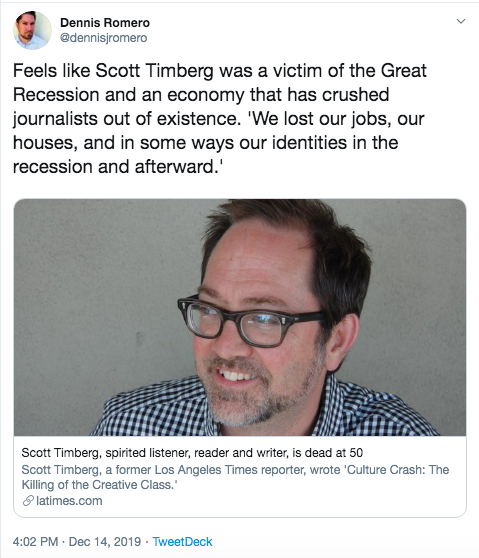
I didn’t know Los Angeles cultural journalist and author Scott Timberg, but it seemed all my friends did. The Los Angeles Times obituary called him “a ferocious listener and reader whose cultural appetites fueled his career as an author and journalist in Los Angeles and led him to question the future of the arts in the internet age.” Timberg died on Tuesday. He was 50.

“His death by suicide shocked us all while also silencing a voice of tremendous insight and eloquence about so, so many things that he loved,” wrote the writer’s brother, Craig Timberg, in a message to friends.

The Palo Alto-born journalist wrote Culture Crash: The Killing of the Creative Class, which discussed how digital technology and economic polarization were damaging American cultural life. The acclaimed book was published in 2015 by Yale University Press.

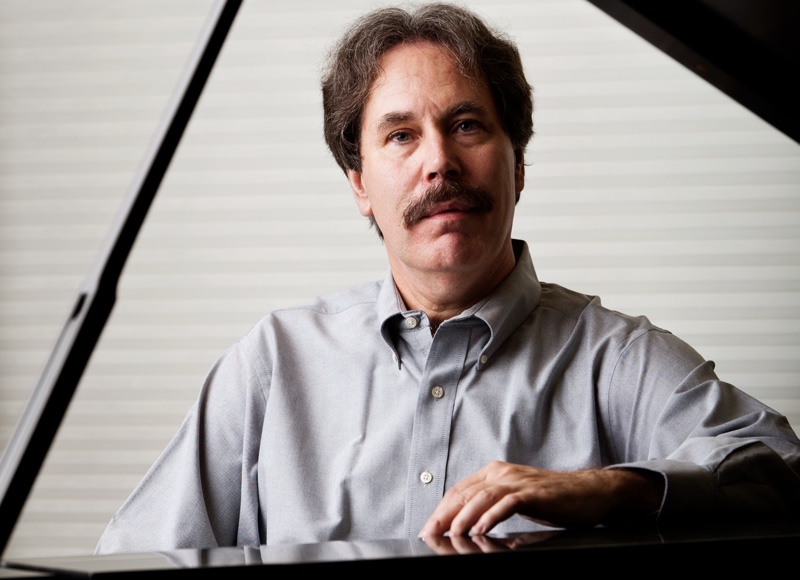
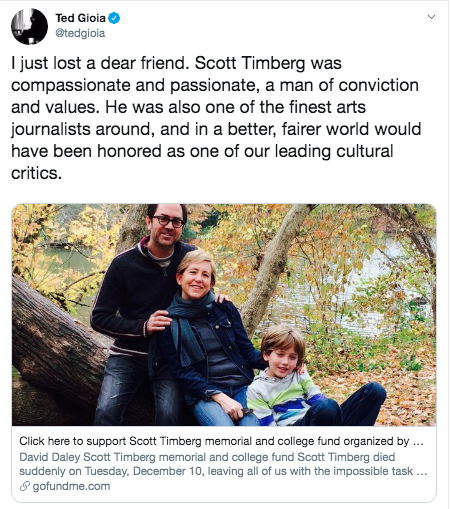
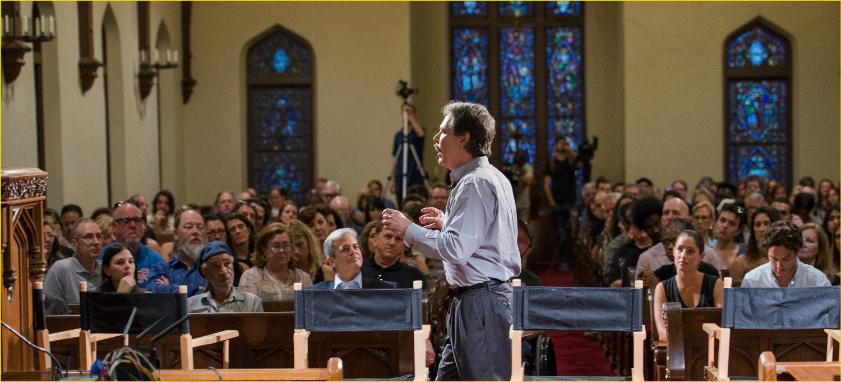
Ted Gioia recalls “earnestness and enthusiasm”

“You could talk to him about virtually any subject,” wrote friend and author Ted Goia. “In fact, I don’t think I’ve ever met anyone who combined earnestness and enthusiasm (typically opposed traits) in such a high degree.”

An excerpt from the obituary:

Timberg’s cultural explorations continued after The Times laid him off amid budget cuts in 2008, and the Timberg family had to relinquish their home. Timberg began to question conventional wisdom about the internet boosting opportunities for writers, artists, musicians and others.

Between freelance assignments for clients including the New York Times, Timberg gradually assembled the manuscript that became Culture Crash and took it to Steve Wasserman, who edited the book for Yale University Press and now serves as publisher and executive director of Heyday.

The book, wrote reviewer Richard Brody in the New Yorker, is “a quietly radical rethinking of the very nature of art in modern life.”

Timberg’s lament for the creative class “seemed to have been written with a pen dipped into the inkwell of his own blood,” Wasserman said Friday. He called Timberg a man of “exquisite, promiscuous curiosities” whose death “is the moral equivalent of a book-burning.”

“A pen dipped into the inkwell of his own blood”

“He could write about music better than any other literary journalist, and he could write about literature better than any other music journalist,” said David Kipen, a friend, editor and founder of the nonprofit Boyle Heights lending library Libros Schmibros.

Said his friend and editor Joe Donnelly, “His death is a casualty in the fight for the soul of the city.”

After discussing his book, the L.A. Times says: “The sting of those disappointments, friends and family said, never seemed to fade.” It wasn’t clear whether it was the disappointment in  the digital technology and economic polarization, or being laid off and losing one’s home. I know what it is like to live as a free-lancer in the “gig economy.”

I look forward to reading his book. He will be missed.

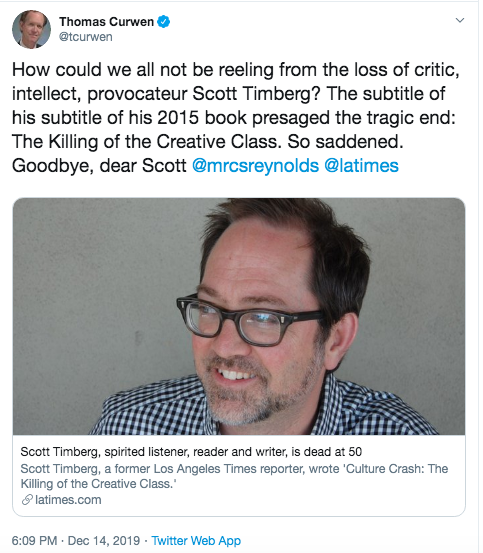
Read the whole thing here. Tweets from NBC news journalist Dennis Romero, Ted Gioia, and the Los Angeles Times‘s Tom Curwen.

“For most of history, music was a kind of cloud storage for societies”: Ted Gioia talks music with Tyler Cowen

Share

“Most people in my generation had better sound systems as teenagers than they do now.”  (Photo: Brenda Ladd)

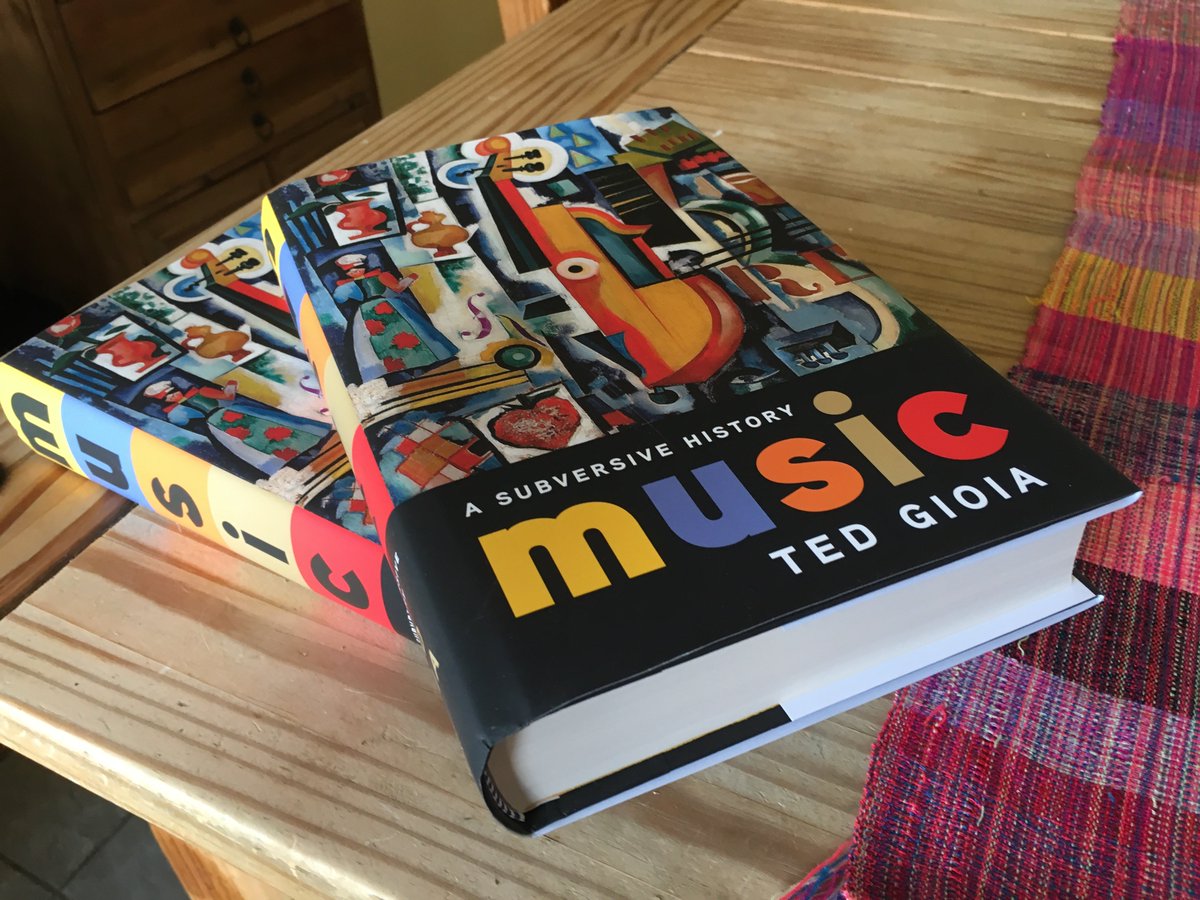
Jazz scholar Ted Gioia listens to three hours of new music per day and over 1,000 newly released recordings in a year. (We’ve written about him here and here and here.) His latest book, Music: A Subversive History covers the evolution of music from its origins in hunter-gatherer societies, to ancient Greece, to jazz, to its role in modern-day political protests such as those in Hong Kong. Over at Medium, he joined the popular economist Tyler Cowen to discuss music in a wide-ranging interview (the podcast is here) that also takes on the music industry, technology, and the reason for loud restaurant music (hint: René Girard).

The news is not all good: “In fact, I would say that music is the only form of entertainment in which the technology has gotten worse during my lifetime. I go to movies now, and it’s this big screen and surround sound. Video games put the Pong that I used to play to shame. TV is so good, it’s being called a golden age of television. But in music, most of us listen to songs on these lousy handheld devices. Most people in my generation had better sound systems as teenagers than they do now. That worries me more than the whole idea of how songs are written. I’m really concerned about the technology lessening the whole listening experience.”

Ted’s first copies of his new book. (Via Twitter)

An excerpt:

COWEN: … Do you think our collective memory from music is decaying more rapidly because communications technologies move so much faster and preserve things so much better?

GIOIA: What people don’t understand is that, for most of history, music was a kind of cloud storage for societies. I like to tell people that music is a technology for societies that don’t have semiconductors or spaceships. If you go to any traditional community, and you try to find the historian, generally it’s a singer. Music would preserve culture; it would preserve folklore.

Well, nowadays, we rely on cloud storage to be the preserver of these same things. And I think there’s a strange shift. Both we rely on the cloud to preserve our music, but also, we no longer rely on music to preserve our culture. This is potentially a dangerous thing because it could create a situation where our musical lives grow more and more distant from our actual social lives with the people around us in our larger community.

Here’s another excerpt:

COWEN: But what really embarrasses you? What admission can I squeeze out of you?

GIOIA: When I was a teenager, I listened to Emerson, Lake, and Palmer.

COWEN: Now that’s embarrassing.

GIOIA: Right before I discovered jazz, I was listening to Keith Emerson. This was the quandary I was in.

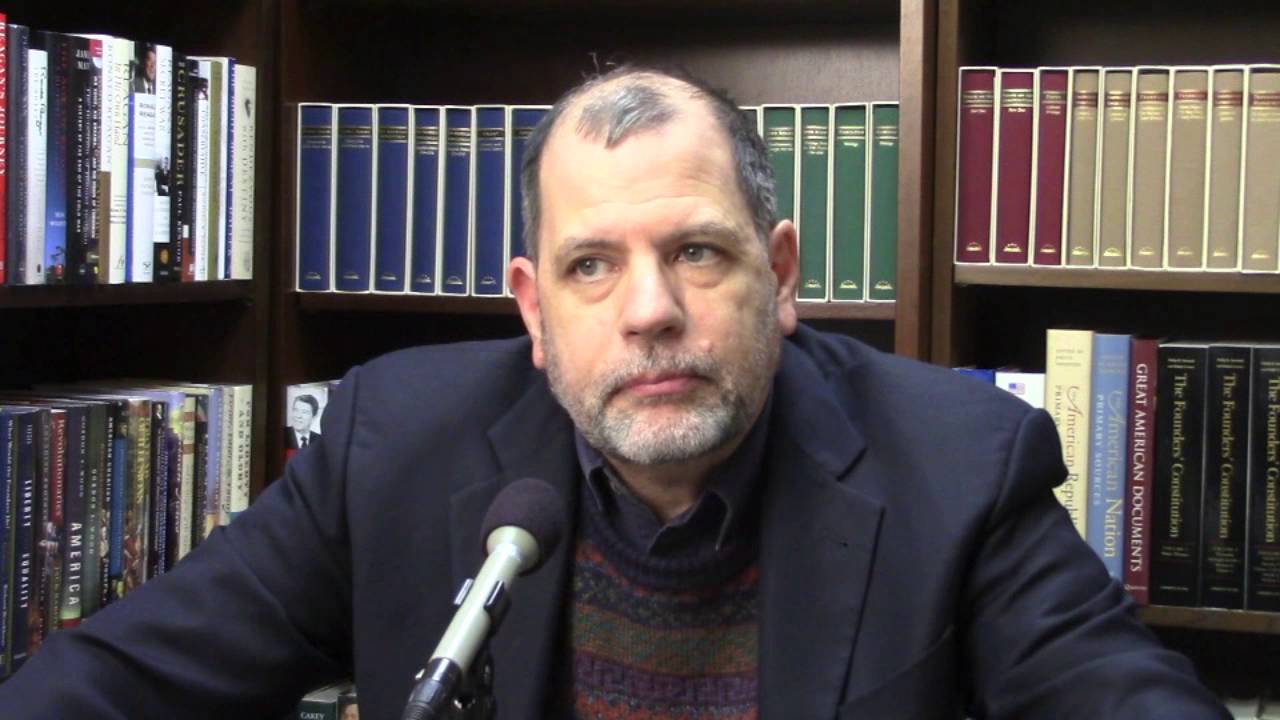
Economist Tyler Cowen asks an embarrassing question

COWEN: It was jazz, in a way.

GIOIA: It prepared me for jazz. It really did. When I was a teenager, I was playing piano, and this was the problem I faced. I liked rock because of its emotional immediacy, but it didn’t have the sophistication I wanted. Then I loved classical music like Bach for the sophistication, but it didn’t have the emotional immediacy. And I said, “I need something that brings together both.”

Then I walked into a jazz club. Literally, I walked into the Lighthouse in Hermosa Beach, California. I was a high school student. I sat down, the music started, and within 10 seconds, I said to myself, “This is what I’ve been waiting for.” Really, it was this epiphanal moment. But before that, it was Keith Emerson.

And a third, about one of my own pet peeves – loud restaurants:

COWEN: Why are restaurants so much noisier today? And they’re still getting noisier.

GIOIA: In fact, I’ve got to say I prefer the quiet restaurant, but I understand everybody else wants the noisy restaurant. And I do think we’re going back to René Girard territory, where everything’s imitation, where you choose the restaurant not on what’s the best food, but what other people are doing that I can imitate. There are two restaurants in town. You go in the one with the most people. I think that imitative behavior patterns explain much more in society than we care to admit.

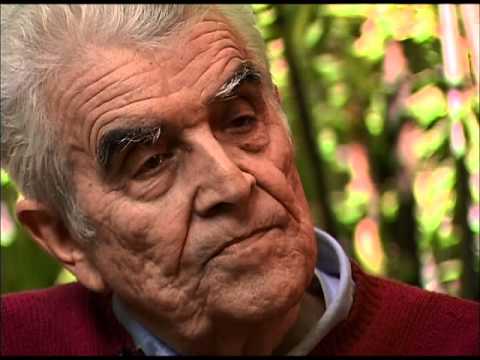
Merci, René Girard.

COWEN: But there’s much more noise pollution more generally. Restaurants are noisier. It seems that music, in general, is louder. And in terms of dynamic compression, the range is much narrower. So why is there this general tendency toward more noise? Why are markets undersupplying peace and quiet?

GIOIA: Because they want to stand out. It’s interesting, in my book I talk about the very first musicians, who were hunter-gatherers. What they did was fascinating because back then there were no loud sounds. You could live your whole life in prehistoric times and maybe never hear a loud sound unless you went near a waterfall or maybe during a thunderstorm. But for the most part everything was quiet.

So that’s why there’s a plausible theory that the early hunter-gatherers invented choral singing to hunt. They were scavengers, and they didn’t try to kill the lion themselves. They let the lion kill the prey. Then they would sing together to scare away the lion, and they would get the food. That tells you that back then, loud sounds were so rare that they were an amazing expression of power.

The thing to remember is, even today, loud sounds are an expression of power, notoriety. So you have competition in terms of sound, and the restaurants believe — and maybe rightly — that they’re going to stand out with the noisier environment. Now, once again, I will avoid those restaurants. I’ll go to the quiet one, but I really think the same way there was an arms race in the 1960s, there’s a noise race in society right now.

There’s lots more. Read the whole thing here

“A Genius, Without a Doubt”: Ted Gioia considers Gershwin’s legacy

Share

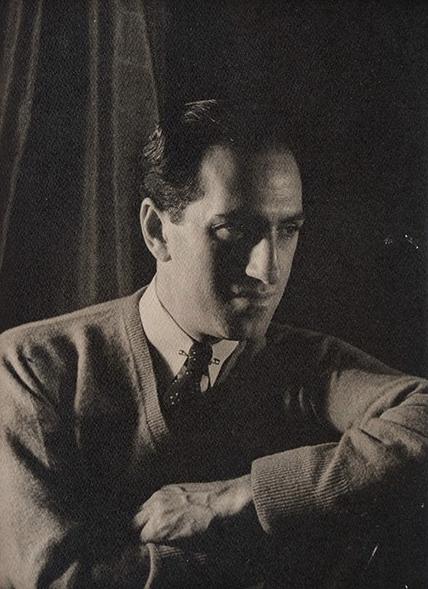
The year of his death. (Photo: Carl Van Vechten)

Jazz scholar Ted Gioia‘s personal connection to George Gershwin’s music goes back to his teenage years, when he first started performing his music on the piano.

Ted reviews the newest biography, Richard Crawford‘s Summertime, in A Genius, Without a Doubt, in yesterday’s Wall Street JournalTed describes it as “a genial account … that demonstrates his passion for Gershwin on almost every page.” At nearly 600 pages, it’s not for the faint-hearted.

Many biographies precede it: the earliest, George Gershwin: A Study in American Music, was published in 1931 to coincide with the composer’s 33rd birthday – not as soon as it might seem. The gifted composer died at 38 of a brain tumor.

It was the first of many biographies: “Two dozen more have appeared since, along with various musicological studies, sheet-music compilations and other works,” Ted writes. “Howard Pollack’s George Gershwin: His Life and Work, published in 2006, clocks in at almost 900 pages and stands out from the pack for its intelligence and depth. Ira Gershwin, the composer’s brother and frequent lyricist, left us a charming 1959 volume titled Lyrics on Several Occasions, a gossipy and insightful guide to their collaborations. Finally, I’ve consulted the chapter on Gershwin in Alec Wilder’s seminal American Popular Song (1972) so many times that my copy is falling to pieces (perhaps the ultimate testimony to a beloved book).”

His legacy? “Gershwin’s reputation as a composer is still going strong 100 years after he emerged on the music scene, but probably not in the way he envisioned. Sheet-music sales don’t generate much income nowadays, and Broadway has almost become a Disney theme park, but Gershwin calls the tune in other, unexpected places. You will hear his melodies everywhere from Starbucks playlists to United Airlines flight-safety videos.”

Yet Ted finds it puzzling that Gershwin “allegedly legitimized jazz as serious music with the success of ‘Rhapsody in Blue’ in 1924 but that not a single jazz musician was able to benefit from this crossover success.

“You might think that Duke Ellington or James P. Johnson or some other jazz star would have also been embraced as a composer of symphonic music. But the door opened for Gershwin and quickly shut behind him. We can hardly blame Gershwin for this—he was, after all, an ardent champion of his favorite jazz musicians—yet it remains an important matter and isn’t dealt with anywhere in these pages.”

He concludes: “We still need a book that makes a strong case for this towering figure’s relevance in our own time.” Read the rest here.

Postscript on 8/31: A Facebook comment from journalist Jeff Selbst:  The fallacy cited is that somehow Gershwin was a ‘crossover’ figure who should have been followed with the same respect by James P. Johnson or Duke Ellington. This fundamentally misunderstands Gershwin’s music and his place within music history.  He was emphatically not a composer of jazz. Every analysis will reveal a composer who began firmly in the tradition of Tin Pan Alley and transitioned successfully to a conservative classical tradition. “Jazz,” if it exists at all in his music, is a spice, an overlay, a hint of exoticism over well-shaped post-Romantic classical music. His most important works were written in the late 20s through the mid to late 30s, a period in which really revolutionary things were being done in music (Shostakovich, Stravinsky, Ravel), something Gershwin recognized when he went to Paris to ask Ravel to teach him and was famously turned down. (In a wonderful irony. Ravel wrote his Piano Concerto in G shortly after meeting Gershwin and guess who seemed to have rubbed off on him!)

The point of all this is that the door didn’t open and close around a seminal jazz figure. He was never the groundbreaking figure that some musicologists pretend. That said, I find his music bloody irresistible.

Robert Harrison’s “Entitled Opinions”: philosophy without borders

Share

Over at the blog for the American Philosophical Association, I have a guest post describing my work with Robert Pogue Harrison‘s brainchild, the intellectual talk show Entitled Opinions, available as a radio show and podcasts. The piece been adapted from a longer essay that will appear in Literary Criticism as Public Scholarship (edited by Rachel Arteaga and Rosemary Johnsen), under contract with Amherst College Press. An excerpt from the blogpost:

I teamed with Harrison to plan for a bigger future for Entitled Opinions a few years agoA generous donation from former Stanford President John Hennessy helped fund a website redesign, with easily searchable programming and a home of its own that was not in a hard-to-find corner of the French and Italian Department website.

I argued that there was nothing on either the new or old website to indicate what a listener would hear in the particular podcast – a powerful disincentive for anyone thinking to invest an hour. Not everyone will gamble an hour of their precious time that way. Jazz scholar Ted Gioia, a master of the social media, had counseled me that the missing component in our modern cyber-edifice is this: while there is much transferring text to visual images, tweets, audio, and so on, there is comparatively little transfer going in the opposite direction – that is, turning audio and visual content into text. A few synoptic paragraphs with quotations from the episode would entice as well as inform potential listeners.

We forged a partnership with the Los Angeles Review of Books, establishing a podcast channel for Entitled Opinions that would bring more visibility to the program and draw new audiences. We also struggled to get a presence on social media – no small thing either, as Harrison was at first resistant to Facebook, Twitter, and the rest. He cherished the cult status of Entitled Opinion, and emphasized the whole message of Entitled Opinions was for long thoughts over short ones, through the medium of intensive hour-long conversations. I was sympathetic. But in today’s world, to get the word out without using social media is to try to get the word out without getting the word out.

Now we are taking the next step: we are creating lightly edited transcripts and pitching them to the international media to spread the word about Entitled Opinions. Harrison’s interview with German philosopher Peter Sloterdijk ran in translation in Die WeltThe original English transcript is forthcoming in Los Angeles Review of Books. The first of a two-part interview with French thinker René Girard ran in England’s Standpointthe second is scheduled for Zurich’s Neue Zürcher Zeitung, which has also run a translation of Harrison’s interview with American philosopher Richard RortyThe Chronicle of Higher Education has published part of a transcript of a conversation with “metahistorian” Hayden White.  More are on the way. (Both the Girard interviews will be published in my forthcoming Conversations with René Girard, to be published by Bloomsbury in 2020.)

Read the whole thing here.

“The fuel for my books is a 50/50 mix of dark roast java and printer toner”: jazz scholar Ted Gioia on writing.

Share

I didn’t know that I had quite so much in common with jazz scholar and friend Ted Gioia until I read  “Award-Winning Historian and Bestselling Author Ted Gioia On The Keys To Productive Research and The Most Important Rule Of Writing” over at the Writing Routines website.

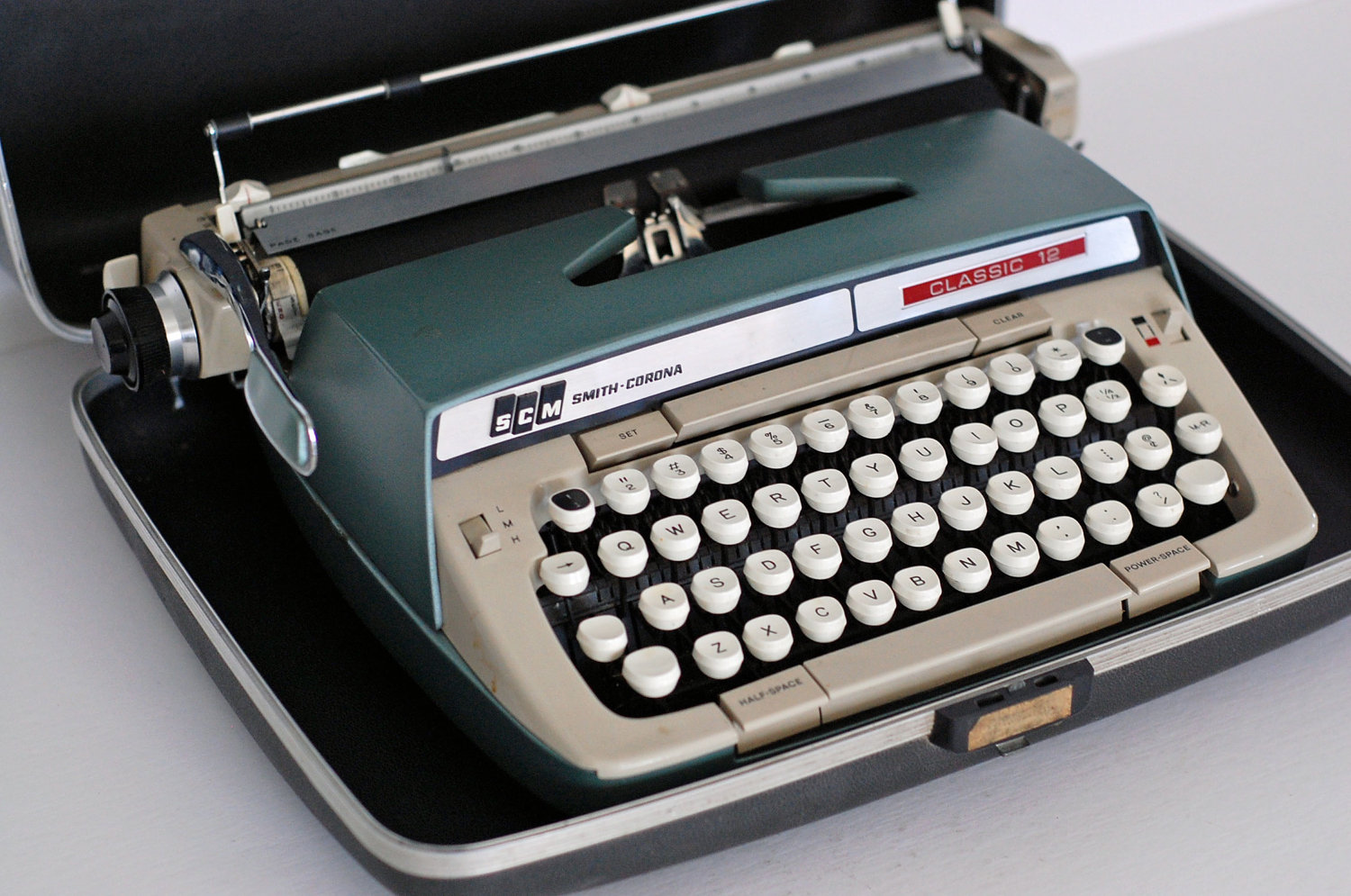
Unlike Ted, however, I left pad and pencil behind at my first newspaper job, as a 17-year-old cub reporter at the Pontiac Press. I was writing, literally writing, a story when an editor brushed by me and said, “Here, we compose on the typewriter.” And so I did. (That’s right – typewriter. Remember those?)

Other than that, we differ only in the brand of coffee. Mine at right. Brew it strong enough and you can stand a spoon up in it.

An excerpt from the Q&A:

When and where do you like to write? Are you the same-thing-every-day kind of writer or can you write anytime, anywhere?

Over the years, I have tried every possible writing routine. My first book was written longhand while sitting at a desk in a library—and I had to hire a typist to turn my scribblings into a publishable manuscript. By the time, I wrote my second book, I had purchased one of the very first Apple computers, but adapting to the digital age was challenging. The floppy disk containing two chapters of that book somehow got damaged, and I had to recreate the text from various notes and earlier drafts. But I persisted with digital technology, and now can’t imagine working without it.

Writer’s block? Ha! (Photo D, Shafer)

Today I write in a quiet home office with two computers, and my large personal library near at hand for consultation.

Do you have any pre-writing rituals or habits before you sit down to write?

Probably the only essential pre-writing ritual is a cup of coffee—preferably Major Dickason’s Blend from Peet’s. Other pre-writing rituals can easily become distractions, so I avoid them. But the coffee is essential. The fuel for my books is a 50/50 mix of dark roast java and printer toner.

What do you do when the writing doesn’t come easy? Do you struggle at all with that dreaded enemy of writing: writer’s block? Do you think such a thing exists?

I don’t believe in writer’s block. If I waited for inspiration before I began writing, I would never get anything finished, or even started, for that matter. I set aside time every day to write. When I sit down and start, I am prepared—because I have spent much of my life in preparation for the writing projects I undertake.

Read the rest here

Why Google sucks: it rips off writers, and tells lies about you, too.

Share

A few days ago I published jazz scholar Ted Gioia‘s letter to the Library of Congress, “Writer to Library of Congress: ‘Pay us!” But there was one provocative argument in the article I didn’t cite, because I didn’t understand Ted’s contention that Google is the biggest thief of all. So I wrote back to ask Ted. Here’s what he said:

Google makes most of its money linking to content that it doesn’t pay for. There has been a huge shift of advertising revenues from newspapers (that create the content) to Google (which is a kind of parasite, living off the content of others).

I didn’t spell that out in the article. But I thought it was important to mention—because Google is the single biggest reason why earnings for writers have collapsed in recent years.
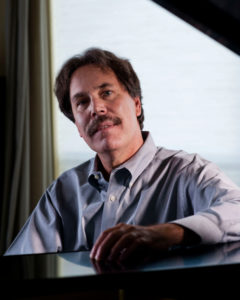
Ted’s not a Google fan (Photo: Dave Shafer)

Here are the paragraphs in full, from Ted’s 2014 Daily Beast article, “Rich People Want You to Work for Free”:

The worst offender, however, is not the government, but Google—a company that has done more to impoverish musicians and other creative professionals than any entity on the face of the planet. Google was once a struggling start-up with little money to spend, but that was a long, long time ago … before the music died. In case you didn’t know, let me point out that Google is now one of the most profitable businesses in history—with a market cap of almost $400 billion and more than $50 billion in cash in its coffers. But what started out as a search engine has evolved into a search-and-destroy machine.

When I ask people why they don’t pay for a music subscription service or (heaven forbid!) purchase physical albums, the most common response is: Why should I? I can get almost any song I want for free on YouTube. I’ve even had people laugh at me for my naïveté in considering any other way of consuming music. And who can blame these freeloaders from taking advantage of a “free” (if sometimes legally dubious) source for almost any song ever recorded? But the highly paid Google execs who run YouTube need to be at the top of any list of the culprits who destroyed the economic conditions for musical artists.

In a fair world, Google would be required to share advertising revenues when a user clicks on a search engine result linking to a newspaper or periodical.  A 50/50 split would be reasonable (and, frankly, 50% is very generous to Google, which is only an intermediary not a creator — what we once called a ‘middleman’). This would bring billions of dollars into journalism, and provide much needed financial support for writers.  And this kind of revenue sharing is entirely fair and validated by past history. Years ago, the government decided that radio stations and retail shops playing music were not just passive intermediaries, but needed to pay for these rights. We need a similar structural solution for the written word.

Google is like a bully who controls the door to a restaurant, and wants to siphon off all the money the previously went to the cooks, servers, food suppliers, etc. Or imagine if some company found a way of owning the sidewalk leading up to your home, and then tried to monetize access. What’s going on in writing in the current day is no different. Just because Google found a fancy high tech way of controlling the path people take to access a newspaper article doesn’t mean it can bleed the newspaper industry dry.

I have my own bone to pick with Google. They have a so-called “Knowledge Graf” that surfaces in every search for a prominent person’s name. It pops up with information that is not verified with the source or, really, anywhere else. Nor are they particular about who qualifies as a “public person” – does a very private author such as myself merit having personal information exposed internationally? Have I forfeited my privacy in the same way a Senator or Beyoncé become “public figure”? My memory of journalism law suggests not. I don’t even have a Wikipedia page.
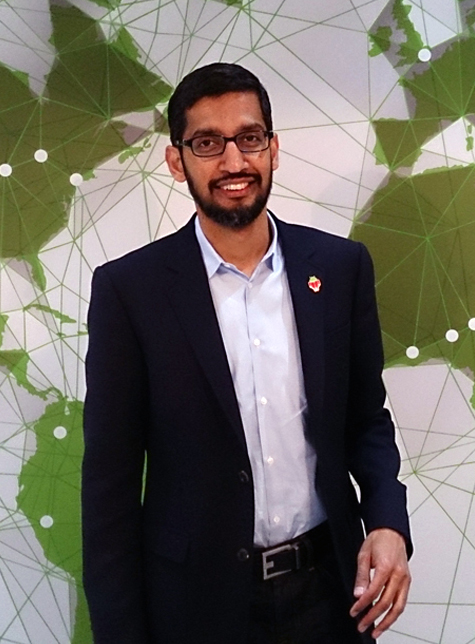
Google CEO Sundar Pichai: I bet he gets to keep his privacy. (Photo: Maurizio Pesce)

They are profiting from slipshod aggregators such as Spokeo, Instantcheckmate, Intellius, and others that collect information on current and former spouses, sisters, brothers, birthdates, places of residence, arrests and traffic violations, and then erps it onto the worldwide web without any factchecking (for example, some of these sites list a Missouri as a former residence; I’ve never even been there). Google vacuums it up, publishing it with a reach The Washington Post would envy. Of course, they say they are not “publishing,” but rather disseminating “free” information, but how is this online publication different from, say, any online journal? As a journalist, I know what would happen to me if I published information from people from one of these sloppy websites without independently checking – after all, your info is shoveled in with everyone else who shares your name or part of your name. Why do they get away with it?

It’s gathered by ‘bots, and published by ‘bots. And no single human being will take responsibility. For, example, the possibilities of identity theft.

Once notified of the error, they defiantly refuse to remove fake information, however damaging it may be to one’s life or one’s career. (They have, with impunity pushed me into my retirement years – not helpful for a freelance writer, or any woman over 50. Age discrimination, anyone? They also list me as a literary critic for The San Francisco Chronicle – I haven’t written a word there for almost a decade. I could go on and on.) I’ve told them its wrong. They persist as if it is true. Malice? Perhaps not. But certainly a willful disregard for truth. In old-fashioned terms, it’s called lying.

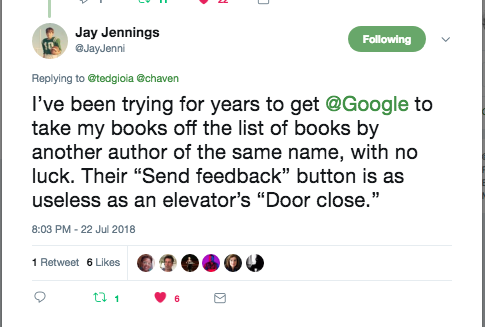
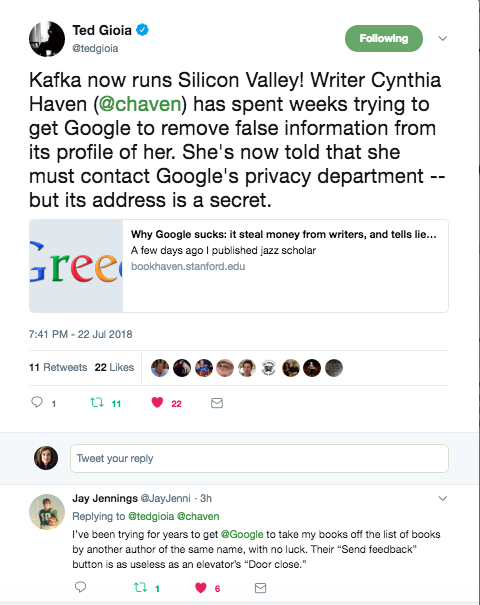
I have spent hours and weeks contacting agencies to remove my listings. I have spent hours talking to Google employees – probably none were over 25 years of age, and they all act powerless within the diasporic organization they work for. None will give their last name. None will give a direct dial phone number so that you can contact them again. Or an email address (if you email back, you either get a rotating roster of kids with whom to discuss your privacy details, or else you get an error message). I have talked to lawyers. I have asked Google for the address of its Privacy Department, and the name of its director. The Kafkaesque organization that is so quick to share information about me is suddenly all shy about sharing simple corporate information that is easily available on most responsible business websites.

Of course, they have a way that you can manage your own site: send them a selfie with your face (not blurry) with government-issued identification. Every line of your driver’s license or passport must be clear and legible to them. They want to be sure, you see, that you are really you – even though they could contact me via my gmail address issued by Google, my Google Plus account, or even this blog. I wish they had been so impeccable about facts when publishing information for worldwide dissemination.

They miss the point, of course: they have to prove their information is correct. It is not my responsibility to provide them with correct information that I don’t want published anyway (let alone my passport number).

In any case, having mismanaged information about me already and violated my privacy, they wish me to give them more information – for example, my height, weight, eye color, hair color on my driver’s license. Oh, they’ll destroy it afterward, they promise. Sure. That’s what Cambridge Analytica said. Google is a big class-action lawsuit waiting to happen.

Google. You suck big time.
Update from Twitter – 7/22: