Evelyn Waugh vs. the BBC

Share
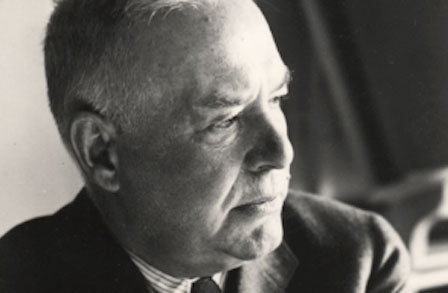
Evelyn-Waugh

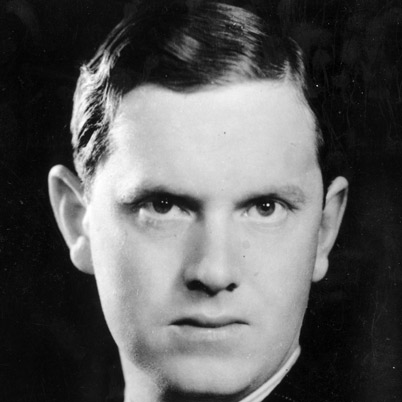
Younger version

Just found this intriguing interview between Evelyn Waugh and John Freeman of the BBC.  It’s the first time I’ve seen him on camera, or heard his voice.  As T.S. Eliot writes in “East Coker,” “It was not (to start again) what one had expected.”  There’s about three or four silly minutes at the beginning of this, “framing” the 1960 interview for us modern viewers, warning us how tetchy Waugh was during this session.  I don’t find him tetchy at all – I do find some of the questions a bit impertinent and testy. Waugh is terse in his answers – “everyone thinks ill of the BBC,” he says cheerfully when questioned – but then, this was his first appearance on TV.  Why did he do it? “Poverty,” he explained succinctly to Freeman.  “We’ve both been hired to talk in this deliriously happy way.”  Enjoy.

Postscript on 10/7:  We received a note from our favorite Polish photographer, Zygmunt Malinowski: “What an enjoyable BBC interview with Evelyn Waugh. Thank you! To me he appeared as  a very pleasant person bombarded by so many personal questions. No wonder some of his answers were short. Besides, he did not seem to appear irritable until the very end. Right in the beginning what intrigued me were the fluid portrait drawings and, to my surprise, at the end Feliks Topolski was credited as the artist. If I remember correctly, one of Topolski’s portraits is hanging in the Polish Instytut of Arts and Sciences in NYC.  Next time I am there I will check what writer he depicted.”

What do Truman Capote, Ernest Hemingway, Philip K. Dick, and Jean-Paul Sartre have in common?

Share

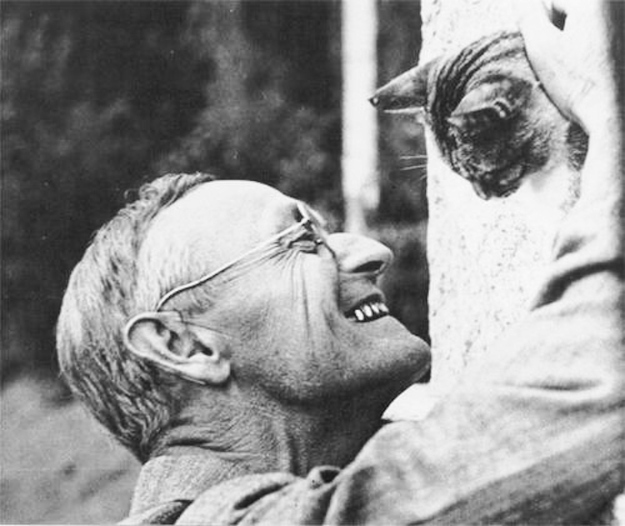
Hermann Hesse finds true love

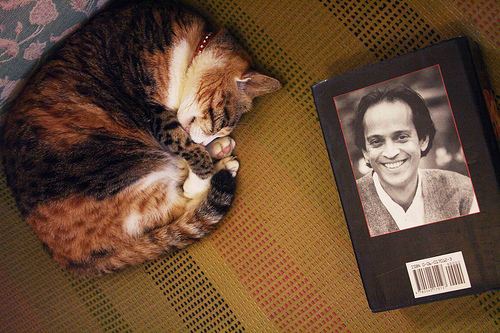
I have a lot of writing to finish between now and Sunday night – I’ll be going at it 24/7.  Meanwhile, you might want to check out Buzzfeed’s “30 Renowned Authors Inspired by Cats.”  There’s also more at Writers and Kitties.

Mark Twain was an obvious choice.  But I combed through to see if they were going to remember some of the world’s most famous cat-lovers.  Colette, for example, who famously said, “Plus je connais les hommes, plus j’aime mes chats.”

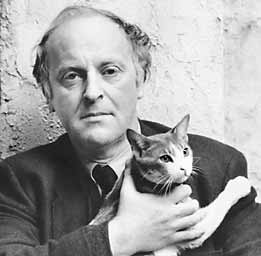
Mississippi and J.B. (Photo: Bengt Jangfeldt)

She’s there, along with Truman Capote, Ernest Hemingway, Edgar Allan Poe, Philip K. Dick, Hermann Hesse, Edward Gorey, George Plimpton, Jacques Derrida, W.H. Auden, and Jean-Paul Sartre make the cut.  But where’s T.S. Eliot, for goodness sake?

A few other notables were missed.  Where is Joseph Brodsky and his famous cat Mississippi?

I’m not entirely sure Vikram Seth is a cat-lover, but I think he must be.  The gnarly old tomcat Charlemagne, in The Golden Gate, is one of the great literary cats. I could find no photo of him with cats – only this from Delhi Walla, which is as close as I’m going to get tonight.  And since my own copy of Golden Gate is loaned out to a good cause, I found this sole sonnet (the novel is composed of Pushkin tetrameter sonnets), in which the lawyer John is warned of his romantic competition for the heart of fellow attorney Liz.  I like the way these fleet, four-footed sonnets fit onto wordpress better, next to a photograph, without awful line breaks:

Vikram Seth and fan

Ah, John, don’t take it all for granted.
Perhaps you think Liz loves you best.
The snooker table has been slanted.
A cuckoo’s bomb lies in the nest.
Be warned. Be warned. Just as in poker
The wildness of that card, the joker
Disturbs the best-laid plans of men,
So too it happens, now and then,
That a furred beast with feral features
(Little imagined in the days
When, cute and twee, the kitten plays),
Of that familiar brood of creatures
The world denominates a cat,
Enters the game, and knocks it flat.

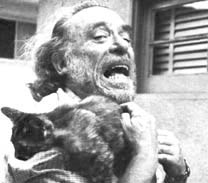
Charles Bukowski and friend

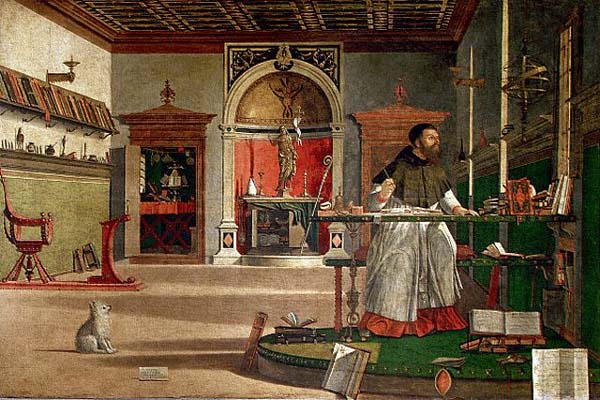
Speaking of Vikram Seth, let’s take a moment to give equal time to dogs.  I have in mind one that played prominently in Seth’s novel, An Equal Music. It’s St. Augustine’s small white Maltese dog in Vittore Carpaccio‘s Saint Augustine in His Study, in Venice’s Scuola di San Giorgio degli Schiavoni. It’s from Carpaccio’s mature period – he began it in 1502 and completed it in 1507. It’s one of seven panels he made, still in the Schola, depicting the guild’s patron saints.

On Vikram Seth’s authority, I shlepped to the Schola a decade or so ago. It’s tucked away on one of Venice’s sidestreets and not easy to find.  It was worth it. The schola is dark and mysterious and pure magic. The painting everything he said it would be.

Highly recommended.

.

A saint's best friend...Carpaccio's Augustine in his study

.

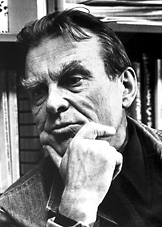
Kind of cool: Andrew Sullivan, Czesław Miłosz, the Book Haven and moi

Share

"That's me."

Andrew Sullivan‘s “The Dish”  picked up one of our posts over at the Daily Beast.  Not that we noticed.  We were in Paris at the time – but a friend tipped us off today.

It’s not the first time we’ve rubbed elbows.  He kindly picked up our “Orwell Watch” gripe on the much-abused phrase, “I take responsibility for…”  And we wrote about one of his posts about the ideas of René Girard over here.

In the February 5 post, he quotes Czesław Miłosz‘s poem, “At a Certain Age.”  Here’s the unfortunate part, though:  He left off the punchline(s).

Oh well.  As he pointed out, you can read the whole poem here.

And read the post he mentions, “The Final Dwarf of You,” where (as he puts it), I “examine” old age.  As well as Wallace Stevens and T.S. Eliot.  It’s here.

(Doesn’t really need to be “examined” … rather it something to be endured.  If one is lucky.)


“The final dwarf of you”: late-life poems of Wallace Stevens, T.S. Eliot, and Czesław Miłosz

Share

Crowd-pleaser

It is bitter cold, dropping below freezing in northern California – but still, a standing-room-only crowd gathered tonight to hear Helen Vendler speak on “Wallace Stevens as an American Poet.”

To be honest, the draw for me was Helen, not Stevens.  She was one of the contributors to An Invisible Rope, and we spent some time together in Kraków last spring.  Stevens is not exactly foreign territory, but I’ve never been attracted enough to make deeper excursions into his poetic terrain.

Then Helen quoted from Stevens’s poem, “The Dwarf,” and I eagerly looked up these incantatory lines later when I got home:

Now it is September and the web is woven.
The web is woven and you have to wear it.

The winter is made and you have to bear it,
The winter web, the winter woven, wind and wind …

It is all that you are, the final dwarf of you,
That is woven and woven and waiting to be worn …

"The web is woven and you have to wear it."

The subject of the poet’s approaching winter holds an increasing fascination for me … well, we are all growing older.  But growing older has been a great surprise – the psychological landscape and vantage points of late summer and autumn are not at all what I had been told or had been expecting.

Helen referred to Stevens’ sense of crustiness and limitation, the disillusionment of approaching old age – the horror and defeat of knowing that change is no longer possible.  But was it ever? Was it ever really?

I wonder, now, whether “progress” and “change” is imaginary even in youth – perhaps our sense of change is merely that we cannot yet detect which way the twig is bent.  Later, with 20-20 retrospection, the years have a certain inevitability to them – partly the illusion of rewriting the past to fit what we now know to be true, partly the result of our decisions.  “Choice” may be no more than whether we pull up the weeds or roses from our gardens, and which plants we water.  Even in old age we have the same choices: the decision, for example, of whether to abandon our vices before they abandon us.

So why do we go kicking and screaming as we are dragged through the first snow?  Obviously, age brings with it strange and bitter medicines of its own. T.S. Eliot put it astringently in “Little Gidding”:

"Then fools' approval stings..."

Let me disclose the gifts reserved for age
To set a crown upon your lifetime’s effort.
… the conscious impotence of rage
At human folly, and the laceration
Of laughter at what ceases to amuse.
And last, the rending pain of re-enactment
Of all that you have done, and been; the shame
Of motives late revealed, and the awareness
Of things ill done and done to others’ harm
Which once you took for exercise of virtue.
Then fools’ approval stings, and honour stains.

The final pill at the bottom of the bottle: a quiet self-acceptance – and with it, a welcome humility.  To return to poetry, isn’t it simply a matter of metaphors?  Why do we choose metaphors of old, unbending, twisted trees – isn’t age, at best, more a distillation, like attar?  The loss of distracting imagination and the fantasy of the infinitely wondrous “me,” the increasing laser-like focus on the one or two things one does well, whether it is writing poems or collecting seashells.  And the gratitude for the time to sustain such efforts – an option that was not given to the peers we buried.

Or, again, another metaphor:  why don’t we describe age in terms of botrytis, the rare “noble rot” of the vineyard, that yields the mellow depth and gentle surprise of late-harvest dessert wines?

"That's me."

Surely Czesław Miłosz knew what I am talking about – his late poems reflect the magic and wonderment of this new territory, and the self-surrender of humility –  a final sense of proportion and graceful humor about “the final dwarf.”

In his late poem, “At a Certain Age,” he admits “We wanted to confess our sins but there were no takers.”  After exploring several options, from pets to psychiatrists, he concludes:

Churches. Perhaps churches. But to confess there what?
That we used to see ourselves as handsome and noble
Yet later in our place an ugly toad
Half-opens its thick eyelid
And one sees clearly: “That’s me.”

On the other hand, there’s also his late-life prose poem, “Awakened”:

In advanced age, my health worsening, I woke up in the middle of the night, and experienced a feeling of happiness so intense and perfect that in all my life I had only felt its premonition. . . . As if a voice were repeating: “You can stop worrying now; everything happened just as it had to. You did what was assigned to you, and you are not required anymore to think of what happened long ago.” . . . The happiness on this side was like an announcement of the other side. I realized that this was an undeserved gift and I could not grasp by what grace it was bestowed on me.

Pablo Neruda: Greatest pick-up artist evah?

Share

The conversation erupted on my Facebook page, debating the eternally recurring subject of unjust Nobel awards. It’s recently been revealed that J.R.R. Tolkien had been snubbed by the Nobel committee because his writing wasn’t up to snuff.

Other poor Nobel choices came to mind among my FB friends – the 1971 Nobel to Pablo Neruda over Tolkien?  Or over W.H. Auden, for that matter?  Or Jorge Luis Borges?  Or Vladimir Nabokov?

Another Nobel laureate, Octavio Paz called Neruda “the greatest bad poet of the century,” a much-repeated soundbite that sticks.  Yet Nobelist Gabriel García Márquez called him “the greatest poet of the twentieth century – in any language.” To which one can only reply Osip Mandelstam, W.H. Auden, Marina Tsvetaeva, T.S. Eliot, Czeslaw Milosz.

Our view of Neruda is now inevitably colored by his Stalinist politics.

Apologists say the Stalinists couldn’t possibly have known about the murderous excesses of the U.S.S.R.  Couldn’t possibly have known?  Despite a generation of slaughtered, imprisoned and exiled writers from Russia?  Despite a man-made famine that starved millions?  Despite the writings of Robert Conquest?  If Neruda had any questions, all he had to do was ask Czeslaw Milosz, who defected in 1950.  Instead, he infamously penned a denunciation of Milosz as “The Man Who Ran Away.”

There is nothing so dangerous to us as the thing we do not want to be true, the thing we turn our backs to.

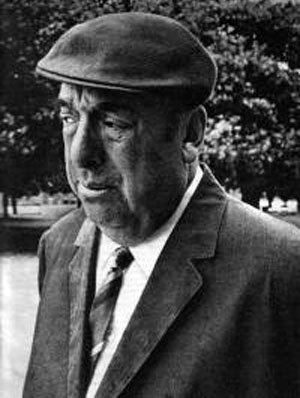
Not bad for a dumpy-looking guy

In time for the 2004 Neruda centenary, Stephen Schwartz (not a literary critic, but a conservative political commentator), wrote in a seminal article that has been cited all over the internet:

There is probably no more chance of halting this current binge of Neruda worship than there is of banishing the cicadas, but, still, the truth does need to be said: Pablo Neruda was a bad writer and a bad man. His main public is located not in the Spanish-speaking nations but in the Anglo-European countries, and his reputation derives almost entirely from the iconic place he once occupied in politics – which is to say, he’s “the greatest poet of the twentieth century” because he was a Stalinist at exactly the right moment, and not because of his poetry, which is doggerel.

So does Neruda’s poetry have a future?

Eternally.  On Facebook, my friend Kevin assured me that Pablo Neruda has enduring market value in the Spanish-speaking world for his … pick-up lines. Not bad for a dumpy-looking guy (see right).

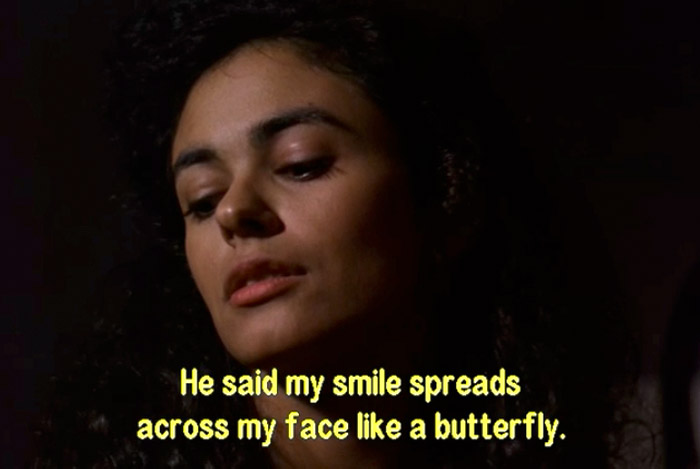
Hard to argue that point – an award-winning film was made on precisely that subject, Il Postino/The Postman.  The plot: nerdy Italian postman wants to pick up pretty girl.  He befriends the exiled Neruda and voilà!  Plagiarism is born in a small Italian village.

As Schwartz himself admitted:

Yes, his work is still plagiarized by teenage boys in Latin America, who see his Twenty Love Poems and a Desperate Song and figure there is nothing wrong with borrowing from it–just as one poem in the book is itself stolen from Rabindranath Tagore – and presenting its overwrought lines to their girlfriends. But if those boys grow up to be serious writers, they leave Neruda behind.

No luck with the line

But Kevin had a story of his own.  During a summer studying at the London School of Economics, an attractive young Spanish woman caught his eye.  How to attract her attention? His friend Pedro (there were a lot of Spaniards around that summer)  said it was very important to open with a sure-fire line.  Neruda was the ticket.

A dormitory lunchroom discussion of Neruda and the art of line-by-line seduction followed.  The young woman demanded an example of a florid Iberian pick-up line: “Let me hear it.”

Kevin recalled the line Pedro had taught him:  “The sentence would be something like “Oh, cielito mío, que Dios me dió” [Oh, my little heaven, given to me by God].

“It’s the cheesiest thing in the world.  And she said, ‘Wow, that’s really good.’”

Did he get the date?  No.  But he learned his lesson: “That’s how it’s done in España.”


The trail of “an Arab and his horse”: Poet Boris Pasternak, artist Leonid Pasternak, and Oxford

Share

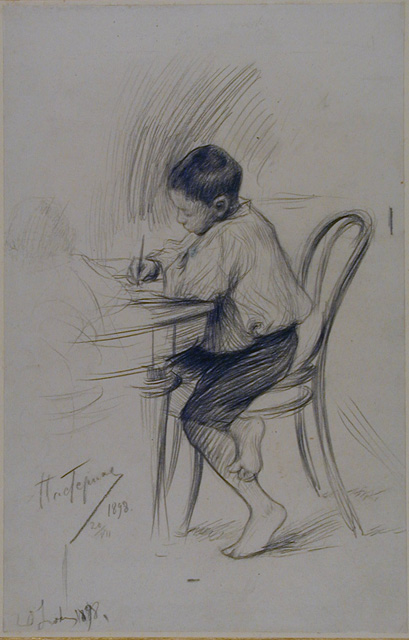
The poet as a boy, 1898 (Photo: Ashmolean Museum, University of Oxford)

The poet Marina Tsvetaeva said that fellow poet Boris Pasternak looked like “an Arab and his horse.”

He does, really.  It’s an amazing, slightly Asiatic face.

I had ample opportunity to gaze at the visage of the Nobel laureate at the Ashmolean Museum, in the inconspicuous Print Room in a secluded corner on the second floor.

Not enough people know the author of Dr. Zhivago – for example, that he was primarily a poet, not novelist – but even fewer know the prominent members of his family.  His father, Leonid Pasternak (1862-1945), was a brilliant painter and friend of the Tolstoys.

In the Print Room, the helpful librarians brought out a large portfolio of the artist’s chalk and watercolor sketches and paintings of his family, of the leading figures of his times, of still lifes and landscapes.  With the white cotton gloves the museum provided, I lifted and examined each in turn, including portraits of Albert Einstein, Rainer Maria Rilke, and others.

I met the Pasternak family during the Pasternak celebration at Stanford last year (I wrote about it here). I was delighted to renew the acquaintance with two of them in Oxford – Ann Pasternak Slater and Catherine Oppenheimer, both nieces of the poet and granddaughters of the artist.  Catherine is an eminent psychiatrist; Ann is professor emeritus of English literature at Oxford (she is currently writing about Evelyn Waugh).

Ann is also a formidable critic, and a matchless champion for Pasternak’s work.  She wrote last year in The Guardian:

As a public speaker he was incomprehensible. His work is notoriously hard to translate. …

Pasternak’s work is also difficult because his mind-set is unpredictably complex, evocatively associative, synaesthetic and polysemous. His vocabulary is exceptionally wide, and his intellect has a pronounced metaphysical cast. In an uncollected letter to TS Eliot, Pasternak explores their shared aesthetic in ambitiously faulty English. Eliot’s art, he writes, like his own, is “a casually broken off fragment of the density of being itself; of the hylomorphic matter of existence . . .” Pasternak became much more accessible in his later work. Doctor Zhivago was suicidally vivid and forthright. The poems that accompany it are translucent.
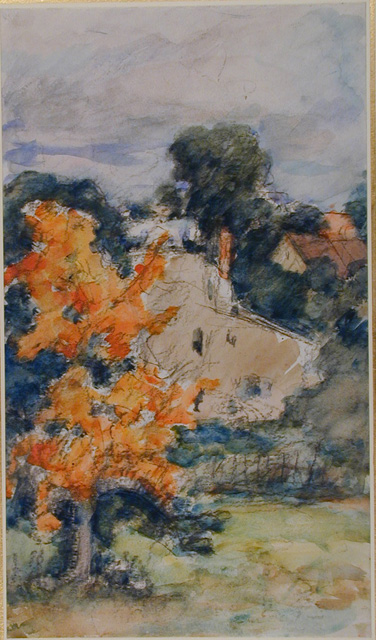
"The Yellow Tree: Autumn Landscape," 1918 (Photo: Ashmolean Museum, University of Oxford)

From his schooldays, Pasternak tells us, Yury Zhivago had dreamed of writing “a book of impressions of life in which he would conceal, like sticks of dynamite, the most striking things he had so far seen”. Doctor Zhivago was that book. It was packed with dynamite and, as Pasternak expected, it blew up in his face.

I talk a little about that explosion here.

I had lunch with Ann and Catherine in the former’s Oxford home, which is almost a museum of their grandfather’s artwork.  (A link for the Pasternak trust is here.) Of course we talked about the translations of the poet (Ann dissed the newest Pevear-Volokhonsky translation in the article I’ve quoted).

Ann describes her uncle’s poetry this way: “Boris’s poetry is formally rich, regularly rhymed, and metrically precise. It is full of delectable assonances, at once musical and wholly natural. My mother’s first priority was to reproduce his aural effects. She did. This difficult demand inevitably exacted its own price. Her English is flawed – it sounds Russian. But it sings, as Pasternak’s poetry does.”

My inevitable question:  Which of the Pasternak translations does she favor?  Her answer: Mother knows best.  (The link, here, also has rare recordings of Pasternak reading his poems in Russian.)

Ann kindly gave me an out-of-print volume of her mother’s translations.  Here’s an example of Lydia Pasternak Slater‘s translation:

Sultry Night

It drizzled, but not even grasses
Would bend within the bag of storm;
Dust only gulped its rain in pellets,
The iron roof – in powder form.

Rainer Maria Rilke, 1921-24 (Photo: Ashmolean Museum, University of Oxford)

The village did not hope for healing.
Deep as a swoon the poppies yearned
Among the rye in inflammation,
And God in fever tossed and turned.

In all the sleepless, universal,
The damp and orphaned latitude,
The signs and moans, their posts deserting,
Fled with the whirlwind in pursuit.

Behind them ran blind slanting raindrops
Hard on their heels, and by the fence
The wind and dripping branches argued –
My heart stood still – at my expense.

I felt this dreadful garden chatter
Would last forever, since the street
Would also notice me, and mutter
With bushes, rain and window shutter.

No way to challenge my defeat –
They’d argue, talk me off my feet.