

Vindication for Terry Castle in Sempre Susan

Share

Applause for Nunez (Photo: Marion Ettlinger)

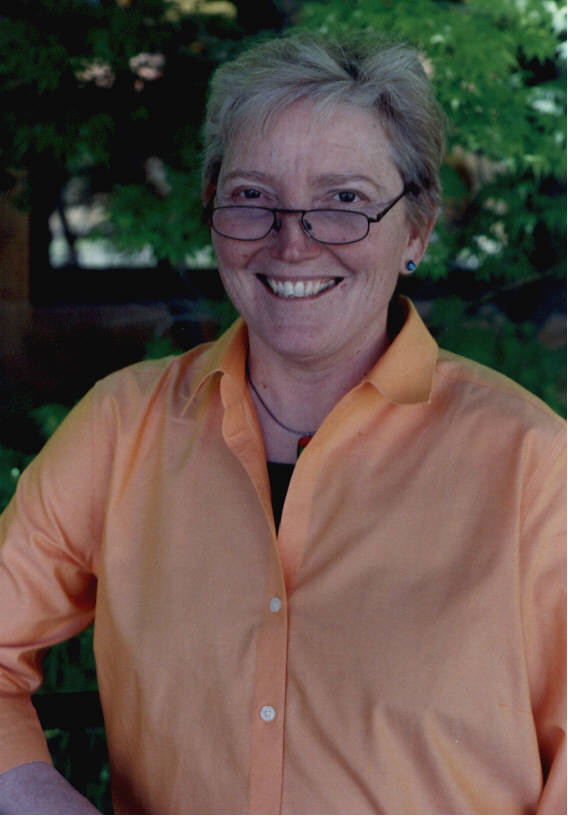
Terry Castle took a lot of heat for what she wrote about Susan Sontag in “Desperately Seeking Susan.” (The London Review of Books carries the 2005 Sontag anti-memoir here).  Although she had she been invited to Sontag’s memorial service, she was “disinvited the day after this piece came out.” She received a nasty email from Sontag’s son, David Rieff.

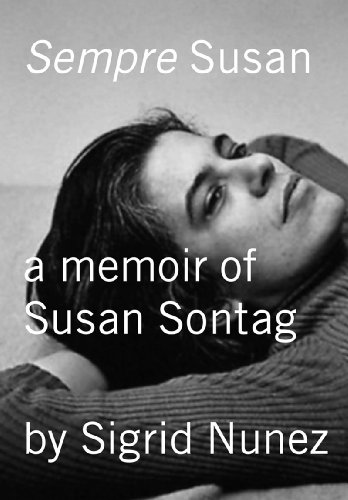
So it’s curious to see the respectful reception given to novelist Sigrid Nunez‘s memoir, Sempre Susan, which is getting some good reviews. Nunez had been Rieff’s lover — a threesome in Sontag’s apartment.  The commotion is somewhat surprising, given that no bookstore in Palo Alto seems to have the book yet — not Stanford Bookstore, nor Kepler’s, nor Borders, nor anywhere else I could find — so I figure it must be carried by a handful of bookstores in New York.

One thing is clear: Sempre Susan vindicates every word Terry wrote.

Joseph Epstein, former editor of The American Scholar, uses the occasion of the publication to take Sontag down a notch or two in the the Wall Street Journal: “In her thrall to ideas she resembles the pure type of the intellectual. The difficulty, though, was in the quality of so many of her ideas, most of which cannot be too soon forgot,” he writes, before recapping her political career.
Vindication for Terry

He concludes:

Although Sigrid Nunez appreciates Susan Sontag’s curiosity, wide reading, courage in the face of bad health, and independence, her unreality, her deep and abiding unreality, is the final impression that “Sempre Susan” leaves on the reader. Sontag didn’t mind whose feelings she hurt. Her trips to give talks at universities are strewn with stories of her disregard of her audience and astonishing impudence. No one was allowed to get in the way of her desires or disrupt her sense of her own high seriousness.

At the end of Sempre Susan, Ms. Nunez presents a woman who is filled with regrets, not about her treatment of others but about her own achievement. Still confident of her “worthy contribution to culture and society,” she nonetheless wishes that she had been “more artist and less critic, more author and less activist. . . . No, she was not happy with her life’s work. . . . True greatness had eluded her.” Deluded to the end, Susan Sontag had no notion that not literature but self-promotion was her real métier.
This is far more unjust than anything Terry may have said in her wry and self-mocking piece. While Epstein quotes Camille Paglia‘s assessment of Sontag — that she “made fetishes of depressive European writers” — it’s worth noting that Sontag’s championing of world literature in America did make a dent in American consciousness, which had, at the time of her launch in the 1960s, been a pretty parochial affair.

And despite Epstein’s dismissal of it, it did indeed take courage to face boos and jeering at the 1982 rally (not to mention the nasty aftermath in the press) where she said: “Imagine, if you will, someone who read only the Reader’s Digest between 1950 and 1970, and someone in the same period who read only The Nation or [t]he New Statesman. Which reader would have been better informed about the realities of Communism? The answer, I think, should give us pause. Can it be that our enemies were right?” Is there anyone outside Nepal who would defend Communism today?

That said, it will take years to figure out Sontag’s legacy — as a writer, and as a role model for a generation of women who were born when the coupon-clipping Mamie Eisenhower was First Lady.

I wrote to Terry to ask her what she thought — of the book, and also of Epstein’s review.  It was several days before she responded — she was swept up in the first week of spring classes. But she finally dashed off a quick email:

“Yes, I devoured the Nunez book as soon as it came out, & also found it pretty good….   The epstein piece made some vivid & nasty & accurate points,  but I don’t think he had any conception of what was great about her too—esp for women of my generation…  It’s all very bittersweet!”
Kudos for Terry Castle’s The Professor — “the prime-cut book of the year”

Share

Castle: Love me tender

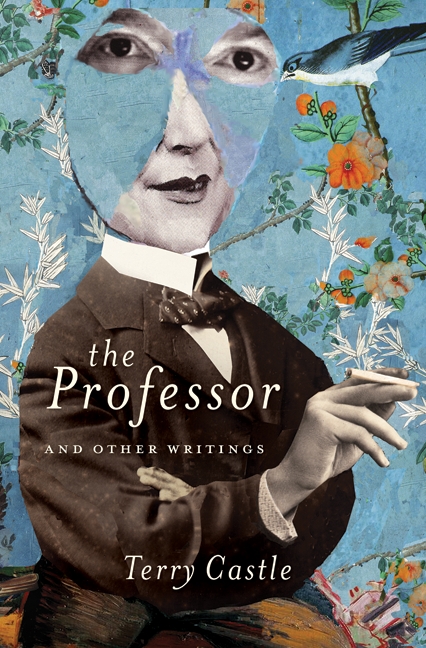
Speaking of The Chronicle of Higher Education … In the onslaught of the holiday season, we rather lost track of Terry Castle‘s honors.  Her The Professor and Other Writings was named one of the top ten books of the year by New York Magazine, which praised her “big human stew of tones: goofy, analytical, slangy, raw, confessional.” It was also among BookForum’s “favorite books of 2010” by which noted that Terry’s “radical candor makes it hard to enlist her under any ideological or political banner, and this recalcitrance alone gives her book an invaluable civic function.”  Amazon also named it #2 among its top ten books in gay and lesbian studies.

But Carlin Romano in the Dec. 12 Chronicle of Higher Education provided the pièce de résistance:

Looking back at the year in criticism between hard covers, one finds lines lingering in the mind, and not a few belong to Terry Castle. Her images of Susan Sontag as “sibylline and hokey and often a great bore,” a “bedazzling, now-dead, she-eminence.” Her self-portrait as a “japing, naysaying, emotionally stunted creature,” the “Spoiled Avocado Professor of English at Silicon Valley University.” …

Castle’s own self-grasped pathology (“Sontag was the Supremo and I the obsequious gofer”) makes the essay a masterpiece on the anxiety of influence in intellectual life. Yet deftly woven in, with all her other jewels of insight, is the superb, ruthless, spot-on assessment of Sontag as a “great comic character,” one with whom Dickens, Flaubert, or James “would have had a field day.” For Castle, “the carefully cultivated moral seriousness—strenuousness might be a better word—coexisted with a fantastical, Mrs. Jellyby absurdity. Sontag’s complicated and charismatic sexuality was part of this comic side of her life. The high-mindedness, the high-handedness, commingled with a love of gossip, drollery, and seductive acting out.”

Romano concludes: “If this is the higher potty mouth, bring it on. Castle remarks at one point that ‘the tenderness between lesbians and straight men is the real Love That Dare Not Speak Its Name.’ OK, love me tender. For any gourmet of cultural criticism with an unabashed taste for truth, this is the prime-cut book of the year.”

“Mortal combat”: Illness as cliché

Share

"In whatever kind of a 'race' life may be, I have very abruptly become a finalist."

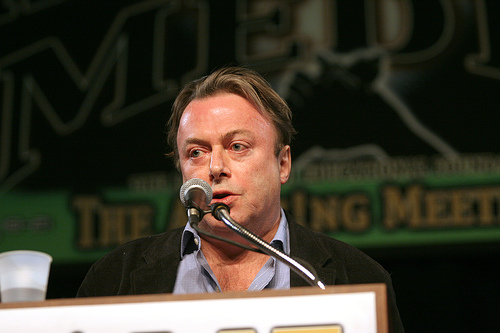
Christopher Hitchens usually summers in the sunny, mild climate of our own beautiful Palo Alto — not, obviously, this year.  He writes about his chemotherapy in “Topic of Cancer,” in Vanity Fair here.

In Susan Sontag‘s 1977 Illness as Metaphor, she writes: “Everyone who is born holds dual citizenship, in the kingdom of the well and in the kingdom of the sick.  Although we all prefer to use only the good passport, sooner or later each of us is obliged, at least for a spell, to identify ourselves as citizens of that other place.”

Here is Hitchens’s version of the 911 call that launched a very different kind of journey during his book tour:

“Any movement, however slight, required forethought and planning. It took strenuous effort for me to cross the room of my New York hotel and summon the emergency services. They arrived with great dispatch and behaved with immense courtesy and professionalism. I had the time to wonder why they needed so many boots and helmets and so much heavy backup equipment, but now that I view the scene in retrospect I see it as a very gentle and firm deportation, taking me from the country of the well across the stark frontier that marks off the land of malady.”

Hitchens continues Sontag’s metaphor in his piece, with an unexpected detour for Edna St. Vincent Millay (of all people).  Hitchens at his best when his observations are sharp, pungent, and iconoclastic, even when his offensive observations land like a pie in the face (and any with an IQ over 73 will meet something that offends).  Oddly, it’s only in his prejudices that he descends to conventionality.  So cancer has found him, ironically, in good hands — his bracing attempts to come to grips with sudden illness will have a familiar echo for anyone who has suffered a forced deportation to this unwished-for valley.

With his illness, he has entered the land of cliché, and for a writer that is mortal combat indeed.  As someone who survived a terminal cancer diagnosis nearly a decade ago, I appreciate the vividness of his own internal experience contrasted with the shopworn expectations and conventions of the “well people” (for example, I recall their sentimentality, as if I had crossed the final border into terminal self-pity when I was merely struggling to breathe or swallow).  I also recognize his startled confrontation with the barbaric practices that are the very best modern medicine has to offer — but that remain outrageous assaults on the body and its sense of well-being.  One views as a stranger one’s own, equally barbaric will to live:

“Myself, I love the imagery of struggle. I sometimes wish I were suffering in a good cause, or risking my life for the good of others, instead of just being a gravely endangered patient. Allow me to inform you, though, that when you sit in a room with a set of other finalists, and kindly people bring a huge transparent bag of poison and plug it into your arm, and you either read or don’t read a book while the venom sack gradually empties itself into your system, the image of the ardent soldier or revolutionary is the very last one that will occur to you. You feel swamped with passivity and impotence: dissolving in powerlessness like a sugar lump in water.”

Among the clichés one confronts are the strictures of Elisabeth Kübler-Ross, whose constructs are often seen as ironclad, rather than commonplace patterns. Hitchens of course has a few clichés of his own:  I rather doubt his chest hair was once “the toast of two continents” — in fact, I’d rather not think about it at all.

His piece is well worth the read.

Walcott to Europe: “What is the meaning of your empires?”

Share

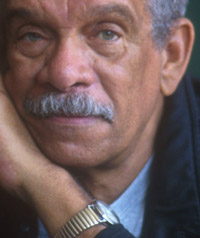
Rush Rehm‘s kind comment on yesterday’s post, “From Troy to the Caribbean: Homer onstage,” returned me to another passage from Irena Grudzińska Gross‘s Czesław Miłosz and Joseph Brodsky: Fellowship of Poets.  The passage occurs after an acrimonious confronation between Miłosz, Brodsky, and Susan Sontag on the nature of empire.  Walcott “rejects linear thinking, the straight line linking today to the past. Because the straight line, in the words of Peter Viereck, ‘is the longest distance between two points. And the bloodiest.'”  She continues:

Walcott "rejects linear thinking"

“During the conference in which Miłosz debated Brodsky on the matter of Central Europe, Walcott also spoke.  He had been hesitating, he began, before speaking: ‘I’ve a very great difficulty here between friendship and ideology. And I think that’s a penalty of ideology.’ This conflict causes in him ‘flashes of rage and an alternation between that and nausea. … The imperial voices dominates this conference and its range increases with every representation by European tribe, by European nation. This is not merely a historical posture of ancestry and tradition which goes under the general name of “civilization.” I am talking about tone … about a linear concept of progress and experiment in literature which I find no different from the presumptions of the priest and the conquistador. You writers of Europe continue that tone, that responsibility of carrying the banner and the cross or the book.  I have found no breadth, no expanse of imagination and, even at the risk of sounding corny, no evangelical vision.  What is the meaning of your empires? To hear all this from contemporary writers is only to deepen my conviction that for all its wars, its museums, its literatures, its revolutions, the provinciality of Europe and of Russia increases. Writers are not inheritors of history.'”


Another country heard from

Share

Over at the Cellar Door, student John Whipple gives his take on Holbrook’s take on Twain, and of my take on Holbrook’s take on Twain:

Much farther than a stones throw away from a Twain scholar myself, I find that Holbrook’s own answer to my question, “how can we regain morality in a society that seems to have lost it?”, gives us an accurate insight into Twain’s thoughts. …  He believes that we have lost an important tradition of “reading good books”, books that make you think, like Huck Finn.  I think by extension what he means is that we have lost the tradition of giving credence to the importance of reflection.  For example, Holbrook deplores how on television news programs, everyone interrupts and talks over one another, each opinion worse than the one before.

Well, that explains the bit about news programs I walked in on.  I think Sontag’s comments give a pretty good take on the role of books in developing a civilized sensibility — much in line with the thinking of her friend, Joseph Brodsky, who always contended that aesthetics is the mother of ethics.

Still seeking Susan Sontag …

Share

sontag3Czesław Miłosz told me in 2000:  “It seems to me every poet after death goes through a purgatory, so to say.  …  So he must go through that revision after death…”

He was referring to T.S. Eliot — but he might as well also have been referring to prose writers, too, such as essayist and novelist Susan Sontag. We recently participated in the cyberspace roasting with Terry Castle here — but reading an interview with Sontag by my friend James Marcus (of House of Mirth blog fame) reminded me of how inspiring and impressive she was in the first place — a figure so relentless and towering that you craved her approval and patronage.  You can read the Marcus interview here.   An excerpt that reminds me why I’ve spent a lifetime with my nose in a book:

“Reading should be an education of the heart,” she says, correcting and amplifying her initial statement. “Of course a novel can still have plenty of ideas. We need to discard that romantic cliché about the head versus the heart, which is an absurdity. In real life, intellect and passion are never separated that way, so why shouldn’t you be moved by a book? Why shouldn’t you cry, and be haunted by the characters? Literature is what keeps us from shriveling into something completely superficial. And it takes us out of ourselves, too.”

“Perhaps some people don’t want to be taken out of themselves,” I suggest.

“Well, reading must seem to some people like an escape,” she allows. “But I really do think it’s necessary if you want to have a full life. It keeps you–well, I don’t want to say honest, but something that’s almost the equivalent. It reminds you of standards: standards of elegance, of feeling, of seriousness, of sarcasm, or whatever. It reminds you that there is more than you, better than you.”