
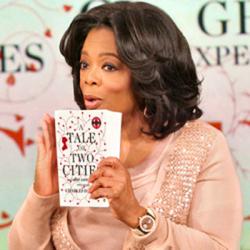
Too easy a target
I was shocked, shocked during the holiday season when a friend told me he had never read Charles Dickens. So, motivated by, of all things, Oprah Winfrey, I made sure A Tale of Two Cities was among his Christmas presents. No, no, not Oprah’s cheesy edition, but the annotated Penguin one.
Cheesy edition… that’s just it, isn’t it? Many of Oprah’s endeavors justly inspire ridicule. She is too easy a target. So The New Republic’s lambasting her for choosing Great Expectations and A Tale of Two Cities as her December Book Club selection was, well, a bit cheesy in itself. Hillary Kelly explodes:
“On December 2, as Oprah Winfrey stood on the stage of her TV show, tightly clutching her newest Book Club selection to her chest so that no one could see its title, she proclaimed in her singular, scale-climbing voice, ‘Dickeeeens for the hooolidaaaays!’ Oprah declared that she has ‘always wanted to read Dickens over the holidays,’ and ‘now [she] can.’ Never mind that she could have read Dickens whenever she wanted, seeing as his books have been popular for more than a century. Never mind that Oprah hadn’t chosen A Christmas Carol, The Chimes, or any of Dickens’s other Christmas tales. Never mind that neither Great Expectations nor A Tale of Two Cities, the books she did choose, have anything to do with the holidays. Our shepherd has spoken, and we must blindly follow.
Kelly is concerned that Oprah Winfrey’s “sentimentalized pitch” will result in “a frightening number of purchases.” Winfrey, you see, admits she has never actually read Dickens. Kelly continues:
“She has asked millions of people to follow her into some of the more difficult prose to come out of the nineteenth century—prose she knows nothing about. Put simply, a TV host whose maxim is to ‘live your best life’ is not an adequate guide through the complicated syntax of Dickens, not because she lacks the intelligence—she is quite clearly a woman of savvy—but because her readings of the texts are so one-dimensional.”
She’s not done:
“Even more confusingly, Oprah’s comments about Dickens making for cozy reading in front of a winter fire misinterprets the large-scale social realism of his work. It stands to reason that her sentimentalized view of Dickens might stem from A Christmas Carol—probably his most family-friendly read and one of his most frequently recounted tales. But her quaint view of Victoriana, as she’s expressed it, belies an ignorance of Dickens’s authorial intentions. Indeed, both A Tale of Two Cities and Great Expectations are dark and disturbing, with elaborate ventures into the seedy underbelly of London and the bloody streets of Paris. How can we trust a literary guide who, ignorant of the terrain ahead, promises us it will be light and easy?”
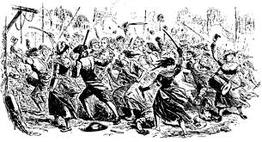 I am glad I did not have Kelly around in my own adolescence. As a girl of about 10 or 11, I picked up (you guessed it) Tale of Two Cities. Undaunted by its “complicated syntax,” I read it straight through to the scaffold. And I expect from the little I know of Winfrey’s background, she might have a better grasp of a work that is “dark and disturbing” than Kelly herself.
I was gratified to see the readership of the New Republic nailed the implicit elitism of Kelly’s remarks:
“Wow. ‘Cadres of women from around the globe’ will discover that Dickens can be tough sledding. I imagine that more than a few, however, will muddle through on their own and actually get something more out of it than a cup of hot cocoa. And it’s really this, I suspect, that you find so ‘appalling.'”
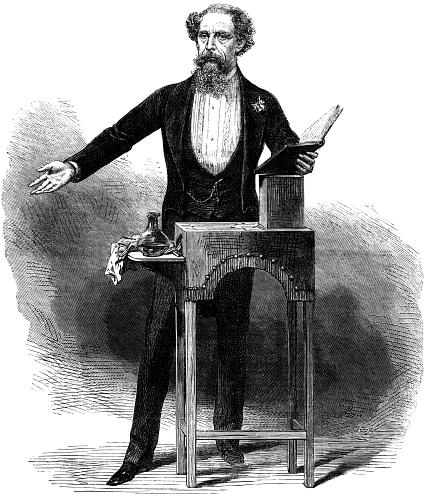
Dickens at the podium
Another writes:
“This article strikes me as deeply wrongheaded. So what if Oprah has a silly, narcissistic view of literature? If she gets her fans in their thousands and millions to go out and buy books, some of them authentically great literature, I say more power to her in this age of illiteracy! And by what right does Ms. Kelly sneeringly dismiss all those book-buying fans as dunderheads who could not possibly understand a “great book” unless it is spoon-fed to them by a Certified Literature Professor? Surely some of them are capable of reading and thinking for themselves, and possibly even having insights that have never occurred to Hillary Kelly! If the Western canon is to have any claim to universality, it must be that it is potentially accessible to everyone–that is the great lesson I took away from my immersion in the University of Chicago’s Robert Hutchins-inspired “core curriculum” in the humanities. Or are we to lock the gates of the Temple of Literature to all who do not have a Ph.D. in literary theory? That, surely, would be a far worse catastrophe for the human spirit than Oprah telling people to have a cup of hot chocolate while reading Charles Dickens!”
And I’m not sure today’s world is so very far from the one Dickens describes. A couple years back, Rush Rehm and I were discussing people’s general reluctance to engage in volunteer work. I had recently tried to help out at the Stanford Hospital, and been given forms to fill out and asked to sign on to a training schedule — impossible then, and even less possible now. Rush extolled the organization of Mother Teresa and her nuns. He told me that if you show up on the doorstep, her nuns will stick a broom or mop in your hands, no questions asked, no names taken. It’s not grandiose stuff. Washing a few dishes at the AIDS hospice in Pacifica may not be making the world safe for democracy, but I think Dickens would approve. They use you while you are there, and welcome you back whenever you return. That might be one of the most remarkable features of the whole outfit.
So, on a very rainy Christmas morning, I made my occasional trek to the Golden Gate Park, where they feed the homeless, with several bundles of new socks for the dispossessed. They go through them so quickly living in the San Francisco chill. I never found the nuns yesterday, but I did notice that the homeless seem to be everywhere this Christmas — not only in the park, but up and down Haight Street, and Oak Avenue, and everywhere hunkered under makeshift cardboard, broken umbrellas, and stolen shopping carts.
A quick stop in Pacifica delivered the socks, and the nuns greeted their wet and slightly manic visitor with their usual unruffled and unhurried calm and friendliness.
I also delivered my Christmas greetings to the gray and magnificent Pacific, my touchstone — and returned to my modest Palo Alto life that is, by any world standard, and particularly the by the standard on Haight Street, unquestionably luxurious.