

Congratulations, once again, to Dana Gioia!

Share
gioia

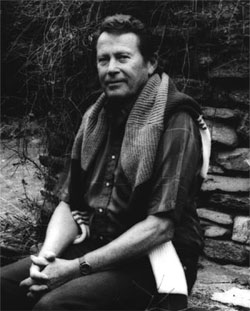
Dana at Stanford in 2007 (Photo: L.A. Cicero)

Once again, Dana Gioia has a new honor: This time, the Sewanee Review has just announced that he will receive this year’s Aiken Taylor Award for Modern American Poetry.

Previous winners have included Richard Wilbur, Anthony Hecht, W.S. Merwin, Anne Stevenson, Donald Hall, X.J. Kennedy, and others.

Dana, known for his poetry, criticism, and arts advocacy, holds the newly created Judge Widney Chair in Poetry and Public Culture at the University of Southern California.  He’s also a former chairman of the National Endowment for the Arts, and has received a number of honors in recent years, including the Laetare Medal. We’ve written about him here and here and here and here and, oh, perhaps a zillion other places.

His most recent collection is Pity the Beautiful – we’ve written about it here, and I’ve published excerpts from the volume, also here.  Writing in Best American Poetry, David Lehman stated unequivocally:  “I have no hesitation in declaring it to be his finest to date . . . These poems in which sentiment is refined by technical prowess, and simple words combine to make music and meaning merge marvelously and memorably.”
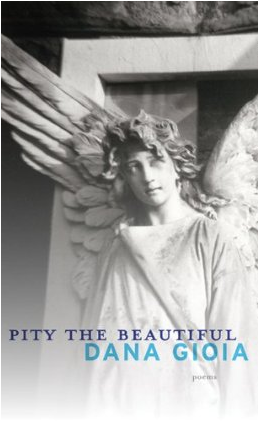
Pity-The-BeautifulI love all the Gioias – including those I have never met (his parents, for example) – so perhaps my favorite passage from the announcement is this one:

Gioia’s poetic philosophy—particularly his belief that poetry should “touch on those things that are central to people’s lives”—can be traced back to his childhood in Los Angeles, where his Sicilian father and Mexican mother raised him. He remembers that his mother, who, he says, received no education beyond high school, recited poems to him by heart and read others from a “crumpled old book that had belonged to her mother.” Because of this, Gioia says, “I have never considered poetry an intrinsically difficult art whose mysteries can be appreciated only by a trained intellectual.”

The awards ceremony will take place February 19 at the University of the South in Sewanee.  David Mason will give a lecture on Dana’s work on the 18th.
Poems from my co-pilot

Share

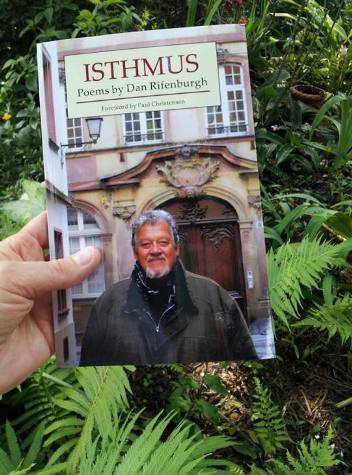
rifenburgh2I met poet Daniel Rifenburgh ohhhhh… a dozen-or-so years ago.  We’ve stayed in touch since.  We had an unforgettable June evening together at the West Chester Poetry Conference.  We were in a rented car crammed with people, en route from the university to the home of Michael Peich, conference’s co-founder (with Dana Gioia).  As I recall, David Slavitt was piled into the car, too.  Can’t remember who else … plenty of people pushed into a small vehicle.

Dan was driving – as I recall he was a taxi-driver at that time, so he was pro.  Later, he taught at the University of Houston.  Now he drives an 18-wheeler flatbed rig, hauling steel out of the Port of Houston.  On that particular night, however, he had the misfortune to appoint me as his co-pilot and hand me the maps.  We quickly became confused and lost in the suburban Pennsylvania neighborhood, with its winding, pointless streets, but we were having fun, anyway.  We may have been the only ones in the car who were.  We found the party eventually, and stayed in touch over the years, respectfully addressing each other by title, always – “co-pilot.”

So I was pleased to receive in the mail his newest volume of poems, Isthmus (it was signed – what else? – “To my co-pilot, Cynthia, with admiration and affection”).  I was also pleased to hear that we have a mutual friend, Anne Stevenson.  Here’s what she wrote about his poems in London Magazine, after recounting a career that included serving in the U.S. Army during the Vietnam era, and working his way through Latin America as a reporter: “Rifenburgh is enjoyable because he ranges at large over many subjects, testing, exploring, reporting, celebrating; he has many moods … Yet, for all his ironic witticisms, Rifenburgh is, au fond, a profoundly spiritual poet, committed, like Hecht and Wilbur, to declaring his seriousness.”

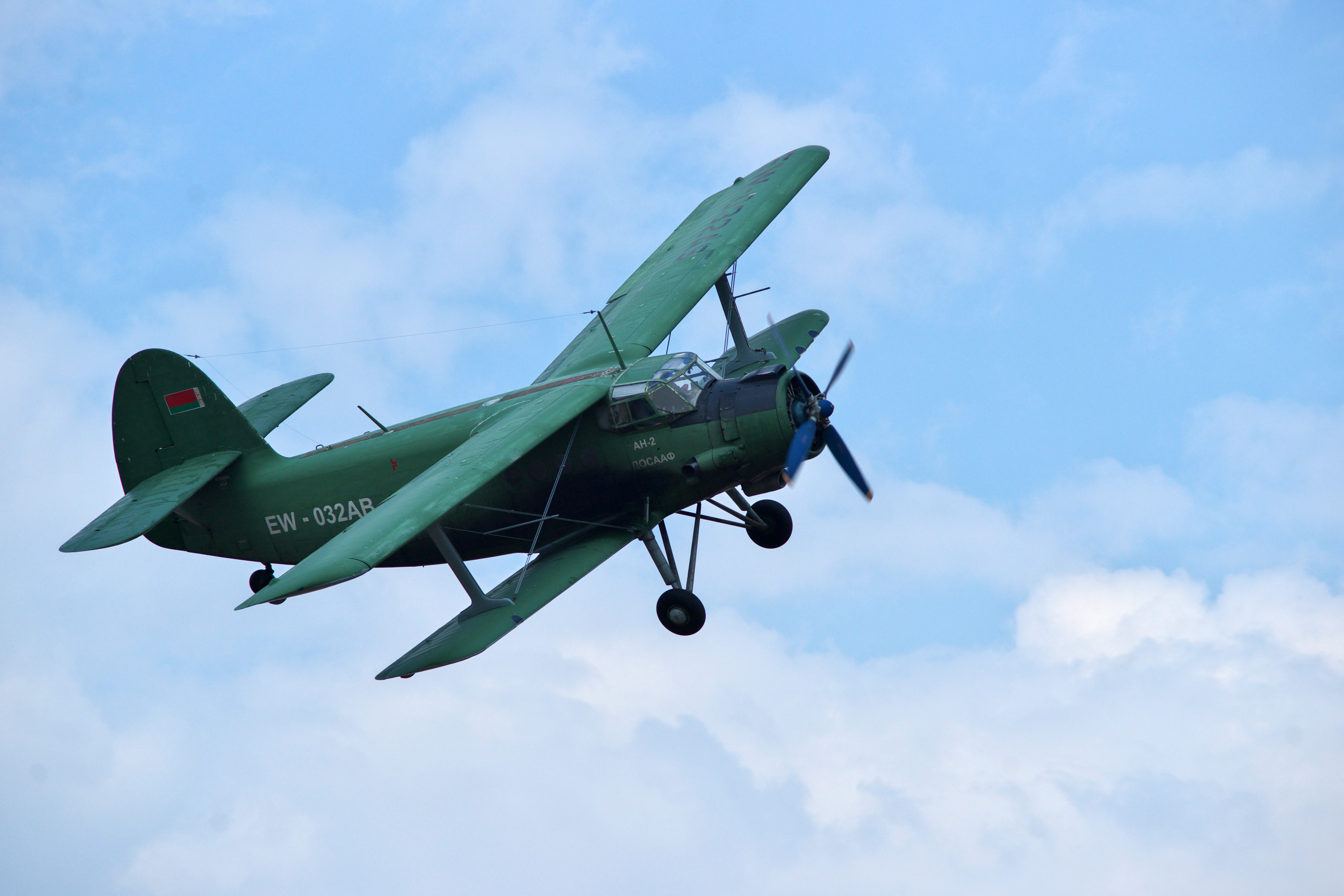
Antonov An-2

A better way to get around Pennsylvania?

Other supporters include Richard Wilbur, who says his poems “can also stun the reader with a brilliant, slow-fuse image. What governs the movement of the poems is a genius for the speaking voice.”  Isthmus is dedicated to Donald Justice, who said Dan’s poems “are terrific: so fluent, so smart, and brimming with charm.”  Both Justice and Anthony Hecht figure in the poems, as dedicatees or the source of subject matter or epigrams – and Adam Zagajewski, who taught with Dan in Houston, makes a welcome guest appearance, too.  Hecht wrote, characteristically, “These poems are startling in their vividness, skill, their originality and solidity. I find that lines and images resonate long after they have served the purposes of their local contents.”

Dan said I could reprint a poem – but which?  Sometimes the first choices are best.  When I opened the book, my eyes fell on this one, and I liked it.  It grabs me still, though I haven’t read them all, so I can’t claim it’s my favorite yet.


The Fragments of Heraclitus

The name of the bow is life, but its work is death.
.                            The Fragments

The fragments of Heraclitus,
Compact, trenchant, inscrutable,

Are lovely in their resistance
To analysis. Therefore, from sympathy,

And, being immortal,
They sometimes assume human forms

To attend unnoticed the burials of critics.
They hold by their brims dark fedoras and,

Standing aloof, stolid, anonymous,
Listen respectfully to brief eulogies

While the great world sifts noiselessly
Down through time’s latticework

And the bow named life,
Accomplishing its work, later

Sends them strolling like slow arrows
Away from these shaded gravesites,

Pacing back cleansed
Into birdsong and light.

Happy birthday, Richard Wilbur! The poet speaks of Candide, Russian poets, and meeting “the right girl”

Share

One of the pleasantest people I have ever met is Richard Wilbur, former U.S. poet laureate and two-time Pulitzer winner – a true gentleman, a great poet. So my bad that I almost overlooked his 91st birthday today. (I wrote about his 90th celebration a year ago here.)

Fortunately, Web of Stories kindly sent me a reminder that they have loads of video clips of the poet.

Here’s one where he describes his time at Amherst and meeting the love of his life, his wife Charlotte, who died in 2007. “I was terribly lucky she decided I would do,” he says with characteristic charm and humility:

Here’s another on his acquaintance with Russian poets, including Andrei and Yevgeny Yevtushenko. Listen, in particular, to the tact and considerable diplomacy when, toward the end of the clip, he describes his interactions as he translated the Nobel poet Joseph Brodsky, who was notoriously tough on his translators:

Dick Wilbur was a brilliant translator of Molière – not shying away from the daunting challenge of the playwright’s rhymed couplets.  Here he’s talking about his collaboration with Leonard Bernstein and Lillian Hellman on the musical Candide. Said Hellman: “If he did alright with one witty Frenchman, he might be alright with Voltaire.”

I don’t know when this interview occurred, but his reference to his wife as still living tells us that it was at least four years ago.
Part Deux below, with two readings of two of his greatest poems.

William Jay Smith on “the cinders of your city,” Richard Wilbur on the power of yielding

Share

Native American poet Smith

Thursday’s post on Joseph Brodsky reminded me of the hundreds of lines of poetry the Nobel poet made us memorize at university – an exercise some students defied and ridiculed, but my earlier training in Shakespearean theater taught me to appreciate.

If you want to own a poet, memorize his or her lines.  In this sense, as once said Brodsky, Nadezhda Mandelstam was more deeply married to poet Osip Mandelstam in her widowhood than her marriage, as she preserved his poems against the Soviet regime that would erase them:

“…repeating day and night the words of her dead husband was undoubtedly conneced not only with comprehending them more and more but also with resurrecting his very voice, the intonations peculiar only to him, with a however fleeting sensation of his presence … And gradually those things grew on her.  If there is any substitute for love, it’s memory. To memorize, then, is to restore intimacy. Gradually, the lines of those poets became her mentality, became her identity. They supplied her not only with the plane of regard or angle of vision; more importantly, they became her linguistic norm.”

But what do to do in an era when reading a 300-page book seems like an insurmountable task, and memorizing a poem seems – oh, such a leisurely activity in an increasingly hectic world?  OK, here’s two 8-line poems for you. See if you can get these out of your head – then memorize them, so you can’t.  No excuses.

The first, by William Jay Smith, is dark, cryptic, compact, and layered.  I think it’s one of the finest short poems of the 20th century. The second encapsulates one of Richard Wilbur‘s moments of incandescent euphoria.  (As he once said, “Giving up doesn’t always mean you are weak; sometimes it means that you are strong enough to let go.”)  Jay Parini writes that, in this poem, one of two in “Two Voices in a Meadow”: “Wilbur aspires to a Blakean intensity, with his casual lyricism achieving a kind of perfection rarely found among his contemporaries.”

Elizabeth Frank wrote nearly two decades ago in The Atlantic: “When the whole history of twentieth-century American poetry is eventually written, it will surely be revealed that despite the apparently larger and often noisier triumphs of ‘open’ forms, astonishingly good verse that we can call ‘metrical’ or ‘formal’ has continued to be written by some of the country’s best poets – Smith himself along with his contemporaries and near-contemporaries Richard Wilbur, John Hollander, and Anthony Hecht. That Smith has written poems replete with rhythm, rhyme, wit, and melody – what Louise Bogan called ‘the pleasures of formal poetry,’ in an essay by the same name – is cause for celebration, homage, and gratitude.”

I’ve had the privilege of meeting both nonagenarian poets – but that’s another story, for another time.  Both live in Cummington, Massachusetts.  Must be a delightful place for a visit, for that reason alone!


“Note on a Vanity Dresser”

The yes-man in the mirror now says no,
No longer will I answer you with lies.
The light descends like snow, so when the snow-
man melts, you will know him by his eyes.

The yes-man in the mirror now says no.
Says no. No double negative of pity
Will save you now from what I know you know:
These are your eyes, the cinders of your city.


“A Milkweed”

Anonymous as cherubs
Over the crib of God,
White seeds are floating
Out of my burst pod.
What power had I
Before I learned to yield?
Shatter me, great wind:
I shall possess the field.


And happy 200th birthday, Chopin!

Share

In the celebratory brouhaha over Richard Wilbur‘s 90th birthday yesterday, I neglected another important nativity — the 200th anniversary of Fryderyk Franciszek Chopin, who was born in Żelazowa Wola, Poland in 1811. My longstanding fondness is something I blushed to confess in Poland — where it’s somewhat akin to an American announcing John Philip Sousa as a favorite composer. Chopin, whose name was Frenchified to Frédéric François, is a national institution, and therefore a little kitschy among the intelligentsia.

This very languorous Venetian piece of music is my personal favorite. Enjoy Claudio Arrau‘s perfect rendition, and celebrate with me one day late. After all, what’s a day in two centuries?

Happy 90th birthday, Richard Wilbur!

Share

Happy birthday, Richard Wilbur, on your 90th!  Dan Rifenburgh reminded me of the poet’s birthday on Facebook a few days ago, but he didn’t know whether he’d be spending in Cummington, Massachusetts, or Key West.  Either way, he will probably not be celebrating in NYC: I remember a characteristic passage in one his books where he described a brisk walk near his home with a guest: “But my friend from New York, an excellent abstract artist, walks through our Berkshire woods smoking Gauloises and talking of Berlin. It is too bad that he cannot be where he is, enjoying the glades and closures, the climbs, the descents, the flat stretches strewn with Canada Mayflower and wintergreen…”

Richard Woodward in yesterday’s Wall Street Journal called him “our finest living poet.”  Nice to know someone else shares that opinion — I voiced the same thought some months ago here. Here’s what Woodward said:

Richard Wilbur turns 90 on Tuesday, but it’s unlikely that many Americans will stop to pay tribute to our finest living poet. Despite having earned almost every literary award this country has to offer, including a pair of Pulitzers and Bollingens, as well as the title of U.S. Poet Laureate in 1987-88, he has never enjoyed a rapt general following.

I had dinner with Dick Wilbur and his wife Charlotte oh, maybe a decade ago in West Chester, Pennsylvania.  He was as genial as his reputation had suggested, and his obvious, abiding affection for his high school sweetheart, an effervescent and gregarious matron, was charming.  I never made it out for the Key West interview I had envisioned … perhaps there’s still time.

The poet-critic Randall Jarrell said Wilbur “obsessively sees, and shows, the bright underside of every dark thing,” but his poems, since Charlotte’s death in 2007, have become increasingly death-haunted.

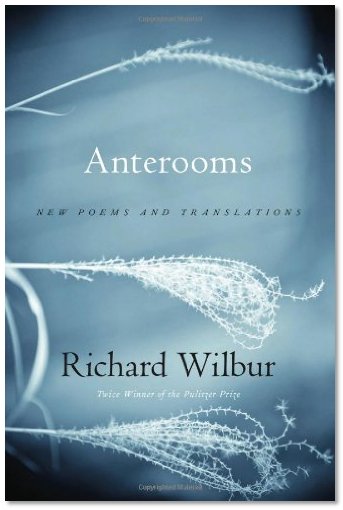
It’s unusual for poets to be productive so long — conventional wisdom is that they do their best work young, and “dry up” as Thom Gunn told me — but Anterooms: New Poems and Translations, is a marvel.  One poem, “A Measuring Worm,” describes a caterpillar climbing a window screen, hunching his back as he goes:

It’s as if he sent
By a sort of semaphore
Dark omegas meant

To warn of Last Things.
Although he doesn’t know it,
He will soon have wings,

And I too don’t know
Toward what undreamt condition
Inch by inch I go.

Woodward notes, “His productivity, never high to begin with, has slowed with age. He finishes poems at the rate that Antonio Stradivari constructed a violin. ‘I often don’t write more than a couple of lines in a day of, let’s say, six hours of staring at the sheet of paper,’ he told the Paris Review in 1977. “Composition for me is, externally at least, scarcely distinguishable from catatonia.”

David Orr in the New York Times writes of Anterooms that “it would be tempting to say that what we have here is a scanty manuscript that will nonetheless be extravagantly praised because its author is still deeply respected and, hey, isn’t it wonderful that he’s still making a go of it at his age? Tempting, but wrong. The better work in Anterooms, however limited in quantity, is as good as anything Wilbur has ever written, and upholds certain virtues other poets would do well to acknowledge, even if they travel roads different from the relatively straight one Wilbur has followed.” He concludes:

“More than 50 years ago, Randall Jarrell claimed that as a poet, Wilbur ‘never goes too far, but he never goes far enough.’ The observation is invariably quoted whenever Wilbur gets reviewed (far be it from me to break the chain). But to write convincingly about death — and also, as Wilbur has increasingly done, about grief — isn’t a matter of ‘going’ anywhere. It’s a matter of remaining poised in the face of a vast and freezing indifference. And while the strong, spare poems here are unlikely to strike many readers as the illustrious pronouncements of a Grand Old Man — the kind of figure Jarrell had in mind — they are wholly successful in meeting the darkest of subjects with their own quiet light. Which is, surely, a far grander thing.”

Anterooms includes some of two translations of poems by Joseph Brodsky (I still think his translations of J.B. are the best) one poem by Stéphane Mallarmé and an unpublished poem by Paul Verlaine.  Wilbur has always had a affinity for French (his verse translations of Molière are unmatched) — and so was the perfect lyricist for Leonard Bernstein‘s Candide, in the spirit of Voltaire. Composer Stephen Sondheim called Wilbur’s lyrics “the most scintillating set of songs yet written for the musical theater.”  I still occasionally find myself, on a sunny day, humming —

What a day! What a day!
For an auto-da-fé!

See the Lincoln Center’s 1986 version below (or for a real treat, check out Kristin Chenoweth in Candide on youtube).

Postscript: Patrick Kurp at Anecdotal Evidence celebrates the birthday here.