
Antoine Jaccottet’s Le Bruit du Temps: Fresh air for French readers

Share

Translation is the poor stepchild of literature – academics get more applause for producing their own books, not for translating the writing of others; for writers, it’s a distraction from their own work and not terribly well remunerated. Hence, a welter of books never appear on the international stage the way they deserve.

So it’s cheering to see a venture like the Paris-based Le Bruit du Temps, a publishing house crowded in one large room in one of the more picturesque neighborhoods in a city that has plenty of them.  Founder and director Antoine Jaccottet has a desk in one corner; his collaborator, Cécile Meissonnier, has a desk on the other side.  Pictures of Osip Mandelstam, Isaac Babel, and others are stuffed into the edges of a large mirror – they are the real masters here. The window next to it gives a clear view on a plaque indicates that James Joyce finished Ulysses across the street here, on rue du Cardinal Lemoine in the Latin Quarter.

Antoine Jaccottet, son of the poet and translator Philippe Jaccottet (who translated Goethe, Hölderlin, Mann, Mandelstam, Góngora, Leopardi, Musil, Rilke,  Ungaretti, and Homer into French), worked for 15 years at the famous French publisher Gallimard, publishing classics, before he broke out on his own for a shoestring enterprise in 2008. The tight-budge endeavor, however, produces elegantly designed, finely crafted volumes.

Masterpieces don’t die, he says, but they can get lost in the noise of time.  It’s the job of publishers to rediscover them for the public, and what better place than the small adventurous publishers who have a freedom and esprit not usually tapped by large publishing houses.
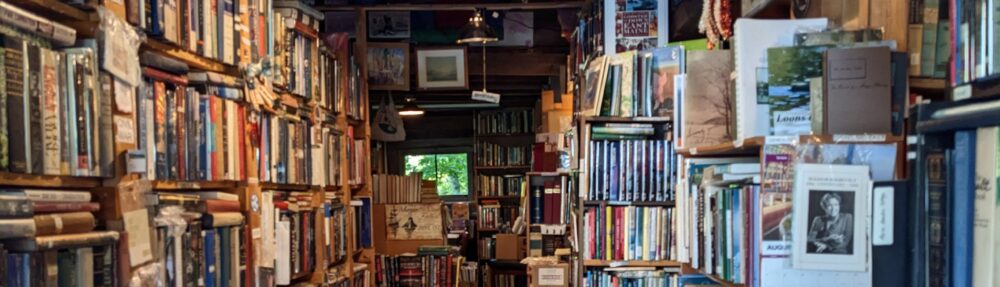
As I gaze over the offices teeming bookshelves, I notice an entire shelf of W.H. Auden in English.  He’s one of the house’s authors.  Le Mer et le Miroir … Auden in French? How does he come across?  It’s difficult, Antoine admits, for the French to “get” Auden’s sensibility.

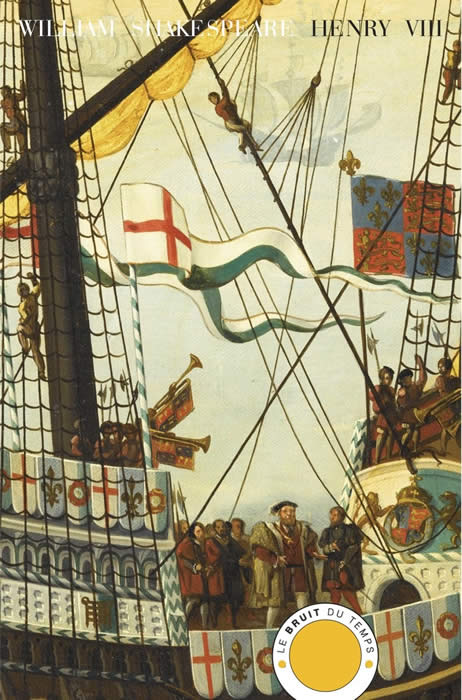
He’s also published  Zbigniew Herbert in French, Lev Shestov‘s Athens and Jerusalem, the complete works of Isaac Babel, and Henry James‘s The Ambassadors.  Even Shakespeare‘s (cough, cough) Henry VIII.

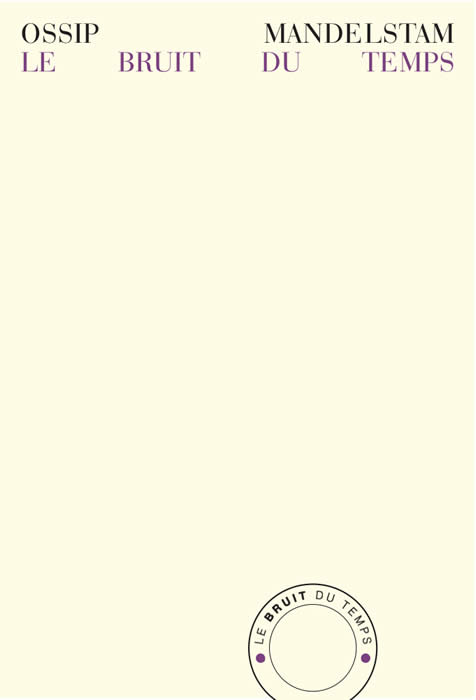
Mandelstam is, in a sense, the reason for the place.  The title of the publishing house itself – “the noise of time” – is taken from the title of Mandelstam’s prose collection, which includes perhaps his most autobiographical writing.  Antoine had been taken with the Russian poet in the 90s, and the translations and biography by the eminent scholar Clarence Brown.  One of the first books the house published was Le Timbre égyptien (The Egyptian Stamp).  The Ralph Dutli biography will be published this month.  (The house published Dutli’s poems in 2009).
A piece of old France

Le Bruit du Temps’ books by and about Mandelstam illustrate an underlying principle at the house:  Antoine publishes works that develop and deepen recurrent themes like a symphony.  In 2009, he published published Browning’s L’Anneau et le Livre, republished G.K. Chesterton‘s out-of-print 1903 Robert Browning (Chesterton’s first book), Elizabeth Barrett Browning‘s Sonnets from the Portuguese and Henry James‘s Sur Robert Browning. That’s probably more Browning than Elizabeth Barrett ever saw.

Literary journalism, apparently, is as much in a crisis in France as it is here – the media often publishes book blurbs intact, and critics are famous for not reading the books they review.  So how do people hear about books?  Often, they don’t, he says.

As I leave, Antoine gives me a little souvenir of my visit, the publishing house’s brand new Le Bruit du Temps, a slim and elegant volume, fresh from the press.  What could be more fitting?

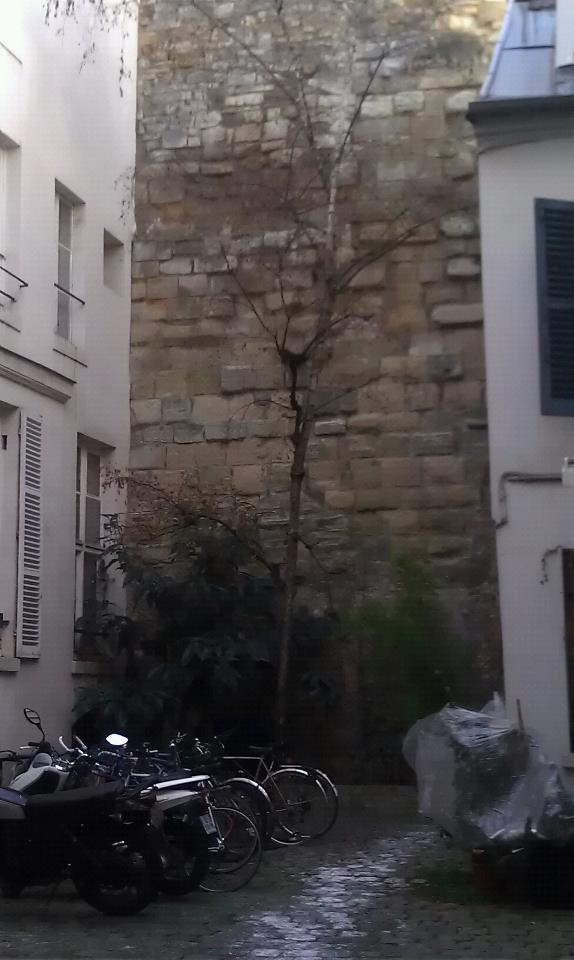
He also shows me a rarely seen landmark as he shows me the door – at the back of the courtyard, between the buildings, in the soft sunlight of the late afternoon, the ancient Paris city walls of  Philippe Auguste, the oldest surviving city walls, about the time of the poet Marie de France.

Postscript on 3/16:  Nice mention on the University of Rochester’s “Three Percent” blog over here.
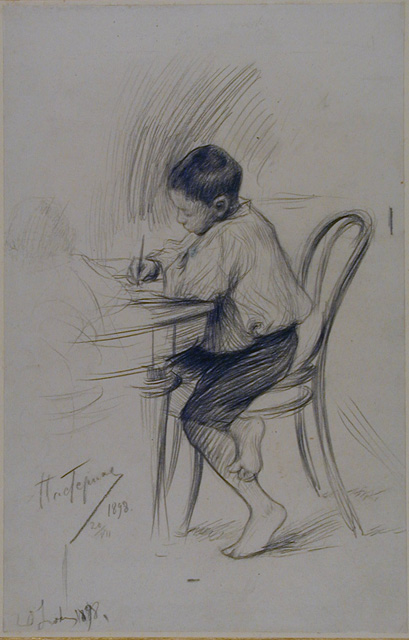
 

The trail of “an Arab and his horse”: Poet Boris Pasternak, artist Leonid Pasternak, and Oxford

Share

The poet as a boy, 1898 (Photo: Ashmolean Museum, University of Oxford)

The poet Marina Tsvetaeva said that fellow poet Boris Pasternak looked like “an Arab and his horse.”

He does, really.  It’s an amazing, slightly Asiatic face.

I had ample opportunity to gaze at the visage of the Nobel laureate at the Ashmolean Museum, in the inconspicuous Print Room in a secluded corner on the second floor.

Not enough people know the author of Dr. Zhivago – for example, that he was primarily a poet, not novelist – but even fewer know the prominent members of his family.  His father, Leonid Pasternak (1862-1945), was a brilliant painter and friend of the Tolstoys.

In the Print Room, the helpful librarians brought out a large portfolio of the artist’s chalk and watercolor sketches and paintings of his family, of the leading figures of his times, of still lifes and landscapes.  With the white cotton gloves the museum provided, I lifted and examined each in turn, including portraits of Albert Einstein, Rainer Maria Rilke, and others.

I met the Pasternak family during the Pasternak celebration at Stanford last year (I wrote about it here). I was delighted to renew the acquaintance with two of them in Oxford – Ann Pasternak Slater and Catherine Oppenheimer, both nieces of the poet and granddaughters of the artist.  Catherine is an eminent psychiatrist; Ann is professor emeritus of English literature at Oxford (she is currently writing about Evelyn Waugh).

Ann is also a formidable critic, and a matchless champion for Pasternak’s work.  She wrote last year in The Guardian:

As a public speaker he was incomprehensible. His work is notoriously hard to translate. …

Pasternak’s work is also difficult because his mind-set is unpredictably complex, evocatively associative, synaesthetic and polysemous. His vocabulary is exceptionally wide, and his intellect has a pronounced metaphysical cast. In an uncollected letter to TS Eliot, Pasternak explores their shared aesthetic in ambitiously faulty English. Eliot’s art, he writes, like his own, is “a casually broken off fragment of the density of being itself; of the hylomorphic matter of existence . . .” Pasternak became much more accessible in his later work. Doctor Zhivago was suicidally vivid and forthright. The poems that accompany it are translucent.

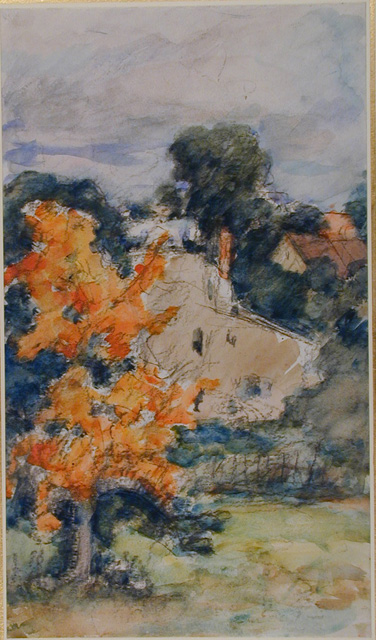
"The Yellow Tree: Autumn Landscape," 1918 (Photo: Ashmolean Museum, University of Oxford)

From his schooldays, Pasternak tells us, Yury Zhivago had dreamed of writing “a book of impressions of life in which he would conceal, like sticks of dynamite, the most striking things he had so far seen”. Doctor Zhivago was that book. It was packed with dynamite and, as Pasternak expected, it blew up in his face.

I talk a little about that explosion here.

I had lunch with Ann and Catherine in the former’s Oxford home, which is almost a museum of their grandfather’s artwork.  (A link for the Pasternak trust is here.) Of course we talked about the translations of the poet (Ann dissed the newest Pevear-Volokhonsky translation in the article I’ve quoted).

Ann describes her uncle’s poetry this way: “Boris’s poetry is formally rich, regularly rhymed, and metrically precise. It is full of delectable assonances, at once musical and wholly natural. My mother’s first priority was to reproduce his aural effects. She did. This difficult demand inevitably exacted its own price. Her English is flawed – it sounds Russian. But it sings, as Pasternak’s poetry does.”

My inevitable question:  Which of the Pasternak translations does she favor?  Her answer: Mother knows best.  (The link, here, also has rare recordings of Pasternak reading his poems in Russian.)

Ann kindly gave me an out-of-print volume of her mother’s translations.  Here’s an example of Lydia Pasternak Slater‘s translation:

Sultry Night

It drizzled, but not even grasses
Would bend within the bag of storm;
Dust only gulped its rain in pellets,
The iron roof – in powder form.

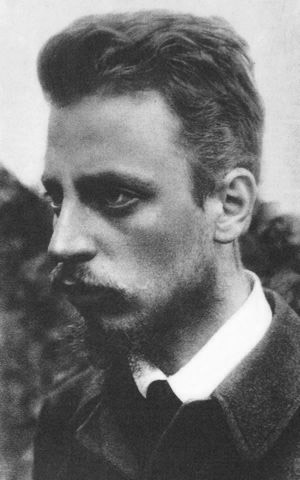
Rainer Maria Rilke, 1921-24 (Photo: Ashmolean Museum, University of Oxford)

The village did not hope for healing.
Deep as a swoon the poppies yearned
Among the rye in inflammation,
And God in fever tossed and turned.

In all the sleepless, universal,
The damp and orphaned latitude,
The signs and moans, their posts deserting,
Fled with the whirlwind in pursuit.

Behind them ran blind slanting raindrops
Hard on their heels, and by the fence
The wind and dripping branches argued –
My heart stood still – at my expense.

I felt this dreadful garden chatter
Would last forever, since the street
Would also notice me, and mutter
With bushes, rain and window shutter.

No way to challenge my defeat –
They’d argue, talk me off my feet.

My quarrel with Rilke

Share

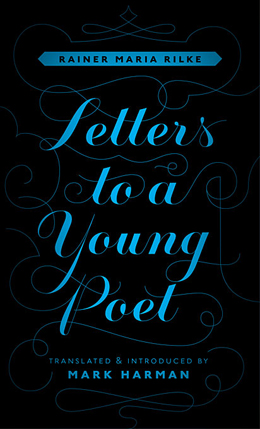
Rainer Maria Rilke‘s advice to an aspiring young writer took the form of a series of letters from 1902 to 1908.  Letters to a Young Poet has been translated again for Harvard University Press by  Mark Harman, who has translated Franz Kafka to much praise. (A podcast is here.)

The Prague-born poet wrote in German, a little in French.  Here’s what Harmon wrote in his introduction:

He also prized the differing personality, as it were, of each language: Two years later in a letter to Lou Andreas-Salomé he notes that on the few occasions when he wrote about the same subject in French and in German it “developed very differently in the two languages: which argues strongly against the naturalness of translation.”

The Harvard University Press’ blog cites one of the most famous passages from the letters:

You ask whether your verses are good. You ask me. You have already asked others. You send them to journals. You compare them with other poems, and are upset when certain editorial offices reject your efforts. Now (since you’ve permitted me to give you advice) I ask you to abandon all this. You look outside yourself, and that above all else is something you should not do just now. Nobody can advise you and help you, nobody. There’s only one way to proceed. Go inside yourself. Explore the reason that compels you to write; test whether it stretches its roots into the deepest part of your heart, admit to yourself whether you would have to die if the opportunity to write were withheld from you. Above all else, ask yourself at your most silent hour of night: must I write? Dig inside yourself for a deep answer. And if the answer is yes, if it is possible for you to respond to this serious question with a strong and simple I must, then build your life on the basis of this necessity; your life, even at its most indifferent and attenuated, must become a sign and a witness for this compulsion.

It all sounds very grand, of course.  But I wonder how many young writers are prepared to make that decision – who could find “the deepest part” of their hearts even with a GPS.  In my experience, many of them think they must write – it’s a compulsive part of youth. They think they “would have to die if the opportunity to write were withheld.”

But somehow they manage, as the years go on.  For most, the question shifts when balanced against the needs of a  household, or when the old Camry breaks down, or when the medical bills pile up.  Of course, it also shifts as the rejection letters mount, and you find that the guidance from your own sweet self isn’t as reliable as the jalopy’s GPS.  Usually,  the writing compulsion leads to others – and who is to say they’re not equally valid?

It’s only when you’re older, more seasoned, and look back over your life and your choices, and realize that, for better or worse, writing is what you did.

“Only silence is innocent”: Zagajewski on Rilke, irony, and the future of poetry

Share

they warm themselves...

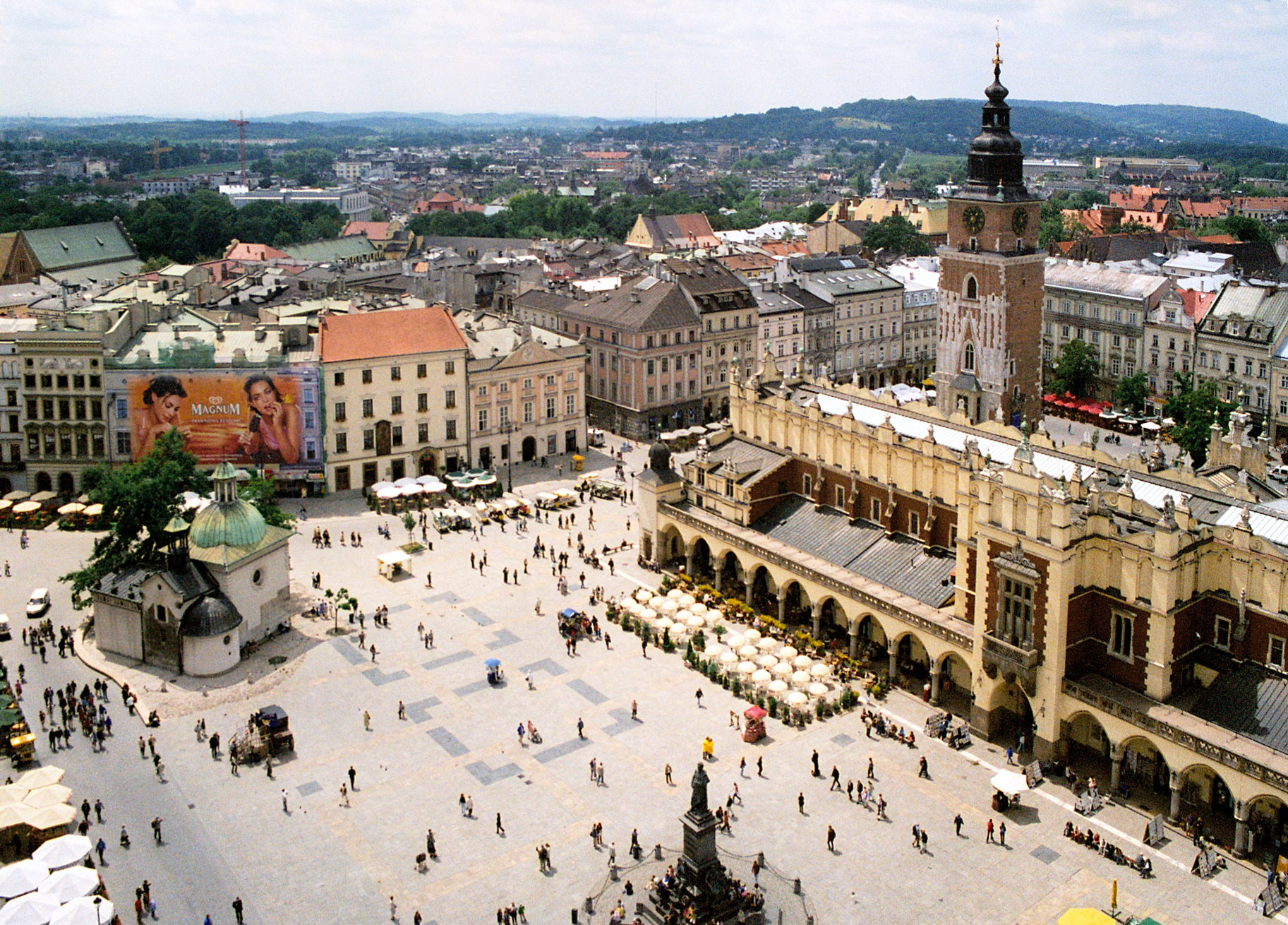
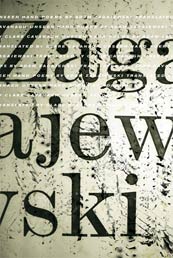
Kraków sustains a steady descant through the pages of Adam Zagajewski‘s new collection, Unseen Hand – most often, it’s Kazimierz, the old Jewish quarter where I stayed in May:

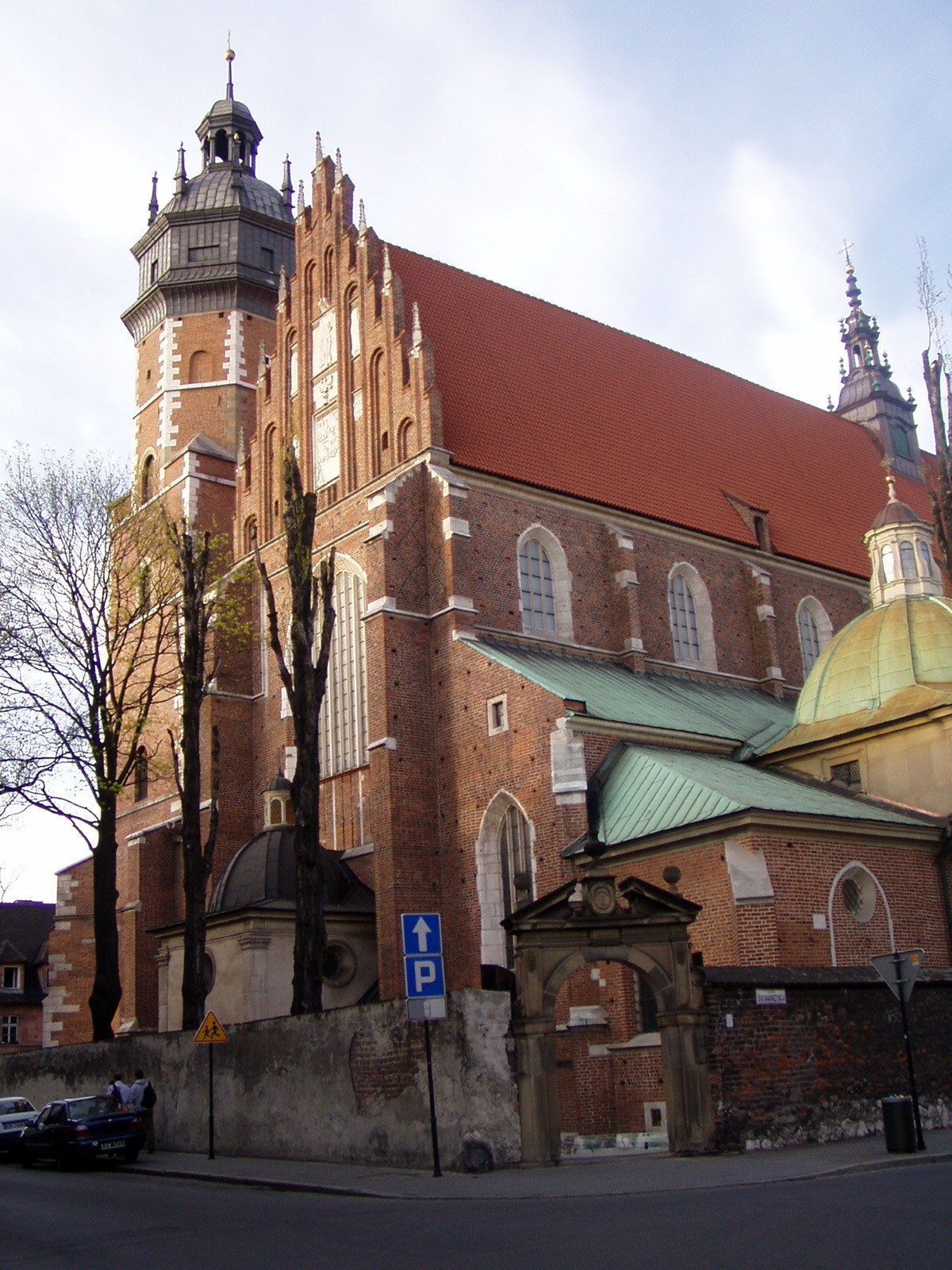
In the Church of Corpus Christi I lit candles for my dead,
who live far off – I don’t know where
– and I sense they warm themselves in the red flame too
like the homeless by a fire when the first snow falls.

That’s Corpus Christi, outside my window in Wolnica Square.  And one poem for St. Catherine’s Church, and at least three references to Jozef Street, catty-corner to Wolnica Square.  “Joseph Street in Winter,” is dedicated to Joachim Russek, the head of the Judaica Foundation, a tutelary spirit for my first trip several years ago:

In winter Joseph Street is dark,
a few pilgrims flounder through wet snow
and don’t know where they’re going, to which star,

And two references to pigeons – charitable, because I know Adam finds them contemptible.  It was the subject of our first discussion when we met in Rynek Główny, which was swarmed with pigeons.

He didn't like the pigeons.

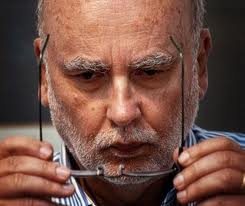
I actually “met” Adam during an online interview six or seven years ago for an article that was published Poetry Foundation article).  But much of the short interview never made it to the final piece.  For example, I asked him what gave rise, to a generation of giants:

“Good question. I have many contradictory explanations. One of the main ones is that the attention given to the meaning of human life in radical circumstances  (as opposed to the hermetic direction, or to a purely formal quest) in Polish poetry after the WWII catastrophe was a very important move: it gave the dying Modernism a new energy. It ‘rehumanized’ a highly sophisticated but a bit empty palace of modern poetry.”

On irony:

“Well, the disease of irony seems to be well identified. I adore irony as a part of our rich rhetorical and mental apparatus but not when it assumes the position of a spiritual guidance. How to cure it? I wish I knew.”

"We'll be living in small ghettos..."

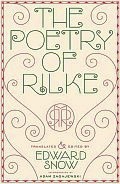
He has earned my own fealty, not only for his poetry, but for his many kindnesses.  So I was pleased when I read on Ann Kjellbergs website for her journal Little Star, a lengthy excerpt from his introduction to Edward Snow’s translations of Rainer Maria Rilke. (It was also excerpted by Poetry Daily here.) Adam is much in demand for introductions, blurbs, reviews, and essays.  This introduction is one of his best (I excerpt from Ann’s excerpts – and by the way, thank you, David Sanders, for pointing out the piece in Poetry News in Review):

“We have a new sorrow today: after the terrible catastrophes of the twentieth century, after the disasters that entered both our memory and imagination, we tread gingerly at the point where poetry meets society; “Don’t walk beyond this line,” as the sign on every jetliner’s wing warns us. And yet the central issue for us is probably the question of whether the mystery at the heart of poetry (and of art in general) can be kept safe against the assaults of an omnipresent talkative and soulless journalism and an equally omnipresent popular science—or pseudo-science. It also has a lot to do with the weighing of the advantages and vices of mass culture, with the influence of mass media, and with a difficult search for genuine expression inside the commercial framework that has replaced older, less vulgar traditions and institutions in our societies. In this respect, it’s true, poets have less to fear than their friends the painters, especially the successful ones, who, because of the absurd prices their works can now command, will never see their canvases in the houses of their fellow artists, in the apartments of people like themselves, only in vaults belonging to oil or television moguls who don’t even have time to look at them. Still, the stakes of the debate and its seriousness are not very different and not less important than a hundred years ago.

We know that the main domain of poetry is contemplation, through the riches of language, of human and nonhuman realities, in their separateness and in their numerous encounters, tragic or joyful. Rilke’s powerful Angel standing at the gates of the Elegies, timeless as he is, is there to guard something that the modern era—which gave us so much in other fields—took away from us or only concealed: ecstatic moments, for instance, moments of wonder, hours of mystical ignorance, days of leisure, sweet slowness of reading and meditating. Ecstatic moments—aren’t they one of the main reasons why poetry readers cannot live without Rilke’s work? I mean here readers of contemporary poetry who otherwise are mostly kept on a rather meager diet of irony. The Angel is timeless, and yet his timelessness is directed against the deficiencies of a certain epoch. So is Rilke: timeless and deeply immersed in his own historic time. Not innocent, though: only silence is innocent, and he still speaks to us.”

From my interview (I had cited this in an earlier post last fall, when Adam’s name came up again for a Nobel), when I asked him about the future of poetry and poetry-lovers in the world of tweets and sound bites he said this:

“We’ll be living in small ghettos, far from where celebrities dwell, and yet in every generation there will be a new delivery of minds that will love long and slow thoughts and books and poetry and music, so that these rather pleasant ghettos will never perish — and one day may even stir more excitement than we’re used to now.”

By the by,  Patrick Kurp of Anecdotal Evidence has a review of Unseen Hand here.