
The Stanford book club that rocks the news

Share
camus5

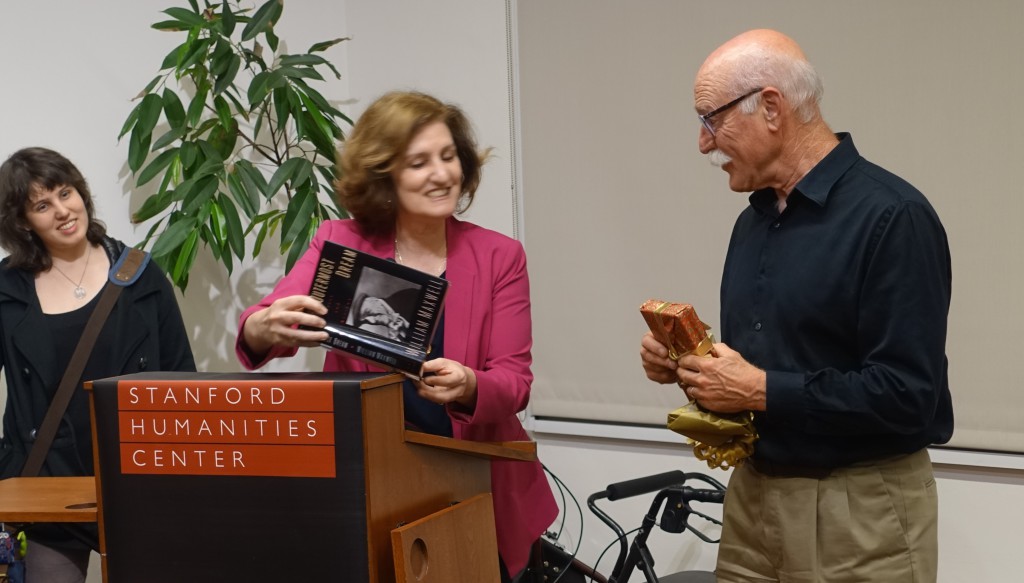
Toby Wolff’s Another Look send-off last spring. (Photo: David Schwartz)

Author Peter Stansky‘s “A Company of Authors,” the annual event where Stanford authors present their books, had its best day ever last Saturday. As I told Stanford Report“The author presentations were eloquent and excellent, without exception, and the audience questions ensured the discussion was spirited and intelligent.” And longtime Hoover fellow Paul Caringella even gave an impromptu pitch for my forthcoming René Girard biography. What’s not to like?

“I always find these occasions extremely exhilarating,” Peter said. “The heart of the university is the life of the mind and you could not have a better example of that than in the books that their authors presented here today.”

Well, you can read the whole thing here. Nearly everyone stayed through all the presentations, and the excited and audible buzz in the lobby afterwards told the story.

And I told a story, too, during my ten-minute solo for “The Wonderful World of Books at Stanford.” Peter introduced me as “the leading figure at Stanford in keeping us involved in so many exciting ways in the world of books.” So I took up the cause of the Another Look book club it has been my privilege to manage for four years. Here’s what I said:

I’m here to tell you the Another Look story. It’s a good story, and I’ve been proud to be part of it. I think you’ll like it because it’s a story about books finding their people.
camus-8

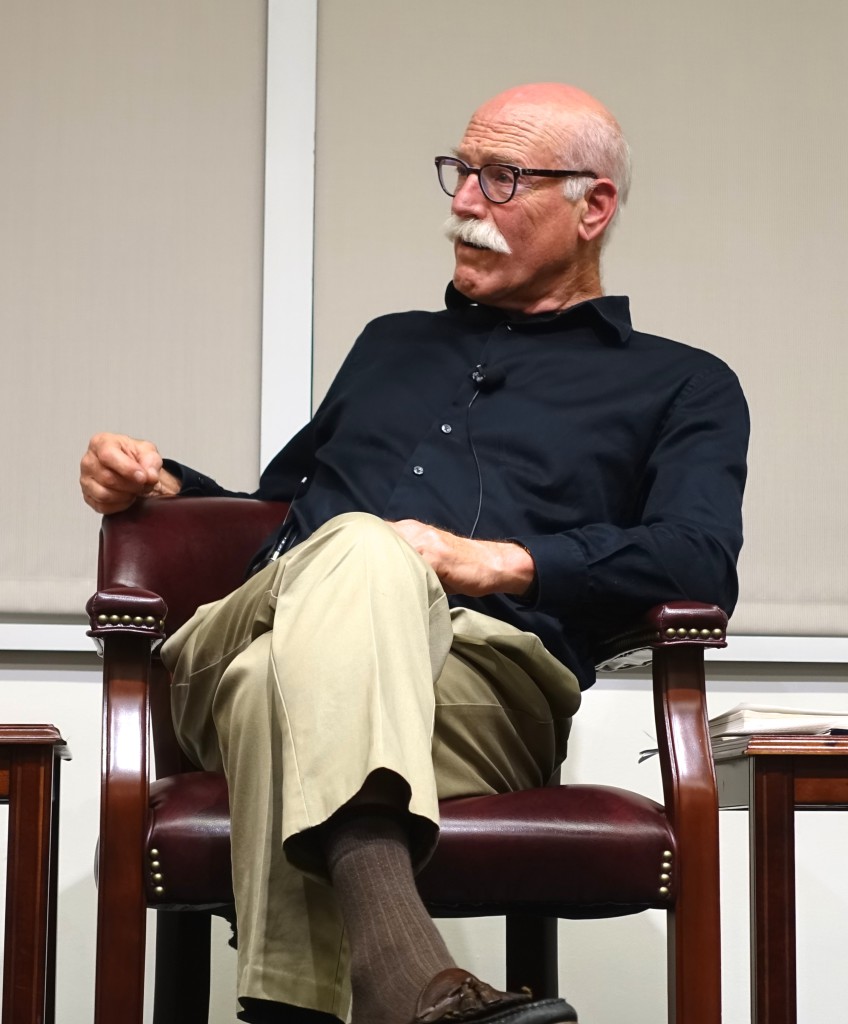
Founder Tobias Wolff. (Photo: David Schwartz)

Four years ago, the distinguished author Tobias Wolff – who was recently named a recipient of the National Medal of the Arts – approached me with an idea: he wanted to create a forum where members of the community would interact with Stanford writers, scholars, and literary figures in the world beyond, to talk about the books they love. He wanted the first book to be a beloved favorite, William Maxwells So Long See You Tomorrow. He asked me if I could make all this happen. Frankly, I have to say, I was doubtful. The term “book club” did not have good associations for me. But as we hashed it out, I realized my issues were two-fold: first, I figured most people, like me, didn’t have the hours and hours to read long books of other people’s choosing; and second, the books tended to be mainstream, middlebrow, middle-of-the-road “safe” choices.

Inspired by Maxwell’s novel, we decided that we would focus on short books – short enough for Bay Area professionals who are pressed for time, and who may spend their days going through legal briefs or medical documents. Also, we would focus on books that were forgotten, overlooked, or simply haven’t received the audience they merit. We would call it “Another Look.” It would be for people who wanted to be part of the world of books and literature – a world they may have lost touch with once they left university. They would be connoisseurs’ choices for books you must read – discussed and even championed by the people who love them.
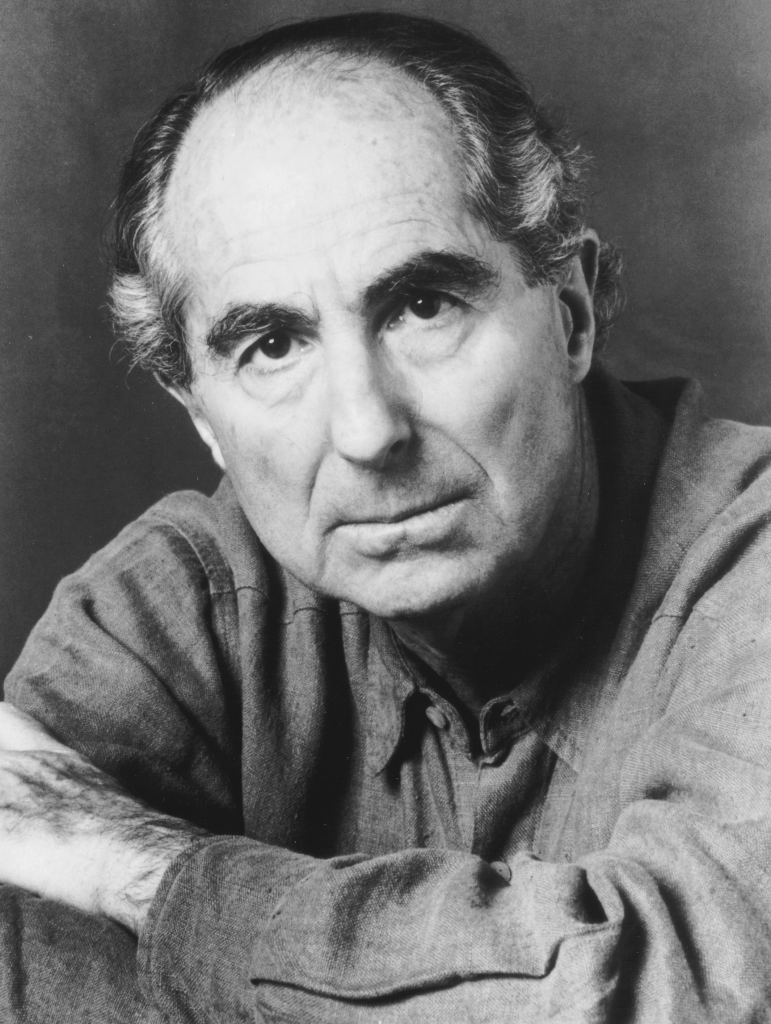
Not delusional. (Photo: Nancy Crampton)

Nobless oblige. (Photo: Nancy Crampton)

We had a full house the first night, and our audiences have been steadily climbing upward ever since. One highpoint: for Philip Roth‘s The Ghost Writer, we were joined by Michael Chabon and Ayelet Waldman. It was the only time to date we have had a living author. And although he had become something of a recluse, I decided to see if I could interview him. The subsequent Q&A was published on The Book Haven and republished in La Repubblica, Le Monde, and Die Welt. It made the international press, and the high-profile Another Look was featured in The Guardian.

Toby retired … or said he was going to retire … last year (he was recalled for another year, but that’s another story). When we announced that Another Look was going to close shop a year ago, we got record numbers of people attending our event for Albert Camus‘s The Stranger – a book, Toby claimed, that was more honored than read. One member in the audience, the acclaimed author Robert Pogue Harrison, stepped forward that night to offer to assume the directorship of the program. We’ve developed subscribers’ list pushing up to 1,400. Our February’s event with Werner Herzog at Dinkelspiel Auditorium, discussing J.A. Baker‘s The Peregrine, is now on youtube, in both highlights and full-length version. (The event was covered by San Francisco Chronicle columnist Caille Millner here.) The repercussions of that powerful book event will continue to unfold in the months to come.
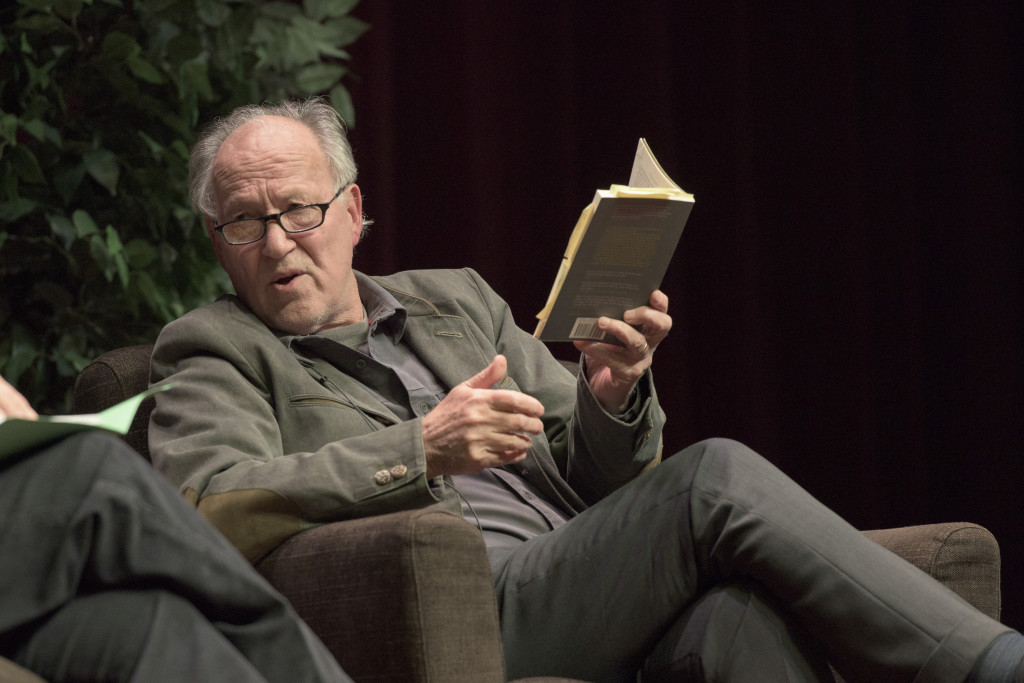
Legendary film director Werner Herzog discusses J.A. Baker's book The Peregrine at the Feb. 2 Another Look book club event.

Legendary film director Werner Herzog discusses J.A. Baker’s book The Peregrine at the Feb. 2 Another Look book club event. (Photo: L.A. Cicero)

It’s been enormously gratifying for me personally to be the point of contact with all of you in our book-loving Bay Area community – and sometimes around the nation and world, too. We have one aficionado driving in from Carmel – others write from far-flung places to tell me they’re reading along with us. And Toby has talked about this program, during his speaking engagements around the country. He’s proud of his brainchild, too.

Why am I so keen on this program? Because it’s rocked my world. Those who know me as a literary journalist know that I’ve sunk my time into the world of Eastern European poets, particularly Nobel laureate Czesław Miłosz, and more recently, into the French theorist René Girard, a longtime Stanford faculty member, a dear friend, and the subject of my biography. Hence, there are huge holes in my knowledge of modern fiction, and particularly American fiction. Without too much investment of time, I’ve caught up with a lot of writers I’d somehow missed. No membership fees, no meetings with minutes, no commitments – just show up, please!

So please join us next month, on Tuesday, May 10, at the Bechtel Conference Center, when we discuss Joseph Conrads novella The Shadow-Line. The story will run in Stanford Report Monday and be on the Stanford news website – we have books in the lobby. Meanwhile, take some freshly minted bookmarks – and take a few for your friends who might be interested, too.
“A Company of Authors” – a pleasant afternoon of classy books this Saturday. Be there!

Share
stansky

Our hero, Peter Stansky.

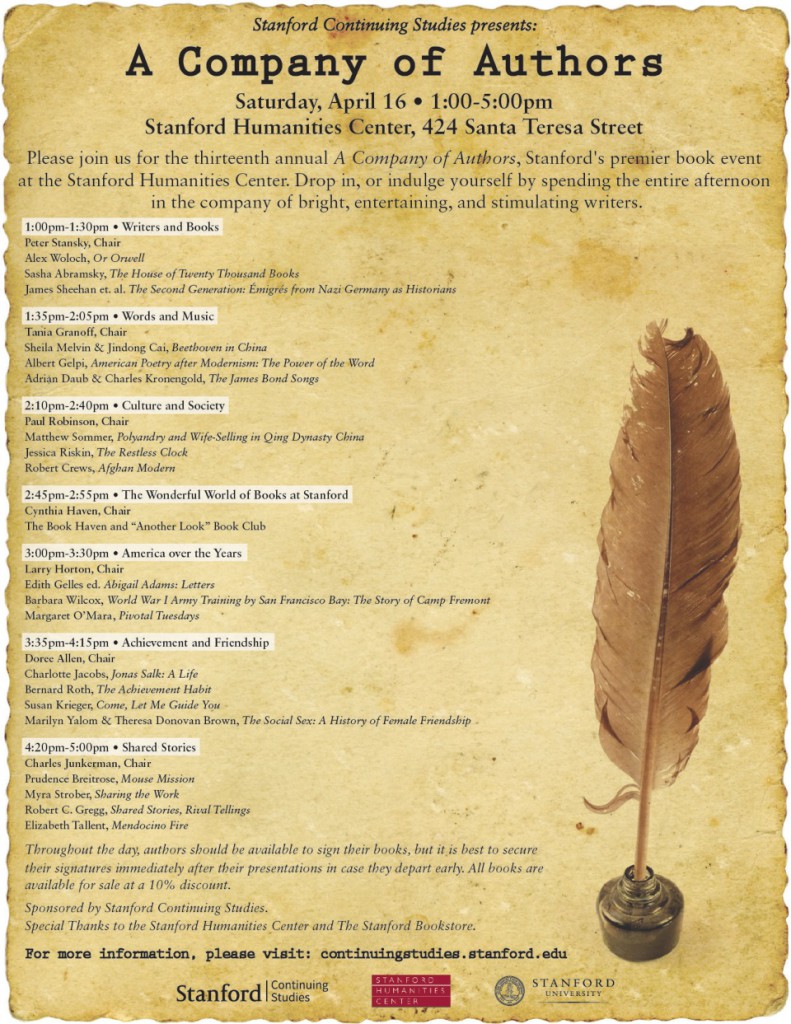
It’s that time. Peter Stansky‘s annual “A Company of Authors” is happening this Saturday, April 16, from 1 to 5 p.m. at the Stanford Humanities Center, 424 Santa Teresa Street on the Stanford campus. The annual event gathers Stanford authors from the previous year to present and discuss their books.

yalom

Encore, Marilyn!

I’m particularly looking forward to Myra Strober‘s new memoir, Sharing the Work and Albert Gelpi’s American Poetry After Modernism. I’ve heard Marilyn Yalom and Theresa Donovan Brown speak about The Social Sex: A History of Female Friendship  before, and also Edith Gelles on Abigail Adams‘s letters (we’ve written about Marilyn here and here and here, and Edie here) – I look forward to doing so again. It’s always fun.

So many people on this list I really want to see this weekend … oh, I could go on and on. What’s that you say? Why, yes, yes … Humble Moi will be speaking at 2:45 p.m. on “The Wonderful World of Books at Stanford.” I’ll be talking about the wondrous success of the “Another Look” book club which brings little-known or overlooked masterpieces to the Bay Area community – and which, I might add (and I will), has received international coverage. I’ve written about the open book club – which focuses on a series of public events –  here and here and here and here, among a zillion other places.

Anyway, great fun, and the Stanford Boostore will be selling the books in the lobby – at a 10% discount, too.

companyofauthors

Rescued from oblivion: selected poems from the early and late Dunstan Thompson

Share

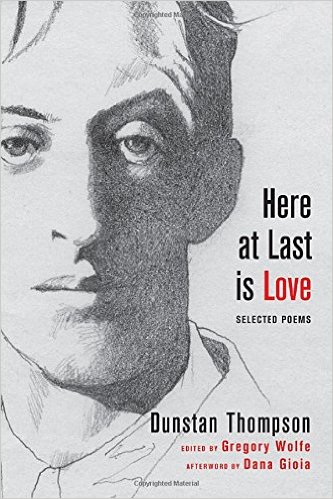
thompsonHere at last is Dunstan Thompson‘s Here at Last Is LoveIt’s been a group effort to get this slim volume published. Author Gregory Wolfe, California poet laureate Dana Gioia, Thompson’s longtime companion Philip Trower, and others have rescued the poet from oblivion.

Thompson (1918-75) was an American poet who had risen to fame in the New York literary scene of the 1940s. After his wartime experience, he all but disappeared in a remote Norfolk village called Cley. His poetry was no longer sought after and published. The problem was, as Dana Gioia wrote, that there were two Dunstan Thompsons: the poetry of early Thompson of the 1940s is “expansive, ornate, dramatic, and confessional.” The later poetry is “austere, urbane, controlled, and quietly confident.” (I’ve written about Gioia’s essay, “Two Poets Named Dunstan Thompson,” which is now the afterword of the book, here.)

According to Kevin Prufer, co-editor of Dunstan Thompson: On the Life and Work of a Late American Master: “Here, for the first time, Gregory Wolfe draws draws poems from the poet’s entire writing life, including his harrowing, erotic wartime poetry and his almost entirely unavailable, more reflective work of maturity. In doing so, he brings to new audiences the work of an essential mid-century poet…”

Greg Wolfe, the book’s editor, has written a graceful introduction to this small volume (128 pages), but this commonplace sentence is the one that stopped me. It describes the poet’s life in rural Norfolk: “A steady stream of visitors – British and American – came to Cley. Thompson’s Harvard friend Billy Abrahams came for many visits along with his partner, the writer Peter Stansky.” Could there be two literary Peter Stanskys in the world, I wondered?

Naturally, I wrote Stanford’s Orwell scholar, Peter Stansky, right away to clear things up. He replied within an hour or so: “Many visits is an exaggeration. The first I remember fairly well, and we may have gone a second time. Dunstan was a contemporary of Billy’s at Harvard and one of his closest friends.  Dunstan had gone to England as a soldier during the war and may not have come back to the U.S.A. except briefly, but I’m not sure of that. If so, Billy would have seen him in New York after the war.

“I met Billy in 1961 and some years after that we went to England to work on Journey to the Frontier. We went to see Dunstan and his partner Philip Trower, a very nice Englishman and writer. Dunstan who had been, I believe, a rather irreverent poet had now become a devout Catholic and Philip had converted.  We had a very jolly time but I can’t remember much in particular. I bravely swam in the sea. We ate and drank well. They took us to Houghton, the great Norfolk Walpole house, where we were shown around by the Marchioness of Cholmondeley [that would be the former Sybil Sassoon, cousin to the poet Siegfried Sassoon]. Philip had been at Eton with her son.”

“Little did I know that years later after her death I would write her biography [i.e., The Worlds of Philip and Sybil (2003)], so in retrospect, it was terrific that I had met her. I have a feeling that we may have visited a Catholic English shrine at Walsingham.  The main point was for Billy and Dunstan to talk about the old days. They may have been somewhat wild, although I don’t remember anything specific mentioned,” he said.

“Billy remained in touch with Dunstan, though I don’t think either were good correspondents. It was very touching that on Dunstan’s death, he left Billy his Bulova watch, some books including, I think, an early edition of Byron I have somewhere and, most wonderfully, he very kindly left me specifically a print by Paul Nash, an artist I much admire that I have on my walls.”

Peter Stansky also gave Dana Gioia several books that Dunstan had inscribed to Billy Abrahams. The Stanford Libraries printed a selection of Abraham’s poems to commemorate Peter’s donation of Abrahams’ papers to Stanford.

The title poem is, as Greg notes, a short “shape poem” called “On a Crucifix”:

See
Here at last
Is
Love.

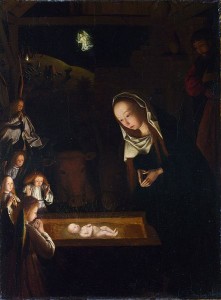
443px-Geertgen_tot_Sint_Jans_002It’s one of the last poems in the volume. In keeping with the season, here’s Thompson’s short “Fragment for Christmas,” another poem from the very late Thompson:
.

Dear Lord, and only ever faithful friend,
For love of us rejected, tortured, torn –
And we were there; who on the third day rose
Again, and still looks after us; descend
Into each wrecked unstable house; be born
In us, a Child among Your former foes.

“A Company of Authors”: meet the writers this Saturday at Stanford’s cozy literary fête!

Share
bookfest_profs

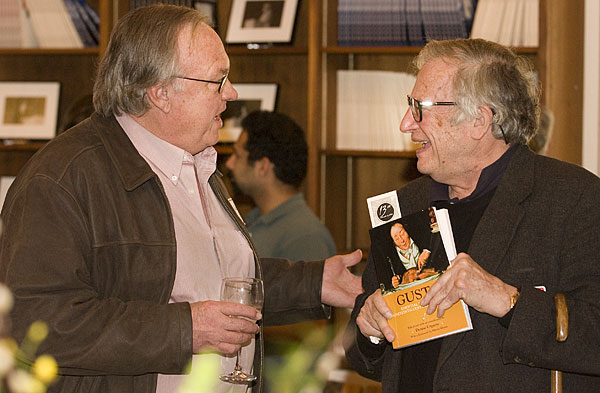
Stanford poet Ken Fields (left) chats with Peter Stansky. (Photo: L.A. Cicero)

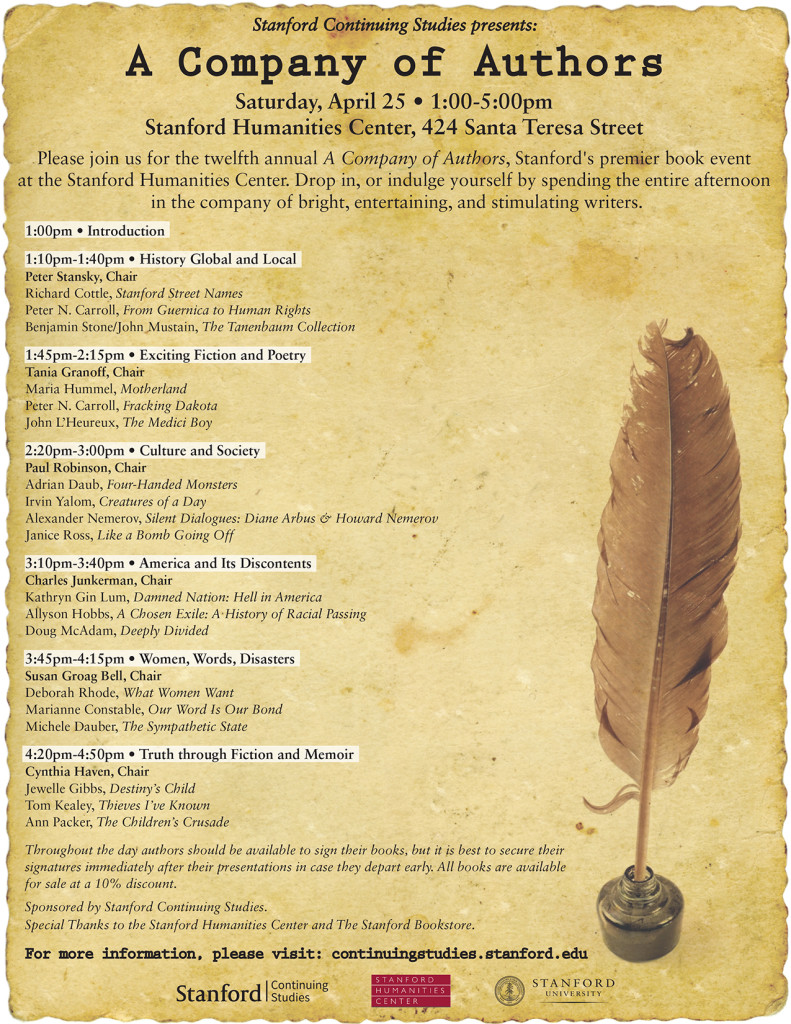
Every year it happens – and every year we announce it. Peter Stansky, the benevolent and erudite spirit who presides over “A Company of Authors” at Stanford (the emeritus history prof is also author of The Unknown Orwell, The First Day of the Blitz, and Julian Bell: From Bloomsbury to the Spanish Civil War) has once again organized the cozy literary fête, now in its twelfth year. The event will happen this Saturday, April 25, from 1 to 5 p.m. Once again, an amazing group of Stanford writers will be discussing their recently published books. Each author will make a brief presentation, answer audience questions, and be available for conversation and book signing.

The authors who are scheduled to be speak include Richard Cottle (Stanford Street Names), Allyson Hobbs (A Chosen Exile), Maria Hummel (Motherland), John L’Heureux (The Medici Boy), Doug McAdam (Deeply Divided), Peter N. Carroll (From Guernica to Human Rights: Essays on the Spanish Civil War and Fracking Dakota: Poems for a Wounded Land), Michele Dauber (The Sympathetic State), Adrian Daub (Four-Handed Monsters), Jewelle Gibbs (Destiny’s Child), Janice Ross (Dangerous Dances), Kathryn Gin Lum (Damned Nation: Hell in America), Irvin Yalom (Creatures of the Day), Deborah Rhode (What Women Want), Marianne Constable (Our Word is Our Bond), Ann Packer (The Children’s Crusade), Alexander Nemerov (Silent Dialogues: Diane Arbus & Howard Nemerov), Benjamin Stone and John Mustain (The Tanenbaum Collection), and Tom Kealey (Thieves I’ve Known). Many have appeared on the Book Haven before.

Not least of this year’s attractions: you will have a chance to meet Humble Moi, who is willing to sign your programs and flyers. If you consult the program below, you will see that I will be chairing the very last of the panels, “Truth Through Fiction and Memoir.”

Did I mention that the event is great fun? Drop in, or indulge yourself by spending the entire afternoon in the company of these bright, entertaining, and stimulating writers. Stanford Bookstore, one of the event’s annual co-sponsors, will sell books at a 10 percent discount, and authors will sign copies. Light refreshments will be served. And it’s all free!

CompanyAuthorsSpring13_LetterSize

“It hurts, but you won’t die.” Stanford poet Rodney Koeneke on Dante and omelettes

Share
purgatorio

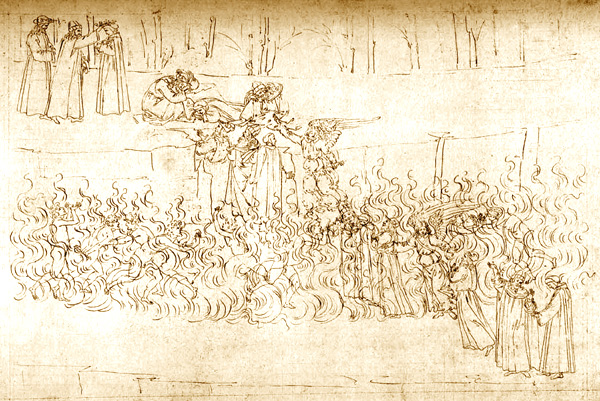
Purgatorio’s Canto 27: Botticelli’s version

Yesterday’s “Company of Authors” event exceeded expectations – and we can expect a lot. Peter Stansky‘s annual recap of Stanford books was an intellectual shake-up – as he put it afterwards, “I think it is pretty exhilarating to hear what is going on at Stanford in terms of splendid writing.”

koeneke

Not jangly at all.

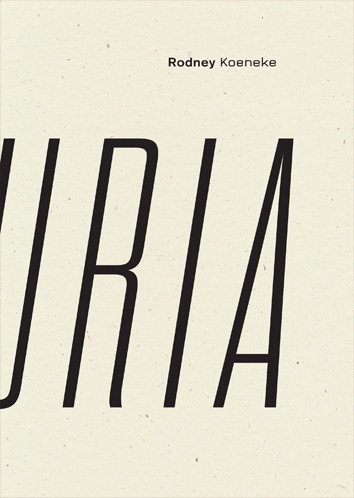
And what of my little panel on “The Power of Poetry,” which I described a few days ago? I must confess that I had a little trepidation about Rodney Koeneke‘s Etruria (Wave Books, 2014). He is an early member of the Flarf Collective, “a group of poets working in loose collaboration on an email listserve, mining the internet for their work, producing jangly, cut-up textures, speediness, and bizarre trajectories,” as I explained at the event. We at the Book Haven try to be avant-garde, really, but still… so imagine my surprise when out of his mouth rolled this lovely meditation about a subject dear to our hearts, Dante Alighieri – echoing Robert Harrison‘s insistence of movement as a theme of the Divine Comedy in general, and of the Purgatorio, in particular, since it’s the only one of the three realms in which time exists – we wrote about that here

The affinity is not happenstance: Rodney said that reading Stanford’s John Freccero and teaching Purgatorio Stanford students years ago were “two sparks for the poem” – then he added, “so it’s nice to have it come home, as it were, to the Haven.”  Our pleasure. Poem below.

As for the panel itself?  Said Rodney: “Only Peter Stanksy could put a scramble of authors together like that and make it an omelette.”

.

La Chevy Nova

Etruria_final_for_website_1024x1024

One of the great pivots in Christian history
occurs near the end of canto 27 of Dante’s Purgatorio, a
canto that opens with the pilgrim comparing the dying sky
to Christ’s vermillion wounds (note the “sun”
deftly figured here as “son”) and the Ebro
and the Ganges, which are rivers,
are empurpled—made royal—by noon
and a glad angel shows up to sing gladly
about the flame that will burn but also purifies,
which our pilgrim by the end of the canto will have to go through
like the muscles behind or just on top of the knee can burn
at the end of a long run, or perhaps (and here’s the pivot)
like the burning some do when they go from a car
at night’s end in a remote parking lot
where nothing is unseemly or sordid
but does in a fashion burn, but also does it purify
as history considered in its Christian dimension must also purify?

Dante, you’ll remember, has spent the preceding cantiche
skillfully working his personal crotchets
into a gargantuan cosmic structure — “I vividly recalled
the human bodies I had once seen burned” —
with his obduracy not once being softened;
yet he manages to nest this ugly effort
in the larger project of turning his passion for the dead Beatrice
into a redemptive program for himself, for time, the reeling stars,
the fishes, the beestes, the air and everything in it
itself and finally, one might point out, for movement itself
which is seen at the end from its center and revealed as an aspect of love.

Structure is on fire, and tercets are on fire, and process
is on fire, and motion is on fire; while the poem has learned
to preen and turn, pivot on, and no longer hurts, or points
at a world, or even at its status as an internally consistent
verbal object, only at the most tiresome conditions
of its own production.
.  .                                   . But I gaze at you and I burn
with a new vernacular; I see you, and I see vermillion,
your color—vermillion in the stoplights
and the stoplights ranged as stars
like the stars could spell out ‘B-E-A-T-R-I-C-E’
and would if they weren’t so dim and talky, stuck
in their orbits where it’s safe to promise love — “it
hurts, but you won’t die”—and you stew in a tepid
amor amicitiae, Socrates spooning
with Alicibiades, warm under sheets
against philosophy’s cold stars:
“It hurts, but you won’t die.”

That even a wound, even now, could make things pure
is enough to count me bitten
returned to the pivoting folds of this world:
count me hurt, count me bitten
Gulls distribute themselves over Oakland’s industrial center
like I leave you, come back to be near you
where I hear their glad song, or watch them scatter gladly
over the beautiful chords of this world;
and beautiful are the chords of this world
with you and everything in it;
Beautiful the Ebro above the phone lines
emitting its fine vermillion into morning
so pleasing to mine and to everybody’s eyes.
So do I live to look at you and so
does everyone: It hurts, but I won’t die —
a little sun, a little wound
“but through that little space I saw the stars.”

Join us for the 11th annual “Company of Authors” on Saturday!

Share

carnochanWe’ve written annually about Stanford’s “A Company of Authors” – here and here and here and here. The unusual event offers a chance to meet top Stanford authors, all published in the last year – plus a chance to buy their books without waiting for an Amazon delivery to your doorstep. But the April 19th event next week is special for another reason: Humble Moi will be one of the moderators, on the session featuring “The Power of Poetry.” Well, not entirely special, actually. I chaired a panel with the same title last year. The charming George Orwell biographer, Peter Stansky, who chairs the event, recycled the title for the panel this year. But what better title could we have picked? What would match the power of poetry?

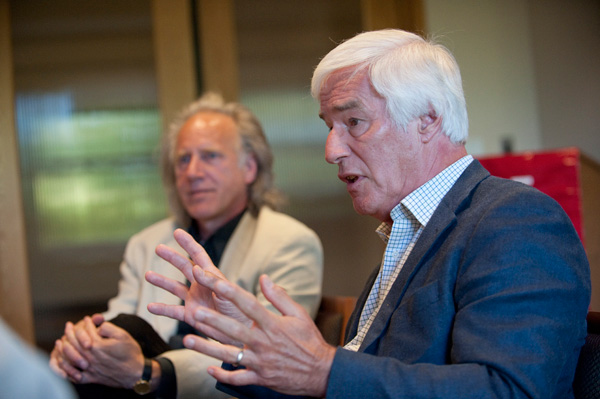
Casper at the conference, Robert Harrison in the background (Photo: L.A. Cicero)

Casper on Arendt, with Robert Harrison. (Photo: L.A. Cicero)

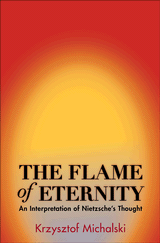
I met with one of my panelists last week for lunch over at the Stanford Humanities Center. Benjamin Paloff is a Slavic scholar deeply immersed in the work of Russian and Polish poets, including Zbigniew Herbert and Czeslaw Milosz, among others, so we had lots to talk about. He’s also  the excellent translator of Krzysztof Michalski‘s The Flame of Eternity, which we’ve discussed on these pages here. But he’s on my panel for the book I haven’t seen – his latest collection of poems, Politics. Benjamin is currently a fellow at the Stanford Humanities Center, visiting from my own alma mater, the University of Michigan – Tung-Hui Hu, also on my panel, is an assistant professor of English in Ann Arbor. So three of us are used to cold weather. Tung-Hui wrote me this morning from the foggy cliffs of Djerassi Ranch. Well, we’ve written about Carl Djerassi‘s philanthropic venture here, and the terrors of driving to the place here. As for Rodney Koeneke, the final member of my panel, the Stanford alum and poet is visiting us from Portland. He appears to have no Michigan connection, nor anything that’s not on the Pacific. Quite wise of him.

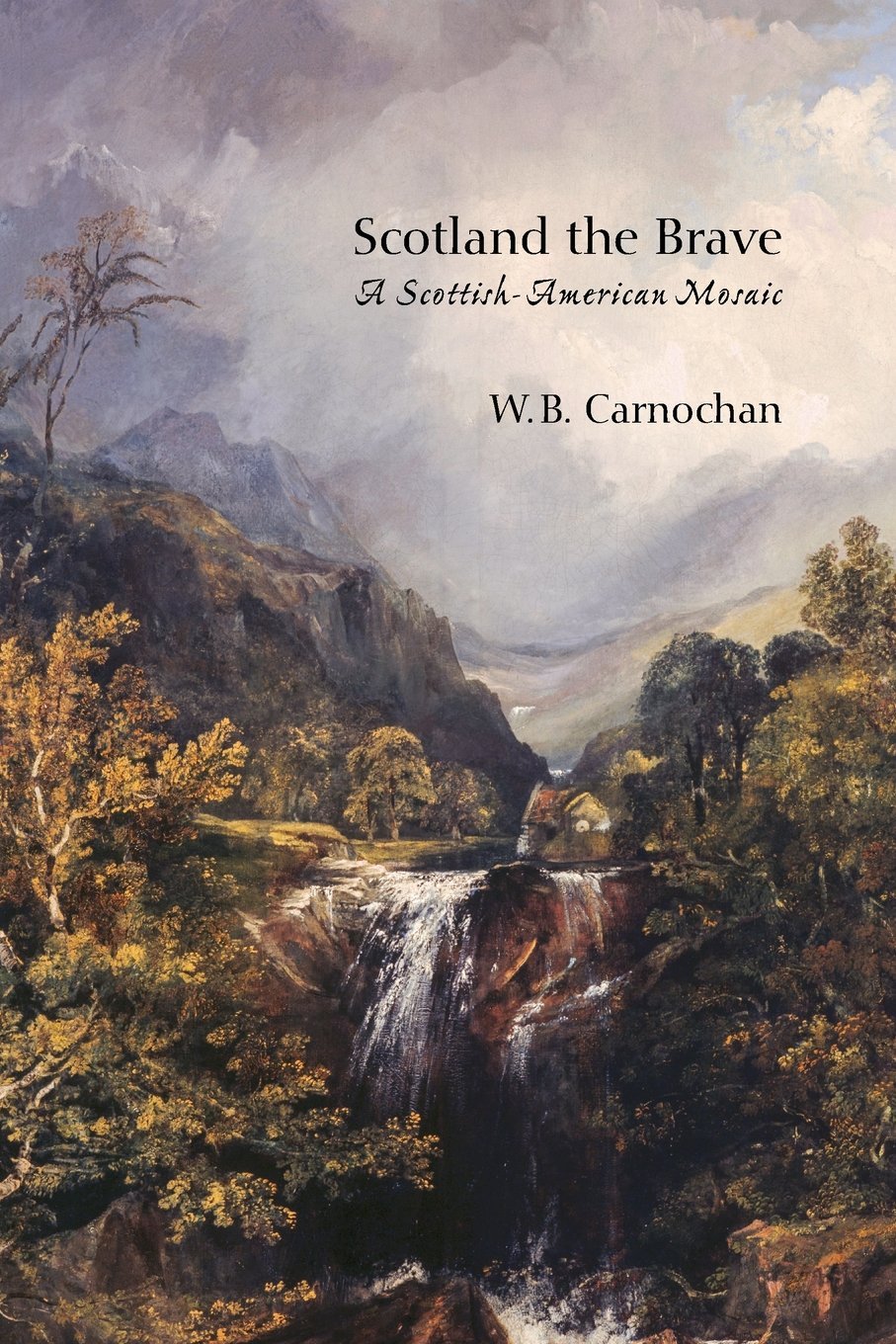
michalski2At least one of the other books has been on these pages: Bliss Carnochan‘s Scotland the Brave.  We’ve also written about Ian Morris, Gavin Jones, Peter Carroll, and others. We haven’t written about former Stanford president Gerhard Casper (except to discuss his friendship with Hannah Arendt  here and here), but we should. His new book, The Winds of Freedom: Addressing Challenges to the University, has been getting some buzz.

Peter Stansky, as always, is the master of ceremonies. We can’t do much better than give you the elegant playbill below, and urge you to come to the Stanford Humanities Center next Saturday at 1 p.m. Oh, and it’s free. How many things can you say that about nowadays? I’ll be chairing the panel on “The Power of Poetry” at 4 p.m.

Read more here.