
Tomorrow: Meet the authors, and celebrate birthdays with Shakespeare, Wordsworth, Nabokov, and St. George

Share

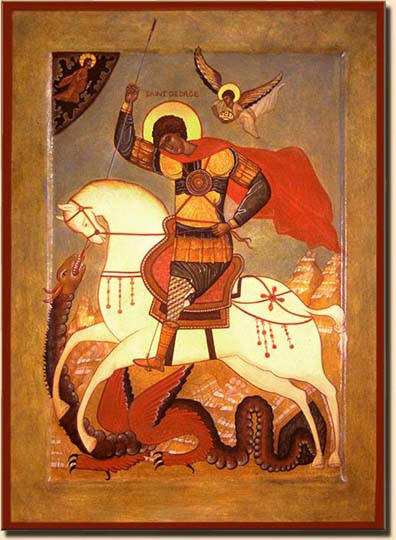
“Cry God for Harry, England, and Saint George!”

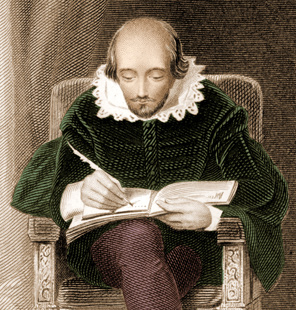
Tomorrow, April 23, is William Shakespeare‘s birthday.  It’s also William Wordsworth‘s birthday, and Vladimir Nabokov‘s birthday – and St. George’s Day, to boot.

It’s also the 8th annual “A Company of Authors” celebration at the Stanford Humanities Center, an all-afternoon gig celebrating the variety, richness and importance of the books produced by the Stanford community.  (More on the event here.)

This year’s auspicious date is not entirely a coincidence.  George Orwell biographer Peter Stansky, who founded the event along with the late, lamented Associates of the Stanford University Libraries, was particularly pleased by the possibilities offered by the juxtaposition.

Peter will open the event by reading a poem by George Steiner about the wisdom of choosing one’s birthday – you see, it’s Steiner’s birthday, too.

The event was inspired by the Los Angeles Times Book Fair and the annual Humanities Center Book party.  There’s a difference, however: the books will be available for sale at a 10 percent discount.  The fête kicks off at 1 p.m., and it’s free at the Humanities Center on Santa Teresa, and the company will be excellent, if I do say so myself.

“It is open to all who wish to come and learn more about the authors’ thinking behind their work, would like to chat with the authors in the periods between sessions and have the opportunity to purchase their books,” he said.  It has another purpose – “and that we can all feel that somehow we are in the tradition of Shakespeare!”

Authors include:  Charlotte Jacobs, Henry Kaplan and the Story of Hodgkin’s Disease;

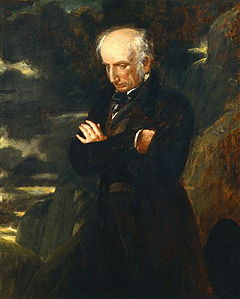
Birthday boy

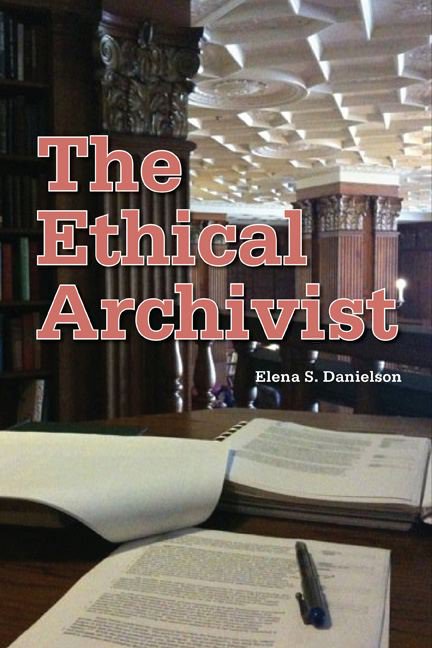
Susan Krieger, Traveling Blind; William Kays, Letters from a Soldier; Gabriella Safran, Wandering Soul: The Dybbuk’s Creator: S. An-sky; Abbas Milani, Myth of the Great Satan and The Shah; Ian Morris, Why the West Rules—For Now; Karen Wigen, A Malleable Map; Elena Danielson, The Ethical Archivist; Jack Rakove, Revolutionaries; Karen Offen, Globalizing Feminisms; Myra Strober,  Interdisciplinary Conversations; Stina Katchadourian, The Lapp King’s Daughter; Dan Edelstein, The Enlightenment: A Genealogy; Herbert Lindenberger, Situating Opera: Period, Genre, Reception; Debra Satz, Why Some Things Shouldn’t Be for Sale.  And you guessed it, Humble Moi – Cynthia Haven for An Invisible Rope: Portraits of Czeslaw Milosz.

No RSVP needed

According to Peter, “Most importantly in my view, the books reflect the most important aspect of the University: the life of the mind which sometimes gets forgotten in the many day to day events that take place at Stanford. In my view, this event represents the essence of the University.”

It is also J.M.W. Turner‘s birthday as well as Shirley Temple‘s, which he doesn’t mention.  “Perhaps you can arrange for Shirl ey Temple to come,” he suggested to me.  Do you think?

Postscript:  I know, I know … Shakespeare’s birthday is conjecture, based on his April 26 christening.  Usually, in the 16th century, a birth was followed post haste by a christening in anticipation of instant death.  And, given that he died on April 23, and that April 23 was St. George’s day, and, after all, he did need a birthday – the world fixed on April 23rd.  Good enough for me.  Hope for you, too.  See you tomorrow.

Postscript on 4/23/2013  We mistakenly reported that Alexander Pushkin‘s birthday is on April 23.  Wrong!  It’s June 6, 1799 (what a pleasant way to usher in a new century!)  The error has been corrected.  Thank you, Tatiana Pahlen, for pointing it out to us.

So where, exactly, is Martin Luther King’s stuff?

Share

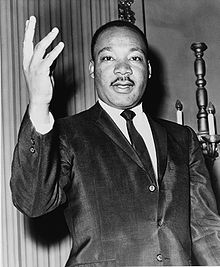
Happy birthday, Martin Luther King Jr. But where’s all your stuff?

The answer is a complicated one, and “a cautionary tale,” according to Elena Danielson, author of The Ethical Archivist and sometime contributor to the Book Haven.

Principally, problems arise when collections are seen as windfalls and brain bling, rather than social and cultural responsibilities.

Here’s Elena’s story:  MLK got his PhD from Boston University and met his future wife Coretta in Boston.  The transfer of his papers to Boston University began “by an exchange of letters, a once-common practice.”  King intended to make a loan or deposit, that would evolve into a gift.  The terms were never finalized.

After his assassination in 1968, the family established the King Center in Atlanta.  Most pre-1961 are in Boston; most post-1961 papers are in Atlanta.

The problem is, Boston University isn’t a hotspot for academic research on civil rights.  Its special collection is famous for collector the papers of Hollywood figures, who jostle with King on its website.

That’s not all, of course: hundreds of letters and bits of paper are all over the country, many held privately.  For example, Harry Belafonte had several major King documents.  He tried to sell them at public auction in 2008, but withdrew them under protest.

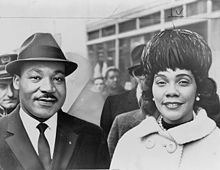
Martin and Coretta in 1964

Coretta King tried to get Boston’s papers back, beginning in 1987.   Could a lawsuit be far behind?  James O’Toole, an expert archives witness, recommended consolidating the collection in Atlanta, and testified that at least one item had been lost in Boston, and that the university had not provided the appropriate levels of professional care.

Boston University won the case.  “The decision was narrowly based on property law that treated archives as objects, no different from a dispute over the ownership of furniture,” Elena writes.

The situation worsened with Coretta King’s death in 2006.  The estate put a large collection of King papers up for auction at Sotheby’s – “The commodification of the King legacy directly threatened its integrity,” Elena writes.  Public outcry resulted in a $32 million fund to keep the papers in Atlanta, housed at Morehouse College.

Believe it or not, this tangled story has kind of a happy ending.  There was another strand of activity:  In 1985, Coretta King asked Clayborne Carson of Stanford to edit King’s papers for publication.  The multi-volume edition brings together the scattered texts for researchers – volume 1 came out in 1992, and several more have been published since (14 in all are planned).

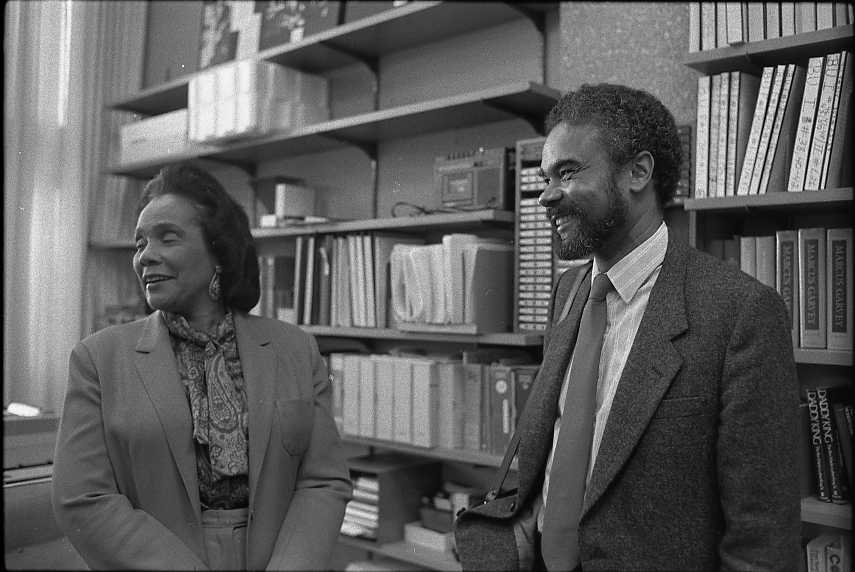
Coretta and Clay at Stanford in 1986

Carson turned the limited funding to good use by hiring a regiment of student research assistants – that is, a new generation of researchers.  Technology has reunited the the collection with high-tech images.  The “virtual collection” at Stanford augments the published volumes.

Clay is an affable kind of guy, a natural uniter.  Maybe peace and reconciliation are contagious:  “After decades of divisive competition, threats of auctions, and obstructed access, curators in Boston and Atlanta are cooperating, as envisioned by the archival code of ethics.  If the program proceeds according to this vision, the results could be remarkable,” she writes.  “This kind of documentation gets to the core of history as it happened.”

Elena’s point:  Archival ethics are about more than academic nitpicking.  “When papers preserve the shared remembrance of society, they become a shared cultural heritage.  In these cases the traditional archival concept of respect for the integrity of the collection is something more than a professional technicality.  Remembering is a core value.”

Happy Martin Luther King Day, everybody.

Postscript: Just found this video — Clay Carson speaking on what MLK would say about the USA today. Enjoy.