
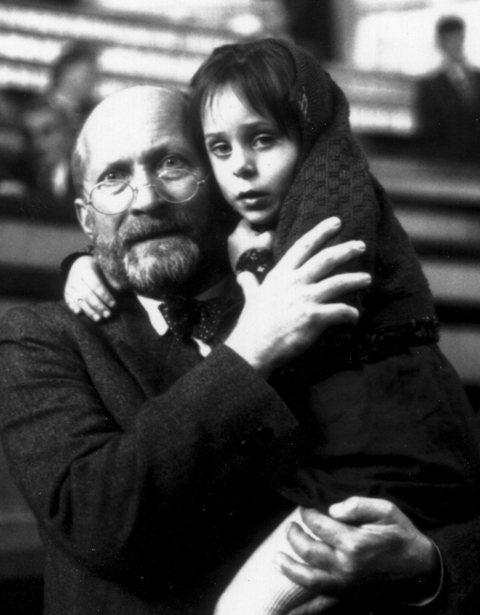
From Andrzej Wajda’s 1990 movie
Among my first errands in Warsaw was delivering several DVDs of Mary Skinner’s In the Name of Their Mothers to Warsaw filmmaker Leszek Cicirko, who worked with Mary in Poland, and Hana Rechowicz. She is the daughter of Sendler’s co-worker, Jadwiga Piotrowska – I wrote about her here.
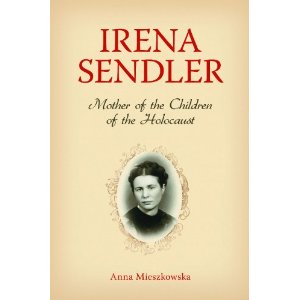
On the train from Kraków to Warsaw, I finally got back to Anna Mieszkowska‘s Irena Sendler: Mother of the Children of the Holocaust. It’s a problematic book, crying out for a good editor and better organization, but it’s all we’ve got in English or Polish on the woman who saved 2,500 Jewish children in the Warsaw Ghetto from certain death. It’s filled with long excerpts from Sendler’s own writings, which redeems its many flaws.
I reached the point in the book where Sendler describes the Polish Jewish pediatrician and children’s author, Janusz Korczak, who had established a Jewish orphanage along the lines of his educational theories. (Culture.pl, an online magazine promoting Polish culture, has a biographical article here.) Sendler had of course worked worked with the doctor in the Ghetto, after the orphanage was moved inside its walls in 1940. Korczak refused many offers to be smuggled out of the Ghetto – he would not abandon the children in his care. And so he died with them. On August 5, 1942, Korczak joined nearly 200 children and orphanage staff members were rounded up for deportation to Treblinka, where they were all put to death.
In Sendler’s words:
“He walked at the head of this tragic procession. He held the younger child in his arm and with his other hand he was leading another infant. That’s how various people have recorded it in their memoirs, whereas others record it differently, but this doesn’t mean anyone has made a mistake. One has only to remember that the route from the orphanage to the Umschlagplatz was long. It lasted four hours. I saw them when they were turning from Żelezna Street into Leszno Street.”
Curiously enough, Korczak was the subject of a recent email from Helen Pinkerton, who had seen my posts on Mary Skinner’s PBS film, which reminded her of Edgar Bowers‘ poem, “In Defense of Poetry,” in his Collected Poems. The poem ends:
An old light shining new within a world
Confusing and confused, although their teachers
Deny the worth of writing – my latest colleagues,
Who hope to find a letter in the mail,
Are happy if their children study Shakespeare
At Harvard, Penn or Yale, write articles
To prove all writing writers’ self-deception,
Drive Camrys, drink good wines, play Shostakovich
Or TV news before they go to bed,
And when their sleeping or their waking dream
Is fearful, think it merely cinema,
Trite spectacle that later will amuse.
But when my mind remembers, unamused
It pictures Korczak going with his children
Through Warsaw to the too substantial train.”
 Curiously, too, this poem was also the subject of a recent post by Patrick Kurp in Anecdotal Evidence, who compared its quiet power to Clint Eastwood’s Mystic River, where “Every frame is too emphatic, too loud, too cartoonish, too insistently certain of its own bravery in the face of evil.”
Andrzej Wajda also made a movie, Korczak – so Korczak’s story has entered the world of art.
But I’m always a little uncomfortable when suffering of this magnitude gets turned into a poem or painting or even movie – it’s too easy to appropriate the suffering of others to give massiveness to one’s ideas, and to subtly enhance oneself. Regardless of the artistry of the result, the process is morally questionable. I know Czesław Miłosz felt much the same way about his own “Campo dei Fiori.” As I noted in an article a few years ago, “The Doubter and the Saint“:
“Later, in Conversations with Czesław Miłosz, the poet called it an ‘immoral’ and dishonest poem, ‘because it was written from the point of view of an observer about people who were dying.’ It was too easy, he seemed to be saying: the poet observes an atrocity, writes a poem in protest, and is pleased at having written a beautiful poem; conscience slackens.”
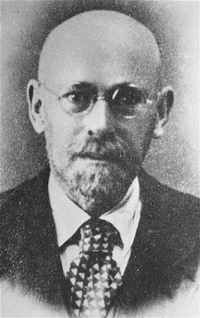
The real Korczak
Moreover, it’s a strange process by which we begin to prefer the glossiness of the artistic version – in fact, I just proved it. While looking for a photo, I quickly latched onto Wajda’s movie image of Korczak, which was much preferable to the real doctor at right, who wasn’t an actor and didn’t have a cameraman.
Sendler, who was on site for the unspeakable event, recalls that Korczak had, a few weeks before, directed the children to perform Rabindranath Tagore’s play, Post Office, which describes how a child striving to escape his sickroom confines, ultimately dies, with death seen as, in Tagore’s words, “spiritual freedom” from “the world of hoarded wealth and certified creeds.”
But I think Sendler’s artless words are simplest and best when describing the atrocity:
“I was at the orphanage to see that play. And then, when on August 6, 1942, I saw that tragic parade in the street, those innocent children walking obediently in the procession of death and listening to the doctor’s optimistic words, I do not know why for me and for all the other eyewitnesses our hearts did not break.”
“But our hearts remained intact, and what also remained were thoughts that to this day cannot be understood by any normal person.”