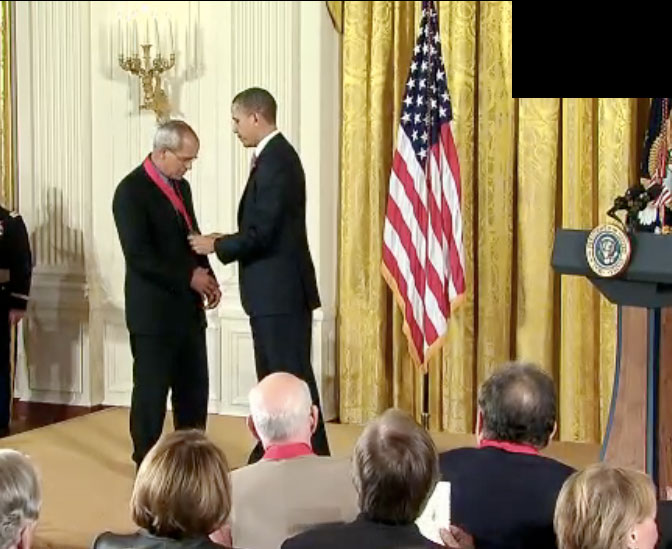

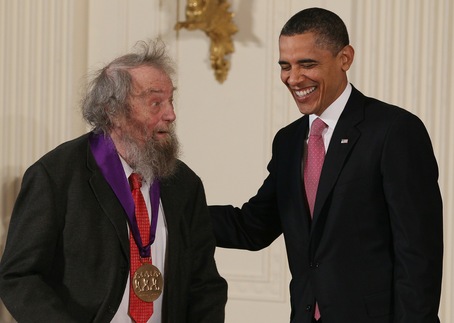
 No, I’m not talking about Donald Hall‘s appearance in this headline – rather, I’m talking about the ugliness of the Washington Post‘s online derision of him, following his acceptance of the National Medal of Arts last Wednesday (we posted about the awards here – and there’s a nice March 2 article about Donald here).
In the column, which is determined to be unflaggingly perky, Alexandra Petri commented on the 82-year-old poet, “who is not, in fact, a yeti.” She invited us to think of a funny caption for the photo – but the suggestions in the comments section make clear the mean-spiritedness of the whole, largely ageist, enterprise. If the comments aren’t enough, you can read a discussion of the submissions on the chat here.
“What does this photo say to you, other than: ‘Help! I’m a talking photo!'” Petri asked. David Sanders in his emailed newsletter, Poetry News in Review, responded more graciously than I could:
A better question might be what does a photo caption competition say about you. I wish I can articulate exactly why this bothers me. I suspect it has something to do with my own inclination to poke fun at the perceived deficits of others without regard to whether they are self-created, congenital, or accidental, as if that mattered. It’s not a side of me that is attractive, but mockery is easy and instantly gratifying.
In this case: Donald Hall, a white, male, octogenarian, successful poet, with an unkempt mane and beard, appearing with our dashing president to accept a prestigious award. So which of these things is open to ridicule and mockery at the behest of our utterly charming Washington Post columnists? All of them.
Of course, this bothers me particularly because I know who Donald Hall is, what he’s achieved, and admire his body of work. I’ve met him only once and that was in passing a couple of years ago, but he seemed to be content with himself. So I assume that this little cleverness from our well-tailored friends at the Post would not bother him, if he even knew about it. And he doesn’t need me to defend him. So I won’t. But I will be embarrassed for the rest of us.
(You can subscribe to David’s Poetry News in Review here.)
Postscript on 3/8: Philip Terzian writes: “One of the embarrassments of the nation’s capital is that the dominant newspaper in Washington is relentlessly philistine, and routinely second-rate in its cultural coverage. Its free-standing book section was discontinued last year, and its coverage of music, art, dance, theatre, and film is either nonexistent or seemingly aimed at the lowest common denominator in its readership. The jeering, juvenile tone of this Petri joke at the expense of Donald Hall is, sadly, all too typical.”
Postscript on 3/9: After Terzian wrote about this kerfuffle in The Weekly Standard following my post, Sarah Palin picked up the banner on Twitter. From there to the world. (Ted Gioia posted my post on his Facebook page, where Terzian found it and commented – the evolution of a tweet.) This is a bipartisan issue – or rather, a totally apolitical one – so I hate to see it become a political football of one side or ‘tother. David Sanders‘s judicious and humane comment speaks for itself. I think his remarks are still the best reflection on this whole situation.
Postscript on 3/10: Petri’s definitely not a class act. She defends her ridicule of Donald Hall by attacking Sarah Palin – and the sight isn’t pretty. More here.