
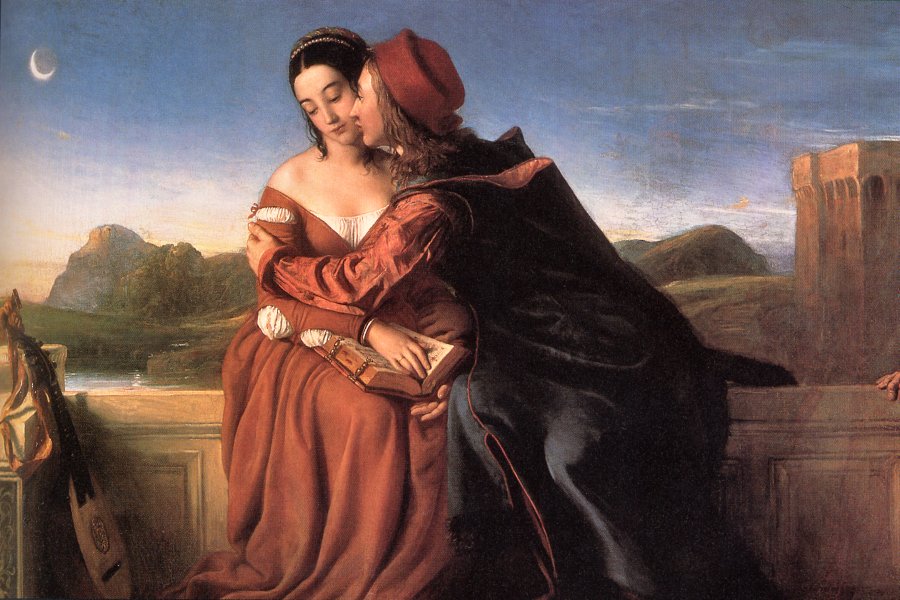
The fatal kiss of Francesco da Rimini and Paolo Malatesta, as portrayed by William Dyce in1837.
The world of Dante scholars is a small and close-knit one, and Rachel Jacoff is one of its leading luminaries. In this Entitled Opinions conversation, she discusses The Divine Comedy, and more particularly The Inferno, with her former student, our Entitled Opinions host Robert Pogue Harrison, himself a major Dante scholar. It’s over at the Los Angeles Review of Books here. (It’s part one of a three-part series – but don’t worry; each operates as a stand-alone interview.)
They begin with the setting of the Divine Comedy, and the spiritual, existential, biographical, and political crisis in which it is born. The epic poem takes place in the Jubilee year 1300, when the Florentine was 35 years old, at the midpoint of his life. He was in the middle of two prose works he couldn’t finish, Convivio and De Vulgari Eloquentia. Instead, he undertakes the major work for which he is most remembered, The Divine Comedy.
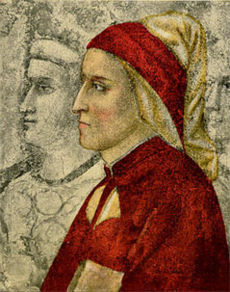
Da man.
Entitled Opinions host and guest discuss the great poem’s background, the spiritual crisis that gave birth to it, the mysterious role of Virgil as Dante’s guide, and the role of women in the drama (both as mediators to Dante’s spiritual climb, and as sexual sinners in the Inferno). And, inevitably, they discuss the renowned Canto V, with the adulterous lovers Francesca da Rimini and Paolo Malatesta. (More about the doomed couple from two other Stanford scholars, René Girard and John Freccero here.)
The discussion begins with the First Canto, and Harrison’s comments on the Florentine’s immortal opening to his Divine Comedy. Dante has hit an impasse, and the only way up is down:
“There’s always a before, and always an after, to the beginning. Every beginning starts in the middle of something. That’s what the ancients meant by in media res. For Dante, in medias res meant in the middle of a forest: ‘In the middle of our life’s way, I found myself in a dark wood, where the straight way was lost.’ What kind of middle of the way is this, where forward motion hits a dead end, where life’s vital energies come to a terrifying standstill, where every step you take could be your last step? This is the midpoint, a strange and uncanny place. It’s not the halfway point on a straight finite line. It’s not equidistant from beginning and the end. No, it’s a sentiero interrotti – a path without issue. It’s a place where all footing is lost, and where, if there’s to be any resumption of motion, it will have to be on a different footing altogether. That’s what it means to begin in the middle of the way. To find a new footing, and in so doing, to undergo a turn, a swerve, a clinamen, rather than continue on the same rectilinear course. The midpoint represents a turning point. … The only way up is down.”
Potent quotes:
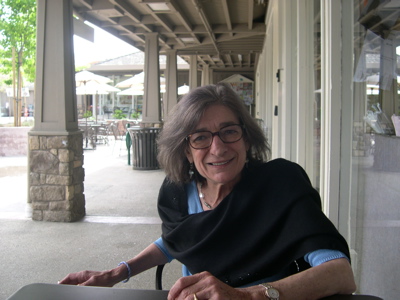
Jacoff @Stanford
Rachel Jacoff:
“If we only had only the first canto, we wouldn’t know anything about the political crisis, we wouldn’t know about the exile, we wouldn’t even know Dante was a Florentine. … The language is deliberately vague enough so that almost everyone can find their own mid-life crisis in this language.”
Rachel Jacoff:
“People have read this as a poem about depression, they have read it as a poem about many different things, because they’re able to connect with the sense of a dead-end.”
“It has collective epic community, but also lyric individuality. It becomes a first-person epic, which distinguishes it. There is an ambiguousness about its autobiographical nature … and yet it is generic. There is a way in which Dante has to be an everyman.”
“Reading Virgil might have given him the idea that maybe he was writing the wrong book. He shouldn’t be writing a philosophical book, he should be writing a poem – and a poem informed on many levels by The Aeneid, in particular, the journey to the other world.”
“It is a very Christian poem; Virgil is a pagan. This is a primary, extraordinary fact. Unlike other texts with visions of the journey to the other world, in which the guides are angels or saints, Dante chooses a poet, and perhaps the most important thing to Dante, a poet of Rome and of the Roman Empire.”
Go to the new Entitled Opinions channel at the Los Angeles Review of Books here.
Robert Harrison:
“In Dante’s age, there was no analysis or psychotherapy, no prozac. Help took a different form – the form of a literary ghost, the ghost of Virgil who comes on the scene.”
“Wouldn’t it also be fair to say that Dante was also chosen by Virgil? … He had been rereading Virgil’s Aeneid massively. Something changed in rereading of that poem about the founding of the Roman Empire. He landed in a dead-end as a result of reading Virgil, and so perhaps only Virgil could get him out.”
“Sometimes the living adopt their ancestors, but sometimes the dead have a way of adopting the living.”
“Dante was primarily a lyric poet before he wrote The Divine Comedy. Virgil perhaps provided a model for how he might go from being a lyric poet to writing a Christian epic.”
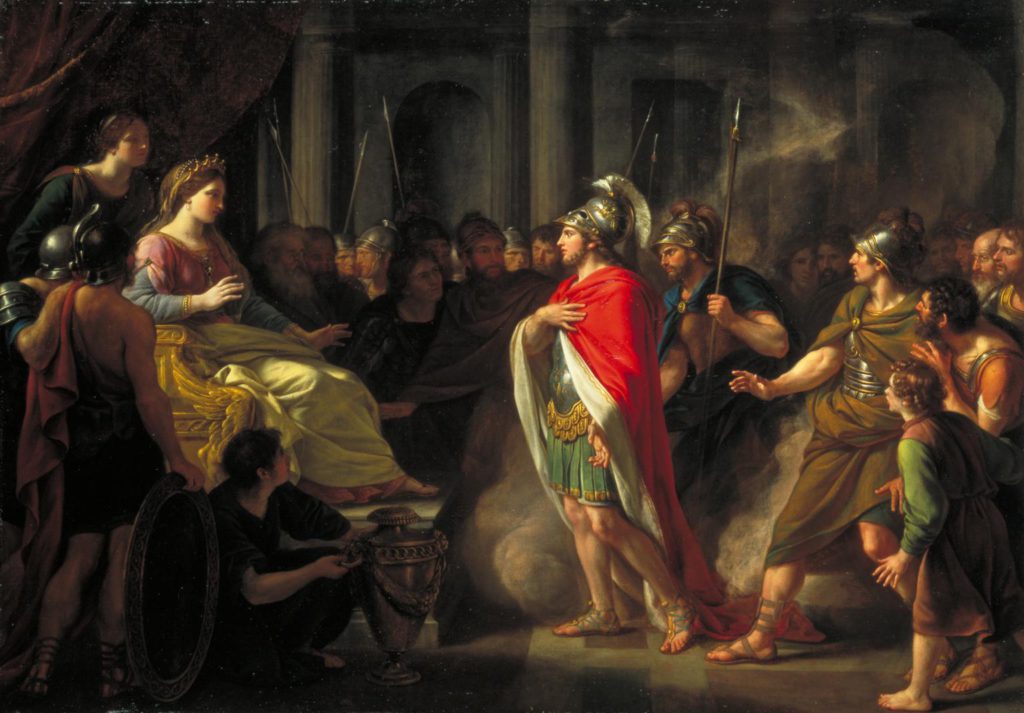
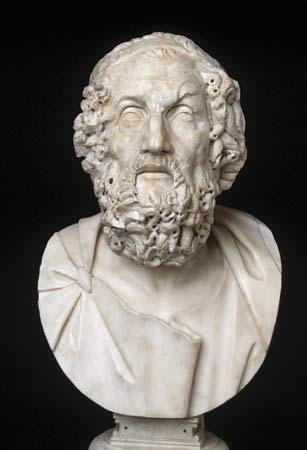
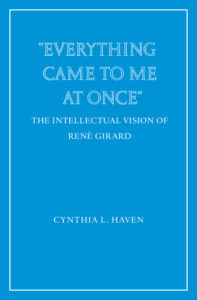 From the jacket:
 René Girard had reached the traditional midway point of life—35 years old—when he had a major course correction in his journey, rather like Dante. The event occurred as the young professor was finishing Deceit, Desire, and the Novel at Johns Hopkins University, the book that would establish his reputation as an innovative literary theorist. His first book was hardly the only attempt to study the nature of desire, but Girard was the first to insist that the desires we think of as autonomous and original, or that we think arise from a need in the world around us are borrowed from others; they are, in fact, “mimetic.” Dante’s “dark wood” is a state of spiritual confusion associated with the wild, dangerous forests. Three beasts block his path; the leopard, the lion, and the wolf represent disordered passions and desires. Dante’s conversion begins when he recognizes he cannot pass the beasts unharmed. Girard experienced his “dark wood” amidst his own study of the disordered desires that populate the modern novel. His conversion began as he traveled along the clattering old railway cars of the Pennsylvania Railroad, en route from Baltimore to Bryn Mawr for the class he taught every week. …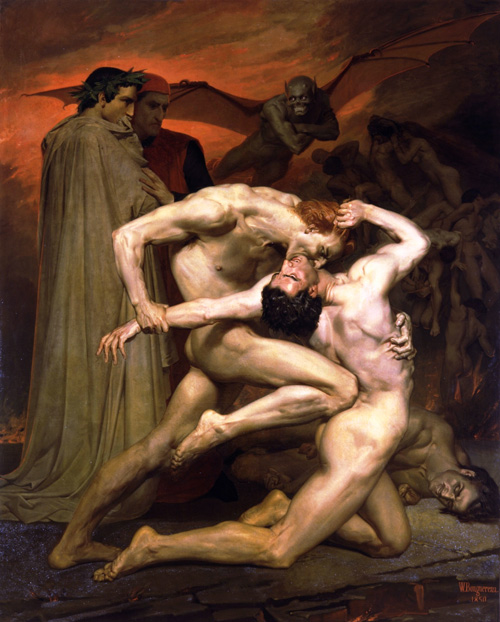
 The strange mystery surrounding Dante’s marriage is also seen from a genial and old-fashioned point of view. Boccaccio made Gemma, Dante’s wife, into one of the shrews about whom he liked to tell funny stories in the Decameron. So, when Dante was exiled, Boccaccio has her remaining in Florence, with the marriage effectively at an end. Santagata shows how Dante holds back, in the Commedia, from attacking Gemma’s family, the Donati, until Corso is dead. He does not directly place Corso Donati in Hell, leaving it for his brother Forese Donati, in the Purgatorio, to describe Corso’s grisly death. In Paradise, we find Corso and Forese’s sister Piccarda, who is given one of the best lines in the entire poem. So, while the poet was ruined by his wife’s family, Santagata thinks that Dante made every effort to be pardoned by the city of Florence and to be allowed back. Gemma, Santagata speculates, might well have later joined Dante in his exile. Perhaps one of the most moving Canzone might even have been addressed to her.