
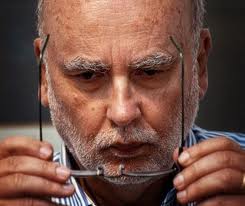
On Adam Zagajewski: “He followed his own path, and at times it seemed that he had been abandoned there, alone.”

Featured

Share
His poetry “exploding with light”

Tomasz Różycki and I met a decade ago, at a New York City party celebrating the publication of my An Invisible Rope: Portraits of Czesław Miłosz. He was an up-and-coming poet then, a new generation, and I was told he was someone to watch.

I had met Poland’s greatest living poet, Adam Zagajewski, during my first visit to Kraków in 2008; he became an important reason to return to that jewel-box city. But I didn’t know of the connection between the two poets until The Los Angeles Review of Books‘ quarterly review (that’s right, the LARB has a print edition) published this marvelous homage: “Dark Coat: On Adam Zagajewski,” remembering the poet’s life and work before his shocking and unexpected death on March 21. The artistic reason for the tribute: the younger poet writes that “poetry is, finally, a mourning of each death, of every vanishing, witness to the ‘fury of disappearance.'” In this case prose will serve the cause as well.

According to Tomasz Różycki: “He followed his own path, and at times it seemed that he had been abandoned there, alone.” In writing a retrospective, he has written the best introduction to Adam Zagajewski and his work I know. (The translation of the essay, by the way, is by the poet Mira Rosenthal, a former Stegner Fellow at Stanford.
)

A couple excerpts, the first one discussing Adam Zagajewski’s renowned poem, “To Go to Lvov”:

It was a very concrete and Polish kind of poetry, as much as Polish recollections of a lost Lwów can be — and, at the same time, it was detached from our cursed Polish problems. It was different, worldly, free. Not because the poems were detached from reality, as Polish critics often accused them of being, no — they were about reality itself, since our reality is twofold, if only because of the fact that it’s made up of the visible and the invisible and, in addition, to quote Hegel, it is threatened by the “fury of disappearance” and, therefore, only accessible to us within the blink of an eye. Moreover, poetry is the awareness of this vanishing, an elegy, a farewell to reality, a moment of mourning, necessary for us to be able to cope with the loss and to deal with the overabundance of memory. 

I’m writing this because some things only happen once in a lifetime; we can pass them over in silence, but sooner or later that silence will overwhelm and engulf us. We can try to be thankful for them, however ineptly, but that gratitude by its very nature will be less than the gift we received. It’s helpful to gain distance from something in order to describe it. It’s even better if the object of description has been frozen, though that’s not possible in this case, even with the help of such a fixative as death.


***

“I’m writing this because some things only happen once in a lifetime.”

His poetry seemed different from anything I had read before, especially from contemporary poetry, which was marked by some king of gloomy heaviness, some kind of dry, wooden palpitation of language. Within Adam’s poetry, there was breath, space; it was not cramped, but exploding with light. Within it, there was no confusion or great toil; it was exactly as he had written — “a search for radiance.” And it was a poetry of joy — the pure joy of being, of admiration for beauty and the world, of being a child in the world. Joy like the joy of swimming in the warm Mediterranean Sea. He understood and wrote about the fact that, in the same sea, refugees were drowning, just as he understood and wrote about the fact that Lwów, a city that he loved dearly, was the site of so much death just before his birth. “A poem grows on contradictions, but it can’t grow over them,” as he wrote in “Ode to Plurality.” His poetry did not absolve him of anything, but it took on what poetry has taken on from the beginning: a celebration of human existence, of human life. The world is sometimes difficult and unbearable, but it also deserves to be praised, life deserves our gratitude and good that is more powerful than evil. Czesław Miłosz adored how Adam’s poems were so “intoxicated with the world.” His poems are often ecstatic, orgasmic, starting with the concrete and transforming into a hymn — as in, among many others, the poem “Lava,” which could be seen as an attempt to answer Adorno’s famous assertion that writing poetry after Auschwitz is barbaric. So many poems tell of flashes of happiness — of those times, as Schopenhauer says, when “we are, for that moment, unburdened of the base press of the will, we celebrate the Sabbath of the workhouse of willing, the wheel of Ixion stands still,” and which Nietzsche described with the phrase “eternal return.” Adam’s poetry is slight and piercing at the same time, and when I read it, I get the sensation that the calendar has made some kind of mistake again and forgot to note the holiday that the poem announces.
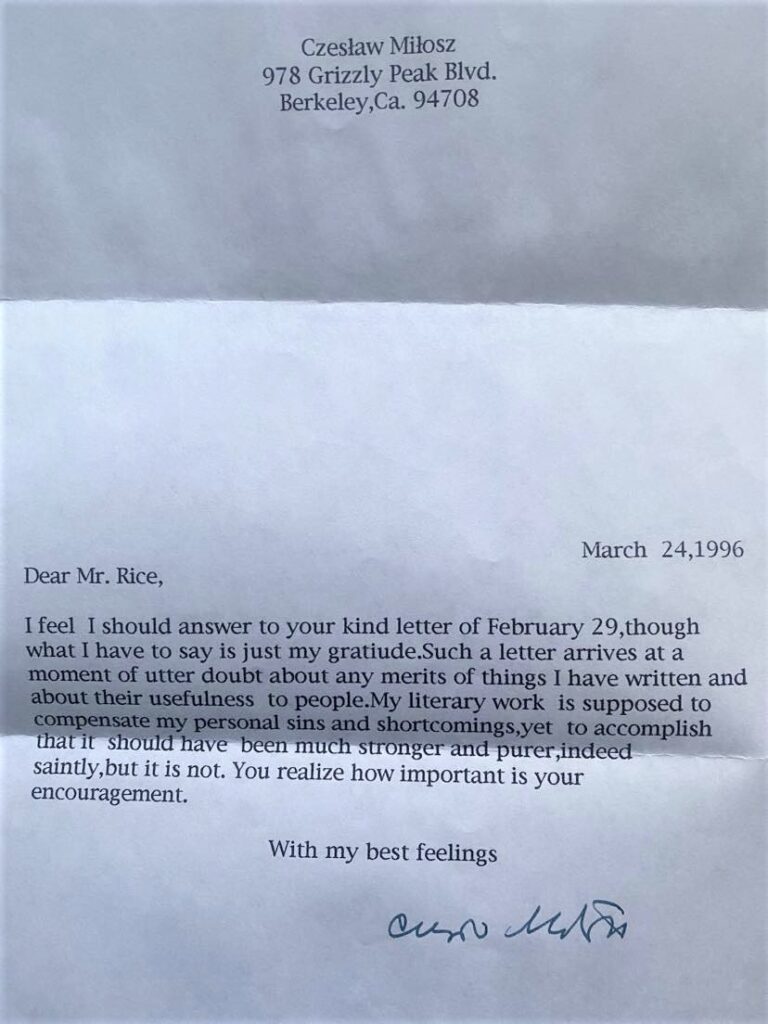
Nobelist Czesław Miłosz to a fan: “My literary work should have been stronger and purer.”

Featured

Share

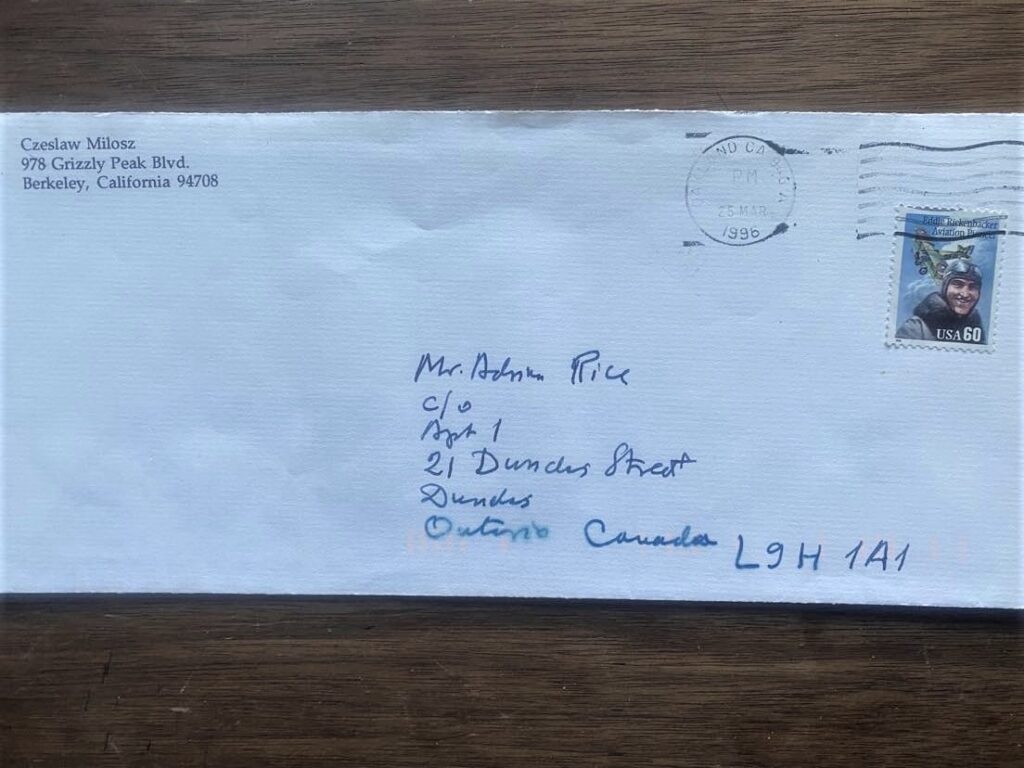
A stunning tweet today from Belfast-born poet Adrian Rice, who wrote: “Loving Cynthia Haven’s new book on Milosz, and it brought me back to one of my personal treasures, a letter from Milosz. Reading Haven’s remarkable new book about a remarkable poet, has restoked the Czeslaw fires within.”

And what a letter it is. Read below. Keep in mind that Czesław Miłosz had already won the Nobel Prize for Literature in 1980, sixteen years earlier.

Adrian Rice promised to tell me the story of how this letter came about, after he finished his classes. He has done so, via a Twitter message. Here it is:

The letter came about after I had bought his latest book – Facing The River – which had just been published at the time, in 1995. I was going through a stressful life-changing time, and I was living in Canada, Dundas, Ontario, thus the address on the envelope. I was feeling particularly down on that day, and headed out in the snow to a local bookshop, not expecting any treasures on the poetry shelves. However, I was surprised to see copies of new books by two poets who meant the world to me – Joseph Brodsky, and Czeslaw Milosz – Brodsky’s essays On Grief and Reason, and Milosz’s latest, Facing The River.

The Belfast poet who got the letter

I took them back to the apartment and was astounded by both, but particularly by Milosz’s book of poems, from that very first serious self-reflection in “At A Certain Age,” right on to the end of the book. The poems simply, somehow, “helped.” I was also working on a chapbook –Impediments – back then, and decided to use a few lines from his book as an epigraph. (I have made sure, ever since, to use a Milosz epigraph in all of my books.) But what really hit me was the ending poem, “In Szetejnie,” and especially those lines near the end of that poem: “If only my work were of use to people and of more weight than is / my evil.”

Working as a freelance poet/teacher back home in innumerable settings, I had used Milosz’s poetry and essays to challenge, and inspire, countless students and ordinary folk of all types of ages and backgrounds, right across the spectrum of Northern Irish/Irish society. And I had seen his work mean a lot. It had mattered, especially given our situation living and learning throughout the ongoing Ulster “Troubles.” So, not being given to any kind of “fan” mail, I nevertheless sat down determined to write Milosz’s publishers to tell them to pass on from me my admiration for his work, and to please make sure that he knew that his work was of great use, to me personally, and to those I shared it with back in Belfast and beyond.

I tried to express just how useful it was to so many folk he would never meet, but who had been changed and helped. Anyway, I sent the letter, and expected that would be the end of it. Imagine, as I know you can, my amazement to return to the apartment in the snow a few weeks later, and to see a letter sticking up out of the mailbox with his address on it. I actually thought it was a joke, that someone back home was playing a wee trick on me, but I knew that no one knew of the letter I had sent.

When I opened it inside the apartment, I was, well, staggered, in the nicest way possible; and have been, on and off, ever since. I only stayed about a year in Dundas, then returned to Belfast. In 1998, I believe it was, an Irish poet friend made me aware that Milosz was appearing at Galway University, and that I could “get in” if I could drive down from Belfast in a hurry. So, I jumped in the car, drove the big distance, and when I entered the auditorium, he had already started, and I walked in to hear him beginning “A Song on the End of the World.” I sat down and enjoyed every minute of the reading. A few questions were taken afterwards, and I think Robert Hass was on stage to help, and then a signing began on stage.

Now, I have mixed with great poets before, but even with Seamus Heaney (who gave me my first book blurb!) I was always shy about presenting too many books for signature, knowing how pressed they can be. But, I knew that this might be my only meeting with Milosz, and despite his advanced years, I was going to at least ask him to sign most of my (substantial!) collection. When I approached him, he smiled, and then kind of joked at the armful of books to sign, but set about it so graciously. I also dared to hand him my chapbook to sign under his epigraph I had used, and he looked at the book, read my name, and then looked at me saying – “Ah, you’re Adrian Rice.” I wasn’t going to mention my letter, but he did. What a man. I blushed, we exchanged a few more words, and off I went.

Well, that’s the story for you, Cynthia. Treasured moments. Goodness, we miss him, and the likes of Seamus today. But at least we have the example, and the words to keep us going. Again, so magical to connect with you today, and to know that you’ve seen the wee letter, and to have your new book, keeping him alive in our hearts and minds. Huge congrats. I’ll spread the good word of it to all I know, especially to my college students. Keep up the important work. Slainte! Adrian x

A Halloween poem from Czesław Miłosz

Featured

Share

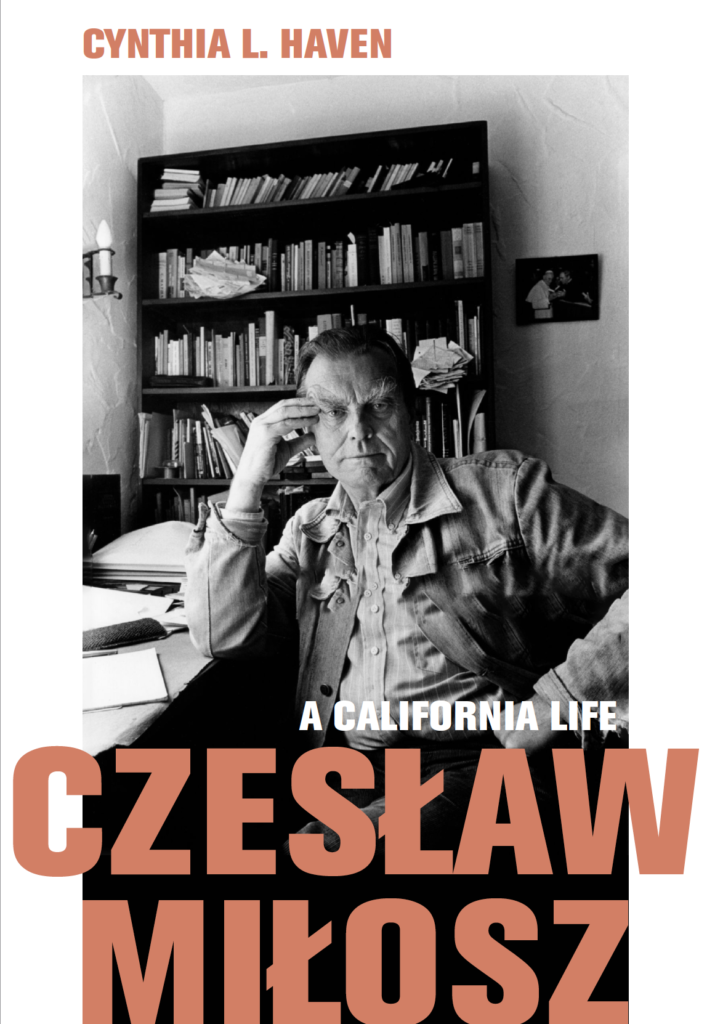
I’ve been on the road, giving talks for Czesław Miłosz: A California Life at the University of Chicago, San Francisco’s legendary City Lights Bookstore, and soon at the University of California, Berkeley. Now I’m camped out at Harvard for a few days. I’ll post links and photos soon.

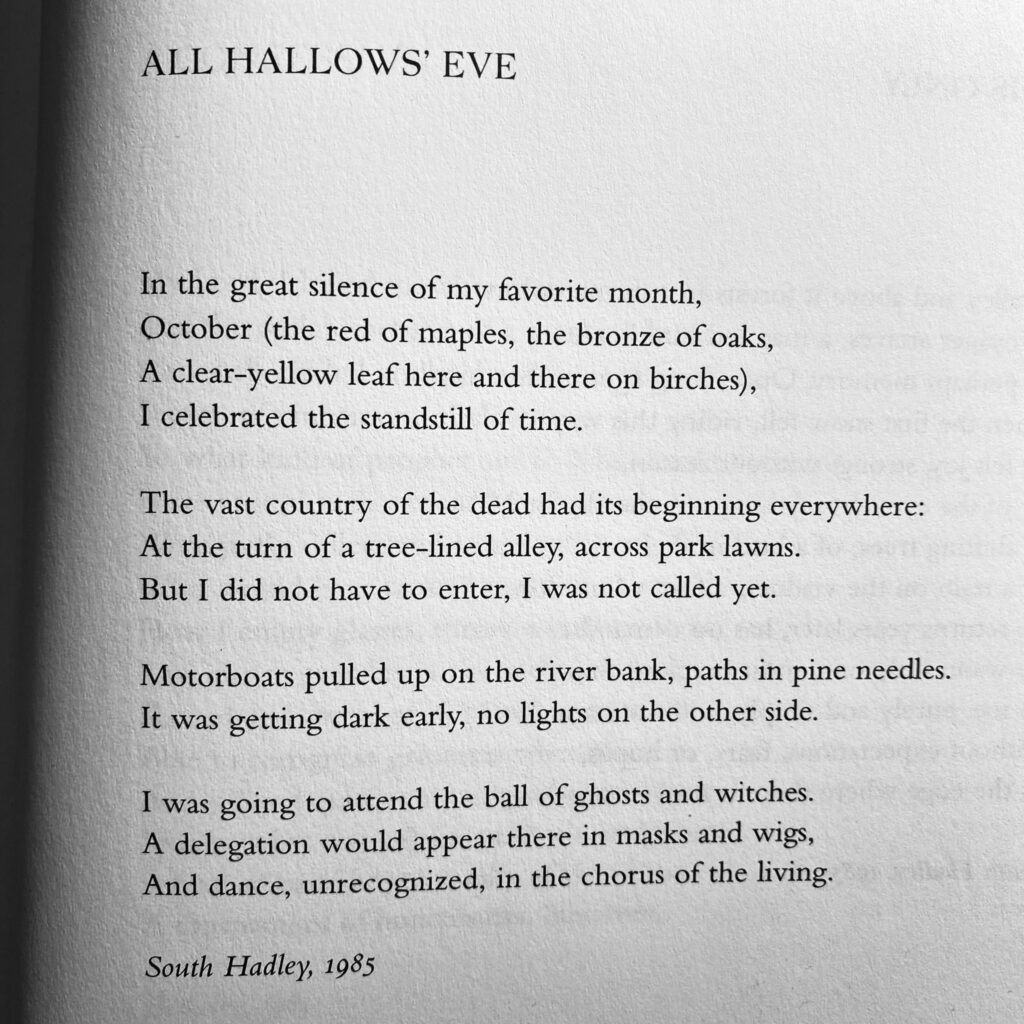
Meanwhile, here’s a timely poem from the subject of my book, Czesław Miłosz, which comes to me courtesy NEA fellow Jim May on Twitter. The poem written in South Hadley. No doubt the Polish poet was visiting his friend and fellow Nobelist Joseph Brodsky.

Postscript on 10/31 from Stanford Prof. Grisha Freidin: “Exile, multiplied by another poet’s exile, by the melancholy season, by the Styx-like river, with the other shore still shrouded in darkness… Note absence of self-pity. Quintessential Czesław.”

Ta-daa! “Czesław Miłosz: A California Life” is becoming a reality.

Featured

Share

Czesław Miłosz: A California Life (Heyday Books) will be out at last on October 19. And Miłosz’s life is a California life, despite the barred “l”s in the poet’s name that stumped so many Americans and marked him as part of “the other Europe,” the half-continent that had been behind the Iron Curtain for much of his life. Hence, his American byline became Milosz, not Miłosz. (Incidentally, the diacritical signifies, in Polish, that the “ł” is pronounced like a “w” … and Polish “w”s are pronounced like “v”s.)

The Nobel poet spent more time in California than any other place during his long 93-year life. He wrote poems about the California landscape, engaged with our culture, and taught generations of students at UC-Berkeley. Some of those students became eminent translators of his work.

The Golden State is truly a state of mind as well as a place, and I was intrigued by how he embraced the land and its people – psychologically, intellectually, and as a poet. I was interested in portraying the California that sinks into us, that we never fully understand, no matter how long we live here – not the media cliché that conceals it. And I wanted to tell the story of the man who had escaped from Stalinist Poland by a miracle, and discuss his great, and often unacknowledged, good fortune to land here among us, where the poet of what he called “an unheard-of tongue” could become a poet of world renown. In California, he could champion Polish poetry, bringing poets such as Zbigniew Herbert into English and publishing the landmark History of Polish Literature and Postwar Polish Poetry. After an initially rocky reception in the United States, he lived for decades on idyllic Grizzly Peak, a literary landmark for Poles today, though little known outside Berkeley.

California Magazine named one the top picks for the fall (see below). And the current Publishers Weekly has a great review: “’The irony is that the greatest Californian poet… could well be a Pole who wrote a single poem in English,’ suggests journalist Haven (Evolution of Desire) in this detailed biography of Czesław Miłosz (1911–2004). California was crucial to Miłosz’s life and work, Haven argues, and notes that the Polish poet had a complicated relationship with the U.S.: ‘He longed for America yet loathed it, too.’” 

It concludes: “Much has been written about the poet, and Haven finds new ways into his life […] her examinations of the influence of place on his poetry are insightful. Fans of Miłosz’s work should give this a look.”

As the Mamas and the Papas warbled, “California dreamin’ is becoming a reality.”

“How difficult it is to remain just one person”: a sculptor remembers poet Czesław Miłosz

Share
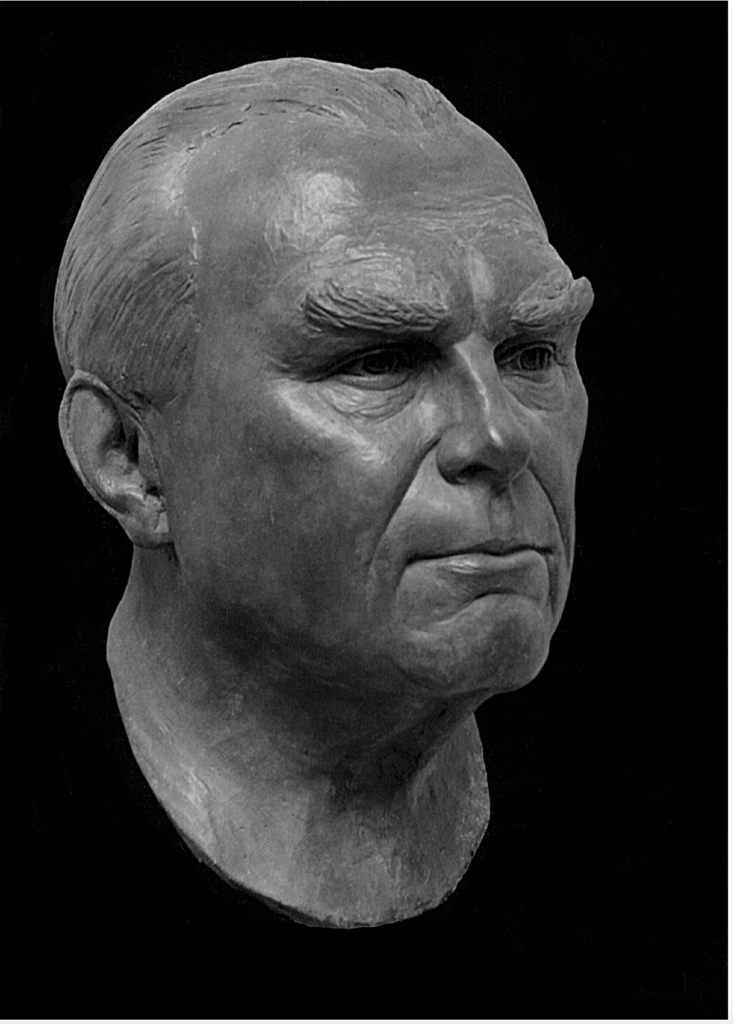
The Berkeley portrait, “the weight of the jaw, the extreme particularity of each feature.”

His large, wide face, with its strong planes, forceful jaw, and unforgettable brows, recalled a medieval wood carved saint.”

Nobel poet Czesław Miłosz had a magnificent visage, and it got even better as he aged. I haven’t seen many sculptures that quite capture it, and I don’t think many will – the opportunity died with him in 2004, and it’s not an art that can take place long distance, at least not entirely.  

Ironic that the image of the poet who wrote of the struggle against oblivion –  with oblivion having the upper hand – has himself disappeared. Or has he?  Jonathan E. Hirschfeld has taken on the struggle to keep that visage alive – in clay and word.

The sculptor, who divides his time between Paris and Venice, California, tells the story in Britain’s PN Review: “I have now read about many encounters with Miłosz and many descriptions of his manner. About his remoteness, his warmth, his humour, even his shyness, his impatience, his anger, his resilience, his complexity, his doubts, the force of his words, written when no words were thought possible, his presence. My goal was a synthesis, a kind of summing up, not any one moment, and certainly nothing that one pose could possibly contain.”

He decided to make the portrait of Miłosz after attending a UCLA reading  in 1982. “The room was packed and worshipful,”  he recalled. “I recall sensing the paradox of a soft melodious voice that could create a feeling of great closeness while preserving a palpable distance. I knew some of his poetry and a number of his essays and recognised the unmistakable rhythm of his language. Robert Hass, his principle collaborator and translator, has described his ‘fierce, hawkish, standoffish formality’. Even allowing for the animated eyes and mischievous smile, he seemed the incarnation of gravity and dignity. His large, wide face, with its strong planes, forceful jaw, and unforgettable brows, recalled a medieval wood carved saint.”

But would the poet cooperate with the sculptor? He did. Miłosz made time for hours and hours of sittings. And for many photographs, too, to help the sculptor when he was hours away, in southern California or France.

Hirschfeld remembers: “During my time with him I watched as intently as I could, scrutinising every detail, absorbing every shifting mood, reaching for something as unachievable, as metaphysically impossible, as the quest that he himself had defined as the poet’s relationship to reality. However, one must earn one’s discontent. One first must notice the weight of the jaw, the extreme particularity of each feature, the breadth and slope of the forehead, the curl of the lips and the swelling of the planes, the folds around the eyes, the quality of the hair, the telling asymmetries that convey the complexity of the emotions and intellect; one must travel again and again this unique terrain until in the mind’s eye, at night while the clay sleeps, one can feel the entire head as one complex mass, with a structure and a thrust, and tilt belonging to this person alone. When you have done that, you have earned the right to say that something is still missing.”

Still, something was still missing. He made the version above in Berkeley, but … he wanted to try again. They continued with a second portrait in Paris.

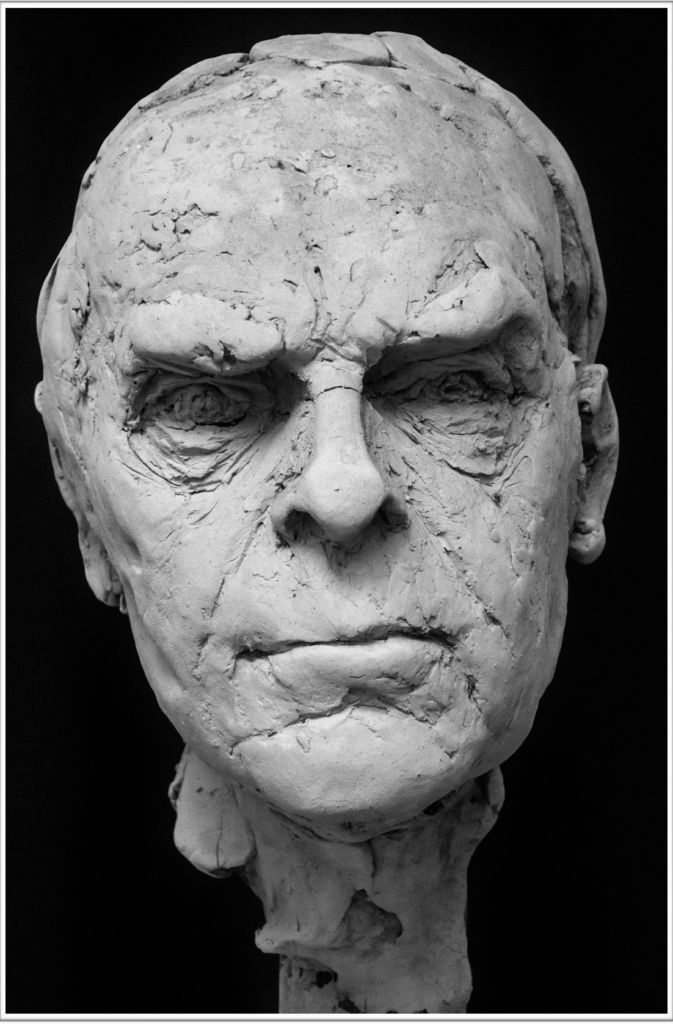
“The version of Miłosz I made in Paris was more than a sketch, and less than a finished work. It is filled with knotted intensity, rough, unfinished forms and the traces of accident. In ‘Ars Poetica’ (Bells In Winter) Miłosz wrote – ‘The purpose of poetry is to remind us how difficult it is to remain just one person, for our house is open, there are no keys in the doors, and invisible guests come in and out at will.’ – By his own account he was ‘neither noble nor simple’. He had cautioned an interviewer ‘Art is not a sufficient substitute for the problem of leading a moral life. I am afraid of wearing a cloak that is too big for me’ (Czesław Miłosz, 1994, Interviewed by Robert Faggen). I knew there was truth in the dry, raw clay of the second version, and it felt right that it should remain just this way.”

Read the whole thing in the PN Review here. (And stay tuned for some updates on my own forthcoming: Czesław Miłosz: A California Life.)

(Photos copyright Jonathan Hirschfeld.)

The Paris portrait: “knotted intensity, rough, unfinished forms and the traces of accident.”

Joseph Brodsky wrote an annual Christmas poem. Why did he do it?

Share

A Christmas card from the Brodsky Foundation features “Anno Domini” and Martin Schongauer.

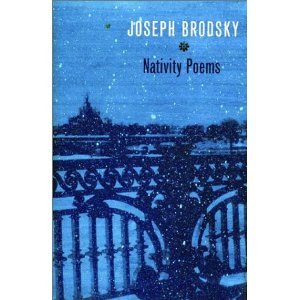
My favorite Christmas card this year has a poem on it. The Joseph Brodsky Foundation usually doesn’t disappoint – not even in the year of COVID, which has put a damper on the season, as well as on its Christmas cards. This year’s greeting features Martin Schongauer‘s 1475 engraving and the Nobel poet Joseph Brodsky‘s 1968 poem, “Anno Domini,” in the Russian. Can’t read Russian? You can read Daniel Weissbort‘s translation of the poem in The Iowa Review here. Or you could buy a copy of Brodsky’s Nativity Poemsa superb collection of eighteen of the poems he wrote annually, as a sort of birthday greeting. The collection is translated by a number of first-rate translators, including Richard Wilbur, Derek Walcott, and Seamus Heaney.

The Russian poet said the annual discipline pretty much began when he began to write poems seriously. He tried to write a poem for every Christmas – even though the Jewish poet called himself an atheist. “I liked that concentration of everything in one place – which is what you have in that cave scene,” he explained. But that’s not all of it, either. He once facetiously described himself “a Christian by correspondence.” I suspect he was only half joking.

Why did he do it? Here’s the way  himself explained it in an interview with Peter Vail, included in the book:

I’ll tell you how it all started. I wrote the first Nativity poems, I think, in Komarovo. I was living at a dacha, I don’t remember whose, though it might have been Academician [Aksel] Berg’s. And there I cut a picture out of a Polish magazine, I think it was Przekrój. The picture was Adoration of the Magi, I don’t remember by whom. I stuck it on the ceramic stove and often looked at it in the evenings. It burned later on, the painting, and the stove, and the dacha itself. But at the time I kept on looking and decided to write a poem on the same subject. That is, it all began not from religious feelings, or from Pasternak or Eliot, but from a painting.

His fellow Nobelist, the Polish poet Czesław Miłoszgave me his own explanation twenty years ago: “If we cannot return to the stable world of the past, at least we can have some respect for some stable points. Brodsky would write every Christmas a poem – on that event, on the birth of Jesus.  This is a sort of piety, I should say, for the past, for some crucial points in our history.”

“Anno Domino” returned me to Nativity Poems tonight, on Christmas Eve. As I recall, I return to this volume every Christmas … my own “stable point.” From Richard Wilbur’s translation of 25.XII.1993:

… For miracles, gravitating
to earth, know just where people will be waiting,
and eagerly will find the right address
and tenant, even in a wilderness.