

In the aftermath of the Google books decision: disappointment … and persistence

Share

No prophet

U.S. Circuit Judge Denny Chin‘s rejection of a deal between Google and book publishers happened while I was in New York City.  You can read about it here.  The federal judge in Manhattan said the deal, which would allow the search engine company share digitized copies,  “goes too far” and would give Google “a significant advantage over competitors, rewarding it for engaging in wholesale copying of copyrighted works without permission.”

It took a few weeks, but Andrew Herkovic at the Stanford University Libraries has issued his characteristically graceful comment on the Google brouhaha in his newsletter:

BooksIn the wake of last month’s judicial rejection of the proposed settlement of litigation between Google Books and various publishers and authors, there are only two firm facts that can be confidently stated about what’s next: first, nobody, with the possible exception of the litigants, knows anything; and second, the litigants aren’t talking. Thus we have the conditions for rampant public speculation, and many have risen to this temptation. I shall not.

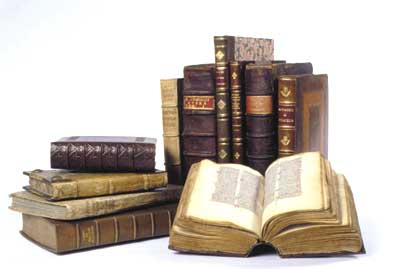
Instead, I remind readers that the scanning of millions of books by the Google Books project has never abated, either at Stanford or among the many other participating libraries. Every weekday, a truckload of books goes to Google and a like number come back from them, in a smoothly choreographed process that assures both safekeeping and tracking of the books. The total to date is in the vicinity of two million volumes, and we anticipate continuing this process for years to come. We do not know how or even if any given book will be used by Google, but we are certain of the utility to Stanford in having our holdings preserved and being made searchable through digitization. We are hopeful of additional beneficial outcomes for Stanford.

The key word in Stanford’s public reaction to the demise of the proposed settlement was “disappointment.” That, almost five years after the class-action suits were initiated against the project, there is no resolution whatever is certainly disappointing; any decision might seem preferable to none. That a startling vision of public access to a vast amount of text as articulated in the proposed settlement has been occluded is another disappointment. That the “orphan works” and other copyright issues remain in limbo is a lesser disappointment, if only because efforts are underway to address them by legislative rather than judicial means. However, the key word I wish you to take away is “persistence.” We persist in scanning books through Google (as well as in our own labs). We persist in developing techniques to help scholars use digitized texts. We may be confident that the litigants will persist in seeking some eventual resolution to the court case. We persist in hoping that the discordance between copyright law and the realities of the digital age will be harmonized, at least with regard to printed literatures, before the century is much further along. We persist in fulfilling a vision and mission that depend on both digital and artefactual means of providing and preserving information.

Looking forward, but unprophetically,

Andrew Herkovic
Clare in NYC

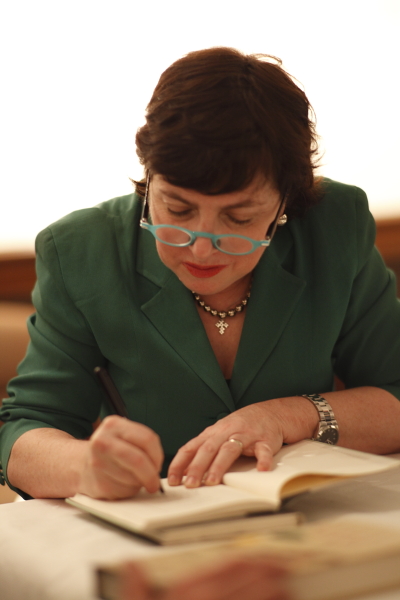
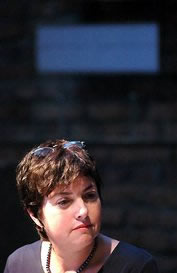
A couple of postscripts:  Speaking of New York, I’ve added a photograph of Clare Cavanagh at last month’s Czesław Miłosz centennary event at the 92nd Street Y – thanks to David A. Goldfarb and his camera.

And, after reading my piece on Kay Ryan‘s Pulitzer, Dave Lull kindly sent me yesterday a Wall Street Journal “Speakeasy” Q&A with Kay Ryan, in which she says:

I never, ever worry about poetry or its survival because it’s the very nature of a poem to be that language that does survive. Poems are even better than tweets – they don’t require any electronic equipment. They can lodge right in your brain. They are by nature short. You don’t even have to remember all of them — you can remember just a phrase. That can be something you can turn to in any emergency, good or bad. You’ll pluck out a little group of words, just maybe a phrase, and that’s exactly what poetry is for. It’s for the things that really last. Because it lasts.

“Like being alive twice”: Hass, Zagajewski, Cavanagh, and Hirsh on Czesław Miłosz — this time in Queens

Share

The crowds are unending

I’ve been to New York City four or five times in my life – but I’ve never been to Queens.  Somehow I didn’t expect the constant river of people to continue beyond the borders of Manhattan, but it did.  Getting on a Queens bus, I saw the line behind me grow steadily longer and longer, increasing rather than diminishing as people climbed onboard.  Finally, until the weary bus driver closed the doors on protesting people, still trying to get on.  That’s usual, he told me.  The line doesn’t end.

So that’s one reason why I was 45 minutes late to the discussion about Czesław Miłosz at Queens College on Tuesday night. Two days ago, I posted about same cast of charactersRobert Hass , Adam Zagajewski, Clare Cavanagh — let me do so again, with the addition of poet Ed Hirsch, MacArthur “genius” fellow, president of the John Simon Guggenheim Memorial Foundation.

Here are a few notes from the discussion (and apologies for not having time to polish these nuggets):

This time at Queens College

Adam Zagajewski discussed the Miłosz’s polyphony and his  “incredible ambition to grasp the world.”  The enormous range of points of view and voices within his work is disconcerting to many readers, who expect “one voice that’s recognizable in every poem,” the unity you find in such poets as Georg Trakl, for example.

Robert Hass recalled Miłosz writing at night, and thinking he had at last captured reality with his words – only to wake up the next morning, reread what he had written, and see he had been “beaten back into the pen of literature.” “He was tormented by the way our experience is lost to us,” said Bob.  “He found time itself unbearable.”

In praise of polyphony

Ed Hirsch commented on the “tremendous internal argument in his work” – in which he would often “criticize the poet who wrote the last poem.” Miłosz’s polyphony is one reason “so many readers and critics latched onto the idea of witness” in his poems.  His reputation as “poet of witness” to two totalitarian regimes has obscured his reputation as a metaphysical poet and a poet of … well, a poet of wonder, really.

The discussion turned to Miłosz’s unfortunate early reputation in the U.S. as a political theorist, thanks to Captive Mind. It’s a book not as well thumbed today as it was a few decades earlier, but Clare Cavanagh pointed out its unusual legacy – for example, in giving us the term ketman, which Miłosz claimed to have rescued from Persia.  Clare, however, searched assiduously on the internet for its supposed Islamic origins and could only find references to Miłosz’s work.  (I have a different memory of finding a few of the references she was seeking – but I’ll have to check again.  The references may be lost in the cyperspace flotsam and jetsam – as endless as the bus lines of Queens.)

Ed called Captive Mind “a remarkable work of historical consciousness.”

“For us, it’s crucial because he anatomizes how people fell into it,”  he said. However, its relevance  for younger readers may not be evident — “one of the problems is that you have to understand what communism is.”  One of history’s terrible lessons that may be lost on a younger generation.

"Like being alive twice"

Bob hailed Captive Mind as “an enormously vivid and readable book … powerful and still relevant.” Young people today caught instead in the “foment of small imperialisms” – but so were the Persians who originated the term ketman, I would argue, and a small tyranny can be as oppressive and barbarous as a large one.

The four writers recalled the arc of his career.

The decades in America prior to the 1980 Nobel were years of excruciating loneliness. Adam recalled that when he turned sixty, Miłosz didn’t receive a single card or greeting.  Bob was told by two people that he used to write letters to himself, so that he would get mail.

Yet, said Bob, when he joined the Berkeley faculty, Miłosz immediately used his funds to hire a secretary and dictated The History of Polish Literature — a work that began to put Polish poetry on the map of American consciousness.

A rebuke instead of blessing

Adam recalled, in his youth, being one of a group of young poets who wrote to the maestro for a blessing.  Instead, they got a rebuke.  He told them they were behaving like “flies in a battle” and urged them towards distance and restraint. “He became a metaphysical poet, but I think he was a little jealous of those lesser poets who touched their own city.”  In other words, he envied those poets whose daily reality included the places where they grew up, who did not partially live in demolished worlds.

During the question period from the large crowd, Ed was asked what poem of Miłosz’s did he wish he himself had written.  “That’s a puzzle,” Ed hedged, then came up with two: “Bypassing Rue Descartes” and “Guilt.”

Bob Hass was asked what it was like spending so many years translating Miłosz.  He responded in an instant: “Like being alive twice.”

Next installment from NYC:  Ed Hirsch, Alyssa Valles, and Adam Zagajewski honor Zbigniew Herbert at Poets House.

“Too big to be swallowed”: Robert Hass, Adam Zagajewski, Clare Cavanagh remember Czesław Miłosz

Share

Clare signs books after the event (Photo: David A. Goldfarb)

The apocalyptic scene enveloping Japan brings to mind Czesław Miłosz‘s poem, “A Song on the End of the World,” written in Warsaw, 1944, during another kind of apocalypse.  The poem ends with a white-haired old man binding his tomatoes, who would be a prophet but is “too busy to be a prophet,” repeating:

No other end of the world will there be.

Sound wrong?  According to translator Clare Cavanagh, speaking at the 92nd Street Y on Monday night, it’s a new kind of right.  The line is usually translated “There will be no other end of the world.”  But the original Polish has an inversion that doesn’t always work well in English.  Antoni Miłosz has translated the poem, keeping the original inversion.  I kinda like it — the poem ends with a dactylic chant.

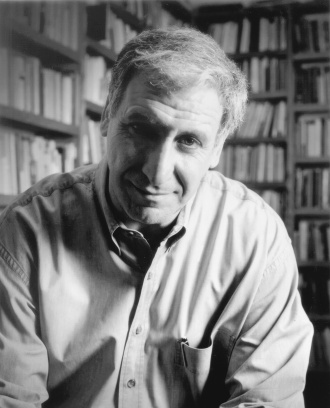
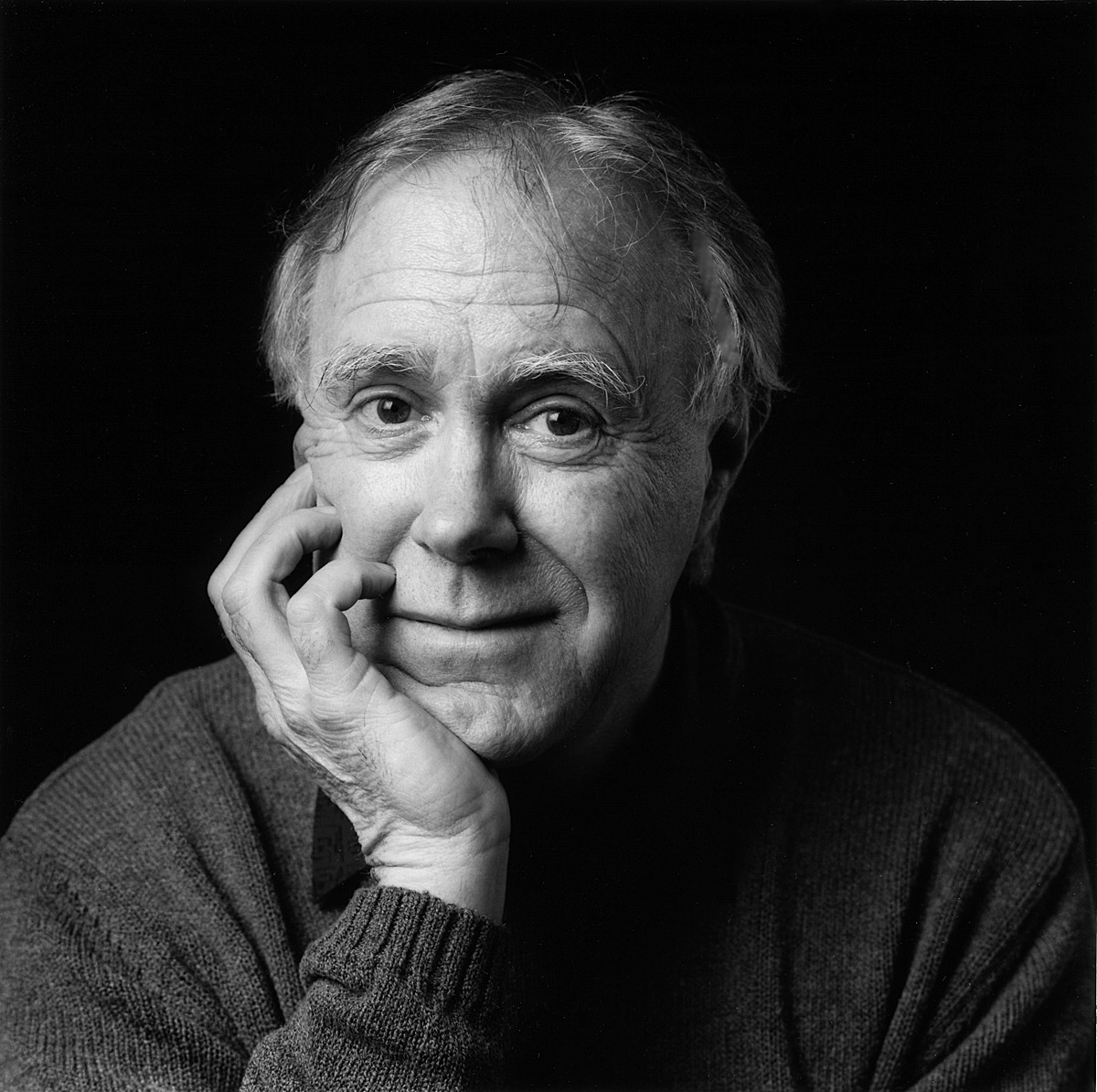
Clare was one of three heavy-hitters speaking about Miłosz that night and reading his poems – Robert Hass and Adam Zagajewski were the others.

Clare pointed out that, although Miłosz celebrates the rural Lithuania childhood, it is at least part an invented one.  In fact, his father was a civil engineer working in Russia, and the six-year-old experienced the Russian Revolution firsthand and traveled widely.  Movement was as much a characteristic of his upbringing as the stability he mythologized.

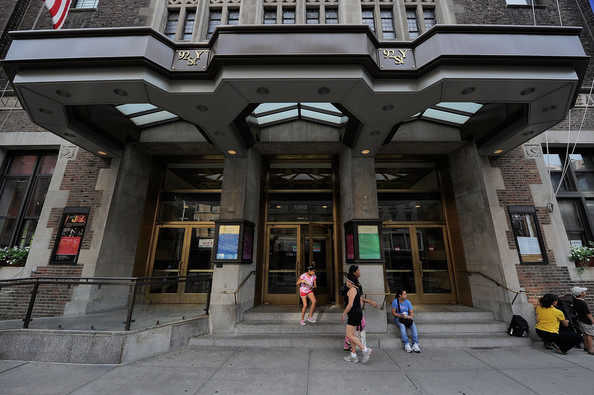
The venue: 92nd Street Y

She recalled the long theological discussions that I mentioned in my post several days ago.  She wouldn’t describe them in the essay she wrote for An Invisible Rope – and she wouldn’t describe them Monday night either.  I hope her silence on this subject is not permanent. “I’m not going to repeat what he said,” she finished, “but I keep wondering what he knows now.”

Bob Hass, wearing a heavy bandage on his nose, told the audience he hadn’t been in a fight, but advised his listeners to wear sunscreen.  He recalled a poet “tormented by how inexpressible experience was.”

"Please wear sunscreen"

Bob quoted Milosz, “War is only nature speeded up.”

The Berkeley prof recalled approaching Miłosz to discuss an anti-nuclear movement on campus, only to be told,  “I am against anti-nukes.”

“Blue hair?  Why does no one protest blue hair?” the elder poet responded. Beautiful young women become old ones with blue hair (note to young ‘uns: blue-tinted rinse was a common for elderly women in the 20th century).  “Who protests?”

“The true enemy of man is generalization,” Hass recalled Milosz saying.  His response to generalization was memory, said Clare. Miłosz’s memory was “beyond human – except that it’s most perfectly human, the way memory ought to be – how it should be in heaven.”

Hass recalled traveling in rural California, and on a whim going into an old secondhand shop – or rather, he said, it was as if he were drawn to it.  He found a thick book, in Polish, on the history of women’s underwear.  He plopped the $40 for the book and gave it to Milosz.

“I do not know that I have ever seen him so happy,” he said.  Suddenly, he could identify the underclothes he had seen on his aunt’s clothesline during his childhood.

"to glorify things as they are"

Adam Zagajewski spoke last – the perils of having a name that begins with “Z,” he said.

He noted Miłosz’s many contradictions.  He was drawn to the notion of “secret knowledge,” Adam said. “He craved initiation and looked for gurus” — for example, Miłosz’s influential kinsman Oskar Milosz and the man called “Tiger” in Native Realm. At the same time, he had “a longing for ignorance and innocence,” said Adam – which accounts for his attraction to William Blake, in part.

Ivan Turgenev said that poets are either rivers, absorbing everything in their current, or mountains, overlooking the world from an elevated plane of existence.  According to Adam, Miłosz decided he wanted to be “like a river and a mountain.”  The result?  A poet “too big to be swallowed,” he said.

Though Miłosz “loathed propaganda poetry,” Adam said he walked “the narrow road between pure poetry and poetry engagée, which he thought a mistake.”

In his restless questioning of existence, Miłosz took on God — “God being the strongest enemy that was,” said Adam, and objected to Blaise Pascal’s wager, which Adam said, “was like a shopkeeper saying it’s better to save some money because times can be hard.”

Adam concluded, “This is his religious vocation – to glorify things as they are.” And in this mission he was truly omnivorous. His poetic hubris – wanting to understand everything, wanting to experience everything – has caused his eclipse in current Poland.  Will his reputation wax again?

“I don’t worry.  I am totally convinced he will return.  He will have the last word.  Not I.” (Adam’s “Z” notwithstanding.)

Meet you in Manhattan!

Share

I’m off!  Or at least I will be in a few hours.

I’m on my way to a week of gigs honoring the Czesław Miłosz centenary in New York City — with a side order for Zbigniew Herbert.  I posted about them a while back here.

Come up and say hello if you see me — otherwise, prepare for a few logistical delays, but I expect to be posting about Clare Cavanagh, Robert Hass, Edward Hirsch, Adam Zagajewski, Anna Frajlich, Bogdana Carpenter, James Marcus, and many others in the coming days.

See you there!

Getting personal: NBCC’s quiet winner Clare Cavanagh

Share

“Poetry makes nothing happen,” W.H. Auden famously observed.

That doesn’t mean it doesn’t try.

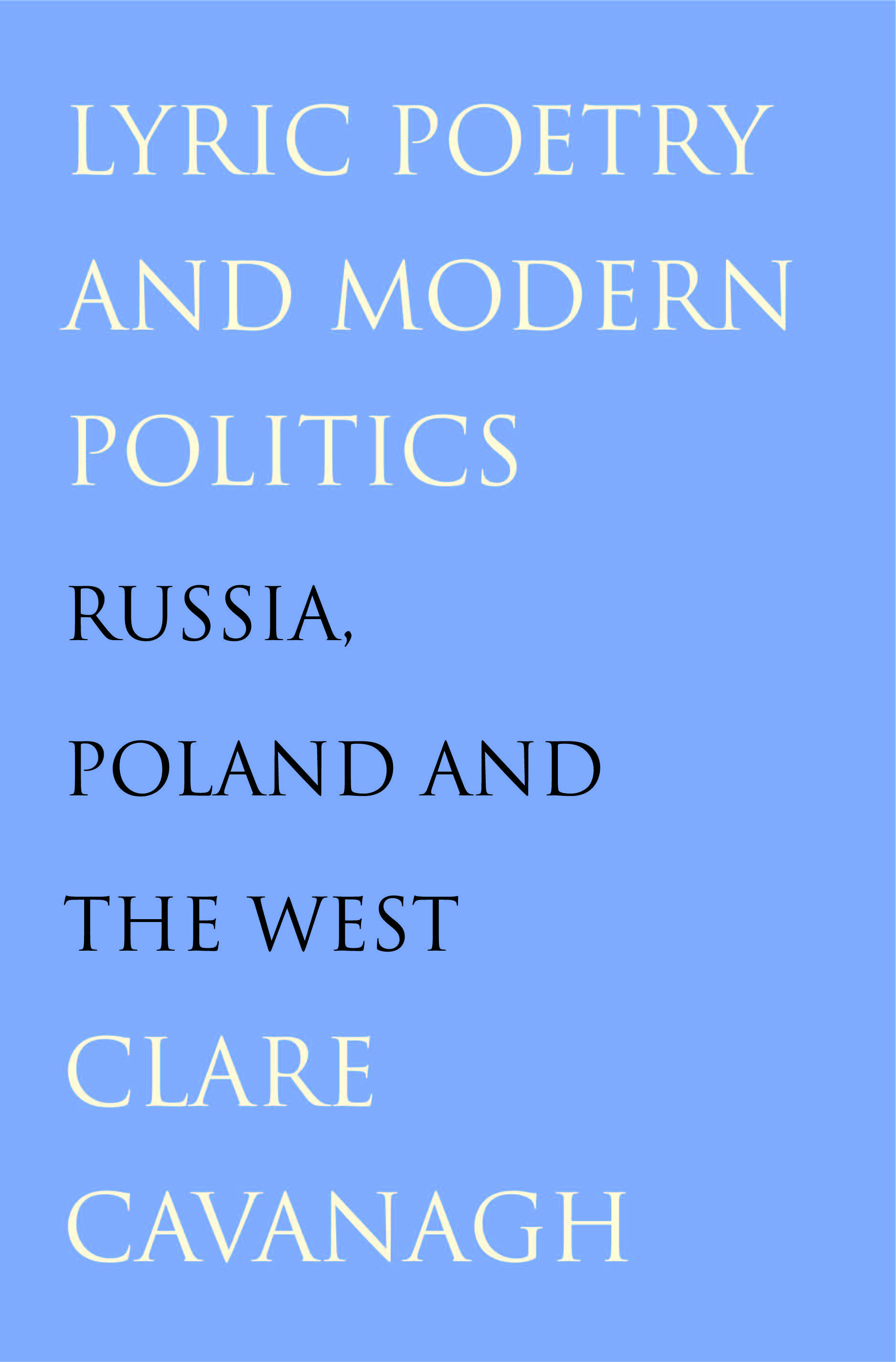
One of the more unnoticed of this year’s National Book Critics Circle award-winners is Clare Cavanagh‘s Lyric Poetry and Modern Politics: Russia, Poland, and the West. Clare takes on the notion of poets as “unacknowledged legislators” (Percy Bysshe Shelley) and “the would-be prophet, who publicly takes his people’s suffering upon himself so that his oppressed, applauding nation might be free.”

The secret police may be the true unacknowledged legislators, but it takes the secret police both to make and to break a nation’s acknowledged, if unauthorized poet-prophets.  … Tyrants make the rules, not poets, and dictators’ deeds change worlds far more often than artists’ words do.  Poetic legislation has its limits: “No lyric has ever stopped a tank,” [Seamus] Heaney remarks. Indeed, by the mid-eighties … [Adam] Zagajewski had challenged his compatriots preoccupation with poetry as a form of collective resistance. He chose to “dissent from dissent,” to break ranks with would-be artist-legislators by setting his lyric “I” against the defiant “we” that had shaped his poetic generation. The “unacknowledged legislator’s dream” has a nasty habit of becoming the acknowledged prophet’s nightmare, as Zagajewski suggests in his programmatically unprogrammatic Solidarity, Solitude.

biographer ...

Of course, being immersed in Polish literature, I’ve known Clare by name for years before I met her in person.

And were it not for Ewa Domanska, I still might not have met her.  Ewa, who teaches at Stanford every spring and then returns to Poznań, gave me a heads-up about a “Workshop in Poetics” on May 27, 2008, led by Clare.  Of course I dropped by.

Clare was a surprise.  Given her heavyweight credentials (she is, among other things, Milosz’s official biographer), I expected someone intimidating.

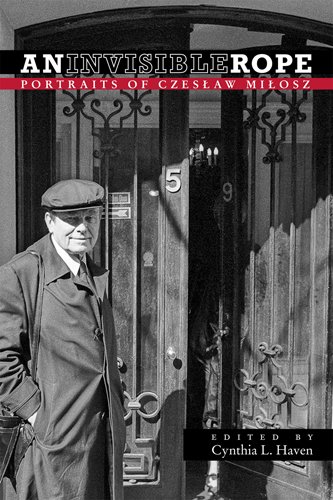
She is not.  This daughter of Eire is affable and down-to-earth.  I should have expected as much from her chapter, “Job and Forrest Gump,” in An Invisible Rope: Portraits of Czesław Miłosz, describing the period after Carol Miłosz ’s death, including a few travails in her own role as biographer:

The visiting got more difficult. I knew he had black moods when Carol was alive, but Carol was famous among his friends for driving them away. But I really saw the doubts, the moods, and the black sides—he could give Jehovah a run for the money when it came to striking terror—only after Carol died. Sometimes it would be yet another younger poet attacking him; “He called me ‘Moscow’s dancing bear,’” I remember Miłosz saying bleakly about one young writer. The attacks came on a fairly regular basis, and he took them all to heart. I suppose this was the reverse side of the childlike joy at every compliment. I once gave a Kraków cabdriver Miłosz’s street address—I never mentioned his name—and he recognized it right away. “Are you going to visit Czesław Miłosz? Please give him the best regards of the cabdriver in the red Mercedes,” he asked requested. Miłosz beamed.

...subject

Sometimes the doubts ran deeper—his life, his poetry, his soul. And sometimes the doubts were about me: “You will produce not my life, but only some facsimile,” he said with a scowled in the summer of 2003. He spent several weeks that summer putting me through the biographer’s equivalent of boot camp. I’d come armed daily with the best questions I could muster, written with the help of a small army of poets, professors, and Miłosz specialists. And every day he gave the same response: “Takie oszywiste pytania,” “(Such obvious questions).” Then he’d would invite me for another session the next day, when yet another set of questions would be dismissed and after an excruciating hour or two, I’d would be sent home to think up some “questions no one’s asked me yet.” Questions no one has ever asked Miłosz. It was like Rumpelstiltskin in Polish, but worse.

Finally, after a sleepless night spent reading and rereading Druga przestrzeń (the then-untranslated Second Space), I went in and asked about the poems, and about religion. Those were the questions he wanted. And that was what I’d wanted to talk about, too, but I’d thought biographers were supposed to do something different. We talked about “Father Seweryn” and “The Treatise on Theology”—I said I’d been surprised by the Virgin at the end, and he laughed and said, “I was, too.”

The next morning, Clare and I chatted and gossiped at Starbucks, at the impossible and dangerous intersection of Stanford and El Camino, before she returned to the Northwestern University.

I don’t remember much of what she said during that seminar (I have notes somewhere), but she read Miłosz ’s canonical “Dedication,” which opens:

You whom I could not save
Listen to me.
Try to understand this simple speech as I would be ashamed of another.
I swear, there is in me no wizardry of words.
I speak to you with silence like a cloud or a tree.  …

As she does in her new book, she pointed out that something obvious that slipped away in the English translation:  The first word, in Polish, is singular, not plural.  Read that way, this is not the declamatory, rhetorical address to nations and peoples.  It is personal, not something to be read over a public address system. He’s speaking urgently to a particular person who perished, in a plea that ends:

They used to pour millet on graves or poppy seeds
To feed the dead who would come disguised as birds.
I put this book here for you, who once lived
So that you should visit us no more.

Join me in NYC for the Czesław Miłosz Centenary!

Share

There’s a swirl of events March 21-28 honoring the Czesław Miłosz centenary in New York City (and one event for Zbigniew Herbert).  Join me in celebrating, if you’re in town!  It’s certainly a rare event for me — at least a decade since I’ve been in New York at all, sedentary little West Coaster that I am.

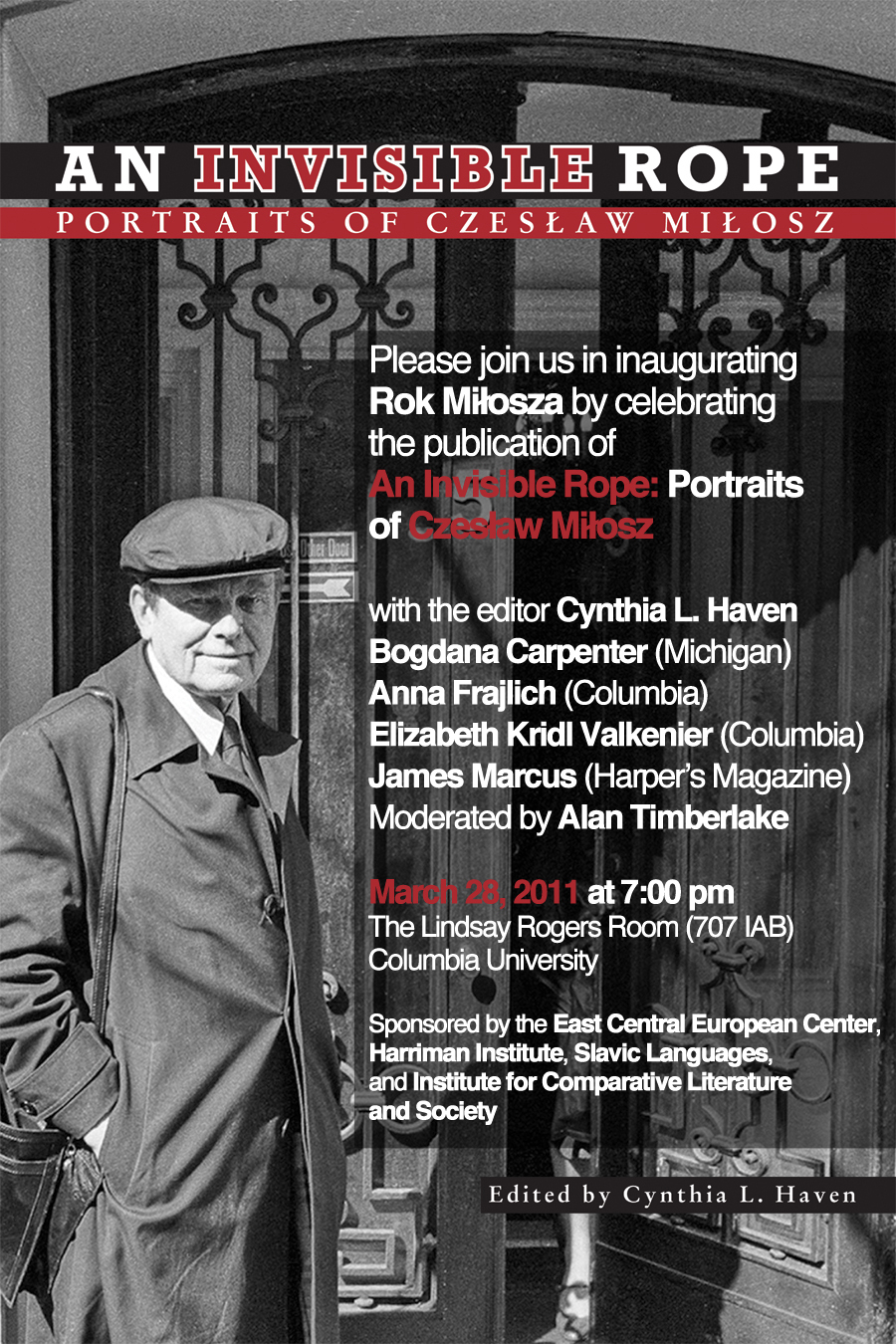
I will be speaking at Columbia University (see poster at right) on the 28th and at the Brooklyn Central Library on the 27th.

Ann Kjellberg at Little Star has blogged about some of the other events here.

They include:

March 21 — 8 p.m., Kaufman Concert Hall, 92 Street Y: “A Celebration of Czesław Miłosz with Robert Hass, Adam Zagajewski and Clare Cavanagh

March 22 — 7 p.m., Music Building, Queens College: “A Centennial Celebration of the Work of Czesław Miłosz” — Clare Cavanagh, Robert Hass, Edward Hirsch, Adam Zagajewski

March 24 — 7 p.m., Poets House: “A Poet’s Prose: The Poetic Vision of Zbigniew Herbert,” Edward Hirsch, Charles Simic, Alissa Valles, Adam Zagajewski

March 27 — 1.30 p.m., Brooklyn Central Library, “An Invisible Rope: Portraits of Czesław Miłosz,” Cynthia Haven, Adam Zagajewski, Anna Frajlich, Elizabeth Valkenier and Zygmunt Malinowski

March 28 — 7 p.m., The Lindsay Rogers Room, Columbia University, “An Invisible Rope: Portraits of Czesław Miłosz,” Cynthia Haven, Anna Frajlich, Elizabeth Valkenier, Bogdana Carpenter, James Marcus, and Alan Timberlake