
Guest contributor Elena Danielson, emerita director of the Hoover Library & Archives, writes about a soon-to-be Russian classic.
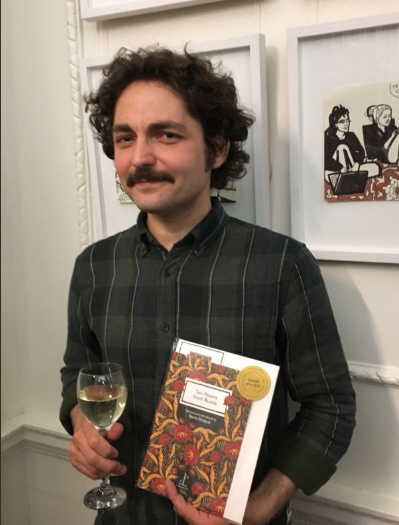
Ukrainian-American poet, editor, writer, and translator Boris Dralyuk (at right) has rescued an obscure masterpiece. Maybe this poem could have been considered a quaint relic of the chaotic Russian emigre experience with educated and once- prosperous, now despairing, people reduced to odd jobs like driving taxis and working as movie extras in a foreign country. But the poem Dralyuk has resurrected, at this crucial moment, has an unexpected immediacy as well as unexpected charm. (Those two qualities rarely happen together these days…)
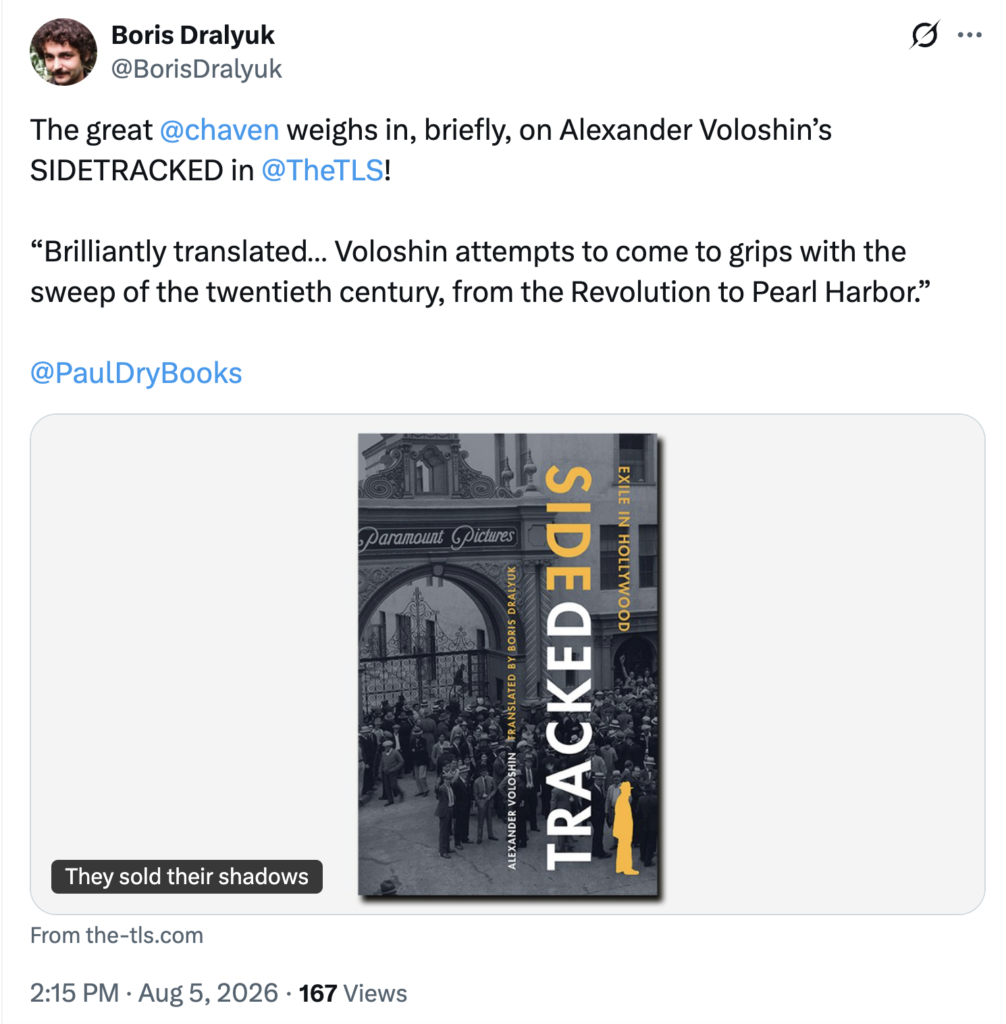
Sidetracked is the titular poem of a 1953 collection that is difficult to find even in the original Russian. Dralyuk’s introduction and notes are crucial to understanding and appreciating the text and context, but his translation makes it a simple joy to read.
As an emigre author, Alexander Voloshin, shared the dual identity experienced by many Ukrainians. Ukrainians that I worked with in the Hoover Archives at Stanford explained that Russian was the language of school, business, and government. The closely related Ukrainian language was spoken almost as a private code at home, with friends and relatives. Ukrainian identity was submerged but never purged. Some of my reading provided a bit of background: Anne Applebaum‘s book Famine, explains the extreme and deadly lengths that the central Soviet government went to in order to crush Ukrainian independence in the 1930s, and Teffi’s memoirs sketch a territory briefly under the control of the Ukrainian separatist Skoropadsky even earlier, during the 1920s. Voloshin was a brilliant writer in classic Russian, and also a Ukrainian proud of his cultural heritage.
Elena Danielson:

After his experiences in the Russian Civil War and the failed efforts for Ukrainian independence during that early period, Voloshin has few illusions. But he did survive, barely, working unpredictable, odd jobs as an extra in Hollywood movies:
“Reader its time you understood:
There’s no free lunch in Hollywood.”
He survived the revolution and civil war, found a perch in Los Angeles, but then news from Europe in the 1930s brought back old fears. And these once esoteric footnotes that I savored as a history nerd, suddenly have an immediate relevance, here and now:
“here – laws are trampled and some crazed
loony takes on the World entire
War, with its bloody wind and fire,
again has set the globe aglow.”
But Voloshin also has a message from his experience that is positive in its own Slavic way:
“War a raging hurricane…
The Whole world has gone insane…
Yet faith smolders in our souls
like a mound of stubborn coals.”
As these brief quotes suggest: the translation is sparkling and brilliant even when dealing with tragedy. There is a chapter on translation in Alberto Manguel’s “History of Reading” that suggests that – while most of the time sense and beauty are ‘lost in translation,’ – there are instances when the translation has its own merits beyond the original. I don’t know the original Russian text of Sidetracked, and my Russian wouldn’t be sufficient even if I tracked it down, but Dralyuk’s translation is simply brilliant. It sparkles. Native Russian speakers do have an appreciation for rhyme – much easier in Slavic languages than in English. But it is instructive that sometimes a Russian can master English better than the “natives.” Darlyuk’s rhyme schemes are highly colloquial, unexpected, and unexpectedly bright. Occasionally I have noticed the same effect when Joseph Brodsky wrote in English. Dralyuk’s English is better than Brodsky’s, but there are also a few times when, like with Brodsky’s English, the text sounds slightly better read with a Russian accent, like when he rhymes “rejoice” with “toys.” In any case I recommend reading Sidetracked, and best to find a quiet spot where you can read it out loud, the way poetry is meant to be.
You can read the full Times Literary Supplement review of the book on the link below:
https://www.the-tls.com/regular-features/in-brief/sidetracked-alexander-voloshin-book-review-cynthia-haven
And there’s more from the Kirk Center here:
https://kirkcenter.org/reviews/a-forgotten-russian-immigrant-poet-in-hollywood/
- Originally published by Elena Danielson on Goodreads.