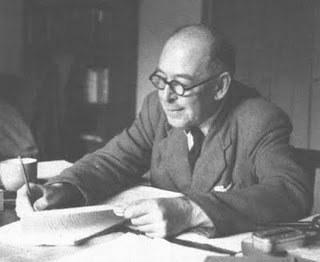
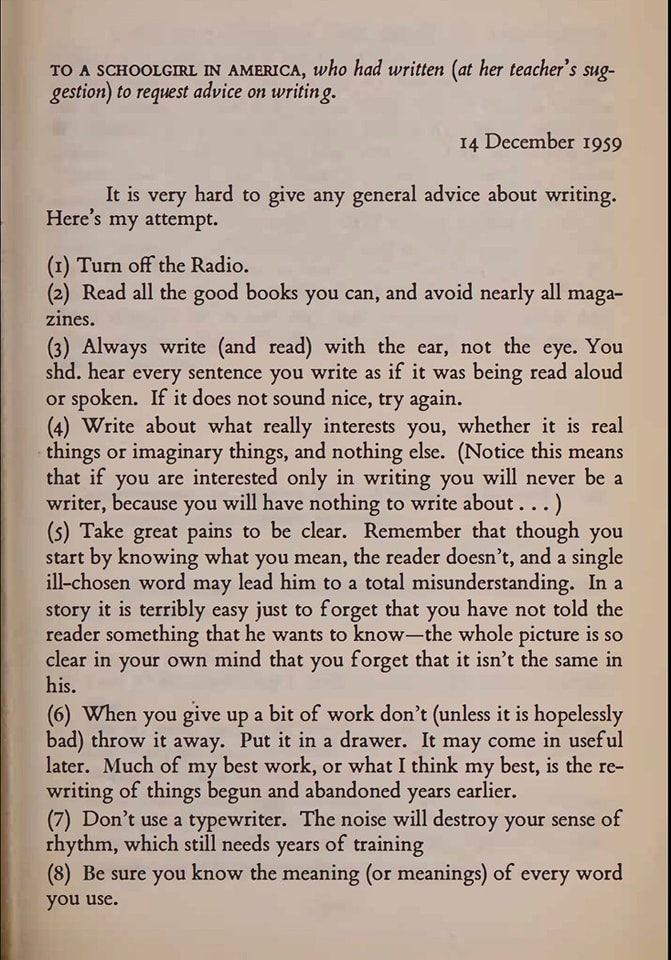
It’s possible to get too much writing advice from famous writers, but so far I don’t think I’ve hit that threshold. I love hearing other writers explain what “works” for them. So below, some long-ago advice Oxford don and Narnia expert C. S. Lewis, shared with an American schoolgirl way back in 1959.
Incidentally, Lewis famously answered every letter he got, no matter who the sender was. Consequently, he spent hours every day in correspondence.
As for the letter below, my favorite chunk of advice is #6. I’ve long adhered to it: “When you give up a bit of work don’t (unless it is hopelessly bad) throw it away. Put it in a drawer. It may come in useful later. Much of my best work, or what I think my best, is the rewriting of things begun and abadoned years earlier.” (I should add that many large plastic bins stored in the garage testify to my adherence to this advice.)
Patrick Kurp, host of the matchless blog Anecdotal Evidence, doesn’t write reviews often. Why? Because he has posted on his blog daily, literally daily, for many years now. How does he do it? (We at the Book Haven wish we could say the same about our own humble efforts!) So when he does write a review in addition, it something of an event.
On the website On the Seawall,hosted by Ron Slate, Patrick Kurp considers Arthur Krystal’s A Word or Two Before I Go: Essays Then and Now & Some Unfinished Business: The Lives of F. Scott Fitzgerald by Arthur Krystal.
An excerpt:
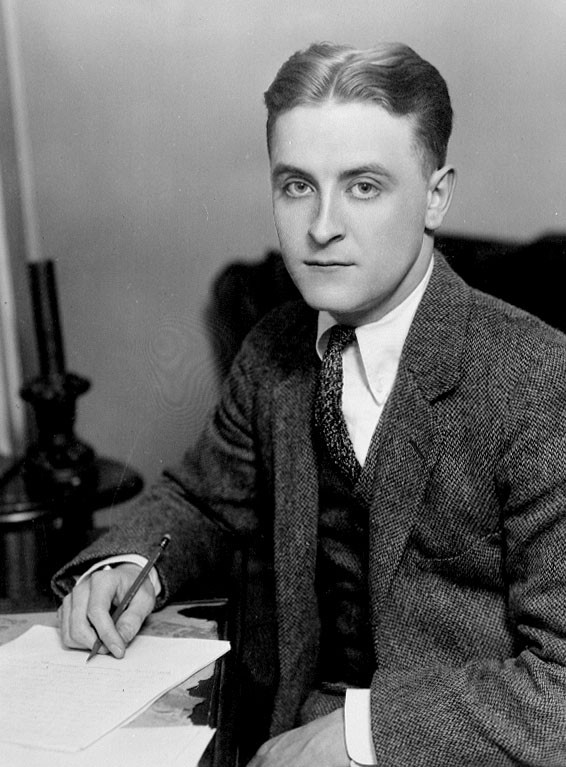
A Word or Two Before I Go is his [Krystal’s] fifth collection of essays and in it he returns to several of his abiding hobbyhorses, including Jacques Barzun, boxing and F. Scott Fitzgerald. Some Unfinished Chaos is Krystal’s first book devoted to a single subject and it often reads like a set of linked essays. No one is likely to read his Fitzgerald biography for the day-to-day details of the novelist’s life, which are thoroughly documented elsewhere. Krystal was drawn to him by The Great Gatsby and the rest of the fiction, but he stuck around for Fitzgerald’s intriguingly complicated and very American character.
Trust him? Maybe not.
One of the epigraphs to the biography, borrowed from the novelist himself, succinctly poses Krystal’s approach: “There never was a good biography of a good novelist. There couldn’t be. He’s too many people if he’s any good.” Krystal resists reducing Fitzgerald to a tidy thesis and defies the tendency to romanticize his alcoholism and the Jazz Age. He lauds the novelist’s professionalism: “[H]e could barely function without a drink, so when he sat down to write, he exercised a control absent elsewhere in his life.” In Fitzgerald he has found his ideal subject, a writer whose life mingled self-destructiveness, immaturity and a literary gift almost unmatched among American writers of fiction:
“One minute you want to hug Fitzgerald, the next you want to wring his neck, not because he was a moralist who behaved like a swine, or a romantic who behaved like a vulgarian — one can chalk that up to booze and false bravado — but because it’s difficult to know when to trust him.”
Since Montaigne, essays have served as literature’s formless form. Almost anything goes. Krystal, typically, is uneasy with the designation “essayist.” It is, he writes, “too grand and too definitive and yet at the same time restrictive.” Krystal is a storyteller even in his essays. He’s an anecdotalist and, the reader suspects, a novelist manqué (he wrote several as a young man, never published).
Read the whole thing here.It’s short.Meanwhile, you might also enjoy today’s post on Anecdotal Evidence. It begins:
On Thursday I gently slipped my brother some Montaigne without him knowing the source. It wasn’t plagiarism, exactly, and it was paraphrased. It’s a well-known passage from the essay “That to philosophize is to learn to die,” one that always reminds me of Spinoza:
“It is uncertain where death awaits us; let us await it everywhere. Premeditation of death is premeditation of freedom. He who has learned to die has unlearned how to be a slave. Knowing how to die frees us from all subjection and constraint.” Read the rest here.
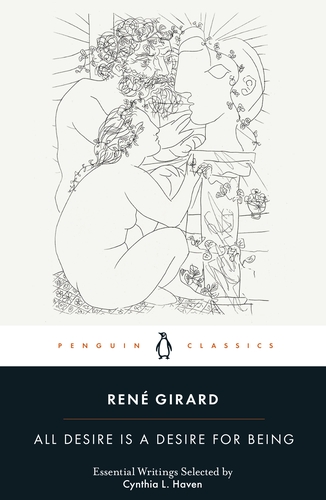
Interest in René Girard from an unexpected source: the current issue of Air Mail, which describes itself as a “mobile-first digital weekly that unfolds like the better weekend editions of your favorite newspapers.” Dramatist, novelist, and poet Matthew Gasda writes: “We are all Girardians now—whether we know it or not. The concepts minted in the early 1960s by the late French literary critic and philosopher René Girard explain the pathologies of the smartphone age as elegantly as Freud’s explained bourgeois neuroses at the turn of the last century.”
Gaspa is a voice worth listening to. Two years ago, the New York Times noted: “Matthew Gasda spent years writing plays on his electric typewriter, and almost no one seemed to care. With Dimes Square, his depiction of a downtown crowd, he has an underground hit.” And so he’s been a voice worth listening to ever since.
Which is especially good for All Desire is a Desire for Being, just out with Penguin Classics U.S. (The U.K. edition was published last year.) You can buy the book here. Meanwhile, read Gasda’s review of the book.
He continues: “While Freud was renowned in his own time, Girard, who died in 2015, is still far from a household name. A distinguished scholar and the author of nearly 30 books, he never broke through to a mass audience like his contemporary Harold Bloom, who transitioned from high theory to cultural critiques in the 1990s. Girard was not a public intellectual; he was a quietly influential, if recondite, academic: the Velvet Underground, not the Beatles.”
“Just as you don’t need to be a Marxist or a Freudian to find class struggle or the Oedipus complex useful, you do not need to be a Girardian, or a Catholic, to find Girard useful. Girard’s dogged attention to what he calls, echoing Nietzsche, the ‘eternal return’ of the scapegoat mechanism (the cruelty and stupidity of the mob) deserves our attention. Girard warns us, with moving pathos, that we are always on the verge of reprising the horrors of history; we are still prone, especially in times of crisis and change, to retribution and revenge (digital or physical).”
He continues: “All Desire Is a Desire for Being is not a reissue but a new collection of essential essays and aphorisms selected by [Cynthia] Haven. It’s the ideal way to read Girard, who only ever had one big idea. He was the kind of thinker Isaiah Berlin would have called a hedgehog, not a fox. But what an idea. Mimetic rivalry is a profound and disturbing discovery, and Girard dedicated his long and distinguished career to its explication. If he is right, we have to question whether the world we are actively creating—or perhaps passively re-creating—is not very, very wrong.”
Read the whole thing here. The bad news: it’s behind a sort of a paywall. The good news: all you have to do is include your email address at the bottom of the page to get access. Enjoy.
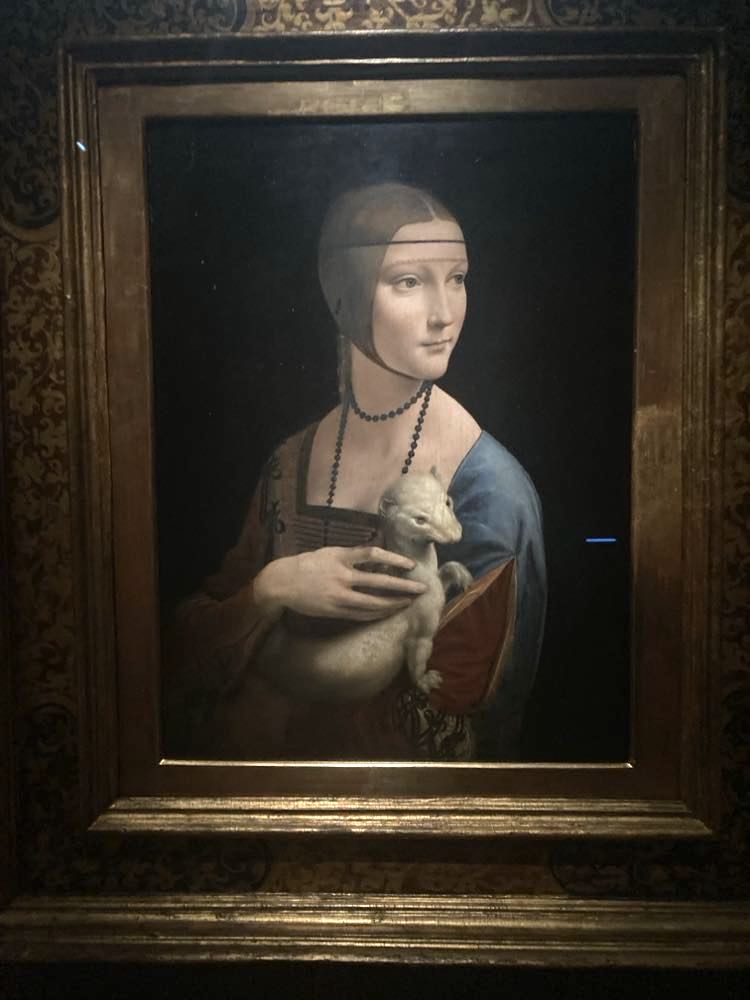
I paid a visit to an old friend today. Last time we visited was six years ago at her temporary digs in Wawel Castle, on a bitterly cold winter day in Kraków – and Polish winters have a sharp bite that has to be experienced to be believed. She was only about two feet away from my face, and no one else was around – as a friend observed, the experience changes when you can see the craquelure up close.
Today she seems to have found a more permanent home at the Muzeum Czartoryskich. Leonardo da Vinci’s 21″ x 15″ oil painting is one of Poland’s great treasures. Stanford archist Elena Danielson described her as “wonderful in person, and much finer and far more mysterious than the Mona Lisa.”
Joy Zamoyski Koch commented on the provenance of the painting: “Lady with an Ermine was purchased in 1798 by Prince Adam Jerzy Czartoryski for his mother (my 4th grandmother) Princess Izabella and incorporated into the family art collection at Pulawy (which is also a museum worth visiting).
“She rescued it from the invading Russian army in 1830, sent it to Dresden, then to Czartoryski family in exile in Paris, and finally to Krakow in 1882.
“In 1939, the Germans seized it and sent it to the Kaiser Friedrich Museum in Berlin. The following year, Hans Frank, the Governor General of occupied Poland, requested its return to Krakow. In 1945 it was taken to Frank’s country home in Bavaria, where it was duly liberated by American troops who returned it to the Czartoryski Museum in Kraków.”
Said one of my bros: “Very cool! I have liked that painting for many years – the ferret and girl have the same look on their faces.” How many people have noticed that?
We’ve written about Trevor Cribben Merrill‘s novel Minor Indignitieshere. We’ve written about Trevor here and here and here). And we’ve also written about fascinating substack, Writing Fiction After Girard, and we recommend a look, especially today, as he writes about “Dana Gioia and René Girard on the Art of Revision.”
An excerpt:
The British novelist Muriel Spark (author of The Prime of Miss Jean Brodie among many others) is said to have revised her work very sparingly, if at all. In this interview on the BBC she cheekily summarizes her novel-writing method: “I begin at the beginning, I write the title, then I write my name, I turn over, I write the title of the book, I write ‘chapter one,’ and then I write on. I leave a space so I can make alterations as I go along, but I don’t revise it afterwards. And then it goes to the typist, and she types it, and I revise that, and that’s the book. That’s finished.”
Trevor riffs on that theme: “’Man mistrusts everything that is effortless,’ the philosopher Joseph Pieper once wrote, and much as I love her novels, I will confess to mistrusting Spark’s approach to the art of fiction. But this may only be because I am so incapable of emulating it. I am the sort of writer whose drafts are usually bad to an embarrassing extent, though as a rule I only realize this in retrospect. Perhaps you have had the experience of sending what you think is a finished piece of writing off to a friend. No sooner has it escaped your control than its flaws become glaringly, horrifyingly obvious. Or else you close your laptop and go to bed in the smug belief that you have written something masterful, only to wake up the next morning, reread the previous night’s pages, and realize how abysmally wrong you were. If these experiences have the ring of familiarity about them, then you and I are the same sort of writers.
The first reaction in such cases is usually to do everything possible to save face—frantically revise and resend, begging your recipient to ignore the previous message; delete the subpar pages and, chalking their mediocrity up to fatigue, pretend they never existed. I suspect that this is because most of us, deep down, feel somehow that we should be capable of tossing off novels (or poems, plays) with the same ease as Muriel Spark. We see our imperfect drafts as evidence of a shameful defect from which our artistic betters have been spared.
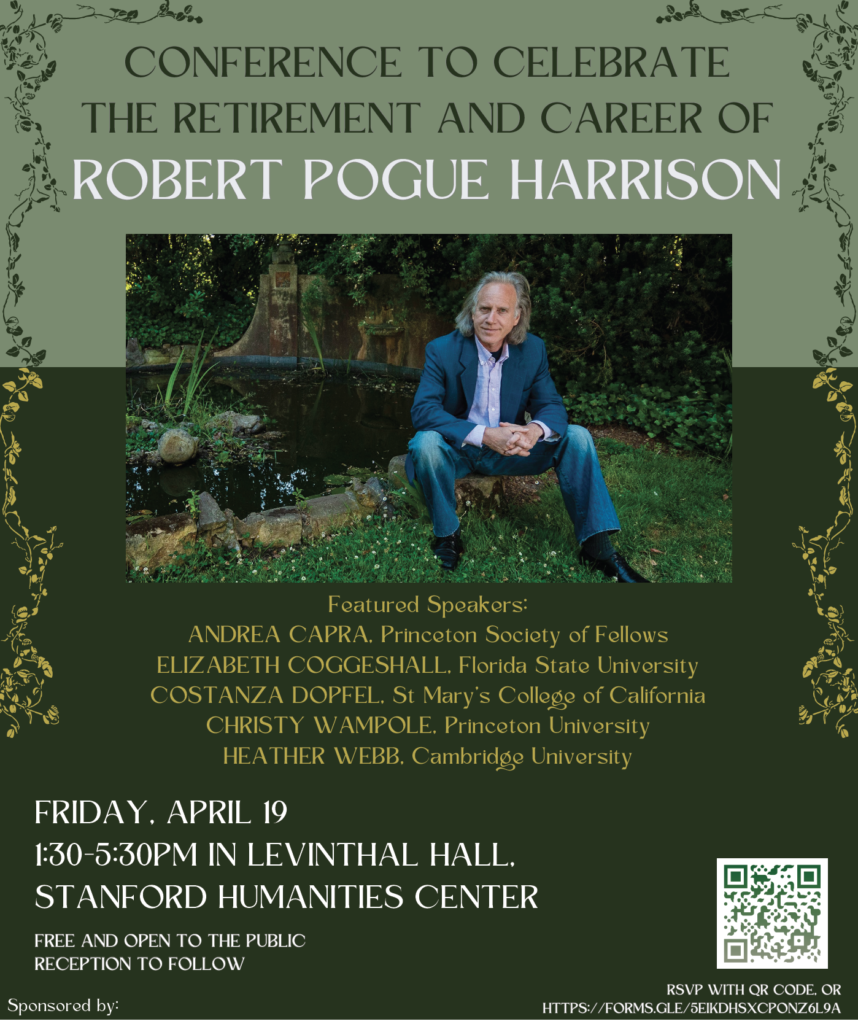
On April 19, Stanford celebrated the remarkable and many-faceted career of Professor Robert Pogue Harrison, Rosina Pierotti Professor in Italian Literature in the Department of French & Italian. We published Andrea Capra‘s tribute to him “How to Think with Robert Pogue Harrison,”on the Book Haven. Capra, a grateful former student, is now Cotsen Postdoctoral Fellow in the Society of Fellows at Princeton. Today, we share the presentation from a colleague who attended the festivities. Pierre Saint-Amand, Yale University’s Benjamin F. Barge Professor of French (he was formerly at Stanford), focuses his research on 18th-century literature, especially the libertine novel, the philosophy of the Enlightenment, the French Revolution, and literary criticism and theory.Some of you may remember also him from the Another Look 2019 discussion of Madame de LaFayette’s landmark 1678 novella, The Princesse de Clèves.He was a brilliant addition to the Another Look panel, and a lively presence at Stanford day-long symposium for Robert Harrison as he officially transitioned to “emeritus.” Here’s what he said:
I am pleased to say a few words about Robert Harrison as we open this conference on the occasion of his retirement. These will be not savant words but words of affection. Robert and I were both young assistant professors in the early eighties, here at Stanford. Robert was then a specialist of Dante, fresh from Cornell, having written on the Vita Nuova. I am glad I had a front row seat to the immediate rise of his global success and his amazing career. I saw him mutate to become a philosopher, in the old sense of the term, one expressing his views on the human condition, and a public intellectual as he took to the waves. Everything started with Forests: The Shadow of Civilization, a prescient book of which I remember the humble and patient beginning. Robert put it together assembling erudition and swaps of visionary poetic language, going from Vico to Zanzotto. I am attached to Robert’s early books, as I felt a part of them when they were being written, and as they got especially a second distinguished life in French. Robert enjoyed naming these translations (beautifully realized by Florence Naugrette): he repeated those names as if they contained a special essence; he would say Forêts, Jardins, Les Morts. They were not books but some kinds of ecstatic emanations of the originals. Robert was a true professor of French and Italian; he was the eminent bridge of these two linguistic regions of this department and certainly the major intellectual spirit linking the two communities.
Pierre Saint-Amand
He writes beautifully of this place, Stanford, that he will never attempt to leave, as I did (for Robert likes the woods as much as I like the city life). The university, he writes in Jardins, gave him so much. It’s strange to think of Robert as a man of institution, but he valued the university, this university, as a place of humanist exception and certainly of civilized friendship. He sees the university positively as a perfected garden. He has stayed here to live at Stanford, finding his habitat, his habitation, on the most perfect and secret street, Gerona Road, a hidden route in a wooden local. Robert finally left a modest cottage in a garden where he wrote his most precious books, now, for his house: a modern construction barely elevated above the land; an almost invisible structure hidden in the landscape of trees. This place resembles him and entertains his monastic and savage legend. I am reminded that in the cottage the forest once came magically to him when a branch of foliage pierced through a window to keep company to his computer. That was an awesome sight, a miracle of provoked thought, we could say, that wanted to prove to Robert he was writing the right books on nature.
Robert is retiring. He will be gone from his classroom, gone from the Quadrangle, but you will still be able to hear him when he takes to the waves. For he has this other life, really a voice, a mix of rock’n’roll and oracular antiquity. Who says KZSU like Robert Harrison? Where is the location of that electronic space that invites his baritone eloquence? You say it comes from the Stanford campus, better it is a global digital agora. That’s where you will find Robert Harrison, Robert the prophet, warning us of the impending doom and delivering an activism of the thought. In the manner of Hannah Arendt, his muse, he sees those dark clouds threatening of a rain that doesn’t come. Recently, Robert has left the forest for the cosmos (I mean by that the worlds) making an even more giant intellectual, philosophical, and critical leap. We have all become followers of Entitled Opinions, hooked to the news of dark times. Robert though has a secret, a pharmakos at the ready, nothing other than the poetry of his vision, a poetry that is always the promise of a survivable redemption.
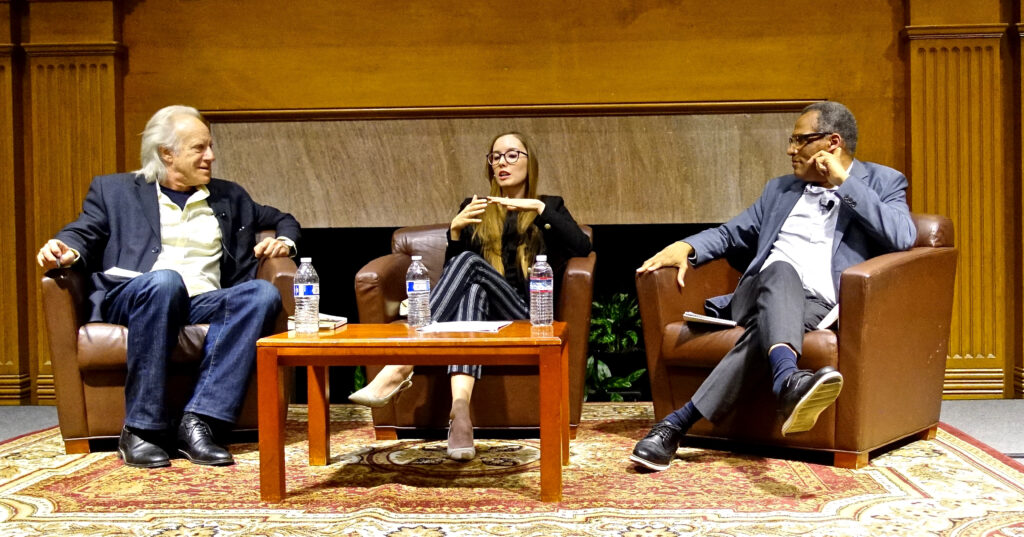
Robert Pogue Harrison with Chloe Edmondson and Pierre Saint-Amand discussing Princesse de Clèves (Photo: David Schwartz)