

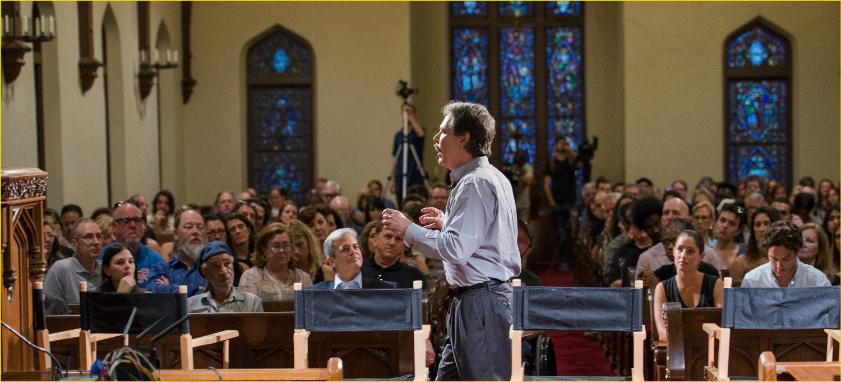
Ted talking music, as always… (Photo: Brenda Ladd)
According to Spencer Kornhaber, writing in The Atlantic, “It might seem like a no-brainer that togetherness is a primary benefit of music. But think about that idea in relation to the ways of listening enabled by 20th- and 21st-century technology. When you tune your earbuds to a playlist on a crowded subway, or blast your favorite album alone in your car, what are you doing? You’re regulating your own mood. You’re occupying your mind. You’re enjoying an art form that captures the ineffable. These are great things. But if you’re plugging into a greater human whole, it’s only in a notional way: a feeling of closeness with the singer, perhaps, and with their far-flung fan scene, maybe. To unlock music’s pleasures, past generations had little choice but to do it in a more directly social way. And by past, I mean ‘very past.’”
What inspired the article? None other than Ted Gioia , we’ve written about him here and here and here, and elsewhere:
This thinking had been informed by reading Ted Gioia’s 2019 book, Music: A Subversive History, which took a sprawling and feisty look at songs’ role across all of human existence. What Gioia makes clear up front is that music in our distant past was a survival tool. To say it helped cohere Stone Age humans into communities is an understatement; music may have actually been a precursor to language. It also may have helped people scare predators away, or herd them so as to hunt them. Music’s physiologically entrancing properties were put to use both in warfare and in medicine.
What’s most difficult for a modern reader to comprehend is that early songs may have existed without some concepts we think of as integral. The notion that music could express a singer’s inner life had to be invented, Gioia argues. So did the idea that songs even had defined, nameable authors. “Note that I haven’t used the word audience yet,” Gioia writes in an early chapter on prehistoric times. “Certainly there were participants—there always are in rituals, where even those who remain silent are integrated into the proceedings … In contrast, the concept of an ‘audience’ for a musical performance is foreign to many traditional cultures. The hierarchies of modern-day entertainment, which radically separate performer from spectator, rarely apply to these situations, in which everyone is invited to contribute, to some degree, in the musical life of the community.”
He goes on, “For the same reason, music is frequently connected to dance in traditional societies—so much so that any attempt to isolate a ‘song’ and assess it in the same way a musicologist studies a movement of a Beethoven symphony is often an exercise in futility and self-deception.”
Read the whole fascinating article here.
What’s my upper during these times? Maurizio Marchini singing “Nessun Dorma” from Puccini‘s Turandot during the tight quarantine in Italy, during the height of the pandemic. (You can read more about him here.)