

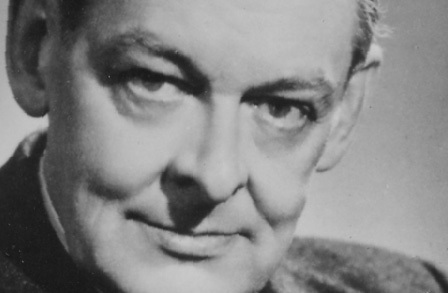
He wanted to get “beyond poetry.”
“Many critics and students have come dangerously close to subscribing to the tenuous proposition that a nearly exact formal analogy exists between the structure of T.S. Eliot‘s Four Quartets and that of Beethoven‘s late string quartets,” wrote Thomas R. Rees in “The Orchestration of Meaning in T.S. Eliot’s Four Quartets” in 1969.
As if the idea had ever crossed our minds.
However, I’ve since learned that the association of my all-time favorite Eliot piece and the Beethoven late string quartets really is a thing. And not only from Rees. I discovered this article written by Katie Mitchell on the subject way back in 2005, when she and a colleague were developing a performance of Eliot’s masterpiece:
It was only by chance that we discovered – in Lyndall Gordon‘s book on Eliot’s later career, Eliot’s New Life – that the poem was inspired by one of Beethoven’s late string quartets. Once the initial connection had been made between the two pieces, I started to research them both, with a view to working out how to put them together. The idea of an evening that somehow combined a reading of the poem with a performance of the string quartet was born. …
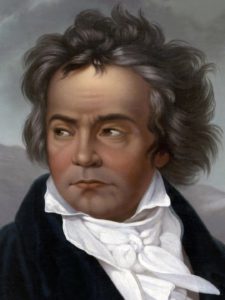
Beethoven composed his string quartet, Opus 132 in A minor, in the winter of 1824-52. He was 54 and recovering from a serious bowel condition from which he had nearly died. As a result, he entitled the central movement “a song of thanksgiving … offered to the divinity by a convalescent”, and the second section of this movement bears the inscription: “Feeling new strength.”
“Feeling new strength.”
Over 100 years later, in March 1931, TS Eliot, aged 47, wrote to Stephen Spender: “I have the A minor Quartet on the gramophone, and I find it quite inexhaustible to study. There is a sort of heavenly, or at least more than human gaiety, about some of his later things which one imagines might come to oneself as the fruit of reconciliation and relief after immense suffering; I should like to get something of that into verse before I die.”
Eliot began the Four Quartets in 1935 and worked on it for years, finishing it in 1941. Whereas the composer wrote one quartet, with five movements, the poet wrote four pieces, each divided into five sections. Like Beethoven’s work, Eliot’s poem was triggered by personal suffering, although not of a physical nature. It was probably connected to his separation from his wife, Vivienne, in 1932; her mental illness; and the rekindling of a platonic relationship with his first love, the American university teacher Emily Hale. …
In 1933 Eliot said he wanted to get “beyond poetry, as Beethoven in his later works, strove to get beyond music”.
Intrigued as I was? Read the whole thing here. Rees’s piece is here. Or listen to the A Minor String Quartet here.
Postscript on 10/14: Faithful Book Haven reader Henry Gould alerted us to his own 2009 post at “HG Poetics” on this very subject, here.
Thank you for the material, which I will delight in pursuing, and the delightful provocation.–Dan
You’re certainly welcome, Dan!