
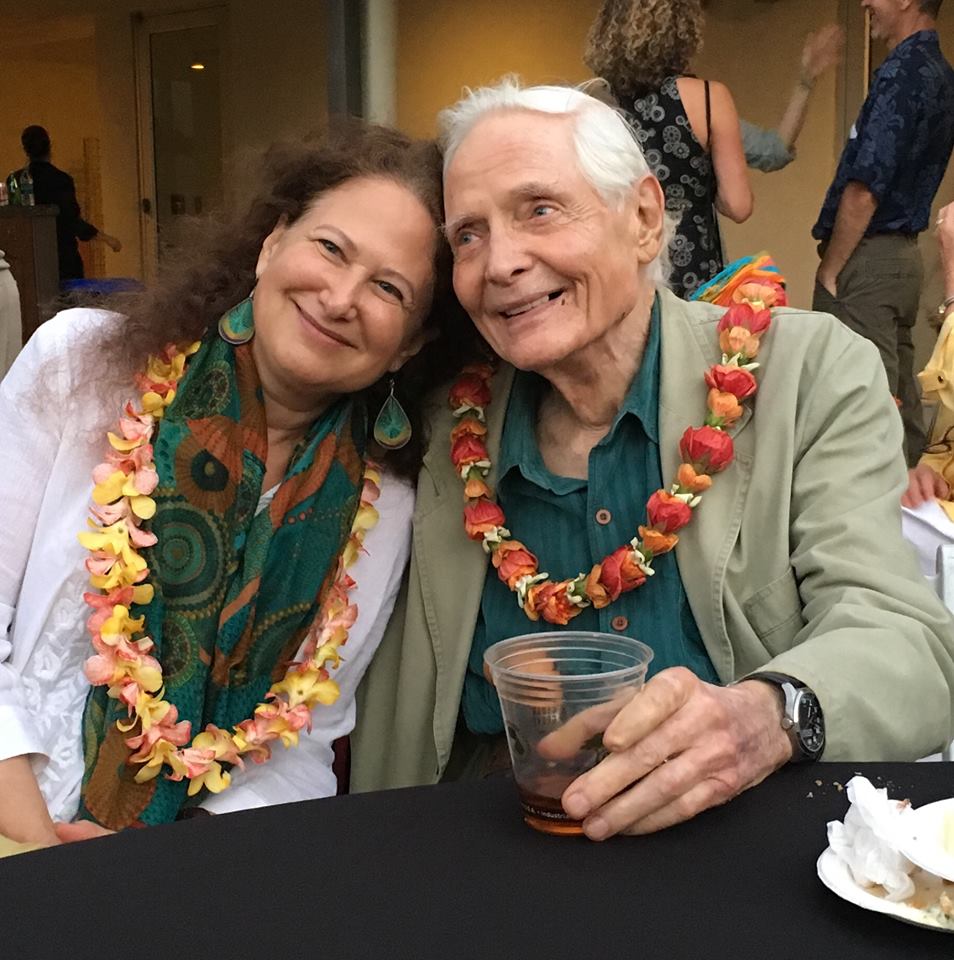
In Hawaii together: W.S. Merwin’s wife Paula Dunaway snapped the photo.
Former U.S. poet laureate W.S. Merwin died on March 15. He was 91. He was the recipient of two Pulitzer Prizes and a National Book Award, among other honors. I knew him slightly, so I have stepped aside for others to speak. Here’s one of them, Marin poet (and friend) Jane Hirshfield, who has provided today’s guest post, with attention to their common Buddhism outlook:
The last time I saw William Merwin was in late March-early April, 2016, when I went to read for the Merwin Conservancy’s Green Room series in Maui. His wife Paula was still alive, and I was able to see them three times in the house William had built decades before with his own hands; to walk through the palm trees he’d planted, now fully grown; to see the nursery with new, young palm trees waiting to be planted.
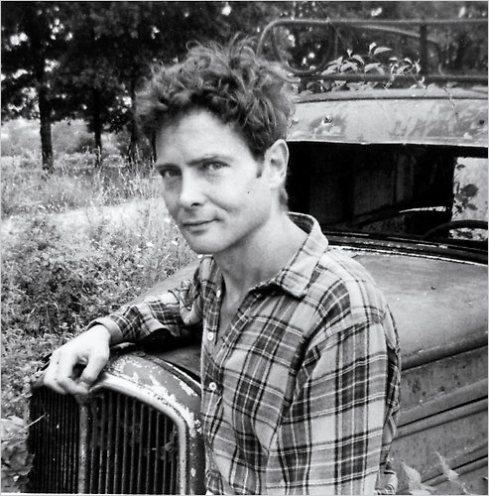
Famously handsome. (Photo: Dido Merwin)
One screen-walled outbuilding was William’s zendo, a meditation room that resembled the nearby toolshed, except that in place of trowel and shovel there were two very small Buddha figures, some rocks, a few incense bowls. A low block of rough-cut wood served as altar. A hand-made clay water pitcher was set just off to one end, as if the one-flavored water of the Lotus Sutra’s teaching might be poured from it whenever needed. As if confident that here, thirst could be simply, straightforwardly addressed, within gathered rain and the poet’s hand-created, permeable concentration.
William was almost completely blind by then, yet still poured the tea Paula had made, asking only for a little guidance to know where my upheld cup was. His superb memory allowed him to move through the long familiar spaces and our conversations’ various rooms with equal ease. One of his beloved chows was still alive, keeping near. The Merwins offered me a tin of organic bug balm to keep at bay the mosquitoes. What William’s eyes could no longer take in, it seemed to me, radiated instead outward from them: the world’s wonder, along with – and just outweighing – its suffering.
William’s poems and example have travelled with me all my life as a person and poet. His openness and his ability to bring into some of his poems what is felt as beyond any saying yet somehow is said. His rigor and his ability to bring into other of his poems his clear-eyed perceptions of the failings of our culture, civilization, and species. His translations were without border, and his compassion without limit. When we first met, at a Dodge Festival, we were sitting next to each other in the big white tent of those days, each of us unable to take our eyes off a nearby seeing-eye Golden Lab. In later years, William would sometimes phone me to talk about Zen and its unfolding in each of our lives—we both wanted practice to be a thing deeply background, not foreground, and perhaps I am wrong to mention it here; yet we both appeared in the PBS documentary, The Buddha, and so I do— as much as of poems, other reading, ideas. Paula was part of these conversations as well, bringing her own steady wisdom and practical affirmation of the centrality of love and human connection in their shared life.
William is sometimes described as a poet of the numinous and absence. But he was a poet of this world, which he loved, cultivated, and restored. The poems continue to hold it all, just as each planted tree in France and in Hawaii does, just as that small, empty, open, still-waiting-to-serve water pitcher does.
William, with so many others this first day of your death, an anniversary now knowable, I thank you.
I love this guy, even though we never met. His passing somehow adds a punctuation mark–though I’m not sure which–to the allegiance I feel to his work and his memory. It’s most likely the “new” punctuation mark I tried to invent and impose upon general usage at ca. age 10 when I proposed a lower-case spiral at the end of a sentence to indicate “sadness.”
If you find a way to include spirals in comments … let me know.
Meanwhile, thanks for checking in, James!
C.H.