

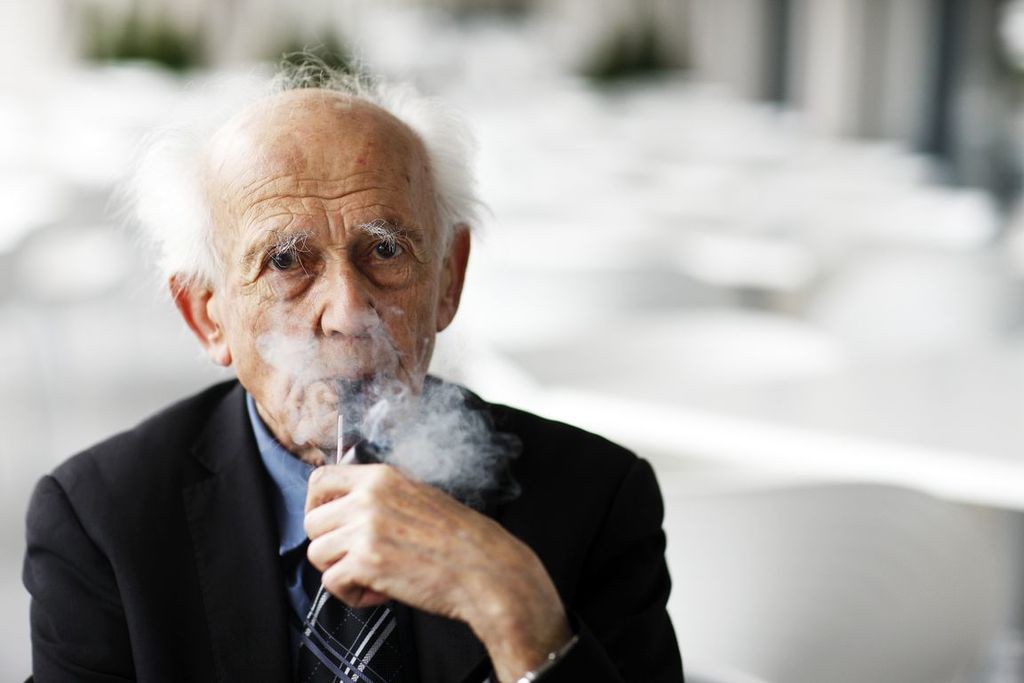
Zygmunt Bauman goes “to liquid eternity.”

Share
Bauman

“There is beauty, and there are the humiliated.” In Wrocław, 2011 (Photo: Wikimedia Commons)

Zygmunt Bauman, the Polish sociologist and a major public intellectual, is dead at 91 – or, as his widow put it, he has changed his place of residence “to liquid eternity.”

According to The New York Times, “The Polish-born left-wing thinker’s works explored the fluidity of identity in the modern world, the Holocaust, consumerism and globalization.” The article continued:

Renowned for an approach that incorporated philosophy and other disciplines, Bauman was a strong moral voice for the poor and dispossessed in a world upended by globalization. Whether he was writing about the Holocaust or globalization, his focus remained on how humans can create a dignified life through ethical decisions.

He wrote more than 50 books, notably “Modernity and the Holocaust,” a 1989 release in which he differed with many other thinkers who saw the barbarism of the Holocaust as a breakdown in modernity. Bauman viewed the mass exterminations of Jews as the very outcome of such pillars of modernity as industrialization and rationalized bureaucracy.

“It was the rational world of modern civilization that made the Holocaust thinkable,” Bauman wrote.

In the 1990s, Bauman coined the term “liquid modernity” to describe a contemporary world in such flux that individuals are left rootless and bereft of any predictable frames of reference.

In books including “Liquid Times” and “Liquid Modernity” he explored the frailty of human connection in such times and the insecurity that a constantly changing world creates.

Read the NYT obituary here. Or, from a more insightful Polish perspective, you might try this piece by Polish scholar Artur Sebastian Rosman over at his blog, Cosmos the in Lost:

His Liquid Modernity might be the single best description of the world we inhabit where all that is solid melts into thin air. The center does not hold, but Bauman is a sure guide to understanding what all that means. What Liquid Modernity describes, and it is something I’ve briefly discussed before, is not an academic exercise, but something that affects not only the present, but also the collective future. I cannot recommend this work highly enough if you feel confused about the world we inhabit and where it is heading. If you can’t relate to this feeling of vertigo then you probably have some bigger problems.

But I don’t want to dwell on psychoanalyzing you, nor on the details of liquid modernity (which you can explore here); nor on Bauman’s period of zealous Stalinism (I believe in Kołakowski’s dictum from Metaphysical Horror, “A modern philosopher who has never once suspected himself of being a charlatan must be such a shallow mind that his work is probably not worth reading.”); instead, a couple days after Bauman’s death (I’m not a fan of the euphemism “passing,” because it lacks substance), I’d like to share the following passage from Of God and Man, since it hopes for a more humane future: “You are right (and deserve credit) when observing that, one way or the other, we somehow possess this world, and, from time to time, here and there, are even able to change at least a small part of it for the better. Given that this world of ours is still in the making, the act of its creation yet incomplete, and the work of continuing the creation and its completion has (to recall our earlier conversations) fallen to us, then it is right for us – as for any responsible host – to care for its well-being and attend to its goodness and beauty. I will repeat again Camus’ credo: there is beauty, and there are the humiliated. God grant that I never be unfaithful to the one or the other.”

Read the whole thing here. Or watch the video, “No one is in control. That is the major source of contemporary fear,” below:

“A writer to watch”: Elaine Ray wins prize for her first published fiction

Share
elaine

New prize for new voice. (Photo: Photo by Rachael Behrens)

One of the finest people at Stanford just won a substantial literary prize –the $1000 Gival Press Short Story Award. We couldn’t be more chuffed.

The Book Haven was one of the first to know about the short story and the prize. Elaine Ray sent her story “Pidgin” to us some time ago. We hesitate to read anything by friends and colleagues – hard to weigh in with a thumbs-down, and the diplomacy in such cases can take as long as the reading (or longer, depending on the ego of the writer).

Our immediate verdict: “Terrific! Go for it!”

We were surprised that the former director of the Stanford News Service, and one of the most beloved people at Stanford for her generosity and kindness, had emerged in fiction with an utterly new voice. We agree with the judge who called it “mercilessly exposed and utterly enigmatic,” throwing light on a lost world that as foreign to most of us as the Incas.

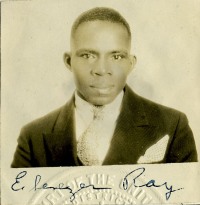
We we’ve written before about Elaine and her blog,  “My Father’s Posts,” named in honor of her father, the journalist Ebenezer Ray, who died when she was thirteen: “What I knew was that  my father had been a newspaper man. He had worked in the composing room of the Pittsburgh Courier before he was disabled  by Parkinson’s disease. I also knew that he had dabbled in photography: There was an abandoned darkroom in our basement, and there were  lots of photos around our house, including my baby picture, which earned Honorable Mention in the Carnation Healthy Baby contest in 1955. …I knew he was born in 1897, immigrated to the United States from Barbados, and had lived in New York  for many years before settling in Pittsburgh.” His story is the fictionalized backdrop of ‘Pidgin.'”

ebenezerHer reaction to the $1000 award? “Blown away and humbled. The first piece of fiction I’ve ever gotten published wins an award.” According to one of the judges, Thomas McNeely, author of Ghost Horse: “In fewer than twenty pages, Pidgin sketches a world of its narrator of color’s post-colonial migration, political activism, and imprisonment within the choices offered him by history. At the same time, it’s a narrative that seems shaped by mysteries that transcend and yet throw into sharp relief its political moment, the chief one being the brilliant voice of its narrator, who is at once mercilessly exposed and utterly enigmatic. Elaine Ray is a writer who plays by her own rules, and is a writer to watch.”


An excerpt, in the voice of her “father”:

My plan was to land a job at one of those big Negro newspapers. But first I had to put in some time with Oliver and Olivia Burns, a couple with ties to the printer I had worked for back home. Mr. and Mrs. Burns owned an establishment that printed invitations, birth announcements and funeral programs. They had clients who fell into three categories: The well-heeled customers they received in the front parlor of their shop with the curtains open— most of them were white or Negroes who could pass for white, like the Burnses themselves. In the second tier were those who were welcomed in the shop, but with the curtains drawn. They were mostly prominent, but browner-skinned Negroes. At the bottom rung of the Burnses’ pecking order were those who brought in most of the money. They tended toward the darkest hues, were working class or poor, and were not welcomed in the shop at all. Those are the ones I was hired to call on.

That’s how I met Lucille Braithwaite, an enterprising Trinidadian who had worked her way into a comfortable living in the ten or so years that she’d been in New York. By night, she toiled in a government factory in Tarrytown. By day and on weekends, she made extra money doing hair, managing a rooming house and hosting gatherings ý rent parties, recitals and receptions— in the upstairs parlor of her Harlem brownstone. She was known to pack a shotgun, lest anyone bring trouble or think about coming between her and her money. She was unmarried and had no children, but kept a parrot named Scarlet whose first language was Pidgin English.

Scarlet was a master of impersonation, picking up accents, inflections and languages with impressive precision.

“Who did you say sent, you?” Lucille asked the day I knocked on her door. At first glance it was hard to tell who was talking: the woman or the bird that stared from atop her head. Both gave me the once over.

colorful-parrot-2400px

“Mr. and Mrs. Burns. You wanted to order some leaflets?” I tipped my hat—a straw cross between a pith helmet and a fedora. The bird snatched it.

“Don’t be rude, Scarlet,” Lucille reprimanded, a touch of amusement around her eyes. She opened the door wider and handed my hat back.

Had it not been for Scarlet’s antics, Lucille, whose hair was wrapped in a brightly colored scarf, would have looked like she was wearing a piece of intricately constructed millinery festooned with bright red, blue and yellow feathers.

“Where are you from, Mr. Clark?” Lucille asked.

I did not realize how ridiculous I looked until I was reflected in Scarlet’s marble eyes— a dark, diminutive, bespectacled figure in navy shorts, a starched white shirt, navy blazer, knee socks and leather sandals.

Lucille was tall, slender, and the color of strong tea. She had a beaklike nose and full lips. When she listened, she stood with her torso thrust forward and her hands on her hips, her elbows taking on the shape of wings.

“Barbados,” I said.

“That must be how you know the Burnses,” Lucille warmed. “Come in.” She led me into a spacious sitting room with two matching upholstered chairs, also bright with color, with a coffee table in between. There was a card table with four folding chairs in one corner and a large wicker birdcage in the other. The place was neat as a pin.

 You can read the whole thing here at the Arlington Literary Journal.

What we’ll need for 2017: a little “elbow grease”

Share
andrew-marvell-3

He started it.

I don’t know about all of you New Year’s revelers, but I’ve been working steadily through the winter break, and feeling mightily miffed about missing so many opportunities to party. What will I need to make it through 2017? A little more elbow grease, I expect, which the U.K.’s “Phrase Finder” website (and thanks, Okla Elliot, for pointing it out to us) defines as “energetic labour.” I always assumed “elbow grease” was an American colloquialism. Not so, says Phrase Finder. In fact, it appears to have been coined by the poet Andrew Marvell (1621 – 1678). The concept is pretty universal, though. Knofedt, anyone?

From the website: 

It has long been said that the best sort of furniture polish is ‘elbow-grease’, that is, there is no substitute for hard rubbing to create a lustrous shine. The term itself is older than might be imagined and dates back to at least the 17th century when it was used in print by the English metaphysical poet Andrew Marvell in Rehearsal Transpros’d, 1672:

Two or three brawny Fellows in a Corner, with meer Ink and Elbow-grease, do more
Harm than an Hundred systematical Divines with their sweaty Preaching.

Marvell was suggesting that, although religious meetings could be disrupted or broken up by the speakers’ opponents, printed material could be circulated unhindered. Of course, Marvell was alluding to writing when he used the figurative expression ‘elbow-grease’. It was also used later in the same century, as it is used now, just to mean sweat or effort. An example of that usage is found in the 1699 New Dictionary of the Canting Crew:

Elbow-grease, a derisory Term for Sweat.

The expression’s inclusion in that dictionary, which itemises the language of the streets, suggests that it was a lower-class term.

Other countries have expression that are near-enough identical. In French we have ‘huile de bras’ or ‘l’huile de coude’, which translate as ‘elbow-grease’ and in Danish we find ‘knofedt’, which translates as ‘knuckle fat’.

Ramble through the whole website and look up your favorite hackneyed phrases here. Meanwhile, I hear a deadline whip cracking. Back to work!