
Victor Hugo and the novel that is “never a downer.”

Share
hugo

Not just a pretty face.

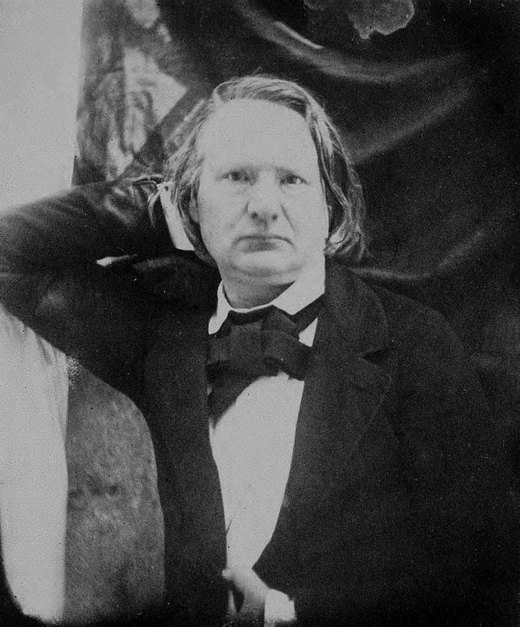
One of the more exuberant articles I’ve read recently comes from the pen of Tim Parks, writing in the current London Review of Books, about Les Misérables and David Bellos‘s new book about that doorstopper epic, The Novel of the Century: The Extraordinary Adventure of ‘Les Misérables.’ After reading the article, and perhaps Bellos’s book as well, it is hard to avoid the conviction that the French poet and master-novelist Victor Hugo was completely mad.

Hugo began Les Misérables in his early forties in Paris, when he was already a leading writer and a controversial public figure. He stopped after three years during the 1948 revolution, and began again in December 1860, nine years into his long exile, by then on the island of Guernsey.

Parks notes that Les Misérables is a curiously sexless book. Jean Valjean seems to live without it. And although Fantine apparently had it, it occurs offstage, so to speak, leaving her an impoverished single mother with Cosette. The sexlessness of the novel is at striking odds with the hypomanic Hugo:

In 1845 Hugo, who had always sought favours from whatever monarch was on the throne, was made a member of the Chamber of Peers, something that would enable him – though not his married lover Léonie Biard – to avoid jail, when caught in flagrante in an act of adultery a few months later. As a young man, he had been romantically conservative and insanely jealous, to the point of insisting that his teenage beloved, Adèle, keep every inch of her ankles properly covered. But after his early marriage to Adèle, in 1822, at the age of 20, five children in rapid succession and the realisation that his wife had had an affair with his friend, the critic Sainte-Beuve, Hugo, in 1833, secured himself a lifelong mistress and worshipper in the actress Juliette Drouet, then in 1844 began his passionate seven-year affair with Biard.

The discovery of his adultery exposed Hugo to ridicule around the time he began Les Misérables, a book that opens, we remember, with a long account of a man who having ‘given the best years of his life … to worldly pursuits and love affairs’ becomes a priest, a prelate and ultimately a kind of saint. ‘People joked,’ Bellos remarks, ‘that [Hugo] must be doing penance for his unsaintly behaviour,’ but declares himself sceptical of this ‘moralising approach’ or of any idea that a troubled Hugo might have looked for ‘refuge in an uplifting tale’. Rather, ‘the main impact of the Biard affair’ was to convince Hugo to ‘write about everything except that’. The novel ‘is unusual … for not talking at any point about adultery or even sex’.

Here’s a fascinating passage from the long review about the names of some of the principals in Les Misérables:

The character names are also, we are reminded, brilliantly invented. Bellos ponders the origins of Fantine, the name of the single mother who falls into prostitution: ‘The first syllable is a contraction of enfant, “child”, so the name itself suggests a meaning close to that of “kid girl”.’ Fantine, Bellos points out, had ‘no parents to name her and no formal identity at all’. The name is part of her status as a misérable. Cosette, Fantine’s illegitimate child and later Valjean’s adopted daughter, might be confused with chosette, a ‘small thing’, or nothing in particular. Again it is a sign she is one of the dispossessed. Bellos doesn’t remark on the irony that these names, while elaborately suggesting a blurred identity at the semantic level, are in fact highly idiosyncratic and wonderfully memorable. It’s in this sense that they are so clever. There are any number of Emmas, only one Fantine. The name is for ever associated with Hugo’s novel. Conversely, Jean Valjean, Bellos explains, couples France’s most common Christian name with a surname that amounts to a contraction of ‘Voilà Jean!’, suggesting ‘somebody or other, anybody, a nobody’. ‘It’s as heart-rending,’ he tells us, ‘as a slumdog answering to the name of “Heyou”.’ Some readers may struggle to feel this.

I take issue, however, with Parks’s accusation that the author “loads the dice,” pushing the situations and characters to unrealistic extremes. I’ve known people and events that will match anything in Les Misérables, and coincidences just as unlikely. I agree that the book is “a story of extravagant gesture and irrepressible underlying optimism,” as Parks writes. “Hugo believes in progress. Despite its title, the novel is never a downer.”

Read the whole article, aptly titled “Thunderstruck,” here.

Pardon our silence.

Share
stone-age

Temporary offices of The Book Haven.

The Book Haven is not dead, though it hath slept.

After six months of increasing desperation and five successive MacBook Pros, our beloved hard drive finally expired on the surgical table of Quick Fix computer shop on El Camino. We are desperately trying to restore our many, many gigabytes of files, photos, recordings, and more, which were thought to be lost forever.

It is one of our longest silences since the humble beginnings of the Book Haven in 2009. (My goodness! Has it really been eight years?)

Harumph.

He gets the last word, always.

We are now working with stone tools, hastily chiseling out articles, Q&A interviews, and delicately worded emails under a deadline whip, with no access to our history or passwords except with the hard drive built into our gray matter. The Book Haven has briefly, but only briefly, been put on “hold.”

You will hear our cheerful voice again when we are restored to the 21st century. We hope you miss us, and hope you agree with Don Pedro in Much Ado About Nothing: “Your silence most offends me, and to be merry best becomes you, for out o’ question you were born in a merry hour.” We were, we were.


Evelyn Waugh: Was he “the funniest man of his generation”?

Share
Evelynwaugh

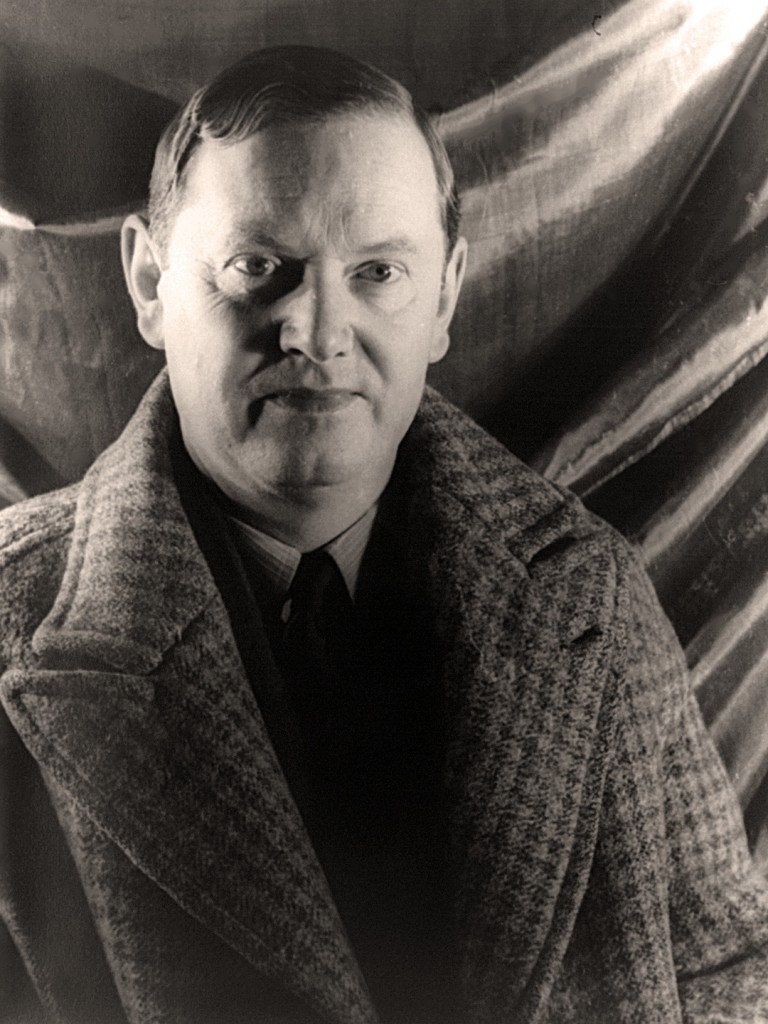
Yes, but funny peculiar or funny ha-ha? Carl Van Vechten’s portrait of Waugh.

Was Evelyn Waugh “the funniest man of his generation”? His son Auberon said so, and thought the obituaries that neglected that observation missed the point.

His humor had a bite in it. You could take it personally. After Randolph Churchill had what turned out to be a benign tumor removed through surgery, Waugh remarked that it was the only thing about Randolph that wasn’t malignant and they removed it. We find it easier to take when the targets are fictional characters, even if marginally fictional ones.

Joseph Epstein reviews Philip Eade‘s Evelyn Waugh: A Life Revisited in “White Mischief,” in the current issue of The Claremont Review of Books.

An excerpt:

Comical all Waugh’s novels indubitably are, often riotously so. He may be the only modern novelist in whom one remembers secondary characters and comic bits as vividly as anything else in his books. Who can forget the vicar in A Handful of Dust who continues to give sermons originally written during his time in India, citing tropical conditions and colonial distance, to his congregation gathered in wintry England. Or in the same novel the bit in which the friends of Tony Last’s adulterous wife search out a mistress for Tony to divert his attention from his wife’s betrayal, and one suggests “Souki de Foucauld-Esterhazy,” to which another responds: “He [Tony] isn’t his best with Americans.” Or the prostitute with her out-of-wedlock child who, despite her lowly station, is not above a touch of anti-Semitism. Or in Brideshead Revisited, Charles Ryder’s quite balmy father; or Anthony Blanche, “ageless as a lizard, as foreign as a Martian”; or the voice of a London hotel receptionist that sounded the note of “hermaphroditic gaiety.” Or Captain Apthorpe in the Sword of Honour trilogy (1952-61) who never travels without his own portable water closet; or, in Scoop, the definition of “the news” as “what a chap who doesn’t care much about anything wants to read. And it’s only news until he’s read it. After that it’s dead.”

Another excerpt:

In a Paris Review interview three years before his death, Waugh remarked: “I regard writing not as investigation of character, but as an exercise in the use of language, and with this I am obsessed. I have no technical psychological interest. It is drama, speech, and events that interest me.” Precise, pellucid, flawless in usage and deployment of syntax, confidently cadenced, Waugh’s was perhaps the purest English prose written in the past century.

Evelyn Waugh has been viewed as chiefly a comic writer. V.S. Pritchett noted that Waugh was always comic for serious reasons, and Prichett distinguished his earlier from his later books by claiming that the former “spring from the liberating notion that human beings are mad,” while his later ones, especially his war triology Sword of Honour, “draws on the meatier notion that the horrible thing about human beings is that they are sane.” Even these earlier books, though, spoke to a yearning for a steadier, more stable world.

Edmund Wilson considered Waugh “the only first-rate comic genius that has appeared in English since [George] Bernard Shaw,” Waugh himself was just doing what came naturally. He once asked:  “Why does everyone except me find it so easy to be nice?”


Who wore it better?

Share

hugo3

Nearly four years ago, we planted some columbine seeds, thanks to Nora Munro over at The Belfry.  The occasion was memorable, for the Book Haven hardly ever goes outdoors into the sunshine, let alone in the dirt. We commemorated the occasion with a blogpost, “Digging History,” on July 6, 2013:

belfry

Hers.

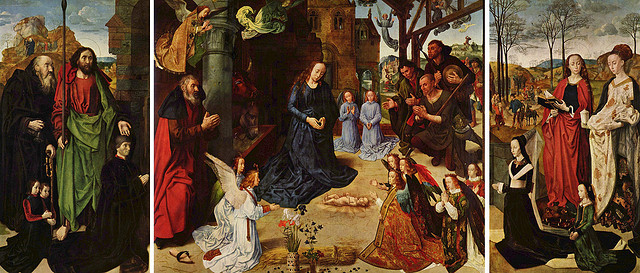
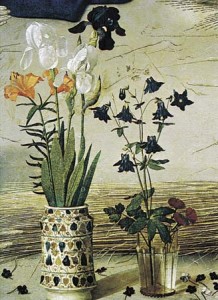
“I met Nora through one of my favorite medievalists, Jeff Sypeck, over at Quid Plura.  His link to “où dort la mélancolie” enchanted and intrigued me. Nora is trying to grow as many authentically medieval plants as she can – but the mid-Atlantic weather isn’t helping.  “I still love the flowery fields in mediaeval paintings, and it pleases more than is probably reasonable that this columbine is exactly the same as the ones in Hugo van der Goes‘ Portinari altarpiece of 1476,” she wrote.  Yes, it’s that Portinari family.  The altarpiece was commissioned by Tommaso Portinari, an agent for the Medici bank in Bruges, and he’s somehow related to Dante‘s beloved Beatrice.

columbines

His.

“Can you see the flowers in the altarpiece above?  I thought you wouldn’t.  Try looking at the photograph from Nora’s garden right.  Then compare with the enlargement from the Portinari altarpiece at left.  Pretty cool.  So I was thrilled when the envelope arrived from Annapolis a few hours ago with … my own seeds.

“The Enclopedia Britannica has yet another version: “The scattered violets indicate Christ’s humility; the columbine flowers represent the seven gifts of the Holy Spirit with which Christ was endowed at birth. The flowers in the albarello (pottery jar) are in royal colours, for Christ was of the royal line of the Israelite King David.”

“But the big queston is: will they grow?  I’ll let you know how it goes…”

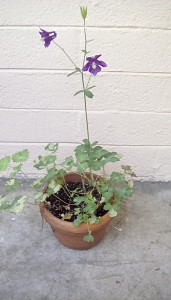
Now the Book Haven is faithfully reporting back to you. They grew. The distinctive columbine leaves have been evident for years. But until this spring – no flowers.

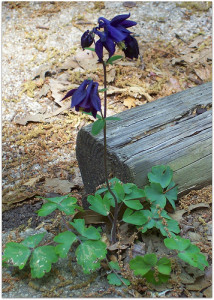
Then… surprise! But perhaps the bigger surprise was that they appear more purple than the navy-blue ones in the painting – or in Nora’s garden.

IMG_20170508_133303_hdr

Mine.

Could it be from the sunshine, bleaching my delicate flowers to a rich purple hue? (As well as bleaching the leaves to a much paler green?) The Book Haven hopes that our readers can answer this mystery.

Meanwhile, here’s a bit of columbine trivia I culled from the world wide web: Obviously, the name “columbine” comes from the Latin word columba, which means dove. But why, why, why are these little blossoms associated with doves? The answer: when the blossom is flipped over, some imaginative people see a ring of doves drinking in a fountain. That’s why they have often been used in art to represent the dove of peace, the Holy Spirit, or anything else that involves a dove.

Why, then, the formal botanical name “Aquilegia,” which is Latin for eagle? Again the imaginative, perhaps drug-addled, note that the spurs of the blossom resemble an eagle’s talons. The eagle is also cited as a reference to the wing-like petals or the closed bud of the flowers which looks like an eagle’s head.

Same flower. Different bird. Go figure.


Happy birthday to poet Charles Gullans! “He did political poetry especially well!”

Share
hogarth

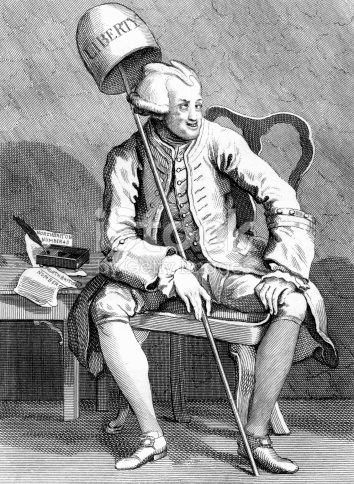
Wilkes as seen by Hogarth

Another birthday celebration, coming to us courtesy the Los Angeles poet (and Stanford alum) Timothy Steele:

The poet and translator Charles Gullans was born on this date in 1929. Educated at the University of Minnesota and Stanford University, where he studied with Yvor Winters, he achieved significant notice in the 1950s and appeared in such anthologies of the time as “New Poets of England and America.” Though his classically inclined work fell from favor during the ascendency of the Beats and the Confessionals, he was a popular and productive professor at UCLA and continued to write excellent poems until his death in 1993. He did political poetry especially well, as is illustrated by his poem about John Wilkes, the eighteenth-century Whig politician, journalist, and thorn-in-the-side of George III. (Wilkes once declined an invitation to play cards, remarking that he couldn’t tell the difference between a king and a knave.) In view of this past fall’s election, some readers may find timely Gullans’ suggestion that we should prefer an imperfect political leader to one who is barbaric. The anecdote to which Gullans refers at the end of his poem exists in several versions and may be apocryphal. But it suits the context and Wilkes’ character in any case. Happy Cinco de Mayo! Happy Birthday, Charles Gullans! (The caricature of Wilkes that accompanies this post is by William Hogarth. [Go here for Tim’s birthday tribute to the artist – ED.])

John Wilkes

Lord Bute, whose rant was the establishment,
Had studied and had mastered the appearance
Of public virtue, but his private bent
Was mistresses and whores built for endurance.

The public interest hid his private acts.
His principle, self-interest of the few,
The fool aristocrat, he hated facts,
And any man of strong, contrary view.

But here was Wilkes, the upstart gentleman,
Bourgeois, with an aristocrat’s disdain
Of canting ethics and of rant in one,
Or in the many, whom he hoped to gain.

“I have no minor vices,” though a boast,
Was license to quick, brittle fools to laugh;
Then, teaching what hyperbole may cost,
His wit pursued him like an epitaph.

No hypocrite, his vices all well known,
“Godless, but never womanless an hour,”
Hard and contemptuous, still the man had grown
Hating restriction and abusive power.

Consistency is firmness in each type.
Yet men of principle may simply be—
Hero or saint, coward or guttersnipe—
Persistent in the partial good they see.

Then if defect seems equal in each eye,
Prefer the cynic to the hypocrite.
Despise the Bute who said to him, “You’ll die
Of syphilis or on the gallows yet.”

birthday cakePrefer the Wilkes who looked into that face,
And with the swift inconscience of the bored
Said, “That depends on whether I embrace
Your mistress or your principles, my Lord.”
Charles Gullans (1929-93)

A Stanford story (and winner!) behind this year’s Compass Translation Awards in NYC

Share
Bella Akhmadulina

Akhmadulina: Singing in another language.

Last Saturday, Stanford’s Glen Worthey spent an unusual evening in Manhattan: he was at the Poets House accepting a Compass Translation Awared Second Prize for his translation of a Bella Akhmadulina poem from the original Russian.

Stepanova @Stanford

She’ll help next time. Maria Stepanova at Stanford Libraries, photographed by C. Haven.

The poet for next year’s translation competition is another friend: one of Russia’s leading poets (and a recent Stanford visitor) Maria Stepanova, and the first-ever living poet to be featured for a Compass competitions.  Maria has offered to consult on her poetry with any translators who may desire it, “which sounds both fun and daunting,” said Glen.

In addition to loads of new impressions and new friends, Glen returned with a small stack of sample journal issues for himself and the Stanford Libraries, as well as signed copies of Irina’s latest book, and some catalogs of the archive of Mark Khedekel’s fascinating father, Lazar Khedekel, a Suprematist architect-philosopher who was a contemporary and collaborator with Malevich and El Lissitzky in the Vitebsk Art Institute.

Oh, and the poem. Read Glen’s translation below, or listen to Akhmadulina read the poem in the youtube video he made at the bottom of this post:


Oh, Runner, Run!

Behold the man, whose race was first begun
So long ago, when light first lit creation;
One cannot count the centuries he’s run:
Run high, run far, toward some consecration,
 .
Some blessed goal.  What triumph might it be
That beckons him to run, to conquer distance?
Behold the man — oh, look at him! and see
Through fogs of time his face’s fine persistence.
 .
Egyptian deserts held him as a slave,
A swarthy outcast, breathless in his fleeing,
Whom death awaited should he cease to crave
To win this race: the essence of his being.
 .
Around him all is motionless and dead.
But he: alive with passion, flexed emotion,
His golden muscles’ movements all embed
Humanity’s own most perfected motion.
 .
Oh, runner, run!  Run, brother; run, my friend!
By force of will your final lap completed,
You run one more, your victory to extend,
To nobly face a future undefeated.
 .
Oh, runner, run!
.