
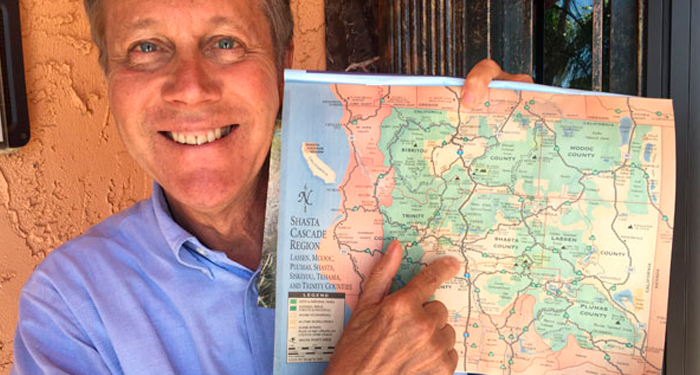
When Dana Gioia became California poet laureate a year ago this week, he vowed to visit all 58 counties of California during his tenure. From my own emails and conversations with him, I know that’s taken a lot of miles – out of him as well as his car. But he’s done it. Or is close to doing it. He’s visited 44 of California’s 58 counties. Only 14 to go in his second year. What will he do then? He’ll start all over again. Why? He replied, “because it is important to visit the large counties several times to reach different communities.”
“Los Angeles County has nearly 10 million people. That requires lots of events. The same goes for the Bay Area. When I was asked to read a poem at the Memorial Day ceremony at the Presidio’s National Cemetery, I immediately accepted because the gathering served a different audience from the venues I had already visited in San Francisco,” he said in a California Arts Council interview. “I also knew that poetry was important for the troops, veterans, and families on such a solemn occasion.”
Obviously, he hasn’t just been catering to the big cities. I attended his event last spring in Nevada County, which held it’s first-ever poetry festival, where he gave a terrific talk, one of his best:
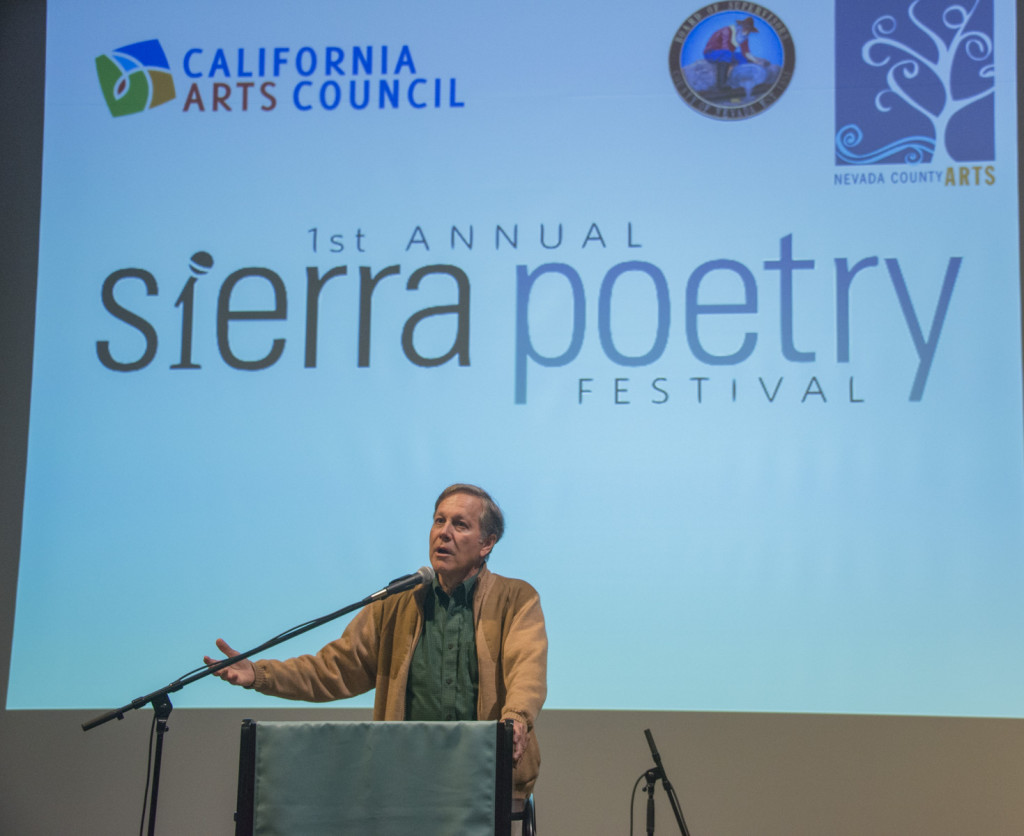
At first-ever Sierra Poetry Festival. (Photo: Radu Sava)
“We bear a certain kind of spiritual wisdom,” he said. “It’s something that happened to all of us. We saw and experienced, at a really very early age, the transformation that beauty affords. We encountered things that changed who we were.”
“You have this beauty, which leads to joy, which becomes wisdom, which becomes a kind of helpful humility about what you can possess, and where and what you are. That has happened to everyone in this room repeatedly. Once you experience that, you want more. You will bring yourself at great expense and great difficulty” to those places that provide such occasions, whether Yosemite, the National Gallery of Art, or a small poetry celebration in the Sierra Foothills.
“It awakens you to the full possibilities of your own humanity,” he said. “What we are sold by society are generic, prepackaged versions of what our lives should be and how we should experience them– and what it’s going to cost us to have those predictable experiences,” he said. “Apple, Amazon, Netflex: they don’t want beauty, they want to own beauty. They ‘like’ art, they want to own art – and turn it into entertainment.”
“They want to take all the unknowns and pre-package them, and sell them as a predictable product that they can own as a kind of property. We’re rather helpless and hopeless in front of this enormous global power which is trying to narrow and define our lives in ways that are not the way we want to live. It’s not the kind of mystery that has to unfold unpredictably and personally,” he said. “Joy is something I cannot own.”
“We don’t lead global lives. We don’t lead generic lives.”
Well, read the whole thing here.
But let’s go back to the California Arts Council interview: “We got big audiences in the smallest towns. There was also a wonderful mix of people. There were, of course, the local poets, musicians, and teachers we expected. But we also got mayors, ranchers, shopkeepers, accountants, almond farmers, veterans and veterinarians. The ages ranged from newborn to near centenarians.”
From an interview with the California Arts Council:
You’re a native Californian. Having traveled to some lesser known and less populated parts of the state, have you gained new perspective on the state and what it means to be a Californian?
 Absolutely! I thought I knew the state pretty well, but these trips have been a continuous discovery. I now realize how little I knew about the eastern half of the state, especially up in the Sierra Nevadas. Those counties are not only spectacularly beautiful, they are also central to the state’s history. There were also a lot of towns I knew only from driving through them on the way to somewhere else. How different it is to meet local people and spend a day or two there.
I just finished spending two weeks with BBC, which is doing a documentary on the statewide tour. I asked that the show only be partially about me. I wanted it to be mostly about the California that the British don’t know—the mountains, the Central Valley, the desert, and the north coast.
One last question, just for fun. If you were hosting an intimate dinner party, and could invite any three people, living or dead, who would they be, and why?
Honestly, I’d invite my mom, my dad, and my late Uncle Ted, because I miss them. But if I had to exclude family, I’d ask William Shakespeare, Edgar Allan Poe, and Oscar Wilde. I’d open up a bottle of good California wine and then listen to the conversation.
And we’d join him. Make it a BYOB. Meanwhile, read the whole interview here. Congratulations, Dana!
.
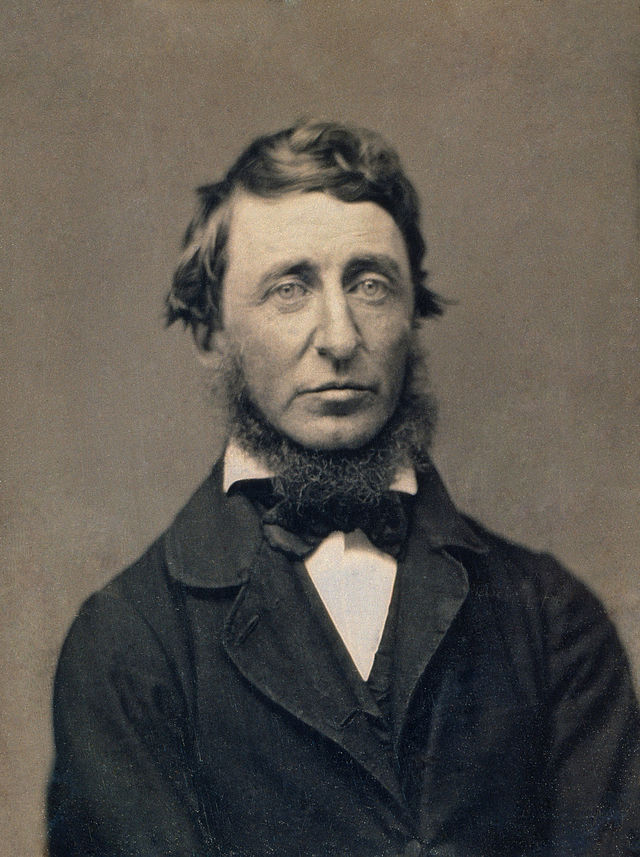
One of two photos we have of him, from 1856
When Henry David Thoreau was near death, a friend at his bedside asked, “You seem so near the dark river, that I almost wonder how the opposite shore may appear to you.” Thoreau’s reply: “One world at a time.”
And what a world it was. According to Robert Pogue Harrison, writing in the current New York Review of Books, “Thoreau was almost superhumanly awake to the flora and fauna of his surrounding environment.” Trees, turtles, huckleberries, or wildflowers would send him into ecstasies.
Robert’s article, “The True American,” reviews ten – that’s right, ten – new books on Thoreau during the Saint of Walden Pond’s bicentennial year. The title of the article borrows from Ralph Waldo Emerson‘s funeral eulogy that “no truer American existed.” But the word “true” requires some parsing. According to Robert:
These days the question of what it means to be a “true” American resists rational analysis. Whatever one can say about Americans that is true, the opposite is equally true. We are the most godless and most religious, the most puritanical and most libertine, the most charitable and most heartless of societies. We espouse the maxim “that government is best which governs least,” yet look to government to address our every problem. Our environmental conscientiousness is outmatched only by our environmental recklessness. We are outlaws obsessed by the rule of law, individualists devoted to communitarian values, a nation of fat people with anorexic standards of beauty. The only things we love more than nature’s wilderness are our cars, malls, and digital technology. The paradoxes of the American psyche go back at least as far as our Declaration of Independence, in which slave owners proclaimed that all men are endowed by their creator with an unalienable right to liberty.
Another contradiction then: Thoreau was ethereal and sensual, unworldly and deeply incarnate – “we occupy the heaven of the gods without knowing it,” he claimed. “I stand in awe of my body, this matter to which I am bound,” Thoreau wrote in his journal. “Daily to be shown matter, to come in contact with it,—rocks, trees, wind on our cheeks!… Contact! Contact!”
Elsewhere, “We must learn to reawaken and keep ourselves awake, not by mechanical aids, but by an infinite expectation of the dawn.” And the dawn is right here, right now. At least potentially. Thoreau declares: “Morning is when I am awake and there is a dawn in me.”
Robert concludes:
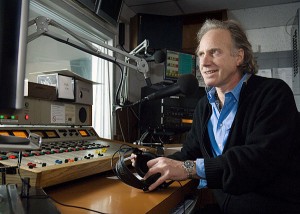
Robert Harrison hosting “Entitled Opinions” (Photo: L.A. Cicero)
Among Americans nothing has more authority than facts. Of course the contrary is also true (a quarter of Americans believe the sun revolves around the earth; more than three quarters believe there is indisputable evidence that aliens have visited our planet). Is it true that we crave reality? Yes, but we crave irreality just as much if not more. Our addiction to our television, computer, and cell phone screens confirms as much. As for death, it does not seem that today we have a knack for concluding our mortal careers “happily.” …
The other equally important lesson is how to touch the hard matter of the world, how to see the world again in its full range of detail, diversity, and infinite reach. Nothing has suffered greater impoverishment in our era than our ability to see the visible world. It has become increasingly invisible to us as we succumb to the sorcery of our digital screens. It will take the likes of Henry David Thoreau, the most keen-sighted American of all, to teach us how to discover America again and see it for what it is.
Read the whole thing here. It’s terrific.
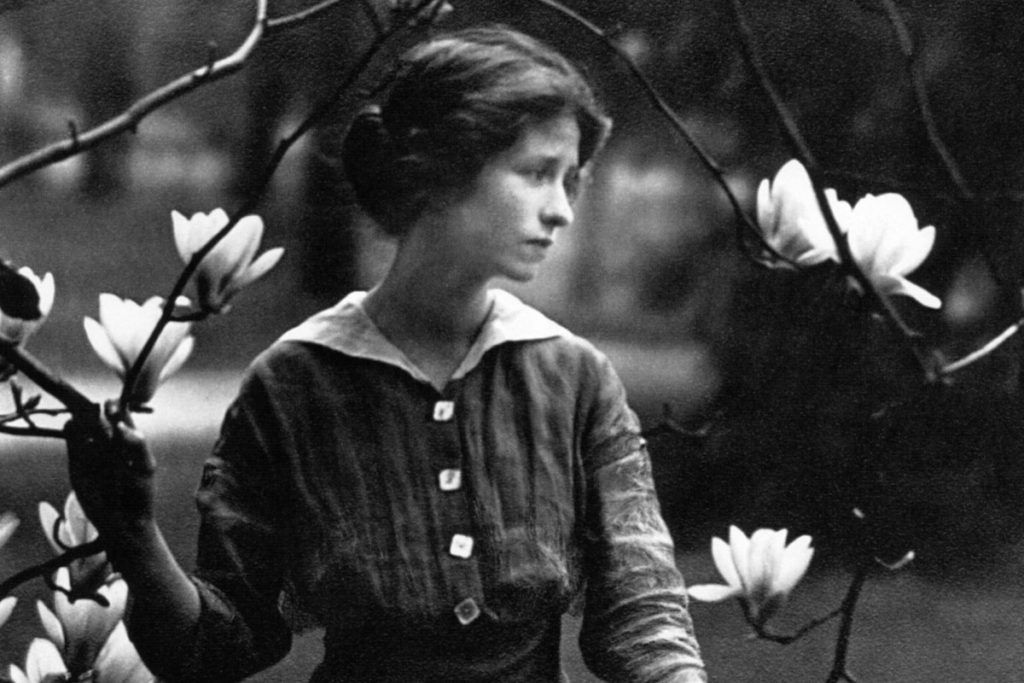
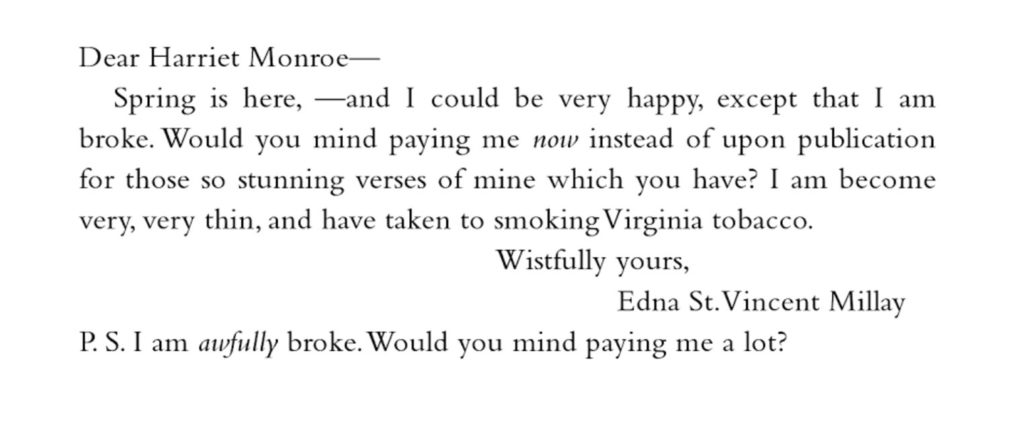
Starving writers: you are not alone! Have you ever wondered how to plea with your editor for payment tout de suite? American poet Edna St. Vincent Millay did it the classy way. Here’s her letter for an advance from the editor of Poetry magazine, in 1918 – about the time the photo above was taken. (And if you’d like to see her rather fancy shoes, try here. and if you’d like to hear about her plummy vowels, try here.)
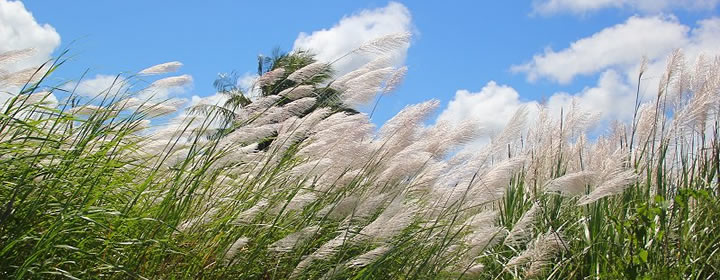
“’Blown canes.’ Those were his first words to mark me,” recalls the Jamaican poet Ishion Hutchinson in the current New York Times Book Review. He continues:
“Like any true discovery, they came tangled in myth. I was about 16, a sixth former at Titchfield, my high school on a peninsula in Port Antonio, a town on the northeastern coast of Jamaica. Almost daily, for my last thing after school, I went to the town’s library. Once inside, I was at sea, isolated, but not alone.”
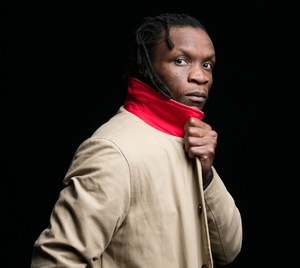
Son of Jamaica
The myth of evening: porous light aslant a single bookshelf labeled West Indian Literature. Was it new? I had never, impossibly, seen it before. I picked up the first book at hand, the soft-covered, fading Caribbean Writers Series Heinemann of Derek Walcott’s “Selected Poetry,” edited by Wayne Brown, a Trinidadian poet and critic. I opened to the lines, “Where you are rigidly anchored, / the groundswell of blue foothills, the blown canes.” A sort of force triggered in me at “blown canes” that fogged my eyes. I stood, rigidly anchored. West Indian literature had arrived on two words.
With a backlog of work on my desk, Hutchison’s tribute for the Nobel poet of Saint Lucia, who died last March, struck a familiar chord. In moments of panic, hurry, confusion, and deadlines, I often think of the beauty of the Caribbean, and my long absence from its white sand and sapphire sea, and the dead quiet of a long empty coastline of Ocho Rios I remember.
Hutchinson eventually got to know the poet whose lines that mesmerized him as a teenager. He quotes a dozen lines from Walcott’s “The Schooner Flight,” then adds:
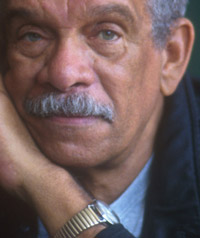
Son of Saint Lucia
The lines are not the most famous. Yet I hear in them the sonic, somber complement to the credo Walcott makes in his Nobel lecture: “Poetry is an island that breaks away from the main.” The vernacular of the lines shelters me into a manifold self. It is the cadence of experience that performs the gathering, a healing, to use a line from “The Bounty,” of “our blown tribes dispersing over the islands.”
Blown tribes. Schoolchildren in uniform, market people, the posh dignitaries, friends from distant countries, daughters, granddaughters, even the wandering tourists — they were all there, the disparate tribes all gathered on the day of his funeral. Where else? Everywhere else. In every nook of private homes pierced by his poetry.
Read the whole thing here.