
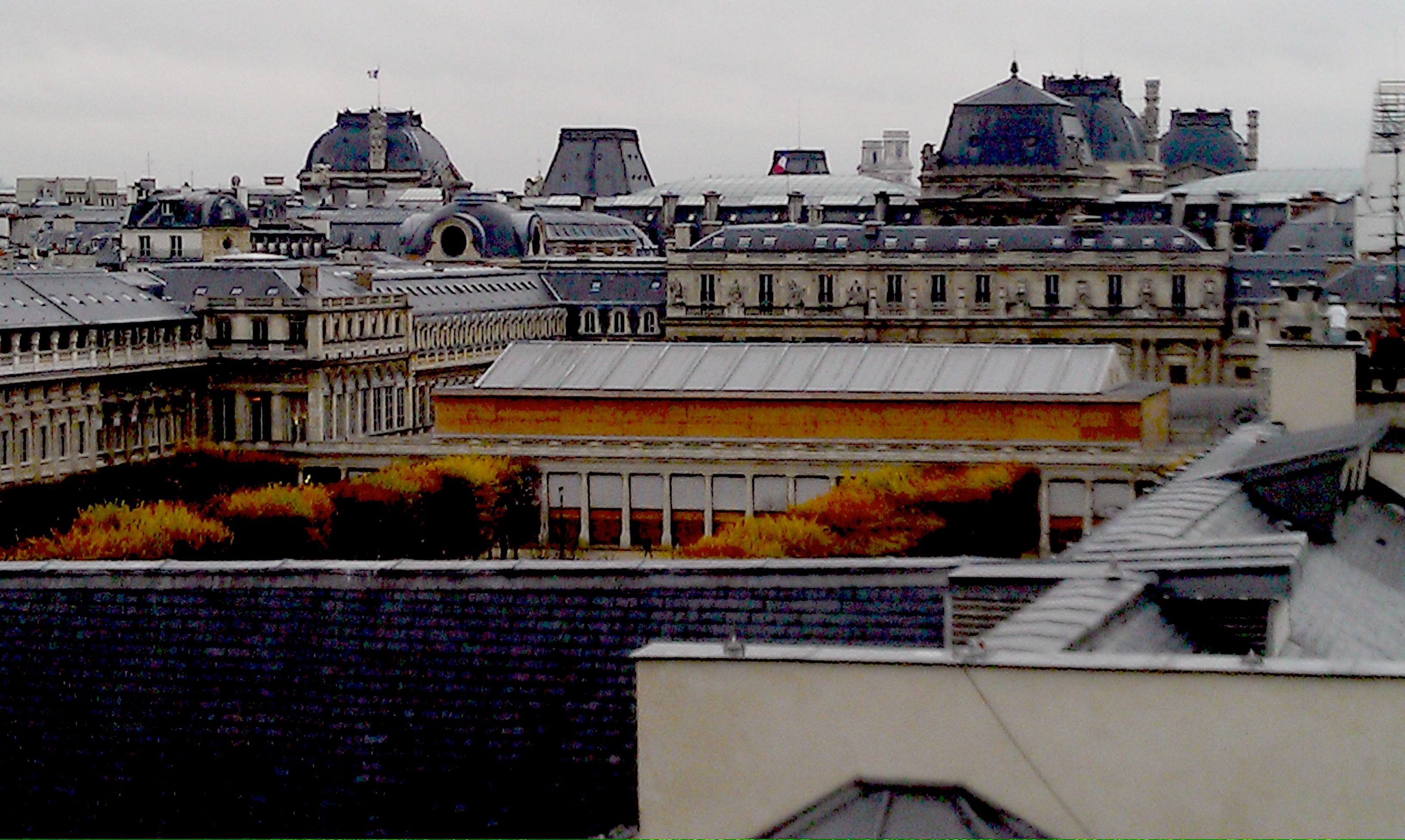
Is it really so bad? The view outside my window. (Louvre at back, with trees of the Jardin du Palais Royal.)
Paris is for lovers, right? Mais non.
I actually enjoy wandering the narrow streets of the first arrondissement alone, exploring the byways that open unexpectedly to a spectacular scene like the autumn trees of the Jardin du Palais Royal, or ducking out to the fromagerie for some Roquefort from the Pyrenées, or discovering a 200-year-old bakery around the corner, Au Grand Richelieu, which provides homemade marrons glacés – or simply sitting alone, in my tiny studio apartment overlooking the Louvre. There is no one to mediate or mitigate my interaction with the city – it’s a direct hit, every step I take.
Susan Sontag, who adored Paris, nevertheless found being alone a drag – even for a quick croissant and coffee in the morning with Le Monde. She told memoirist Sigrid Nunez that when she was alone, her “mind went blank” like “static on the screen when a channel stops broadcasting.” Yet she also claimed, “One can never be alone enough to write.” Well, that’s the point, isn’t it?
Emily Cooke discusses the writer’s solitude over at The New Inquiry: “Being alone lets you develop, become strange, be mad. If to be with people is to be socialized, to submit your rough edges to the whetstone of others’ desires, to be asocial is to be ragged and, thus, original.”
Sontag falls under her lorgnette, but so does Vivian Gornick and Argentine poet Alejandra Pizarnik.
Read the whole thing here.
Postscript on 11/25: My friend Pierre de Taille over at La Plume Périodique tells me what I already knew: “Roquefort cheese is not from the Pyrenées but from the region of the village of Roquefort, south of Le Massif Central (http://www.roquefort.fr/