“Density creates that dynamic”: Lebowitz on NYC and its writers

Share
"I am not the type who wants to go back to the land; I am the type who wants to go back to the hotel."

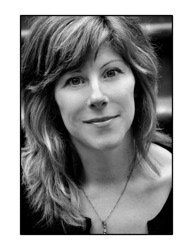
"Humility is no substitute for a good personality." (Photo: Christopher Macsurak)

When I first read Fran Lebowitz‘s Metropolitan Life in 1978, it was hard not to be  captivated by truisms such as these:  “There is no such thing as inner peace. There is only nervousness or death.”

Over at The Browser, Lebowitz discusses  New York, and New York writers.

Nowadays, she seems disgrunted with the place whose ethos she personifies:  “New York has always, always, always – from the Dutch until this day – been about real estate. But it was a billion real estate people – it was not centrally planned, which it now is. In that way, Bloomberg is like Mao. One of the things that Bloomberg did was make a plan for knocking down New York and building up Marina del Rey, or whatever he thinks this is. That was never done before. …

“Present-day New York has been made to attract people who didn’t like New York. That’s how we get a zillion tourists here, especially American tourists, who never liked New York. Now they like New York. What does that mean? Does that mean they’ve suddenly become much more sophisticated? No. It means that New York has become more like the places they come from. That won’t last.”What is immutable about New York is that it’s always changing and it’s relatively hard to live here – relative to the places where people drive from mall to country club. It’s expensive, it’s not necessarily clean and you have to walk. So I think, in the end, the people who will be in New York are the people who deserve to be here – people like me.”

And she still defends smoking:

Urban economist Ed Glaeser told me that cities should be credited for humanity’s greatest hits – from Athenian philosophy through Facebook – because cities enable us to casually exchange ideas, information and inspiration. Do you second this opinion?

I certainly second that opinion. Density creates that dynamic. You don’t get that in Los Angeles, I don’t care who claims it. I don’t care how many rich people build museums in LA. To me, it’s not a city if people spend half their day in a car.

Has Mayor Michael Bloomberg’s smoking ban cut down on the kind of casual exchanges that help New York happen?

I said directly to Michael Bloomberg, “You know what sitting around in bars and restaurants, talking and smoking and drinking, is called, Mike?” He said, “What?” I said, “It’s called the history of art.”

Read the whole thing here.  Or you can stick with the one-liners:

“Having been unpopular in high school is not just cause for book publications.”

“The opposite of talking isn’t listening. The opposite of talking is waiting.”

“Success didn’t spoil me, I’ve always been insufferable.”


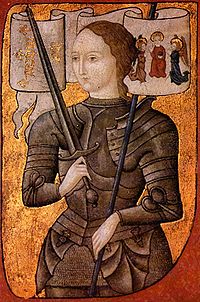
Happy 600th birthday, Jeanne d’Arc!

Share

Almost all little girls have a love affair with horses. They also seem to go through a Joan of Arc phase, too. I was indifferent to the equestrian sports – but I read all the books in my library on the illiterate virgin from Domrémy who gave birth to a nation.

So I was pleased to learn in my online peregrinations that today is her 600th birthday.  How the experts have determined her birthday when we’re not even sure of the year she was born, I can’t remember, if I ever knew.  The picture at right was made about half a century after her death; the only contemporary portrait made of her has not survived.

She may be a powerful reminder that events can be successful without turning out quite as we imagined.  Charles VII, the king whose coronation she engineered, appears to have been a truly nasty piece of work.  Having recently attended the exhibition of The Mourners at San Francisco’s Palace of the Legion of Honor, I enriched my appreciation for what a first-class creep he was:  “the mourners” adorn the tomb of John the Fearless, done in by the king-to-be in a particularly treacherous way.  Old habits die hard:  he did nothing more than a decade later to save his warrior and savior when she was captured by the Burgundians.  She burned at the stake in 1431.

We know her, not only as a warrior, patriot, and saint, but also as the heroine of two great plays:  Saint Joan by George Bernard Shaw, and Jean Anouilh‘s The Lark.

The most famous passage from Shaw’s play follows her agreement to sign a confession renouncing her “voices,” to live under permanent confinement.

“You think that life is nothing but not being dead? It is not the bread and water I fear. I can live on bread. It is no hardship to drink water if the water be clean. But to shut me from the light of the sky and the sight of the fields and flowers; to chain my feet so that I can never again climb the hills. To make me breathe foul damp darkness, without these things I cannot live. And by your wanting to take them away from me, or from any human creature, I know that your council is of the devil.”

Below is a 1957 Hallmark video of the play, starring that remarkable and generally underrated actress Julie Harris as Joan and the better known, for different reasons, Boris Karloff as Pierre CauchonLillian Hellman made the English adaptation and Leonard Bernstein composed the incidental music. (Otherwise you could watch Carl Dreyer‘s reverential and acclaimed The Passion of Joan of Arc, which I have always found a little like watching paint dry. Guess I’m a lowbrow.

I haven’t had a chance to watch the whole Anouilh play, but it looks pretty good in the bits I’ve seen. You’ll have to skip through Hallmark’s 2-minute cheesy commercial at the beginning, and a very blurry video version – but Harris is worth it, I think.

Emmerich’s film Anonymous: a time tunnel in the opposite direction

Share

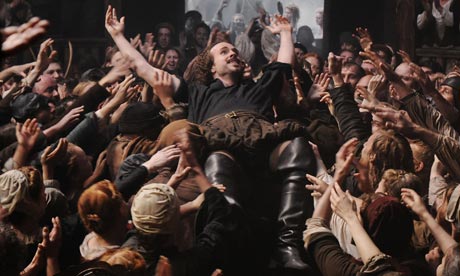
Ruth Kaplan finally got talked into viewing Anonymous, the film about William Shakespeare that is heavy on speculation and very short of facts (we wrote about it earlier in “Shakespeare or the Earl of Oxford? ‘It’s a shame sometimes that dead men can’t sue’ here).  She already knew some of the atrocities in advance: for example, the notion that Christopher Marlowe was devoured with his jealousy of Hamlet.  It was, in fact, written seven years after Marlowe was murdered.

Over at Arcade, she wrote:

“Anonymous also makes unsupported allegations, suggesting, for instance, that Shakespeare never learned to write the alphabet.  The film sees conspiracy in unremarkable events: the introduction makes the (dubious) assertion that we have not a single manuscript in Shakespeare’s hand, as if this is proof of a cover-up, as opposed to a norm for texts from that era.”

She’s also disturbed by the portrait of Queen Elizabeth as a hysterical, lovesick cougar, disinterested in the realm she governs. And she’s scornful of  the notion that an Elizabethan provincial boy couldn’t read (Elizabethan grammar schools were crackerjack – David Riggs discusses that here.)

A retrograde fantasy?

But what really got her was the retrograde fantasy of an entire era, “its ridicule of the very idea of social mobility.  Shakespeare’s desire to raise his social status is represented as vulgar.”

What does it all mean?

So far, she sounds like a lot of people who have seen the movie.  Then she adds a wholly different twist:

Social mobility in modern-day America is now at an all time low.  The gulf between those who go to college and those who don’t continues to widen.  Americans continue to resent women in power, and to resist placing them there: think of the response to Hillary Clinton during her presidential campaign, or look at the US Senate, where only seventeen women serve.  As for culture making, in 2010, only 7% of directors of domestic films were women.  Despite the progress that has been made, we continue to battle as a nation over how to represent and accord rights to non-straight citizens.  As an openly gay German, Roland Emmerich is perhaps an odd director of this portrait of power.  Yet his movie not only mirrors the reality of power in our country, it consolidates and perpetuates the heterosexism, misogyny, and class bias that help maintain that reality. 

The upshot?  “Anonymous may well be the portrait of an age, but it’s not Shakespeare’s.”

It’s good stuff.  Read the rest here.

Sven Birkerts: serious writing as a “rear-guard mission”

Share

"Concentration is no longer a given"

Ted Gioia alerted us to this interview with Sven Birkerts in The Morning News, and it’s too good to miss.

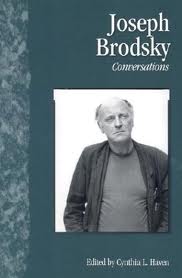
My acquaintance with Sven is born of our common ancestry: We are both former students of Joseph Brodsky, which seems to be an enduring bond with a number of his former students the world over (James Marcus is another one, so is Gwyneth Lewis).

Sven was one of the contributors to Joseph Brodsky: Conversations a decade ago – back in the days before he even had his own email account. According to this interview, there’s been progress: “I started writing on a computer maybe 10 years ago. It was not a direct move—I would still do everything longhand, but then instead of typing I would put it in a computer. Now I actually write on a computer.”

Now he’s a changed man. When interviewer Robert Birnbaum asks him about his future writing, if he planning to do something “wild,” he responds that he wants to write something that “makes sense of this utterly transformed world that we are moving around in. That gives it a kind of identifiable voice.”

He wears three hats: editor of AGNI, head of the Bennington Writing Seminars, and author. He says that “in each of those three areas I am feeling seriously embattled. With the journal, for example, I feel we are fighting an action in the face of diminished attention, and that wasn’t the feel of it when there was more action on that front. With the teaching I really feel like, ‘Boy we have to keep this enterprise alive,’ to keep communicating a buzz around serious writing. Who knows what’s going to happen? So it becomes a rear-guard mission there, too. And with my own writing: definitely.”

I’ve often been criticized (usually by those who live with me) for the size of my library.  Sven managed to formulate the explanation I could never quite manage:
RB: [Umberto] Eco reportedly has a library of 50,000 volumes. I asked him if they are catalogued—which they are not. Nonetheless, he knows where they all are. I asked if he read all of them. He hadn’t but said he had gotten something from all of them.

SB: Yeah, I would sign off on that. I have an unorganized library, but it’s much smaller. Same thing. I find that with me it’s not whether I have read something as much as it has survived my repeated attempts to get rid of it.

RB: (laughs)

SB: And if it has… Things that survive hold such a charge of your own sense of promise about yourself—which is valuable. Or it’s that they hold information that you know according to some obscure scheme is going to become important to you. I think the books that go unread are so important. If I got up and looked at my library and everything was a book I’d read, to me that would be like reading tombstones. I love the agitation, left and right—“Oh yeah, oh yeah.”

RB: I got rid of my vinyl albums. I should do that with books—what an albatross.

SB: Oh yeah. You need your ruins around you.

RB: That would require an enlarged sense of history.

SB: Right, and you have a visibly presented record both of your hopes and your failures. (laughs) It’s all there, kind of mapping you.
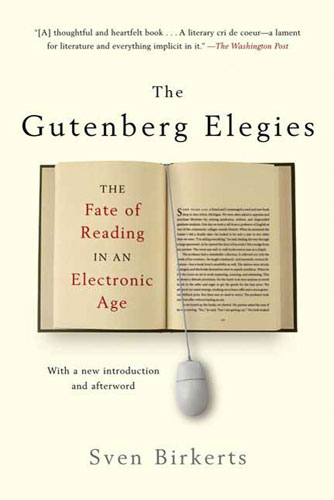
Sven is concerned about the role of the book review today, and the disappearance of book review sections … well, aren’t we all? Birnbaum doesn’t appear to “get it” – it’s not so much about the “middlebrow” reader, as it is about supporting a general culture where every educated person participates in literature, if only as a reader. As I’ve often said, as a writer for the Washington Post Book World or the erstwhile Los Angeles Times Book Review, my ideal reader was someone thumbing their way to the stock market page, becoming intrigued by my review, and buying a volume of poetry or essays. Maybe even forgetting the Dow Jones altogether.

RB: It’s not a contradiction but there is a kind of conflict that faces people who create—much of your world is not real. The real world is when you go to the grocery store or gas station. And then you deal with people who are attuned to scrambling to pay their bills and not the wonders of the creative enterprise. And I feel artists and writers have given up on those people, and there is something self-fulfilling about that attitude. Why did newspapers cut their book sections?

SB: It was largely economics.

RB: To cut features that a loyal core of the circulation read? Why would I go to the newspaper if they didn’t write about what I care about?

SB: That’s true, too.  …

RB: Anyway, what is the reviewing engine about today? I joined the NBCC just to see what critics in the aggregate think their mission is.

SB: My sense is what has fallen out in a big way is the great middle that used to be occupied by the dozens and dozens of critics and reviewers you could have named some years ago. They were writing for a host of papers that paid a certain kind of attention to books. And those are the places that have disappeared or are shrinking. … And now, because of this shrinkage, the reviews editors of those places are desperately playing catch up, saying “We have to do something with this because it’s such a highly-touted book.” What doesn’t get attention is the spectrum—not even the B-list, all those quirky books that are not even going to sell 5,000 copies.

RB: Doesn’t it strike you that as a consequence the [book] awards are looking at books from tiny publishers …
SB: Sure. This situation is probably giving them extra permission to look harder there. They are picking books that in a different order of things should have gotten enough attention so that they wouldn’t seem strange when they were put forward. But because of this great void in the middle no one’s ever heard of them, or they’ve been reviewed once or twice.

His mission, as he sees it:

SB: Sure. The question is whether we live in a culture and psychological climate that is made up of people who feel there is a reason to play the game or else made up of a lot of people who have given up. I’d prefer the former.

RB: Conscious people are more affected than unconscious people.

SB: Absolutely.

If this post looks long, the whole tamale weighs in at over 7,200 words. You can read it here.

I only had one middling disagreement with him, when he defends the writer’s craft and the life-of-the-mind thusly: “People don’t think that sitting utterly inert in front of a screen is as hard as laying bricks. They think, ‘Well he’s doing nothing. But that guy over there is sweating.’”

Some coal-miner working 12-hour days underground would love to exchange his lot for “sweating” in front of a computer screen. We should never forget it.

By the by, the interview alludes to being “part 3” of an interview – but I didn’t find parts 1 and 2 online.  But I did find this from Sven, and it’s absolutely priceless in the era of the tweet:  “Concentration is no longer a given; it has to be strategized, fought for. But when it is achieved it can yield experiences that are more rewarding for being singular and hard-won. To achieve deep focus nowadays is also to have struck a blow against the dissipation of self; it is to have strengthened one’s essential position.”

Postscript on 1/8:  Another part of Birnbaum’s interview has been found:  Dave Lull sent us this Part 1, from way back in 2003, here.  Thanks, Dave!
 

Literary resolutions for 2012 … and a review of 2011, a “Festival of Sleaze”

Share

We all feel a little burned out after New Year’s celebrations, and I’m no exception. So here are some notable literary resolutions to fortify and inspire you for the coming year:

No commas, please

Ben Greenman, author of the short story collection What He’s Poised to Do: “I want to reread all the Emily Dickinson poems, in order, at a slow enough rate that I understand them but a fast enough rate to keep it exciting. It’s not as easy at it sounds. And I also plan to think about why, in a time of reduced attention spans, short stories aren’t getting more traction.”

Elissa Schappell, author of the short story collection Blueprints for Building Better Girls: “It’s the Russians. It’s always the Russians. Oh yes, I’ll read the Russians in the summer months. Two summers ago, I developed such a bad case of Tolstoy‘s elbow from hauling around War and Peace I could barely flip through a magazine. The summer before Crime and Punishment doubled as a drinks tray at a lawn party, and when I got spooked staying alone at a friend’s summer house, I kept it by the door as a weapon. This year, however I’m more hopeful–I’m starting, more appropriately, in winter. Beginning tomorrow I’m going to make Anna Karenina my new BFF.”

The Russians are coming

James Hannaham, author of the novel God Says No:  “This year I want to figure out why, when an author says the phrase ‘working on a story collection,’ as in ‘I’m working on a story collection,’ everyone in publishing reacts as if they have instead heard the phrase ‘molesting several children.’ And I will continue to pray for the demise of e-books, or at least the demise of the stupid fear that they will replace printed books.”

Richard Lange, author of the 2013 novel Gather Darkness (Mulholland):  “I’m going to reread Moby Dick, Crime & Punishment, and The Scarlet Letter. Every time I go back to books that I loved as a kid, I learn more about myself as a writer now.”

Marisa Silver, author of the short story collection Alone With You: “Read more poetry. Use fewer commas.”

Read the rest at the Los Angeles Times here.

Meanwhile, Dave Barry reviews 2011: “It was the kind of year that made a person look back fondly on the gulf oil spill”:

Multiple committees, strongly held views

This was a year in which journalism was pretty much completely replaced by tweeting. It was a year in which a significant earthquake struck Washington, yet failed to destroy a single federal agency. …

But all of these developments, unfortunate as they were, would not by themselves have made 2011 truly awful. What made it truly awful was the economy, which, for what felt like the 17th straight year, continued to stagger around like a zombie on crack. Nothing seemed to help. …

As the year wore on, frustration finally boiled over in the form of the Occupy Various Random Spaces movement, wherein people who were sick and tired of a lot of stuff finally got off their butts and started working for meaningful change via direct action in the form of sitting around and forming multiple committees and drumming and not directly issuing any specific demands but definitely having a lot of strongly held views for and against a wide variety of things. Incredibly, even this did not bring about meaningful change. The economy remained wretched, especially unemployment, which got so bad that many Americans gave up even trying to work. Congress, for example.

Read the rest here.