
Out of the shadows: C.S. Lewis in Oxford

Share

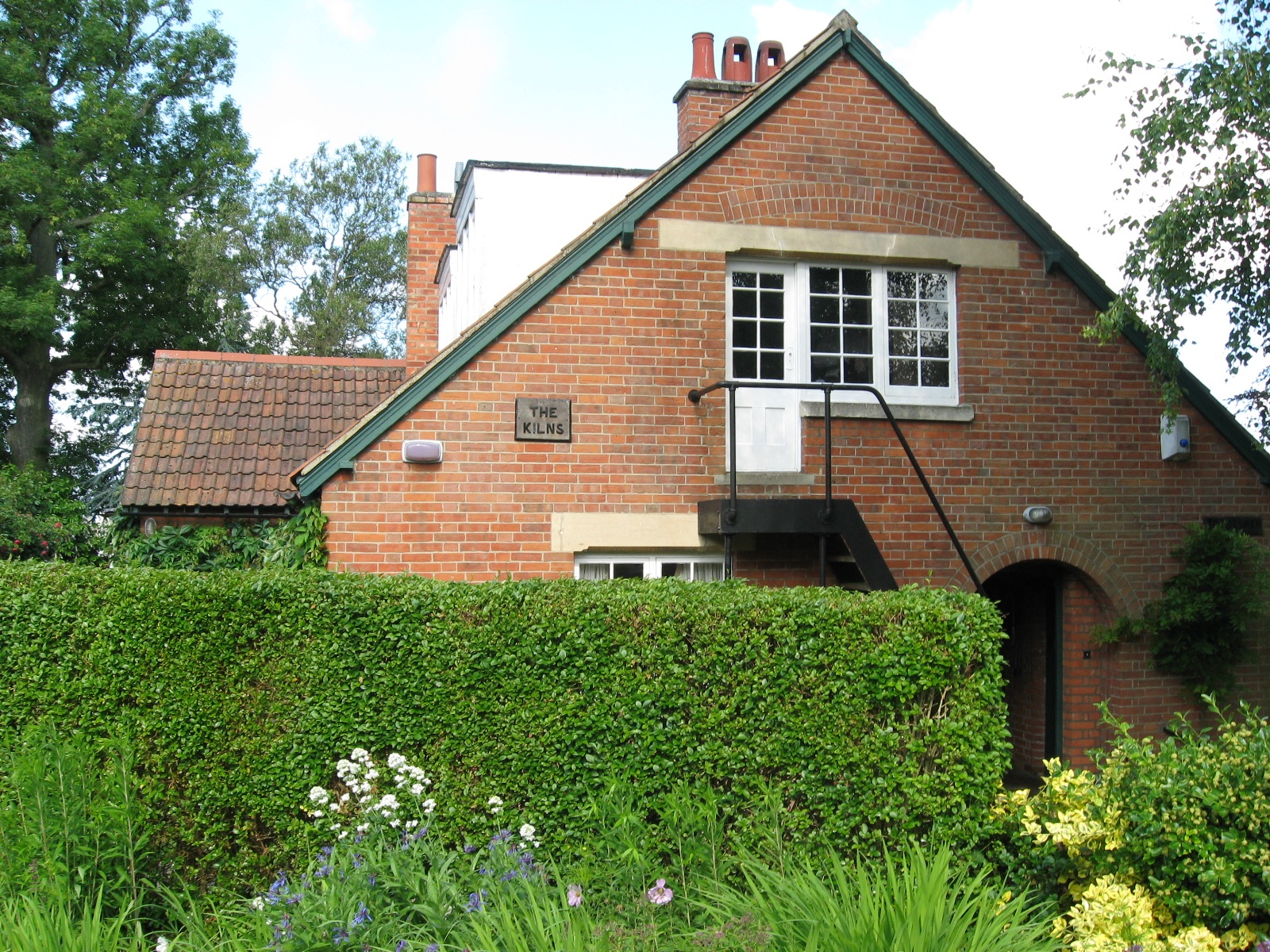
More cramped than it looks (Photo: C.L. Haven)

In the summer of 2009, I visited C.S. Lewis‘s digs about two miles outside Oxford.  Having seen Shadowlands, the movie based on his life (it must have been filmed somewhere else), I must say I was expecting something a little grander.  Not grand, just grander.

I knew the author had never been rich, but I wasn’t expecting a place quite so cramped and makeshift, quite so… well … “adequate.” But what struck me most on the personal tour is how William Nicholson‘s play and subsequent film misrepresented a life that was not a passionless, solitary bachelorhood, but crowded with people and noise and human obligations, whether to the bad-tempered mother of a dead friend who lived at Kilns with him and his alcoholic brother, Warren, or the rotating tribe of teenage wards who came to crowd the quarters.
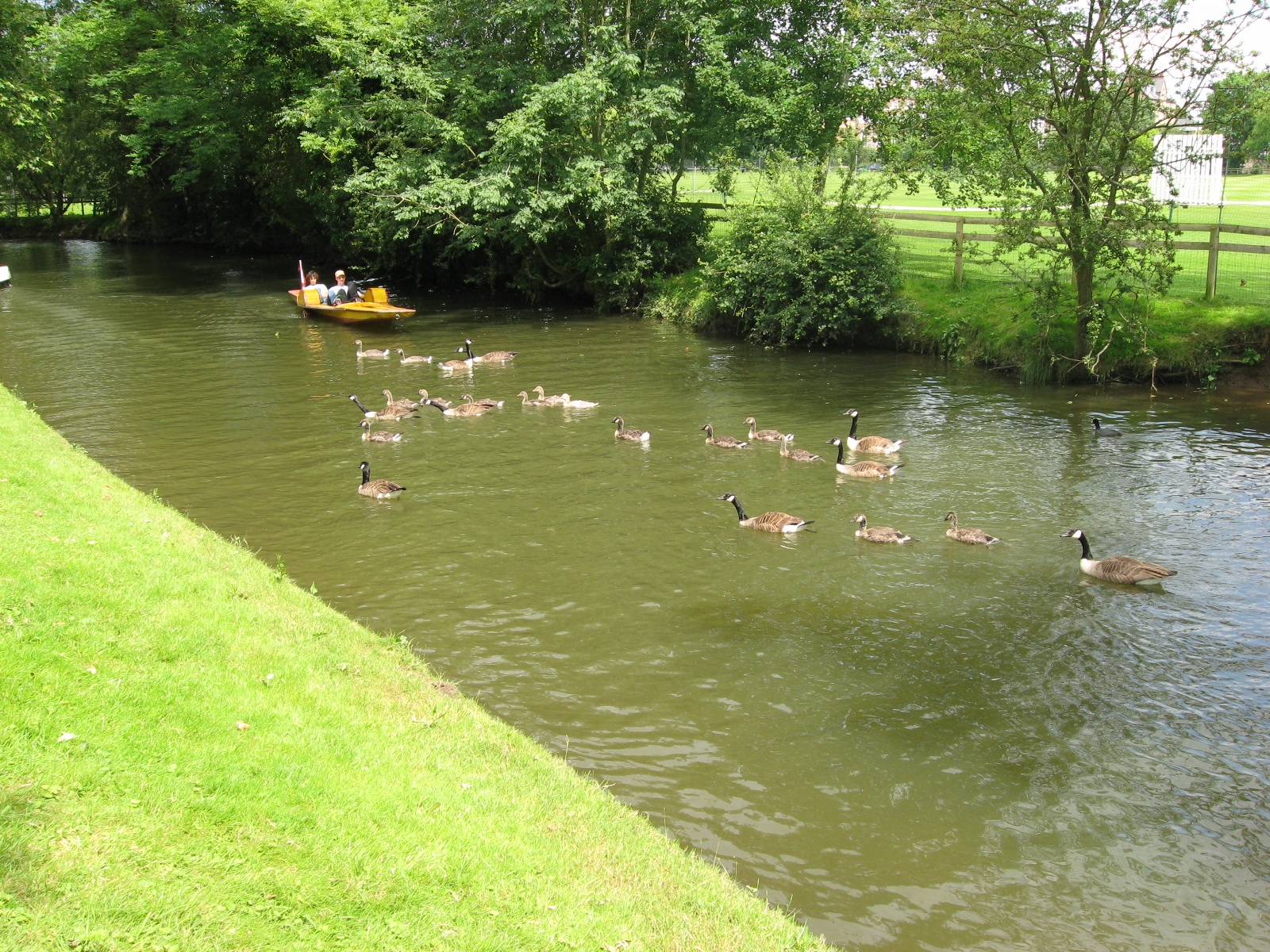
A fateful night on Addison's Walk (Photo: C.L. Haven)

Some of the obligations were self-imposed. As Tom O’Boyle wrote recently in the Pittsburg Post-Gazette:

One discipline he kept as a result was replying to the 20-30 letters he received each day from fans on the day of receipt. It’s estimated he wrote as many as 20,000 letters during his lifetime. Maintaining this practice consumed hours every day and was especially taxing as his health began to fail.

I reviewed the 1,800+ page third volume for the Washington Post here, and mentioned the same. Lewis wrote everyone, including T.S. Eliot, the sci-fi maestro Arthur C. Clarke, and the American writer Robert Penn Warren.  “Other letters were from cranks, whiners and down-and-out charity cases; he answered them all,” I wrote.
“’The pen has become to me what the oar is to a galley slave,’” he wrote of the disciplined torture of writing letters for hours every day. He complained about the deterioration of his handwriting, the rheumatism in his right hand and the winter cold numbing his fingers. In the era of the ballpoint, he used a nib pen dipped in ink every four or five words.”

For me, Jack Lewis is the patron saint of labor.  And the turning point was a warm September night in 1931, when he took an after-dinner walk with Oxford chums Hugo Dyson and J.R.R. Tolkien. The three strolled on Addison’s Walk, a beautiful tree-shaded path along the River Cherwell (I’ve walked it often on my Oxford visits), and got into an argument that lasted until 3 a.m.  It resulted in his conversion.
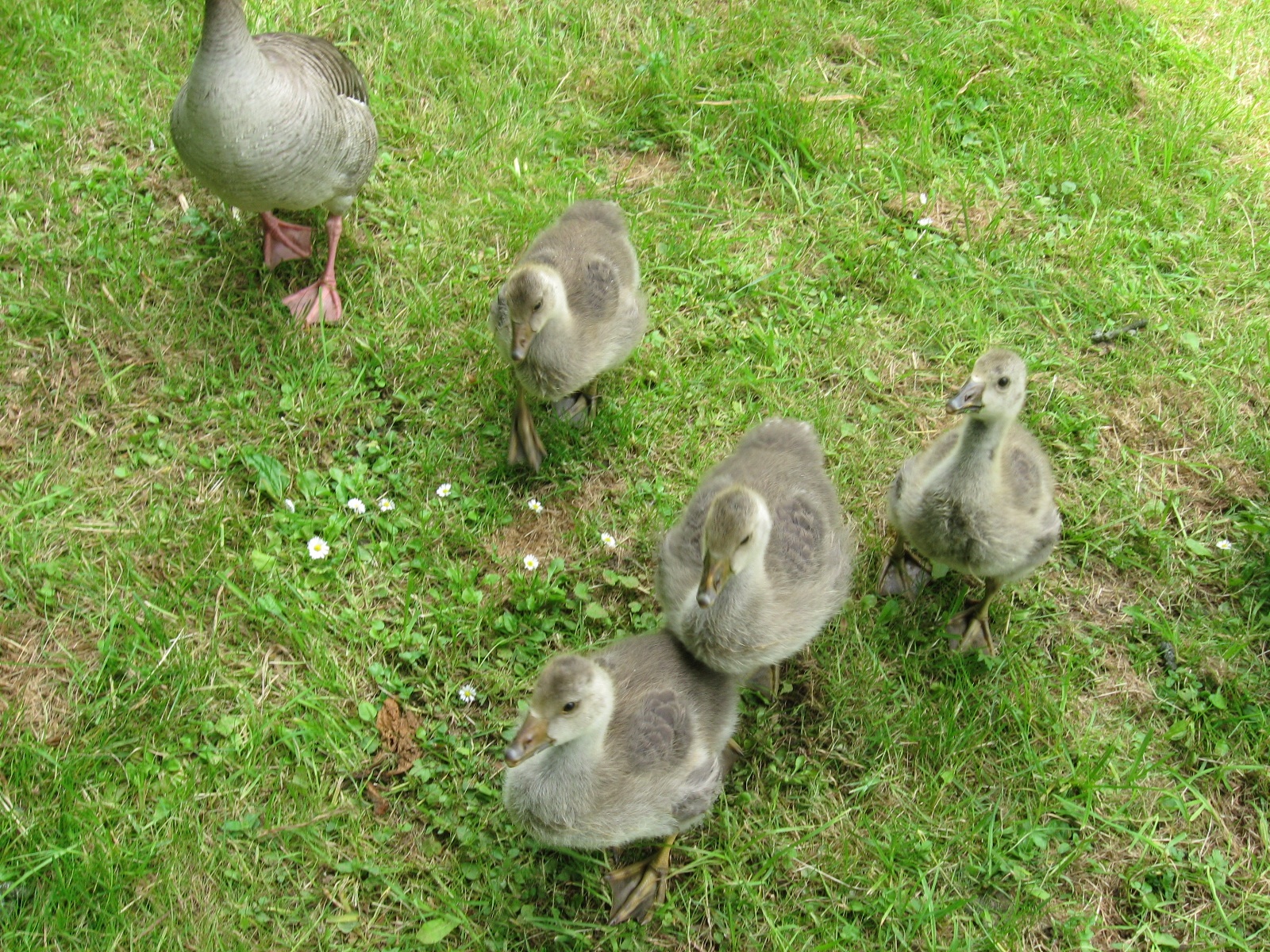
The charms of Cherwell (Photo: C.L. Haven)

As O’Boyle put it:

The effect of this conversion was explosive. Before it, Lewis’ ambition to be a great writer had been hampered by the fact that he hadn’t found anything worthwhile to say. The ledger of pre- vs. post-conversion literary output is hard to fathom. Pre: two slim volumes of verse; post: a torrent of books, essays, novels and radio talks – more than 30 published titles – all works with obvious Christian themes.

After conversion, he also prodded Tolkien to pull together and complete his tales about the private universe that had preoccupied him … Middle-earth.
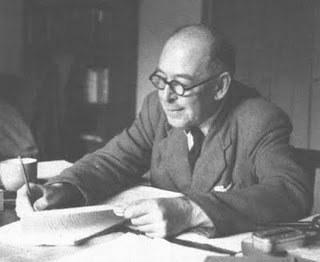
Not a quiet life, nor a lazy one

Two slim volumes of verse.  A couple decades ago, at least, I remembering sitting on a sunny afternoon on a balcony outside a small library, idly thumbing through a volume of C.S. Lewis‘s poetry.  The magical lightness, the imaginative leaps, the quicksilver sense of the miraculous everywhere which colors Till We Have Faces, The Space Trilogy, The Great Divorce, and the Narnia books was nowhere to be found.

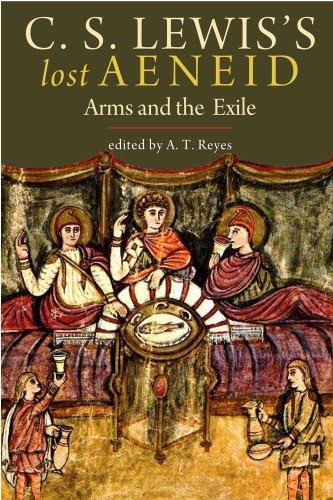
As I recall it, the poems had the solid, leaden consistency of a bowl of porridge.  So I was eager to alter my opinion with his recently published fragments of Virgil‘s Aeneid, a translation project that was interrupted by his death, the same day that John F. Kennedy was shot, Nov. 22, 1963. I haven’t had time to give it a fair shake, but I haven’t seen much to change my mind.
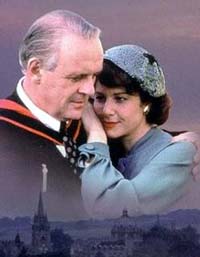
Not the whole story

In Books and Culture, Sarah Ruden agrees.  She wrote that, in his preference for archaic language and stilted locutions in his poetry showcase “Lewis at his narrowest.”

I know the narrowest (he disliked not only Eliot’s verse, but Evelyn Waugh‘s prose), but find virtues that more than offset them in the man as well as in the prose. (Besides, people say the same about Jane Austen – and really, isn’t that’s one of the reasons she’s delightful?)

Steve King, in a Barnes & Noble review, “Remembering C.S. Lewis,” on Lewis’s Nov. 29 birthday last week, recalled his prodigious memory:  “Meetings often lost focus as Lewis galloped through whatever books, ideas, allusions, and quotations sprang to mind. Few could keep up on the scholarly ride,” though others found it great fun.  According to his student Alastair Fowler:

Lewis has been called “bookish” — a dumbed-down response. Of course he was bookish; hang it, he tutored in literature. Even standing on the high end of a punt in a one-piece swimming costume with a single shoulder strap, about to dive, he had time for a quotation….”

And maybe there is even something to be said for “Lewis at his narrowest.”  From Fowler again:

He had been laughed at for offering himself as a specimen of Old Western culture. But he proved in actuality to be one of the last of a threatened species. Before he died, he wrote, optimistically, of the tide turning back to literature. In the event…[u]niversities submitted to bureaucratic management, dons morphed into accountants, training replaced education, and Theory displaced literature. Reading simplistic codes, supplying false contexts, pursuing irrelevant indeterminacies or tell-tale “gaps”: these have proved no substitute for the memorial grasp of literature.

A belated happy birthday, Jack.
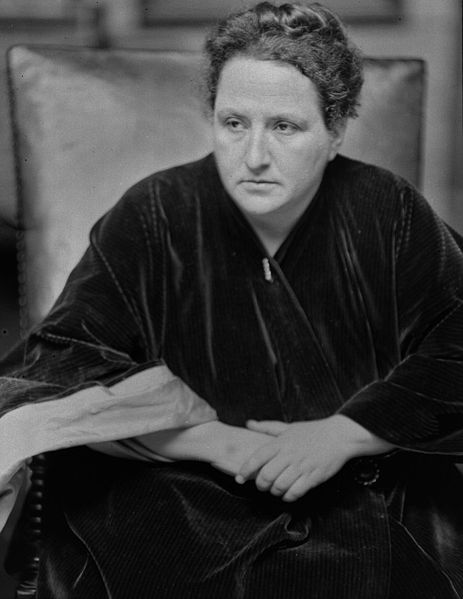
Feeling rejected? Read these.

Share

Not one.

Take heart, rejected writers everywhere!

This is too delicious to pass up:  Flavorwire has 10 nasty rejection letters to eminent writers.  (We wrote about famous rejection letters some time ago here.)

Here’s a 1912 rejection for Gertrude Stein by publisher A.C. Fifield:

Dear Madam,

I am only one, only one, only one. Only one being, one at the same time. Not two, not three, only one. Only one life to live, only sixty minutes in one hour. Only one pair of eyes. Only one brain. Only one being. Being only one, having only one pair of eyes, having only one time, having only one life, I cannot read your M.S. three or four times. Not even one time. Only one look, only one look is enough. Hardly one copy would sell here. Hardly one. Hardly one.”

Sincerely Yours,

A.C. Fifield

Here’s another for the manuscript that eventually became Nobel laureate Isaac Bashevis Singer‘s The Estate and The Manor, rejected by Knopf editor Herb Weinstock in 1959:

It’s Poland and the rich Jews again.

With endless editorial work and endless serpentine dealings with Moshe Spiegel, the willing translator-adapter, this might be turned into an English novel nearly as good and nearly as salable as The Family Moskat. I honestly do not think it worth Knopf’s time and effort … Personally, I’d reject.

"You are scum."

Have to agree with the Guardian Books Blog on this one, which isn’t technically a rejection letter. It’s Hunter S. Thompson‘s letter to his biographer, William McKeen, following the biography’s publication in 1991. It opens:  “McKeen, you shit-eating freak.”

I warned you not to write that vicious trash about me —

Now you better get fitted for a black eyepatch in case one of yours gets gouged out by a bushy-haired stranger in a dimly-lit parking lot. How fast can you learn Braille?

You are scum.

HST

The Guardian blog noted that McKeen now has the letter, framed, on his wall: “That’s one way to deal with rejection.”

Rare punctuation marks. Use with discretion.

Share

Buzzfeed is providing a useful service:  Reviving little known punctuation marks, although I’m pretty sure the folks at Buzzfeed made some of them up out of their heads.

Here are a few:

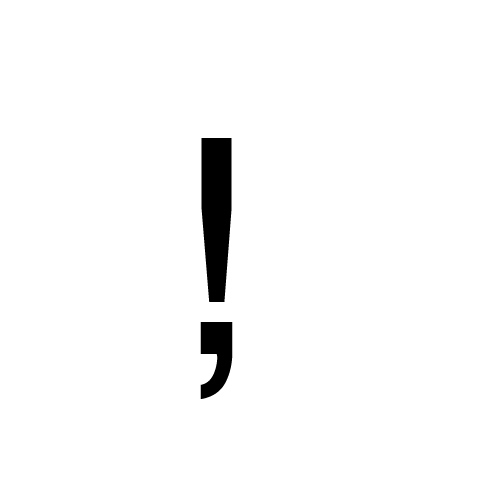
The exclamation comma.  As the site explains: “Just because you’re excited about something doesn’t mean you have to end the sentence.”  I think I’m going to use that one a lot.

The “interrobang” – “It’s a combo-Exclamation/Question mark, and it’s awesome. It is the glorious punctuational equivalent of saying OMGWTF?!”  Well, yes … I think they made that one up.

The third is very useful, and much more evocative than a parenthetical “snark” or the annoyingly ubiquitous  “lol.”  According to Buzzfeed: “Also called the Percontation Point and the Irony Mark, this one’s used to indicate that there’s another layer of meaning in a sentence. Usually a sarcastic or ironic one. So it is essentially a tool for smart people to use to make stupid people feel even stupider. Which makes it the best punctuation mark of all.”

Read ten more here.  (Comments are kind of fun, too.)

Bodleian’s treasures on display: paradise as a library

Share

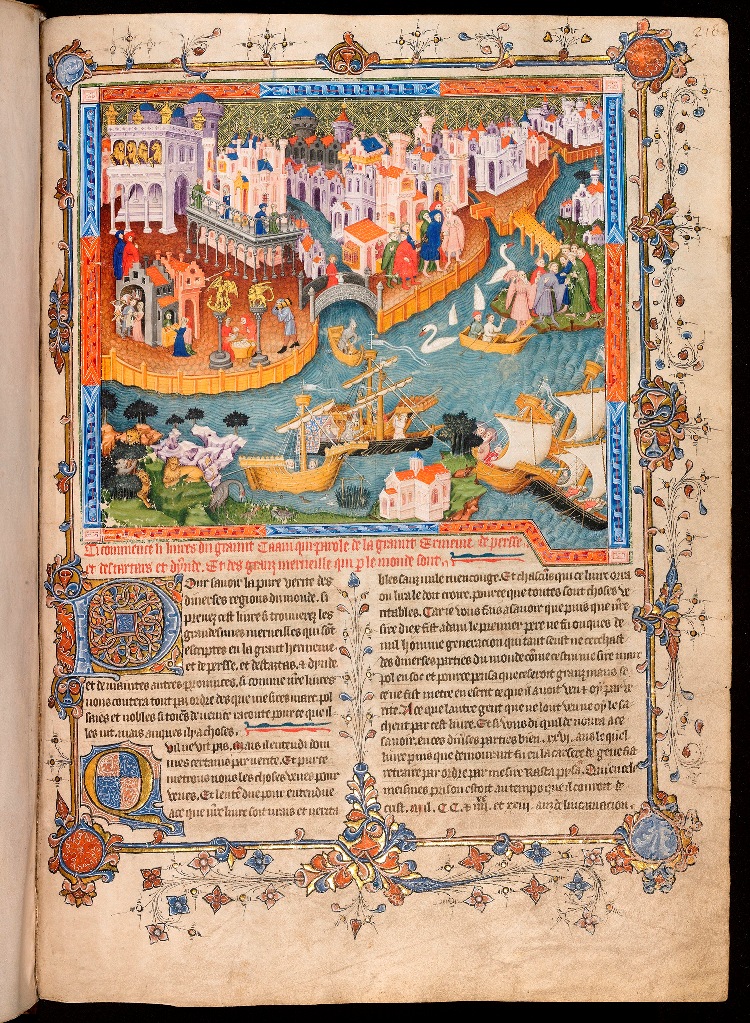
"Marco Polo's Travels," 14th century. Copyright Bodleian Libraries,University of Oxford

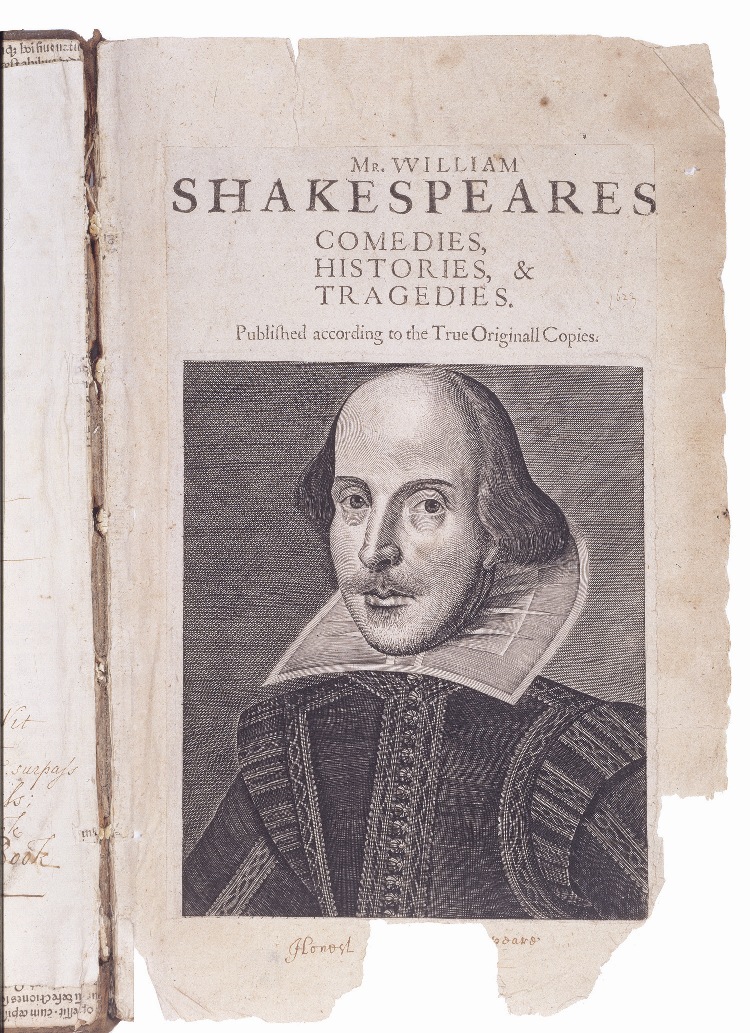
As you enter the darkened room,  a 1623 Shakespeare First Folio is to your right.  Enigmatic scraps of a poem by Sappho, circa 2nd century A.D., are to your left.  And all around you the wonders of the world: weighted with heavy seals, a 1217 “engrossment” of the Magna Carta is nearby (it was reissued under Henry III); so is a 1455 Gutenberg Bible.  In the corner of one glass case –  an exquisite 18th-century miniature scroll of the Bhagavad Gita, which shines like a cache of jewels, somehow pressed and rolled into paper.

William Shakespeare, First Folio,1632. Copyright Bodleian Libraries,University of Oxford

“I have always imagined that Paradise will be a kind of library,” Jorge Luis Borges famously said. And here, in the Bodleian Library’s current exhibition, “Treasures of the Bodleian,” 30 Sept. – 23 Dec. 2011, everyone could see that, well, he had a point.  The exhibition anticipates a permanent gallery in the Weston Library in 2015.  The exhibition shows some of the Bodleian’s rarest, most important, and most evocative rarities.

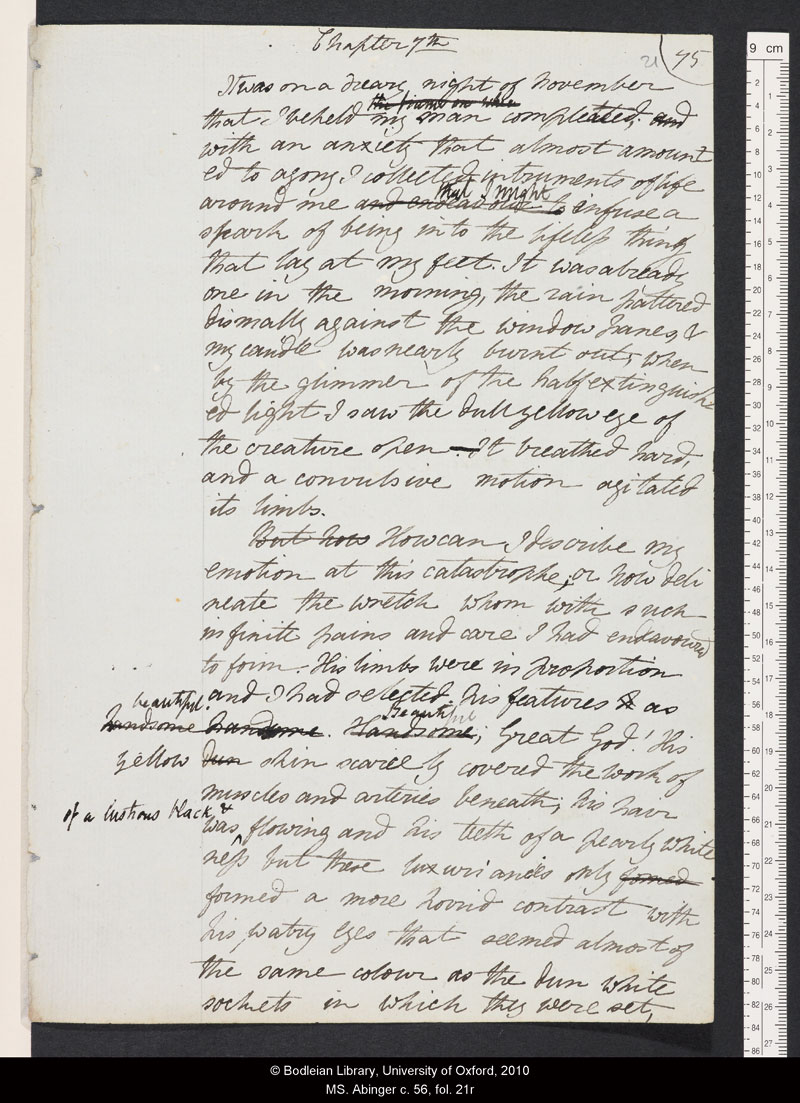
To wit:  In a corner, a single page of Mary Wollstonecraft Shelley‘s Frankenstein describes the ominous night of the creature’s creation. Her scrawled text is corrected and amended by her husband, the poet Percy Bysshe Shelley.  Other handwritten manuscripts are the work of Jane Austen, John Donne, and Gerard Manley Hopkins.  Others are the work of a brush rather than a nib: an exquisite 17th-century picture scroll of the sad Tale of Urashima, a classic Japanese fairy tale which I had read as a child.

For Sir Thomas Bodley, who basically created the museum that opened its doors in 1602, the Shakespeare first folio did not seem like the greatest find. According to the exhibition guide, he “would likely have dismissed this as one of the ‘idle books, and rife raffes’ that had not place among the Library’s predominantly theological collections.”

The volume left the library under mysterious conditions in 1674, and resurfaced only in 1905.  By that time, “the Bodleian was prepared to pay the unheard-of sum of £3,000 to buy back ‘its original long-lost copy of the First Folio of Shakespeare.'”

William Shakespeare,First Folio,1632. Copyright Bodleian Libraries,University of Oxford

I visited the exhibition in the company of my friend, Oxford’s Eliza Tudor, and we gravitated towards our favorites.  Hers seemed to be J.R.R. Tolkien‘s brilliant golden watercolor of Bilbo Baggins, rendered invisible by a magic ring, as he converses with a dragon.  She also took a liking to the Selden map of China, from the Ming era – the earliest Chinese map to show not only shipping routes, but also to depict China as part of a greater East and Southeast Asia. And for me … well, what a choice!  Perhaps I’ll plump for one of the earliest editions of Dante‘s Divine Comedy, fully illustrated, made within decades of his death (see video below).

But there are littler treasures, too – Mohandas Gandhi wrote to his friend, the Anglican missionary Charles Andrews, in a 1932 prison letter exhibited in the collection: “I can therefore never say beforehand what will occupy my attention exclusively or for the most part at a given moment and since a civil resister bargains for the punishment he receives for his resistance, he must not fret over it. Therefore and to that extent I am content with my lot.”

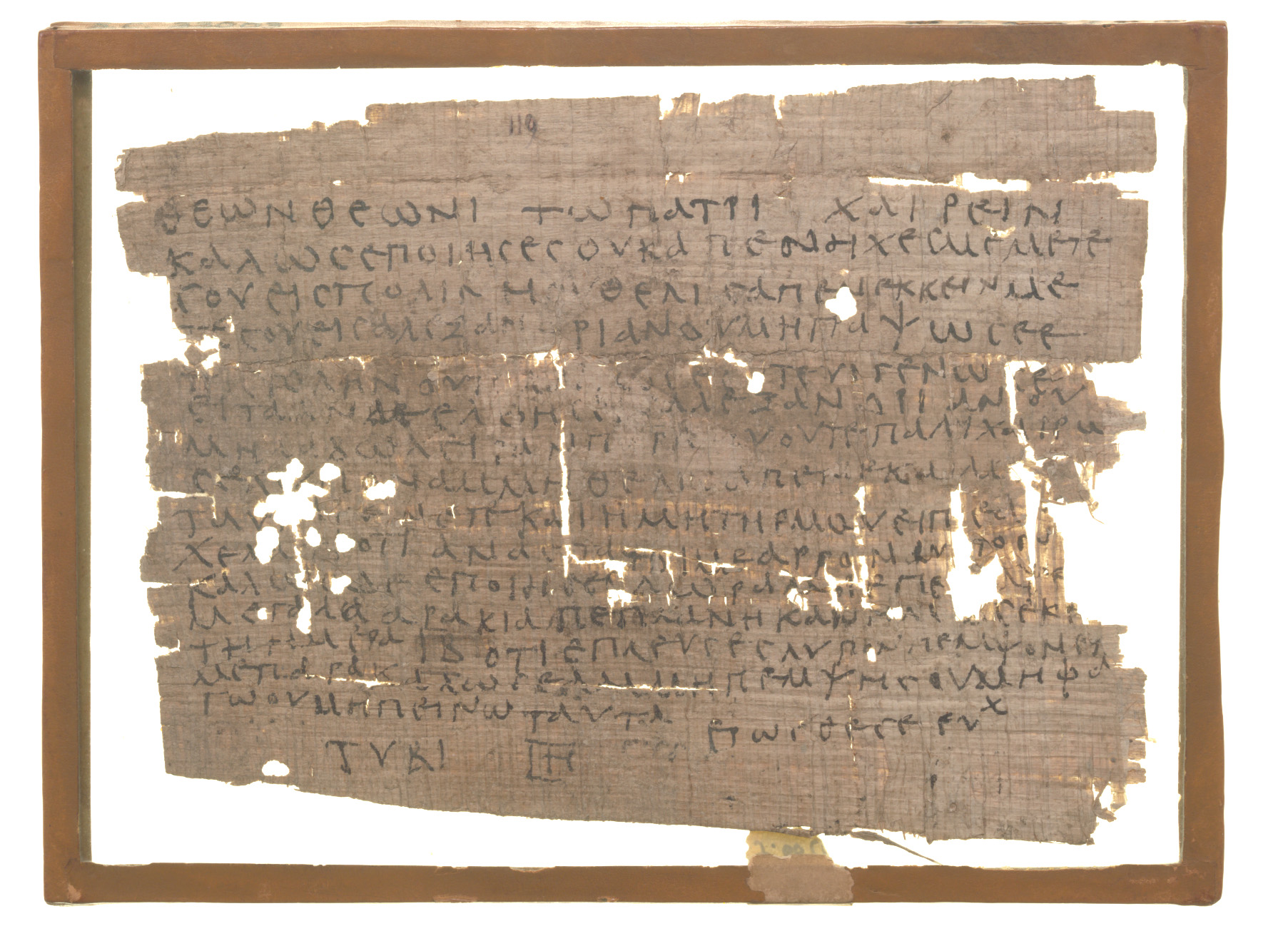
Letter from an Egyptian boy to his father, 2nd or 3rd century A.D. Copyright Bodleian Libraries, University of Oxford

Eliza arrived with her young son Fabian, who was mildly ill and did not attend school that day. His own choice was no surprise.  The exhibit that intrigued him the most was one of the earliest – about the same era, perhaps a little later, as the Sappho fragments: on a sheet of papyrus, an Egyptian schoolboy Theon complains to his father:

Theon to his father Theon, greetings. A nice thing to do, not taking me with you to the city. If you refuse to take me with you to Alexandria, I shall not write you a letter or speak to you or wish you good health. So: if you go to Alexandria I shall not take your hand or greet you ever again. If you refuse to take me, this is what happens. And my mother said to Archelaos, “He’s upsetting me, take him away!” A nice thing to do, sending me these grand presents, a hill of beans. They put us off the track that day, the 12th, when you sailed. Well then, send for me, I beg you. If you don’t send for me, I shan’t eat, I shan’t drink. There! I pray for your health.

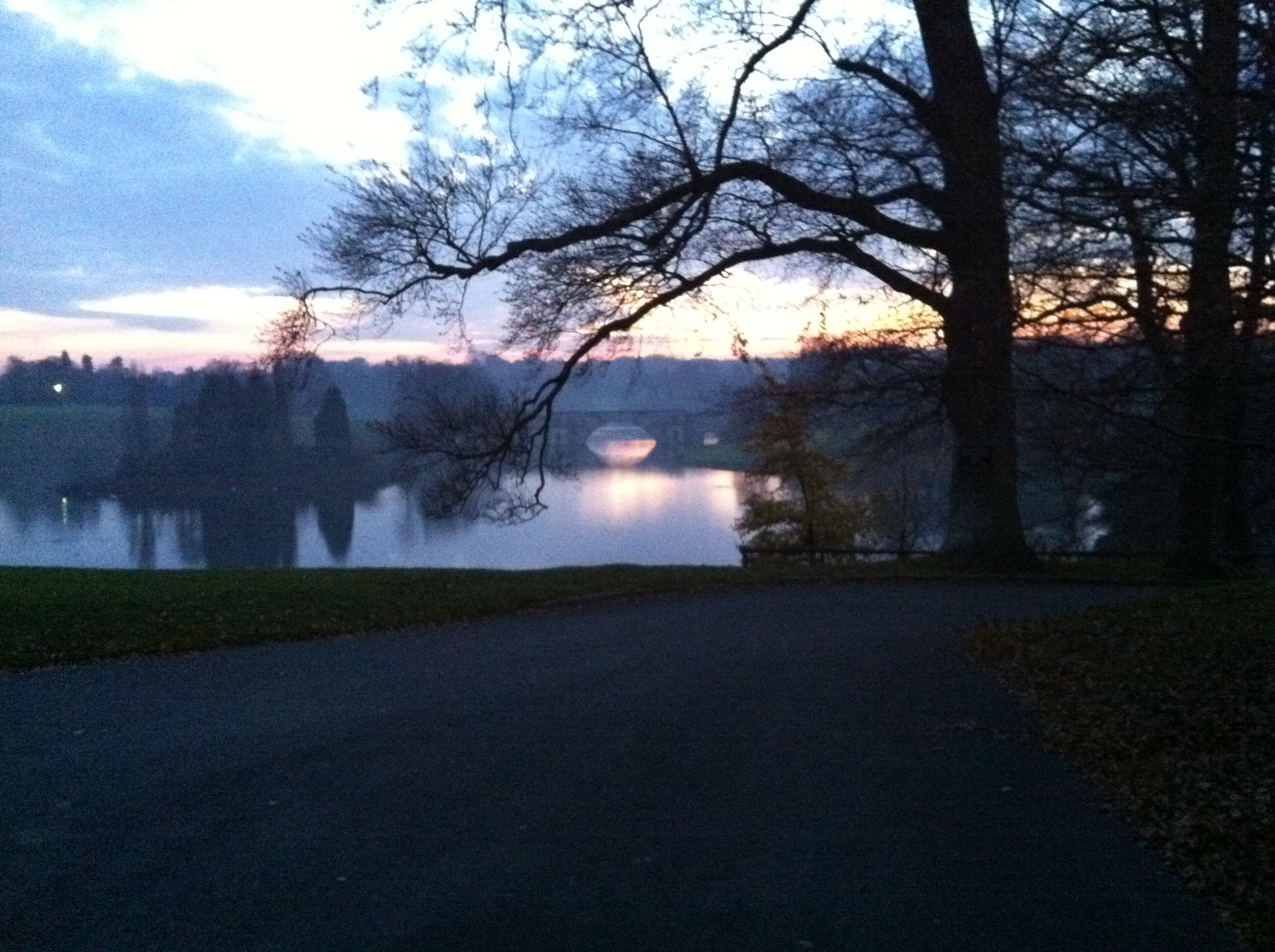
Blenheim at dusk: the most beautiful spot in the world?

Share

Winston Churchill said it was the best view in England … or perhaps the world. For him, it very likely amounted to the same thing.

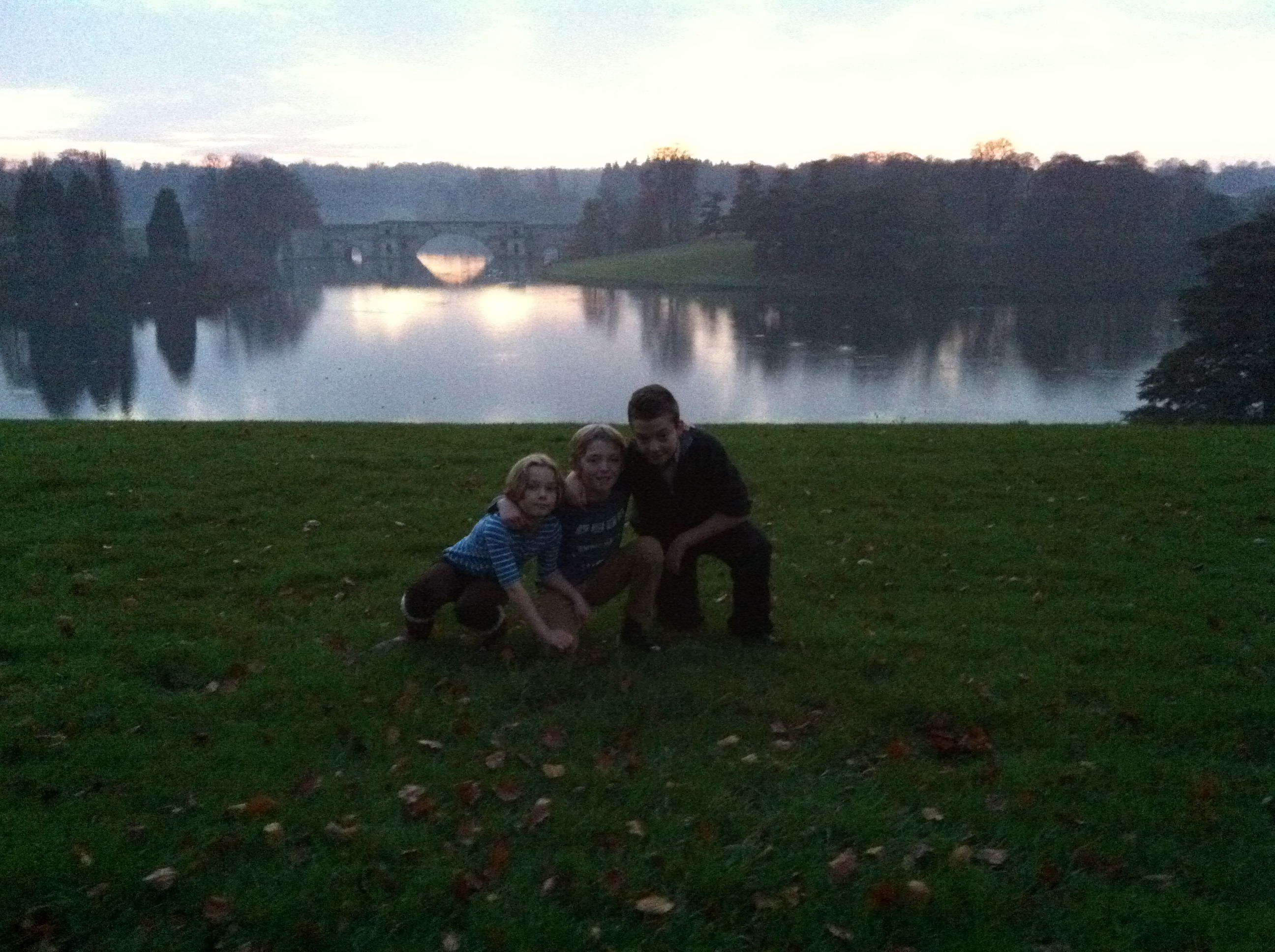
Tussling at dusk: Georgina, Fabian, and Milo Tudor Caruncho

At Blenheim Palace at dusk, or dawn, or any other time of day, it’s hard to argue the point. You walk in through the gate that leads from the town of Woodstock (not the grander entrance on the main road), look to your right, and you see this delicious scene.

Churchill’s views on his birthplace (he described the estate’s origins in his massive work,  Marlborough: His Life and Times) were related to me by my friend Eliza Tudor, who lives in nearby Wootton, next to Woodstock, the ancient burg where her ancestor Edward the Black Prince was born.

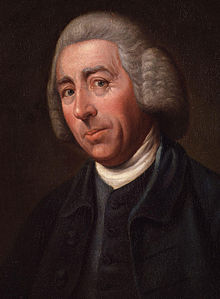
Capable.

Blenheim is, of course, the 18th-century palace where the Nobel writer Churchill was born, where he proposed to his future wife Clementine, and where all the Dukes of Marlborough lived (Sir Winston was, alas, was the son of a younger son).  It also represents the labor of England’s legendary landscape architect Capability Brown (marvelous name, that), who created two thousand acres of verdant slopes, leading to this lake, with architect Sir John  Vanbrugh‘s Grand Bridge.

Anyway, these pictures (except for Capability’s) are taken from Eliza’s iphone.  Not bad.  With only a little imagination, they take me away from a messy house, a score of emails and letters to write, and the dishes in the sink on a long holiday weekend.

Hope they do the same for you.  At least a little.

TLS: Czeslaw Milosz around the world

Share

Rock star treatment

What a nice way to celebrate Thanksgiving!  My article in the Times Literary Supplement is online today, and not behind a paywall.  It begins:

In May this year, the streets of old Cracow were dominated by two names, two events. Czeslaw Milosz’s centenary jostled with Pope John Paul II’s beatification in windows, on banners and billboards, on bookstore shelves, in fliers and leaflets – the pope, perhaps, having the edge over the Nobel laureate, except on the kiosks where Milosz Festival posters prevailed. “It seems to me every poet after death goes through a Purgatory”, Milosz told me over a decade ago. “So he must go through that moment of revision after death.” The “revision”, at this point, is a triumph of twenty-first-century branding and marketing, featuring commemorative books, pens, postcards, blank books, and T-shirts; Milosz’s scrawled signature appears on napkins and even on the wrappers of tiny biscotti.

The Works

Few poets have been feted with such rock star exuberance. The “Milosz Pavilion” on Szczepanski Square hosted literary luminaries such as Adam Zagajewski, Bei Dao, Tomas Venclova, Adonis, and Natalya Gorbanevskaya. (Even the reclusive Wislawa Szymborska made a rare public appearance with her colleague Julia Hartwig at the medieval St Catherine’s Church.) Meanwhile, the Jagiellonian University’s Collegium Novum sponsored a week-long scholarly conference with seventy participants from around the world, including the eminent critics Helen Vendler and Clare Cavanagh, and some leading Polish scholars. The Jagiellonian Library, farther from the centre of town, exhibited manuscripts, photographs and first editions. The events were attended by thousands. All this year, books have poured from Polish publishers. Most notably, Milosz’s own publisher, Znak, issued two hefty volumes: Andrzej Franaszek’s 1,000-page biography – a bestseller – and a new 1,500-page Collected Poems. A few of the literati complained to me that Milosz was not receiving his due among the younger generation – an honoured marble bust to be dusted off seasonally, but not read or remembered – but I saw plenty of evidence to the contrary.

The rest is here.