

450-year-old “raunchy love poem”? A little context, please.

Share

Pining for a lost love?

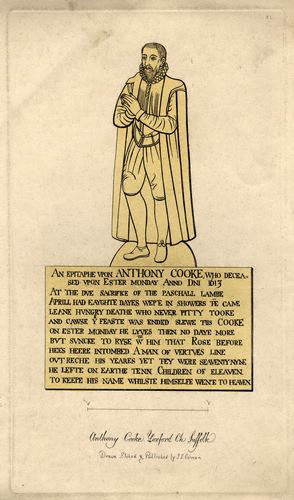
in a 16th century edition of Chaucer‘s works, a Florida professor has discovered a naughty poem in Latin, written by Elizabeth Leyburne, Duchess of Norfolk (1536–1567) to her former tutor, Sir Anthony Cooke (1504–1576).  She was 17, he was in his 40s when their paths crossed.  He was a hard-core Protestant; she was from a family of Catholic recusants.

Nothing interesting ever pops out of the books I open, except for the occasional shopping list, train ticket stub, or unpaid bill.  Still … the articles that have been written about this long-lost, lovelorn poem in Latin have mostly grabbed the wrong end of the stick.

Press attention has focused on the sole risqué line in the entire, rather plaintive poem.  Huffington Post rather prudishly calls it a “crude love poem” and “raunchy love poem” on the basis of this single line.  Yet the line in question is not even an original – it’s pinched from Martial.  Apparently, it still strikes modern people as a surprise that their forbears were not celibates, although our very existence would seem to argue to the contrary.

Cooke, the recipient of the letter, went on to become a mentor to Edward VI, the kid brother of Queen Elizabeth and also a Protestant hard-liner with a puritanical streak.

Elizabeth Leyburne went on to marry twice – at the age of 19 to Thomas Dacre, 4th Baron Dacre of Gilsland, and shortly after his death over a decade later, to the queen’s cousin, Thomas Howard, 4th Duke of Norfolk.  The poem was apparently written when she was a young mother and wife of Dacre, perhaps glancing back at what never was.
More warm-blooded than he seems?

The articles seem to take no particular interest in who these people are, beyond the simplest outlines of their lives, and blithely wonder why she did not divorce to get it on with Cooke.

What is missed is a far more subtle, and nuanced tragedy of the terrible English Counter-Reformation.  While I was reviewing Peter Ackroyd‘s Shakespeare: The Biography for the Washington Post, I noted the author’s confusion over Shakespeare’s Protestant and Catholic pals, as he tried to draw conclusions over the playwright’s religious affiliation.  He overlooked the obvious conclusion: the government cared a lot more about theological distinctions and church affiliations than the people did.

For example, although he was a Protestant reformer, Cooke’s daughter Margaret became a lady-in-waiting to Queen Mary, the Catholic sister who succeeded Edward VI (the epithet “Bloody Mary” is not entirely fair, and could just as easily been bestowed on her half-siblings).  Meanwhile, Cooke was exiled during Mary’s reign – he had backed the doomed nine-day reign of King Edward’s childhood pal, the scholarly Lady Jane Gray.

Cooke’s memorial at the Romford parish church notes his “exceptional learning, prudence and piety.”  However, his recent biographer Marjorie Keniston McIntosh, describes him as “a strong protestant of a dark and unforgiving colour.”

Just the kind of glowering, older Heathcliff a young 17-year-old girl might want to die for.

The article goes quickly to cite what the professor calls Howard’s “cruelty” in not calling for a priest as his wife was dying in childbirth: “the Duchesse . . . desir’d to have been reconciled by a Priest, who for that end was conducted into the garden, yet could not have access unto her, either by reason of the Duke’s vigilance to hinder it, or at least of his continual presence in the chamber at that time.”
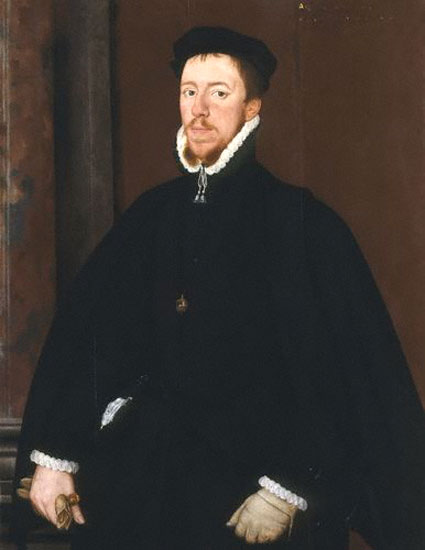
The man she married...

Not so fast.  The Howard family was a prominent recusant family.  Or was it? The line between “Protestant” and “Catholic” was much more fluid and complex than we assume it to be today.  The nature of the Great Elizabethan Compromise was the queen’s promise to leave her subjects’ beliefs alone, as long as they attended her Church each Sunday. It was a subtle maneuver:  How long can you keep your beliefs unaffected by your daily actions? Those who complied with her requirements, over the years, or over generations, became Protestant in their hearts.  What you do is as important as what you think.

The battle was won, but the debt is being paid centuries later:  A 2006 New Yorker article described how Elizabeth’s machinations led to a church which, founded on compromise, is now compelled to compromise  itself out of existence in the 21st century.

The Great Compromise also set loose a network of government spies, headed by Walsingham.  For the government knew that a man’s thoughts, not his compliance, were the true indicator of his allegiance, so thoughts became the enemy.  Perhaps that’s why, in Shakespeare’s plays, there’s always someone behind a bush or arras, eavesdropping on a private conversation.

How, after all, could you find out what was in a man’s heart?  However, only those who insisted on an outward fidelity, rather than merely an inward one, could be executed.  So Howard’s reluctance to invite a priest in for last rites was probably mortal terror rather than religious scruples or hard-heartedness. Harboring priests could get you killed.

He got killed in any case, and for reasons mixed up with religion. As Elizabeth’s widower, would meet his own death after trying to negotiate (yet another) marriage with the imprisoned Mary Queen of Scots, a rallying force for the Catholics in England and a fervent Catholic herself.  The Scottish queen’s plotted alliance with a kinsman of Queen Elizabeth, and the richest man in the kingdom, would have further solidified her claims to the throne.  The queen’s beloved coz was beheaded in 1572.
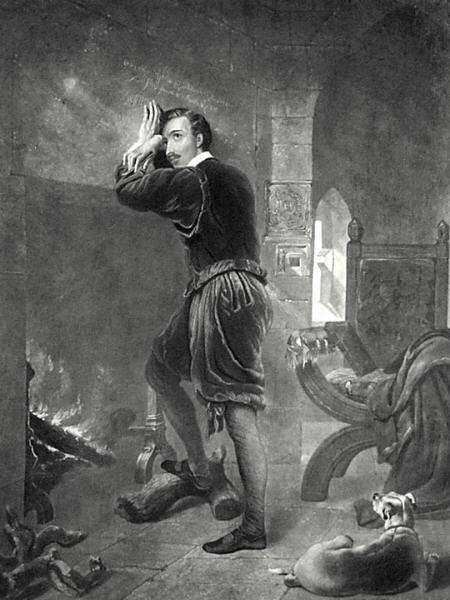
Her son-in-law, in the Tower

His son, Philip Howard, previously an aristocratic wastrel, converted to Catholicism and died a prisoner of conscience – and after long neglect of his wife, he became a devoted husband to boot.

As he lay dying in the Tower of London, he asked the queen if he could have a final visit with his wife and son, who was born during his imprisonment. The Queen responded, “If he will but once attend the Protestant Service, he shall not only see his wife and children, but be restored to his honors and estates with every mark of my royal favor.”

He replied: “Tell Her Majesty, if my religion be the cause for which I suffer, sorry I am that I have but one life to lose.”

Elizabeth Leyburne would have taken note with a motherly pride:  The wife to her stepson was her own stalwart daughter, Anne Dacre, who has also been mentioned as a candidate for sainthood.

All of which makes a far more interesting story than one overheated line, recalling a love that was likely unrequited.  Cooke seems rather a cold fish.  One never knows, however.  Even cold fish get fried.

Read the rest here or here or here.  You’ll even see a photo of her precise Latin penmanship.


Most beautiful college libraries in the world, with a nomination of our own.

Share

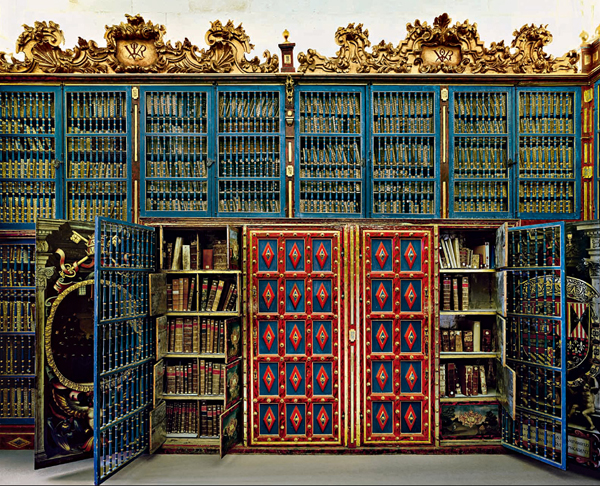
Coimbra

‎Today is the birthday of journalist and author H. Allen Smith, born on this date in 1907, who wrote, “The human animal differs from the lesser primates in his passion for lists of Ten Best.”

The Book Haven is no exception, so naturally we were suckers for Flavorwire‘s list of “25 Most Beautiful College Libraries in the World”:

The college library, whether ornate or modern, digital or dusty, is in many ways the epicenter of the college experience — at least for some students. It is at once a shining emblem of vast, acquirable knowledge, a place for deep discussions and meetings of the mind, and of course, a big building full of books, which, as far as we’re concerned, is exciting enough. Colleges and universities are understandably quite proud of their libraries, which can be a selling point for prospective students and donating alumni alike, and they often become the most well-designed and beautifully adorned buildings on campus.

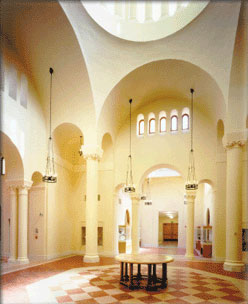
Salamanca

OK, this isn’t a Ten Best, but a 25 best.  It also cheats a bit – Oxford’s many colleges are treated separately, so it gets to hog a few extra places.  Cambridge claims awards for both St. John’s and Trinity; Oxford bags honors for Queen’s College, All Souls’, and the Bodleian. Commenter Ravi notes that 13 of the 25 libraries are in the U.S., and five in England – which hardly seems a global perspective, anyway.

But two of the top spots (#1 and #3) go to the Iberian peninsula, and libraries I’d never heard of:  the University of Coimbra General Library in Portugal and the University of Salamanca Library in Spain.  We can’t resist these photos.  We can’t resist half the photos in Flavorwire‘s collection.

Closer to home … Green Library

Among the comments: “Looks like the only criteria is a high ceiling,” grumbled  Kevin.  A commenter called “H” noted that “Many of the American ones look like dining halls.”  Jonathan Miller had an observation: “The most beautiful library is one filled with readers. Too many of these photographs are of empty libraries.”

California gets a few of the honors:  Doe Library at Berkeley gets a mention.  So does UCLA’s Powell Library  … but, but, but … may we make our own nomination? (One commenter, Maggie, noted the same omission).

Stanford’s Green Library is splendid, but then I’m prejudiced.  I’ve spent more hours in its nooks and crannies than any other library on the planet. I used to have fantasies of the “Big One” happening while I was buried in the stacks of West 7, leaving my body forever unrecoverable beneath the books. But perhaps I would have gotten in a few quiet reading hours in the meantime.

What a way to go!


Václav Havel, the dissident writer: “metaphysics more dangerous than a direct message”

Share

Havel: "warm, intense, a concentration of nervous energy"

Václav Havel is dead.  All the talk about the man as activist, leader, the Czech Republic’s first democratically elected president, tends to overlook the playwright and writer, renowned in the Cold War for his 145 published prison letters to his wife, Letters to Olga.

So I turned to the only Havel book in my library, Living in Truth, a collection of 22 essays by and about him, published on the occasion of the award of the Erasmus Prize in 1986.

In “Prague – A Poem not Disappearing,” Timothy Garton Ash recalls that, during the 1980s, he was  “determined to visit Václav Havel.”  This is what he found:

“Havel is a short, stocky man with curly blond hair; his moustache and lower face remind me of a friendly walrus.  … He is warm, intense, a concentration of nervous energy. …

He talks about the nervous strain of writing under these conditions, when at any moment the police might walk in and confiscate a year’s work. How he has crept out into the woods at night and buried parts of his typescript in the hole of a tree.  How as a manuscript piles up he writes faster and faster: the fear of a house search concentrates the mind wonderfully. Far more effective than any publisher’s deadline. Just yesterday he was writing about this nervous tension. Then his wife came in and said ‘The police are outside again. I’m afraid they aren’t our usual ones.’ …

Determined to visit

This is nothing compared with the conditions under which he wrote in prison. There he was not allowed to write at all, except for one letter a week to his wife – maximum four sides, and only about ‘personal matters’, as the prison regulations specify. This was his only opportunity to express himself as a writer, over a period of almost four years.  If any part of a letter was unacceptable, the whole letter would be confiscated. The commandant of the prison camp at Hermanice took a sadistic delight in enforcing this instructions. … His particular delight was censoring the writer’s letters. Havel started writing a ‘cycle’ of letters about his philosophical views. He mentioned the ‘order of being’. ‘The only order you can write about’, declared the commandant, ‘is the prison order’. Then he decided Havel should not write about philosophy at all.  ‘Only about yourself.’  So Havel designed another cycle of letters on the subject of his moods: sixteen of them, two to each letter, one good, one bad. And he numbered them.  After eight, the commandant called him in: ‘Stop numbering your moods!’  ‘No foreign words!’ he ordered one week. ‘No underlining!’ the next.  ‘No exclamation marks!!'”

"an end to the finite"

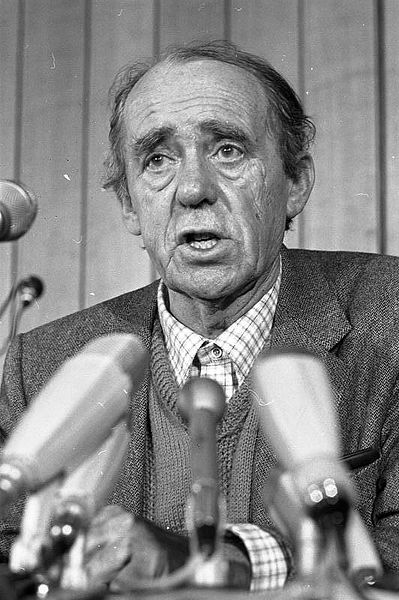
A chapter earlier, Nobel writer Heinrich Böll, in “A Courtesy Towards God,” quotes Czech politician Jiří Dienstbier that “Václav Havel was a particular target for persecution.’ His overall manner of courtesy, of having been ‘well brought up’, gave the impression that he was ‘soft and easily broken’.  It was seductive.  ‘Those around him reacted all the more excitedly to Havel’s unyieldingness, to this “inaccessible systematist”, who even tidied up his prison cell in so precise and presentable a fashion that it could have served as the model for the graduates of an officers’ training school.'”  Then Böll adds:

“Havel nevertheless managed, in spite of the censorship, to smuggle out a scale of his moods … he devotes himself at great length to the ‘dejectedness of Sunday’, to what he calls this ‘problem of civilization bearing the name Sunday’. These moods, in particular those on Sundays, are to him ‘the typical cracks through which nothingness finds its way to man, this modern face of the Devil’.  He does not shrink from calling it by name.  …

‘The global wonder of existence’, that peace of mind which ‘Christians call mercy’, was also allowed through. One would have had to be a censor in order to review these letters.  Is not so much metaphysics more dangerous than many a direct message?  The following resulted from a particularly beautiful moment in the prison yard: ‘The more beautiful the moment, the more distinct is the growth of the eerie question:  What else? What more? What now? What next? What am I to do, and what will I achieve? I would describe this as the feeling of having arrived at a kind of end to the finite.'”


“The deadliest artifact in the history of civilization” – and the worst is yet to come

Share

The holiday season is upon us, bringing eggnog, fruitcake, plenty of brandy – and a lot of stress.  Time to take a break, light up, have a smoke, and postpone that “quit” pledge till 2012…

Stop!  Consider this post a Public Service Announcement.  My article from earlier this week, from a new book about smoking, is perhaps the best Christmas present I can give to the readers of The Book Haven:

The cigarette industry is not dying. It continues to reap unimaginable profits. It’s still winning lawsuits. And cigarettes still kill millions every year.

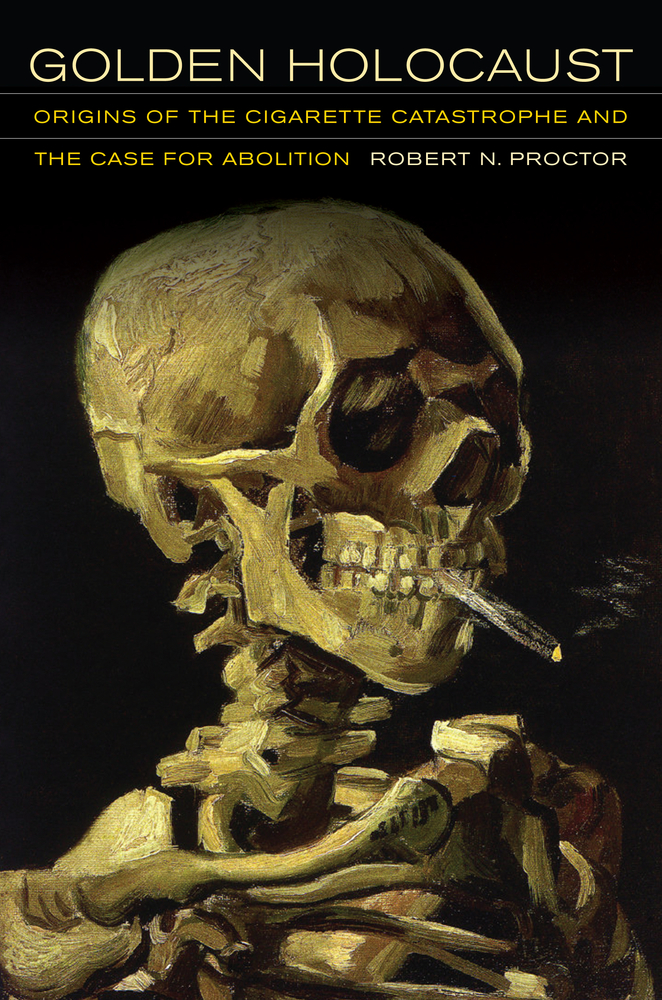
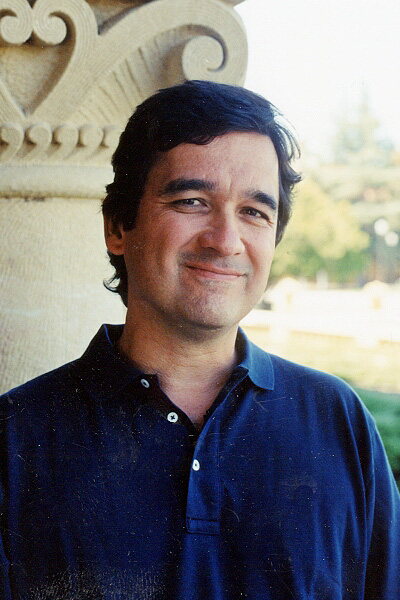
So says Stanford’s Robert Proctor, author of the new bombshell study, Golden Holocaust: Origins of the Cigarette Catastrophe and the Case for Abolition, a book the tobacco industry tried to stop with subpoenas and hundreds of thousands of dollars in legal fees.

Proctor, the first historian to testify in court against the tobacco industry (in 1998), warns that the worst of the health catastrophe is still ahead of us: Thanks to the long-term effects of cigarettes, “If everyone stopped smoking today, there would still be millions of deaths a year for decades to come.”

“Low-tar” cigarettes? “Light” cigarettes? Better filters? Forget it, he said. They don’t work. Today’s cigarettes are deadlier even than those made 60 years ago, gram for gram.

Half the people who smoke will die from their habit. A surprising number will die from stroke and heart attacks, not cancer.

Moreover, he asks, “How many people know that tobacco is a major cause of blindness, baldness and bladder cancer, not to mention cataracts, ankle fractures, early onset menopause, ectopic pregnancy, spontaneous abortion and erectile dysfunction?”

Six trillion cigarettes are smoked every year – that’s 6,000,000,000,000. Proctor said that’s “enough to make a continuous chain from Earth to the sun and back, with enough left over for a couple of round trips to Mars.”

His 750-page book, a decade in the making, has already earned high praise, with terms like “a real page-turner,” “a must-read,” “the most important book on smoking in 50 years.”

“This book is a remarkable compendium of evil,” wrote Columbia’s David Rosner, an author of Deceit and Denial: The Deadly Politics of Industrial Pollution. “It will keep you spinning from page one through the last. … It is the type of book that makes you wonder how, in God’s name, this could have happened.”

According to Donald Kennedy, Stanford president emeritus and former editor of the journal Science, the book “unpacks the sad history of an industrial fraud. [Proctor’s] tightly reasoned exploration touches on all topics on which the tobacco makers lied repeatedly to Congress and the public.”

The hefty book has not only won him accolades, but it’s personally cost Proctor $50,000 in legal fees to defend himself against the industry, which subpoenaed his email and unpublished manuscript.

According to an article in The Nation last year, Proctor is one of only two historians who currently testify on behalf of smokers injured by tobacco products; 50 have testified on behalf of the industry. Academics from virtually every discipline have been collaborating with the Marlboro Men – and made big money doing so.

“This is the biggest breach of academic integrity since the Nazis,” he said, and “certainly the most deadly.”

Such language is typical for Proctor. When it comes to cigarettes, he speaks in provocative superlatives, pulling no punches.

Cigarettes are “the deadliest artifact in the history of civilization” – more than bullets, more than atom bombs, more than traffic accidents or wars or heroin addiction combined. They are also among “the most carefully and most craftily devised small objects on the planet.”

“The industry has spent tens of billions designing cigarettes since the 1940s – that’s from the industry’s own documents,” he said.

He also marshals evidence to show that smoking contributes substantially to environmental damage, even global warming: “When we finally decide to take seriously the problem of global climate change, cigarettes will come under increasing scrutiny. Tobacco agriculture and cigarette manufacturing have heavy carbon footprints – think deforestation and petrochemical pesticides – and cigarettes are leading causes of fires and industrial accidents. There’s not much room for cigarettes in an environmentally conscious world.”

For the industry, though, the cigarette represents the perfect business model. “It costs a penny to make. Sell it for a dollar. It’s addictive,” says investment guru Warren Buffett. Proctor notes that “by artfully crafting its physical character and chemistry, industry scientists have managed to create an optimally addictive drug delivery device, one that virtually sells itself.”

“There’s hundreds of things people don’t know about smoking,” said Proctor. Myths have instead lulled the public into complacency. He listed a few of the most common:

Myth #1. Nobody smokes anymore. If you read the media, smoking sounds like a dying habit in California. That’s far from true, said Proctor. Californians still smoke about 28 billion cigarettes per year, a per capita rate only slightly below the global average.

So why do we have this illusion? “We don’t count the people who don’t count. It’s not the educated or the rich who smoke anymore, it’s the poor,” said Proctor.

Also, look at popular social trends – the recent trendiness of cigars, for example. Or the current fad for hookah parties. He recalled one such event at Stanford: “They would never have a Marlboro party. But hookah is just as addictive, and just as deadly.”

Myth #2. The tobacco industry has turned over a new leaf. “The fact is that the industry has never admitted they’ve lied to the public or marketed to children or manipulated the potency of their project to create and sustain addiction,” Proctor said. “A U.S. Federal Court in 2006 found the American companies in violation of RICO racketeering laws, and nothing has changed since then. And the same techniques used in the past in the U.S. are now being pushed onto vulnerable populations abroad.”

Myth #3. Everyone knows that smoking is bad for you. Proctor pointed out that most people begin smoking at the age of 12 or 13, or even younger in some parts of the world. “Do they know everything?” Proctor asked rhetorically. “And how many people know that cigarettes contain radioactive isotopes, or cyanide, or free-basing agents like ammonia, added to juice up the potency of nicotine?”

Myth #4. Smokers like smoking, and so should be free to do it. And the industry has a right to manufacture cigarettes, even if defective. Proctor called this “the libertarian argument.”

“It is wrong to think about tobacco as a struggle between liberty and longevity; that tips the scales in favor of the industry. People will always choose liberty, as in ‘Give me liberty or give me death.’ What people don’t realize is that most smokers dislike the fact they smoke, and wish they could quit. Cigarettes are actually destroyers of freedom.”

There are tobacco industry documents, he noted, in which smoking is compared not to drinking but rather to being an alcoholic. Proctor also points to how we handle other forms of toxic pollution: “We don’t allow kids to play with toys coated with lead paint. We don’t drive cars that don’t meet safety standards.”

The upshot: “People should be free to smoke wherever it harms no one else, but cigarettes as now designed are too dangerous to be produced or sold.”

Myth #5. The tobacco industry is here to stay. Global tobacco use would be declining were it not for China, where 40 percent of the world’s cigarettes are made and smoked. Proctor has a bet with a colleague, though, that China will be among the first to bar the sale of cigarettes, once their financial costs are recognized. Governments throughout the world have benefited from tobacco taxes, which he calls “the second addiction.” The costs of paying for diseases caused by smoking are high, however – especially when you count lost productivity – and governments will start winding down on tobacco, he says, once this is taken seriously.

Proctor also said that in the United States, a “Kafkaesque world” divides smokers and non-smokers. The industry has computerized databases of virtually all smokers and spends over $400 per smoker per year on special offers, coupons, sign-ups and other direct mail approaches – an unseen world to non-smokers. “This is precisely how the industry wants it; a fungus always grows best in the dark,” he writes.

Proctor admits to a personal motivation for his research. Three of his grandparents died from smoking – one from emphysema, another from lung cancer and a third from a heart attack in his mid-50s. The family blamed the last death on eating too many eggs. “That’s the story,” said Proctor, “but he smoked nonstop.”

For Proctor, then, his engagement with Big Tobacco is more than just research: “It’s part of my sense of what it means to be an ethical human being, using my expertise to do what’s right for humanity on the planet.”

The Book Haven is moving!

Share

Roland Greene, our hero

The Book Haven is moving to a different server this week, and will have a new home with Arcade.  Frankly, we’re very pleased about our new digs.  Arcade is kind of a Huffington Post for academics and others, under the benevolent guidance of Stanford’s Roland Greene, the site’s director, and an editorial and consulting board that includes some of the nation’s most eminent scholars.

You’ll be able to reach us via the same URL, and it will be the same Book Haven – it’s just that we’ll be neighbors with an elite crew instead of sitting out here all by our lonesome.

As I wrote last year:

Pretty much by word-of-mouth alone, and some nifty technological know-how, it’s now attracting more than 5,000 visitors a day.

Arcade provides a venue for scholarly articles, an intellectual network, a public conversation, a digital salon and a sounding board for ideas before they wind up between hard covers. “In my field, it’s really a boon,” said Greene, professor of English and of comparative literature. “There’s nothing like it on the web.”

The site hosts two digital-only journals – Occasion and Republics of Letters. It includes podcasts and videocasts on “The Arcade Channel” and discusses works in progress on “ArcadeWorks.”

“The Art of Translation,” in conjunction with San Francisco’s Center for the Art of Translation, also nests on the site, along with about 35 bloggers (discussions are pending to add about 20 more).

Arcade describes itself, in a brochure, as “curated but participatory” and “technologically rich in the service of ideas.”

Fine company indeed.  So, thanks, Roland!  And thank you, Arcade! And be patient, gentle readers (in the last day alone, from Uganda, Palestine, Slovakia, Guyana, Latvia, Sri Lanka, Belarus, and Kuwait, among other more or less exotic locales), there may be a few bumps during the transition from the Stanford News Service, but all shall be well.

The bashing of Helen Vendler

Share

Has she been "slimed"?

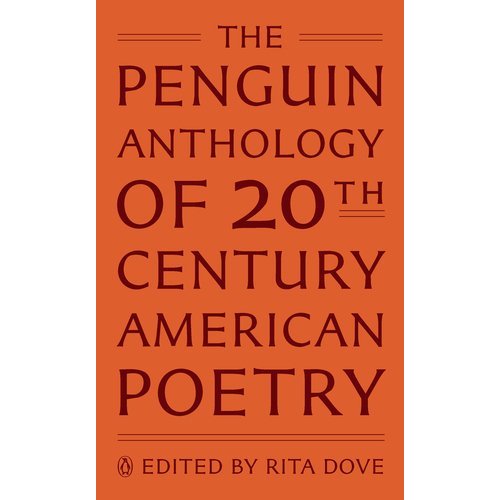
The internet has been warmed this week by the fires between Harvard critic Helen Vendler and former U.S. poet laureate Rita Dove.  The upshot: Vendler didn’t like Dove’s Penguin Anthology of Twentieth-Century American Poetry, and Dove didn’t like that Vendler didn’t like it.  Angry letters have been pouring in against Vendler.

Vendler’s Nov. 24 article in the New York Review of Books, “Are These Poems to Remember?” notes: “Multicultural inclusiveness prevails: some 175 poets are represented. No century in the evolution of poetry in English ever had 175 poets worth reading, so why are we being asked to sample so many poets of little or no lasting value? Anthologists may now be extending a too general welcome. Selectivity has been condemned as ‘elitism,’ and a hundred flowers are invited to bloom. … Which of Dove’s 175 poets will have staying power, and which will seep back into the archives of sociology?” Why only six pages for Wallace Stevens, and no more than the single poem from James Merrill?

Vendler takes particular aim at Dove’s introduction:

“She denigrates Frost’s ‘Design’ and ‘Acquainted with the Night,’ for instance, as ‘blunt and somewhat smug,’ calls Eliot ‘a sourpuss retreating behind the weathered marble of the Church,’ and says that Elizabeth Bishop ‘somehow managed to chisel the universe into pixilated uncertainties.’ Merrill, whose ‘formal verse placed him squarely on the side of the poetry establishment,’ is said to have shed ‘the jeweled carapaces of formalism in favor of the rules of the Ouija board.’ Can Dove think that a poet of Merrill’s depth can be confined to the putative space of a vague ‘poetry establishment,’ or that placing poets on one side or another of such an assumed ‘establishment’ says anything about their abilities? And as a poet herself, she must know better than to refer metaphorically to formal verses as ‘jeweled carapaces’: carapaces belong, after all, to insects and tortoises. Such cartoonish remarks are not helpful to the understanding of poetry. …

She stands by her review.

These are the kind of passages that makes every writer cringe.  Who among us can throw the first stone?  Haven’t we all written hastily, sloppily sometimes?  On the other hand, that’s exactly what critics are for: to spank us when we do.

Dove responded in a 1700-word letter.  She could have done it more effectively with far fewer words.  She has some good points to make. Taking on Vendler’s comment,  “Did Dove feel that only these poems [five early poems by Stevens] would be graspable by the audience she wishes to reach? Or is it that she admires Stevens less that she admires Melvin Tolson, who receives fourteen pages to Stevens’s six?”

Ah, here we go, totting up pages of poetry rather than the poems themselves. Tolson is represented by two poems (actually, one poem and one section of a book-length poem); Stevens by six. Should Tolson be denied representation because he writes long poems? As far as the selection of early Stevens goes, my original choices included several middle-period poems, but rights problems prohibited their final inclusion. I can’t expect Vendler to know this, and though it is a sad comment on the deplorable state of the American reprint permissions process, I accept responsibility for the resulting omission. However, in juxtaposing a great Anglo-American poet with a great African-American one, Vendler immediately draws unsubstantiated conclusions that fit her bias.”

But then Dove goes too far.  She accuses Vendler of racism, and stoops to attack the critic rather than the criticism. Finally she foams: “I would not have believed Vendler capable of throwing such cheap dirt, and no defense is necessary against these dishonorable tactics except the desire to shield my reputation from the kind of slanderous slime that sticks although it bears no truth … she not only loses her grasp on the facts, but her language, admired in the past for its theoretical elegance, snarls and grouses, sidles and roars as it lurches from example to counterexample, misreading intent again and again.”

Vendler’s response is short: “I have written the review and I stand by it.”  It’s not a “cheeky” reply, as The Atlantic Wire wrote.  It’s professional.  And The Atlantic is also wrong in asserting that “what they’re really fighting about” is “each other’s credentials.”

Largely, the two women have a different idea of what anthologies should do, and it’s a discussion worth having.  Is Vendler looking for a “Top Ten,” Dove asks?  Truly, there is a lot to be said for favoring a minor, relatively unknown poet who lights a fire in a few souls over some widely accepted canonical poets. How to balance the worrying, risky – and inevitably biased and unfair – process of winnowing against the easy out of letting 175 flowers bloom?

Also, Vendler is reacting to a literary world where poets often have an eye to classroom sales. Bashing off a quick anthology with a breezy introduction is a cash cow for an otherwise poorly remunerated profession.  I’ve seen some shamefully sloppy stuff from some very prominent poets – they get away with it because their names are big.

Fortunately, James Fenton at the London Evening Standard takes a more even-handed p.o.v., and slaps down political correctness and Penguin, too, while he’s at it:

The best thing Dove could have done was shut up and let people draw their own conclusions. Vendler is known to “bear, like the Turk, no rival near the throne”. Perhaps this was just another example of territoriality.

Excepting that it wasn’t. In most, though not in my opinion all, of her criticisms, Vendler put her finger on blatant weaknesses, although she ignored the most obvious weakness of all: nothing by Sylvia Plath, and nothing by Allen Ginsberg. Dove explains in her introduction that her permissions funds did not run to such expensive poets, and she says to the reader: “For these involuntary gaps, I ask you to cut me some slack.”

This is just not good enough, and the fault here is largely with Penguin for not seeing the difficulty Dove was in and coming to her aid. A small publisher might plead for the reader’s understanding over such omissions. A large one has to decide whether it is prepared to stump up the money to do the job properly.

Fred Viebahn offered this tidbit in the comments section of the London article, pointing out Dove’s words in the Dec. 2011 edition of The Writer’s Chronicle: “… the worst offender by far [demanding outrageous fees] was the publisher of Sylvia Plath and Allen Ginsberg, whose ‘couldn’t care less’ attitude resulted in none of this house’s authors being included … Negotiations dragged on literally until the day when the anthology went into production; seeking common ground, I offered several solutions, including reducing the overall number of poems … while meeting their exorbitant line fees … The answer was nothing less than shocking: All or nothing. In other words, if I didn’t pay the same high line fees for all their poets as well as, unbelievably, take all the poems I had initially inquired about, I couldn’t have Ginsberg nor Plath … Pleas from upper Penguin management and even from one of the affected poets, who declared his willingness to forgo royalties, fell on deaf ears; the day before the anthology went into production, [the publisher of Plath and Ginsberg] withdrew all pending contracts and declared the negotiations closed.” He adds that  paying more for some permissions would have violated agreements with other publishers that did not permit to “robbing Peter to pay Paul.”

He ought to know. He’s Rita Dove’s husband.

Helen Vendler will be speaking on “Wallace Stevens as an American Poet” at 6 p.m. on Tuesday, Jan. 17, in the Stanford Humanities Center. The event is free and open to the public.