
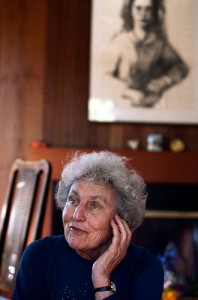
Tillie Olsen in 2001
I interviewed Tillie Olsen circa 1983 when Marilyn Yalom‘s Women Writers of the West Coast was first published. It was a brief but bracing experience. I unwittingly mentioned a third writer who triggered a bitter association. The telephone nearly burned my hand.
Apparently, Olsen could be somewhat prickly — as confirmed in this account published in the Sacramento Bee this week. Panthea Reid’s almost-500-page biography, Tillie Olsen: One Woman, Many Riddles, is “the first book to unravel the riddle of a life devoted to and tormented by writing,” according to the Kansas City Star.
The reviewer, Carl Rollyson, has a somewhat mixed reputation as the author of an unauthorized biography of Susan Sontag. But anyone who has worked in the umbra or penumbra of biography will appreciate this account:
Panthea Reid was flattered when Olsen responded affectionately to one of Reid’s appreciative letters. But the correspondence ended when Reid announced she wanted to write Olsen’s biography.
A year passed and after making contact with Olsen’s family, Reid began to get her subject’s cooperation. All to the good, until Olsen balked at granting the biographer’s request for permission to quote from Olsen’s Stanford University archive.
What was the problem? Like Huckleberry Finn, Tillie Olsen did not mind telling quite a few “stretchers.” In fact, Olsen had not witnessed the aftermath of a black man’s terrible beating; she had not been held back in school because she was deemed retarded. Her dramatic versions of her childhood were false or wildly exaggerated, as Olsen’s brother and others were quick to tell Reid.
It brings to mind Lillian Hellman‘s tall tales — which caused Mary McCarthy to remark “every word she writes is a lie, including ‘and’ and ‘the.'” The fighting words on The Dick Cavett Show in 1979 triggered a $2.25 lawsuit, which ended only with Hellman’s death.
Reid’s story has a happy ending, however — at least for the “sly biographer,” who composed a statement lauding Olsen for making her archive at Stanford University available to scholars – “and then slipped in a phrase about giving permission to quote. ‘What a nice letter,’ Olsen said, as she signed her approval.”