Philip Larkin on WWI: “Never such innocence again.”

Share
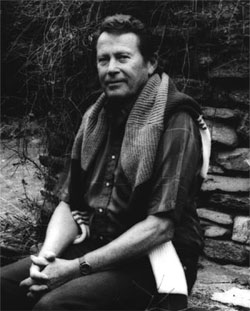
philip-larkin-1943-006

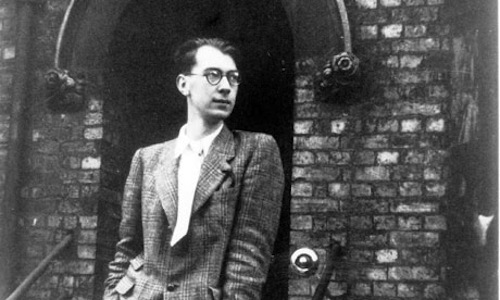
Larkin at Oxford in 1943, before “the failures and remorse of age.”

W.H. Auden‘s “September 1, 1939” was a World War II poem, without a single gun in it, and then had a powerful revival on 9/11. The New York Times recounted its newfound fame:

”Auden’s words are everywhere,” wrote the author of a ”Letter From New York” in The Times Literary Supplement of London. At least a half-dozen major newspapers reprinted ”September 1, 1939” in its entirety. It was read on National Public Radio. It was introduced into hundreds of chat rooms on the Internet. In the Chicago area, the Great Books Foundation and The Chicago Tribune sponsored discussions of it. Students at Stuyvesant High School, four blocks from ground zero in Manhattan, produced a special issue of their school newspaper (which The New York Times distributed to its readers in the metropolitan area) prominently featuring one of the poem’s most familiar lines, ”We must love one another or die.”

Surely, however, it shared the somber honors with Adam Zagajewski’s “Try to Praise the Mutilated World,” which appeared on the back cover of the New Yorker after 9/11.

zagajewski

Praising the mutilated world…

Could the poem for World War I be Philip Larkin‘s MCMXIV? It’s getting a lot of play this month, during the centenary of the beginning of the Great War.  The poem was first published in 1964, fifty years after the events it describes, in the collection Whitsun Weddings. 

A few words from critics about Larkin that I found along the way: Andrew Sullivan feels that Larkin “has spoken to the English in a language they can readily understand of the profound self-doubt that this century has given them.” X.J. Kennedy wrote that Larkin’s oeuvre is  “a poetry from which even people who distrust poetry, most people, can take comfort and delight.” J. D. McClatchy said that Larkin wrote “in clipped, lucid stanzas, about the failures and remorse of age, about stunted lives and spoiled desires.”

XCMXIV is only one remarkable sentence long  (mind the punctuation), and describes the enlistment of naïve young men at the war’s outset. Read it, and hear it, in the video below.


Congratulations, once again, to Dana Gioia!

Share
gioia

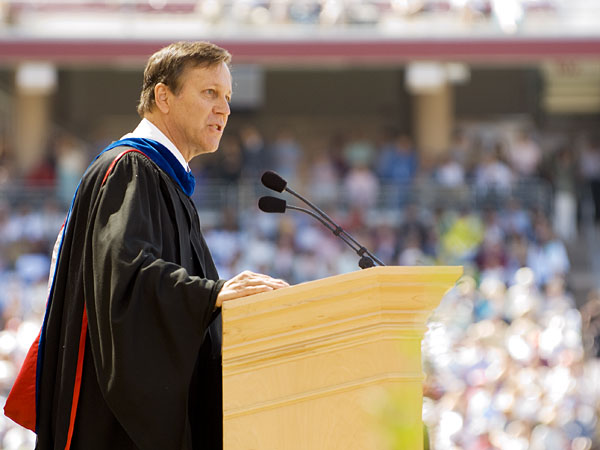
Dana at Stanford in 2007 (Photo: L.A. Cicero)

Once again, Dana Gioia has a new honor: This time, the Sewanee Review has just announced that he will receive this year’s Aiken Taylor Award for Modern American Poetry.

Previous winners have included Richard Wilbur, Anthony Hecht, W.S. Merwin, Anne Stevenson, Donald Hall, X.J. Kennedy, and others.

Dana, known for his poetry, criticism, and arts advocacy, holds the newly created Judge Widney Chair in Poetry and Public Culture at the University of Southern California.  He’s also a former chairman of the National Endowment for the Arts, and has received a number of honors in recent years, including the Laetare Medal. We’ve written about him here and here and here and here and, oh, perhaps a zillion other places.

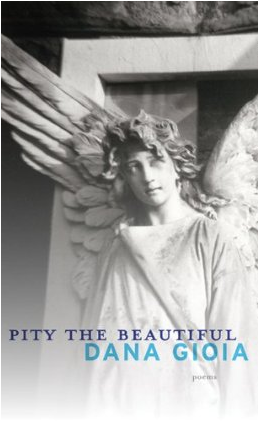
His most recent collection is Pity the Beautiful – we’ve written about it here, and I’ve published excerpts from the volume, also here.  Writing in Best American Poetry, David Lehman stated unequivocally:  “I have no hesitation in declaring it to be his finest to date . . . These poems in which sentiment is refined by technical prowess, and simple words combine to make music and meaning merge marvelously and memorably.”

Pity-The-BeautifulI love all the Gioias – including those I have never met (his parents, for example) – so perhaps my favorite passage from the announcement is this one:

Gioia’s poetic philosophy—particularly his belief that poetry should “touch on those things that are central to people’s lives”—can be traced back to his childhood in Los Angeles, where his Sicilian father and Mexican mother raised him. He remembers that his mother, who, he says, received no education beyond high school, recited poems to him by heart and read others from a “crumpled old book that had belonged to her mother.” Because of this, Gioia says, “I have never considered poetry an intrinsically difficult art whose mysteries can be appreciated only by a trained intellectual.”

The awards ceremony will take place February 19 at the University of the South in Sewanee.  David Mason will give a lecture on Dana’s work on the 18th.

Seth Abramson dons “Kick me!” sign; makes list of top 200 advocates for poetry.

Share
Jane-Hirshfield

Jane made the cut.

Seth Abramson is an intrepid man in a country that publishes 20,000 books of poetry each decade, among 75,000 poets (who counts them, and how?) Here’s why: he has issued a list of “The Top 200 Advocates for Poetry (2013)” in the Huffington Post – it’s here, as well as on dartboards across the U.S.  We all love lists, of course, and everyone has an opinion on how they should be done – this one, particularly.  Two hundred is long enough to give the impression that everyone ought to be included, but short enough that not everyone can be. So Abramson’s gesture is akin to wearing a “Kick me!” sign on your back. He begins by almost apologizing: “The poets favored by one reader will invariably not be the poets favored by another; in fact, it’s getting harder and harder to find two readers whose reading interests or even reading lists exhibit much overlap at all. Too many such lists, such as the widely- and justly-panned one recently published by Flavorwire, exhibit obvious age, race, ethnicity, and (particularly) geographic biases.”  We would like to fault him, first of all, for hyphening an adverb that ends in “ly,” which is never done – moreover, it’s dangerous to begin a list by dissing someone else’s. In that way, you’ve made your first enemy already.
Wilbur2

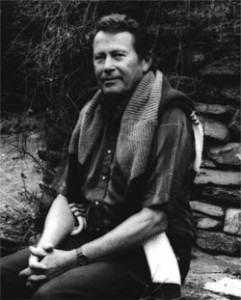
Lifetime achievement, for sure.

He continues for some paragraphs in the same vein: “As a contemporary poetry reviewer who publishes his review-essays in The Huffington Post, I have no special access to knowledge of who is or isn’t doing the most to be an advocate for American poetry (a term I define very broadly) on a national or global scale. While I’m lucky to have access to many more published poetry collections than most poets or poetry readers do, as like any reviewer I regularly receive poetry collections in the mail from U.S. and international publishers, because the list below isn’t intended to detail who’s presently writing the best poetry, but is rather simply a list of who’s doing the best to advocate for American poetry by any and all means (including by writing it, but by no means limited to the authorial function), I’m not in a much better position than others are to generate a list of the most influential poetry advocates in America and beyond.”

Well, sure, I guess.  That said, we were pleased to see a number of friends and colleagues on the list – Kay Ryan, Jane Hirshfield,  W.S. Merwin, Don Share, Ron Silliman, Helen Vendler, Heather McHugh, Allison Joseph, Eavan Boland, Mark McGurl – and nonagenarian Richard Wilbur, a lifetime achievement award, for sure.
hirsch

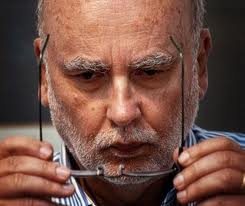
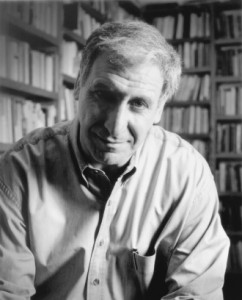
Where’s Ed?

Abramson qualifies that “the list below is neither exhaustive nor authoritative nor superlative. I have no doubt that I’ve missed a number of important names, due either to forgetfulness or an unconscious bias or simply (and most likely) sheer ignorance of who’s doing what across the vast landscape of American literature. … Those poets and allies of poetry offering contributions to American poetry commensurate with the contributions of the individuals listed below should therefore consider themselves honorary members of the ‘Top 200 Advocates for American Poetry” list as well.’
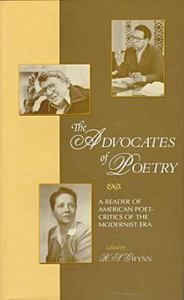
RSGWYNNThen he issued this invitation: “I strongly encourage readers of this list to contribute their own names to the comment section below the article.”  Needless to say, there were a number of people ready to take him up on the offer, including other friends’ names.  What?  No Edward Hirsch?  What?  No Robert Hass?  And no mention of Dana Gioia, whose work at the NEA was tireless?

Naturally, Humble Moi didn’t make the list – but to my surprise, I did make it in the first few comments in the section afterward, for which I’m grateful to R.S. Gwynn, another friend, who did make the list:

“I’m happy to be listed here (even though I’d like to be known as ‘poet and critic’) but I miss the presence of such names as Alfred Corn, the late Tom Disch, Dana Gioia, Cynthia Haven, X. J. Kennedy, and David Mason, all of whom are (or were in Tom’s case) great advocates.

As a small plug, I’d like to mention that I edited a book of the works of modernist poet-critics some years ago. Its title?  The Advocates of Poetry.

Just for that, here’s a picture of Sam Gwynn’s book, which discusses John Crowe Ransom, Randall Jarrell, Allen Tate, John Ciardi, and Robert Penn Warren – great advocates of poetry all.

 

“The Purpose of Time is to Prevent Everything from Happening at Once”

Share

Happy birthday, Joe!

X.J. Kennedy – a.k.a. Joe Kennedy – turns 83 today.  I fished out a 1999 email from him so that I could send off a quick birthday greeting before the day expired on the East Coast.  And I received a quick email reply within an hour or so.  Good to know he’s online and quick on the draw.

Birthdays are, of course, a reminder of time.  What better and more fitting way to celebrate than with one of my favorite poems by him:

And yes, Joe, it’s true.  “Huh?  What happened?”  I’m at that point now.


The Purpose of Time is to Prevent Everything from Happening at Once

Suppose your life a folded telescope
Durationless, collapsed in just a flash
As from your mother’s womb you, bawling, drop
Into a nursing home. Suppose you crash
Your car, your marriage – toddler laying waste
A field of daisies, schoolkid, zit-faced teen
With lover zipping up your pants in haste
Hearing your parents’ tread downstairs – all one.

Einstein was right. That would be too intense.
You need a chance to preen, to give a dull
Recital before an indifferent audience
Equally slow in jeering you and clapping.
Time takes its time unraveling. But, still,
You’ll wonder when your life ends: Huh? What happened?