
Out from under his bed: Paul Reid speaks about Churchill, Manchester, and The Last Lion

Share

A few weeks ago I wrote about the world anxiously awaiting the final third volume of William Manchester’s The Last Lion: Winston Spencer Churchill, Defender of the Realm:  “I know, I know,” I wrote. “It’s going to be written not by Manchester, who died in 2004, but by Paul Reid, and everyone is wondering if it will be up to snuff.  So much so it’s a wonder that Reid doesn’t just hide under his bed and refuse to write anything at all.”

Relax, everyone!  He’s fine!  Paul Reid emailed me over the weekend to say: “I have emerged from under my bed to assure you that The Last Lion is being edited, all 470,000 words, every man-jack of them composed, proofed, and sourced while I labored with just ten inches of head room.  It’s so cramped under there even the rats are stoop-shouldered.”

Then he invited me to chat:  “Please allow the phone to ring several times, as it takes me a while to crawl from under the bed, climb the ladder from the bunker to the padded room, and reach the phone.”

Chat we did, and it was great fun.

He recalled the October night when his friend Bill Manchester, in failing health, asked him to continue the series.  “We were watching a Red Sox game – the Red Sox lost, as usual.”

“The night he asked me to do it, I said, ‘Gee I don’t know, Bill.’”

Both men had been feature writers for daily newspapers, banging out articles of about 800 words.  Manchester’s advice to the budding author: “String together a thousand short feature stories and you’ll have a book.”

“If I imagined 800 pages, I would have been pretty daunted,” Paul admitted. He also said that he would have been cowed if asked to write about, say, Paganini.  However, Paul had been a World War II buff from way back:  “I knew the battles, I knew Montgomery, ‘Bomber’ Harris – my whole life, that’s been my hobby. I loved history, from my earliest memory.”
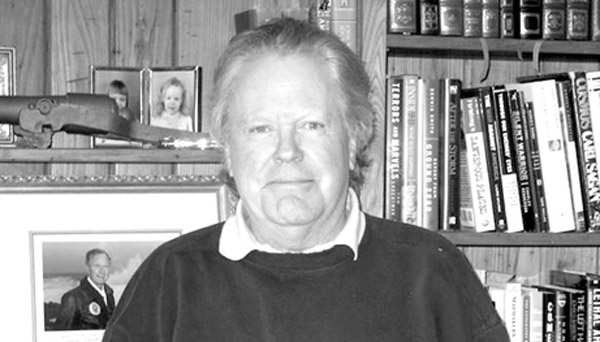
Speaking out from the bunker

“You can do it, just write,” Manchester exhorted Paul. “I’ll have my red Number 2 pencil. I’ll edit; you write.”

That was the plan.  “But he died 7 months later,” Paul said.  Then the younger author was on his own, guided by 4,000-5,000 pages of Manchester’s notes.

Manchester was “an organization guy.” But it was an organization not necessarily recognizable to anyone else.

“He had his own system for putting his notes together.” Manchester had called them “clumps” of notes, formed by taking a hundred sheets of paper, taping or gluing pairs of them together to form one long sheet, and binding them at the top to create his own “tablet.” He would tape or glue Xeroxes of speeches and official documents.  He left behind dozens of these makeshift tablets.
Manchester also had his own notation system. On the lefthand margin of the manuscript, he would jot one of at least a hundred “topic codes” (for example, De Gaulle, Nazi Germany).  A little pound sign would indicate information on Churchill’s family.

He marked the righthand side with cryptic “source codes.”  Paul cracked one early: HAR was a code for Averell Harriman’s memoir. But the others?

“I finally had a brainstorm,” he said.  He called the Wesleyan Library where Manchester did his research, and asked for a list of all the books Manchester had borrowed.  It didn’t keep any such list.  “Because I knew Bill,” Paul said he had another flashbulb moment:  Could have a list of all Manchester’s overdue books? “That ran to dozens of pages.” The code was cracked again.

“I went out and purchased everything,” including collections of Hitler speeches, Roosevelt speeches, diaries of generals.  The Bostonian’s North Carolina bunker has about 25 linear feet of World War II books.  “The war is 85 percent of the story, and that what a lot of people are waiting for.”

Manchester’s manic writing habits were famous (Vanity Fair wrote about Manchester here) – 7 days a week, for 12-14 hours a day.  Paul, however, is a bit more leisurely: he spends about 5 or 6 hours going over sources about a particular week in the war, writes for a few hours, and starts over the next day.

So what does Churchill have to say to us today? “For Churchill, courage – moral courage – was the first virtue in the Aristotelian sense.”

Paul recounted an incident where the prime minister talked to 8 and 9 year old schoolboys at his former Harrow school in 1940.  “That’s when he said, never give in, never give in, to tyranny, to evil.  These are not dark days, best days of our lives.”  This lesson, for 8 and 9 year children, Paul emphasized.
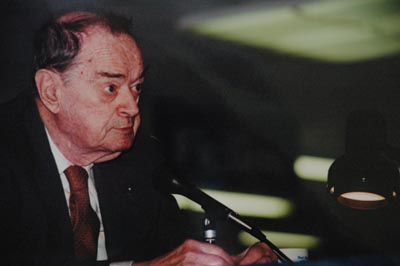
He had a system.

“There was no guile with Churchill.  He didn’t know how to be dishonest.  Stalin knew that.  He [Churchill] was a brave man, but not foolhardy man.”

Nor was he a despot, like his famous foes:  “He pursued knowledge, not power,” said Paul. His pugnacious stances were not just based on opinions, but on his wideranging study:  “He read everything – Aristotle, Plato, Thucydides, Cicero, The Aeneid, The Iliad, The Odyssey, Thomas Aquinas, Augustine, British empiricists,  Macaulay, and all of Gibbons, Yeats and Keats and Byron and Shelley, Longfellow and Emerson.  Everything.”

Manchester and Churchill both threaded through Paul Reid’s mind as he worked, but the final work?  “The work is not only yours, it’s you.”

Now he is close to the finish line.  He won’t prophesy exactly when the book will be out – “it’s a big project, and it will take some time.”

“Churchill would just push ahead. That’s what you have to do.”

Just like I said a few weeks ago.”

Blenheim at dusk: the most beautiful spot in the world?

Share

Winston Churchill said it was the best view in England … or perhaps the world. For him, it very likely amounted to the same thing.

Tussling at dusk: Georgina, Fabian, and Milo Tudor Caruncho

At Blenheim Palace at dusk, or dawn, or any other time of day, it’s hard to argue the point. You walk in through the gate that leads from the town of Woodstock (not the grander entrance on the main road), look to your right, and you see this delicious scene.

Churchill’s views on his birthplace (he described the estate’s origins in his massive work,  Marlborough: His Life and Times) were related to me by my friend Eliza Tudor, who lives in nearby Wootton, next to Woodstock, the ancient burg where her ancestor Edward the Black Prince was born.

Capable.

Blenheim is, of course, the 18th-century palace where the Nobel writer Churchill was born, where he proposed to his future wife Clementine, and where all the Dukes of Marlborough lived (Sir Winston was, alas, was the son of a younger son).  It also represents the labor of England’s legendary landscape architect Capability Brown (marvelous name, that), who created two thousand acres of verdant slopes, leading to this lake, with architect Sir John  Vanbrugh‘s Grand Bridge.

Anyway, these pictures (except for Capability’s) are taken from Eliza’s iphone.  Not bad.  With only a little imagination, they take me away from a messy house, a score of emails and letters to write, and the dishes in the sink on a long holiday weekend.

Hope they do the same for you.  At least a little.

Remembering Borders in Ann Arbor

Share

Bye-bye Borders (Photo courtesy of the Ann Arbor Chronicle)

Borders is gone, and with it an era.

So say all the eulogies, but that era has been long gone for me.  The flagship Borders had a special role in my life. I grew up in a north-of-Detroit suburban burg called Bloomfield Hills.  The nearest bookstore, or what passed for a bookstore, was a “media” store that sold newspapers, magazines, and a few top-selling paperbacks.  It was about a mile away on foot for this book-hungry teenager.

So arriving at the University of Michigan in Ann Arbor was like a starving man suddenly surrounded with éclairs.  How could I miss the first-ever Borders on Maynard Street?  It was just down the street from The Michigan Daily – at that time called “the New York Times of student newspapers” (by the New York Times, no less) – where I spent all my waking hours, and many hours I was supposed to be in class, working alongside journalists who would became renowned nationally and internationally.  (Tom Hayden was a former editor – and returned occasionally for a visit.)

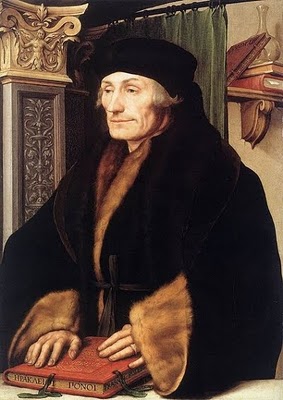
As I spent all my time at 420 Maynard, I spent all my money at 311 Maynard, the location of Borders, enacting Erasmus‘s famous dictum, “”When I get a little money I buy books; and if any is left I buy food and clothes.”

According to the  CNN:

He was right.

“Borders used to be chockablock with books,” said Jonathan Marwil, a University of Michigan history professor and author of a history of Ann Arbor. “It has increasingly looked less like a bookstore than a bowling alley, with its wide-open spaces. Now they’re selling children’s dolls on the front counter. It’s really pretty grim.”

It was a place where employees were devoted to their jobs. They prided themselves on their knowledge of their assigned sections — and everybody else’s. It was a gathering place and community center, just up the street from the university’s main campus.

“We worked when we didn’t have to work because we didn’t know we were working. We would go into the store when it was closed to do more work,” said Sharon Gambin, who arrived for the 1982 holiday season and went on to hold several positions during a three-decade career. “That’s how much we loved what we did.”

According to the Macomb County Legal News, “The 40-year-old Ann Arbor-based bookseller hasn’t turned a profit since 2006, having lost $605 million in the last four fiscal years.”

Borders was founded in 1971 by brothers Tom and Louis Borders, who were University of Michigan students.

Ann Arbor scene ... I don't miss the winters.

Originally called Borders Book Shop, it was located in a 800-square-foot building on South State Street in downtown Ann Arbor (currently, Borders in downtown Ann Arbor is located at Liberty and Maynard in what was once Jacobson’s Department Store — another defunct Michigan-based business — and is considered the flagship store).

Not so.  It began on Maynard and Liberty, and moved later.  I remember Jacobson’s, too – the Bloomingdale’s of Michigan.

I still have the (unread) multi-volume Marlborough: His Life and Times, by Winston Churchill, that I bought on one of my gluttony, when I would leave with a pile of books.  I remember a fellow Daily-ite from Nebraska telling me he had to order books directly from the publisher.  Time was short, buy books now.

As bookstores disappear into cyberspace, many of us are once again miles away from the occasional signpost of civilization.

Isn’t this the part of the movie where I walked in?

Postscript on 9/15:  Others are sharing their memories of their “first time” – first big experience with a bookstore.

From Jeff Sypeck: “I was in college in 1991 when a Borders opened in Central Jersey. It was such a big deal that we brought jealous out-of-towners to see it; they took home t-shirts as souvenirs. If I were 20 now, and someone told me that, I’m not sure I’d believe it.”

From John Murphy of the University of Virginia: “‘Purists’ sometime knock the big-box chains like Borders and Barnes and Noble. But, growing up in a a very small town, I appreciate the value they have — or, in the case of Borders, the value they had. We had a good public library, but …we were not large enough as a town to support any kind of locally-owned bookstore at all. So Waldenbooks and B. Dalton half an hour away were a very good thing and Borders and Barnes and Noble an hour away were an even better thing. I truly don’t think that the world would have been a better place if the big-city bookstore cultures where ‘purists’ tend to be had never been ‘subjected’ to Borders at all and if people growing up in small towns like mine had never had access to any bookstore culture at all.

And Ken Latta also remembers the original Ann Arbor Borders.  He had an open purchase order at Borders “so I could walk over at lunch time and pick up books for work. Year later wandering around the country consulting one measure of civilization was having a Borders and a Starbucks, hopefully co-located.”

Winston Churchill “lived from book to book, and from one article to the next”

Share

Time Magazine‘s list of “bests” are often a pile of rubbish – but I was gratified to see one personal favorite given pride of place in “All-TIME 100 Best Non-Fiction Books“:

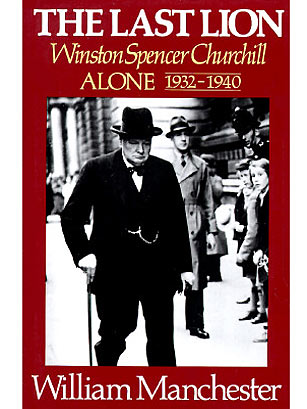
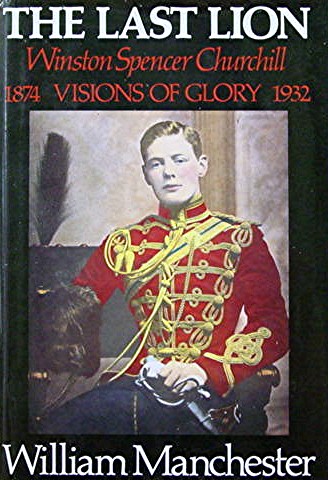
The Last Lion: Winston Spencer Churchill: Alone, 1932-1940 (published in 1988) was William Manchester‘s sequel to The Last Lion: Winston Spencer Churchill: Visions of Glory, 1874-1932 (published in 1983). Alone picks up the story with Churchill cast into the political wilderness and entering what the author believed was the most crucial period of the politician’s extraordinary life — his “finest hour,” if you will — which culminated in his becoming Prime Minister of Britain in 1940, his country once again at war with Germany. Churchill, as Manchester poignantly puts it, “resolved to lead Britain and her fading empire in one last great struggle worthy of all they had been.”

I read this unforgettable book some years ago – stunning, in its step-by-step revelation of Winston Churchill‘s dogged, determined, and humiliating journey through the 1930s to warn a resistant England of the growing dangers of Hitler’s Germany. The war weary U.K. was famously allergic to evidence and eloquence, leading it to the brink of annihilation when Hitler finally attacked.

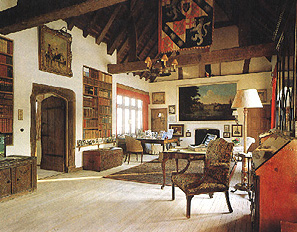
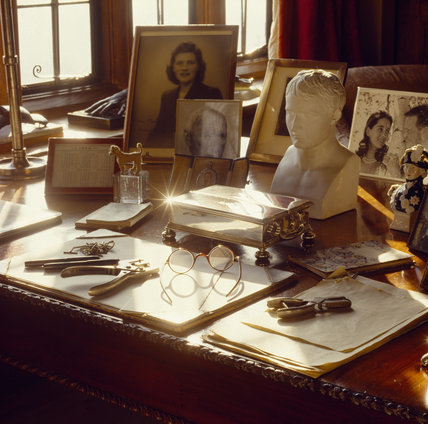
His study at Chartwell

Partly it was in Churchill’s nature to be so.  In his first book he wrote: “Nothing is so exhilarating as to be shot at without result” and “There are men who derive as stern an exaltation from the proximity of danger and ruin, as others from success.” But the fortitude to face humiliation, rejection, and loneliness is never nature alone.

I was so impressed by Manchester’s book, his last, that I gave a copy to Toyko rock star, and peacenik Agnes Chan when she took her PhD at Stanford in 1994 (she’s the UN Goodwill Ambassador for Japan).  It is at once a depressing and a fortifying work for the peacemakers of the world, but offers a salutary lesson: Peace without justice is no peace, and, as Augustine said, “Charity is no substitute for justice withheld.”

But something else impressed me.  Few know that Churchill made his living as a journalist.  Every night, in his magnificent Norman-era estate Chartwell, after the nightly dinner party with tuxedos and evening gowns, silver buckets of champagne, the Gruyère, the pâté, soup, oysters, caviar, after the port, brandy, and cigars were finished, he would shuffle up to his study at about 11 p.m. and begin his working day in his slippers, “entering through the Tudor doorway with its molded architrave…”

Churchill's desk at Chartwell

Manchester writes:  “Only after entering his employ will [his assistant] Bill Deakin discover, to his astonishment, that Churchill lacks a large private income, that he lives like a pasha yet must support his extravagant life with his pen. The Churchill children are also unaware that, as [his daughter] Mary will later put it, the family ‘literally lived from book to book, and from one article to the next.’ Her mother, who knows, prays that each manuscript will sell.”

“…he enters the room in his scarlet, green, and gold dressing gown, the cords trailing behind him. Before greeting his researcher and the two secretaries on duty tonight, he must read the manuscript he dictated the previous evening and then revise the latest galleys, which arrived a few hours earlier from London. Since Churchill’s squiggled red changes exceed the copy set – the proofs look as though several spiders strained in crimson ink wandered across the pages – his printers’ bills are shocking. But the expense is offset by his extraordinary fluency. Before the night is out, he will have dictated between 4,000 and 5,000 words. On weekends he may exceed ten thousand words.”

I envy the fluency.  I envy the output. I even envy the study, in the oldest, 11th century part of Chartwell.  And above I envy the courage, bravado, and style.  I do not envy the pâté de foie gras, the trout, the shoulder of lamb, lobster, dressed crab, Dover sole, the roast beef, and the endless gin.  It’s an astonishment they all did not perish before 30.