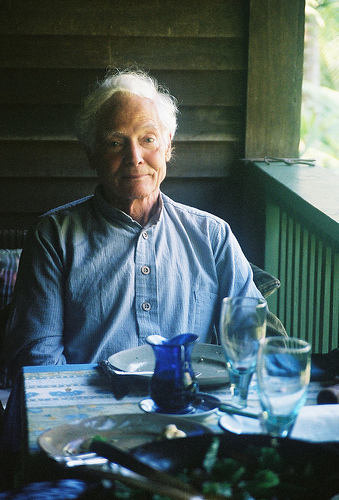
Merwin ... a genial presence
W.S. Merwin has been named the new poet laureate. New York Times story here. An excerpt:
“I do like a very quiet life,” Mr. Merwin said by telephone after learning of his appointment. “I can’t keep popping back and forth between here and Washington.” He said he does relish “being part of something much more public and talking too much,” however, and the job of the nation’s premier poet will enable him to do both.
Bill Merwin contributed to my forthcoming book, An Invisible Rope, so I’ve had the privilege of working with him. In his remote enclave in Haiku, Hawaii, he continues his reputation as the genial father of the American poetry scene. He doesn’t return phone calls promptly, doesn’t use fax or email. He is pretty much a recluse, and likes it that way.
The position does not carry many formal duties, though laureates have traditionally undertaken projects that reach out to potential audiences.
What on earth were they thinking over at the Library of Congress? The Pulitzer prizewinning poet (receiving the award twice) doesn’t need another line on his resume. Every possible honor has already been heaped on the octogenarian poet.
Mr. Billington said he is confident that Mr. Merwin can broaden the audience for poetry through technology, if not in person: “We even discussed the possibility of doing something using remote technology from Hawaii.”
That of course presupposes that Merwin wants technology in his life. So far he hasn’t.
Maybe it’s time that we start putting a thought into what the “poet laureate” gig is supposed to mean. Robert Hass, another laureate, is renowned for his selfless public work. I recall the activism of Joseph Brodsky as poet laureate, with his plan to put American poetry in every hotel room in the U.S., next to the Bible. William Wadsworth, executive director of the Academy of American poets from 1989 to 2001, recalls Brodsky muscular approach to the job here:
We spoke on the phone three days before he died. I was still at the Academy and we were continuing to work with Joseph on the project of distributing poetry anthologies around the country. Joseph called me at the Academy, and said, “Bill, do you know what American poetry is all about?” “No, Joseph, I don’t. Please tell me.” He said, “American poetry is all about wheels, it’s about the Open Road. It’s all about wheels . . . So, you know what you have to do?” “No, Joseph, what do I have to do?” “You have to call up the Teamsters. We have to get poetry on the trucks. So when milk is delivered in the morning to the grocery stores, they deliver poetry with the milk.”
Now the Teamsters Union is the most notoriously corrupt union in the U.S. I said, “Joseph, are you telling me that The Academy of American Poets should collaborate with organized crime?” There was a pause. Then Joseph said, “Bill, one thing about organized crime: It’s organized.” This was the last thing he said to me.
What is the job supposed to do? What do we want it to be? Anything?
Expect a quiet year.