That’s the good news. The bad is that you are only allowed to read the first page online. It’s here.
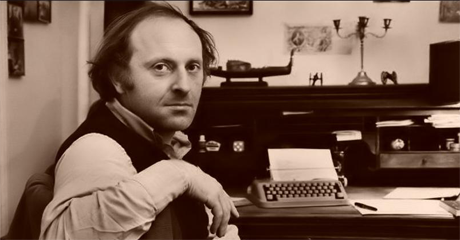
So here’s a little more from the piece, for free: Joseph Brodsky‘s reading style has been much remarked upon, and I open my article with Brodsky’s first engagement outside Russia, at London’s 1972 Poetry International Festival, in the first few dizzying weeks of his exile: “the poet poured out his poems in the hypnotic incantation that was to become his trademark: an archaic sound — a lament from a lost civilization, an ancient prayer, or simply a metronomic wail.”
“ . . . his hands straining the pockets of his jacket, his jaw jutting, as though his attention had just been caught by something and he were staring at it, scrutinizing it, while continuing to mouth the poem, almost absent-mindedly, that is, while the poem continues to be mouthed by him. His voice rises symphonically: ‘syn ili Bog’ [‘son or God’], already on the turn towards an abrupt descent; and then the pause and a resonant drop, a full octave: ‘Ya tvoi’ [‘I am thine’]. As the poet, with an almost embarrassed or reluctant nod, and a quick, pained smile, departs his poem”.
I continue:
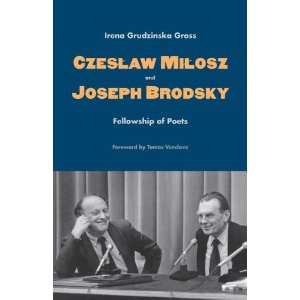
Gross recounts that Brodsky was asked about his declamatory bent during his triumphant tour of Poland, and landed this punch: “Today’s poet is afraid of the sardonic laughter of his reader, and because of it he tries to soften his poems . . . This is a mistake. The poet should charge his public like a tank, so that the reader has no escape. Poetry is an act of metaphysical and linguistic attack, not of a retreat. If a poet wants to be modest and nonaggressive, he should stop writing.”
Not Miłosz’s style, to put it mildly, and so he gently chastised the younger poet. Miłosz also lamented Brodsky’s poetry in English: “The resistance against writing poetry in other languages should be considered a virtue. . . . We are born in a concrete point of the Earth and we have to remain faithful to this point, restrained in our following of foreign fashions.”
This was more than a case of brass meeting polish. Miłosz saw history as a horror he wished to escape, but in a larger sense, he was also at home in the wider story of centuries. He was a son of the Polish-speaking landed gentry in Lithuania and had a law degree from Stefan Batory University. The urbane elder poet had the educational context lacking in Brodsky, the defiant autodidact who dropped out of school as a teenager. When cornered on an error or a prejudice, Brodsky covered himself by firing off a belligerent blast; Miłosz could put his views into a historical framework, whether by referring to pronouncements of the medieval popes or the legal system of the Res publica. History, language, tradition connected with Catholicism because, writes Gross, “Without God there is no history.” But where Miłosz turned to tradition and his Catholicism, Brodsky was in a tailspin and could not find peace.
From Irena’s book, I recount this devastating story:
Few have written about solitude and time with Brodsky’s urgency, before he was finally felled, at fifty-five, by the heart ailments that had dogged him for decades. “Miłosz was very busy, yet he sounded like a person who was not pressed for time. Brodsky ran against time,” writes Gross. “In that fight he was not supported by religion or by history — national or private.” Time was truly his enemy.
Gross recounts this riveting anecdote: “In 1994, when he was forced to visit a cardiologist during his stay in Sweden, he told him that he felt like a wounded animal who simply tried to survive. He expected to die at any time; when leaving his hotel room, he would put his papers in order. ‘Hurry sickness’ was the diagnosis of the psychologist who interviewed him on that occasion”.
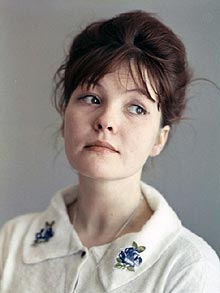
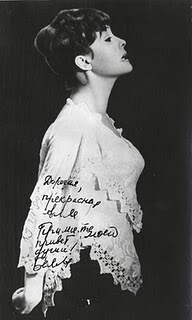
I ran across Robin Varghese‘s recent post on 3 Quarks Daily noting that, he, too, had somehow missed the obituaries for the 73-year-old Russian poet Bella Akhmadulina, who died on November 29 of a heart attack. I spent a little time this afternoon catching up: William Grimes‘s New York Times obituary for the “bold voice in Russian poetry” is here.
Akhmadulina came to fame in the post-Stalin years, the years of the Thaw. She never emigrated, and never was exiled. The Telegraph reported:
“Yet in her own quiet way Bella Akhmadulina was as much of a dissident as better known Soviet writers. Her work as a translator – she translated into Russian poetry from France, Italy, Chechnya, Poland, Yugoslavia, Hungary, Bulgaria, Georgia, Armenia and many other countries – led to her expulsion from the Soviet Writers’ Union in the Brezhnev era, and she openly supported persecuted writers like Boris Pasternak and Alexander Solzhenitsyn and political dissidents such as Andrei Sakharov.”
In 1979, she fell out of favour by contributing a surreal short story, ‘Many dogs and one dog,’ to the Samizdat publication Metropol, and was subsequently condemned for the “eroticism” of her verse and banned from publication.”
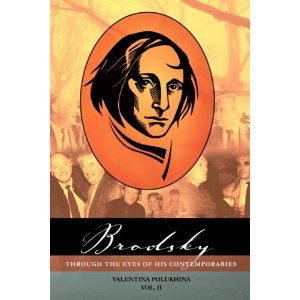
Said the poet: “How did I manage? Well, I think a person has some sort of guiding light. Without doubt, something or someone looks after us from on high.” sThat quotation is from Valentina Polukhina‘s exhaustive and enlightening series of interviews, Brodsky Through the Eyes of His Contemporaries, volume 1.
I didn’t know her poetry — or at least I didn’t know it much. I remember her instead as the the bright, original, and unambiguous voice in Polukhina’s 1987 interview: “The presence of any great poet in the world creates a marked effect on human existence.”
An excerpt:
“But in exceptional cases, as with Bunin, with Nabokov, we are talking about people who have taken with them something that became … as if they created the Russian language inside themselves. He doesn’t need to hear Russian spoken around him; he himself becomes a force that is ripe. He himself is both garden and gardener. …
I said this at some time to Nabokov. He asked me, ‘Do you like my language?’ and I answered, ‘Your Russian, it’s the best,’ and he said, ‘But it seems to me that it is like frozen strawberries.’ And whatever fate does … Well, with such people what is fate?”
In a literary world notorious for backbiting and artistic rivalries, she said this of Joseph Brodsky:
“My particular relationship to Brodsky can be described quite simply: uncritical, one of adoration. I myself have stated somewhere in connection with Akhmatova: ‘Of all calamities, adoration is the worse.’ An admirer can never expect his adoration to be returned. And I am sure, that Joseph … I never think about myself when I think about him. And even when they said to me, ‘you know, what Brodsky thinks of you!’ (Thumb downward.) As he pleases. But it is my business to talk about him with thumbs up.”
Polukhina, however, contradicted her: “He said that Bella is one of the few Russian poets living in Russia who by some miracle has succeeded in preserving her purity, conscience and independence.”
Akhmadulina’s finest online send-off may be the memoir from Gregory Freidin on Arcade — here. He gives us the context for Akhmadulina’s rise to prominence:
“Because of the richness of inflection and infinite melodic variability of the language, Russian poetry is blessed with extraordinary expressive force and a mighty mnemonic potential. This comes in handy if you happen to live under a repressive ideocracy like the Soviet Union, since verses can be easily memorized and leave little material evidence. Indeed, there was no better time to realize Russian poetry’s mnemonic and ethereal potential than in the post-Stalin Soviet Union where the absence of independent publishing coexisted with burgeoning youth culture and a minimal – and for that reason infinitely titillating – lifting of the skirt of Soviet censorship. For us, who belonged the post-WWII generation, shaped by the de-Stalinization campaign and cold war, known euphemistically as ‘peaceful coexistence,’ this toying with the ideological hemline excited our imagination and set our minds on fire! Grim and sclerotic as the Soviet empire was in its decline, it became a Garden of Eden for poetry – and a purgatory, not to say a minor inferno, for the poets themselves. Some, like Brodsky, were exiled or jailed, others went through torments of hell in trying to combine the imperative of remaining true to their calling with the relentless and crushing pressure to conform. That was the cup that Akhmadulina, twenty and otherworldly beautiful in 1956, drank to the dregs.”
I won’t spoil Freidin’s post for you; it deserves a full reading here. And for a taste of Akhmadulina’s distinctive voice, girlish and throaty, click below: