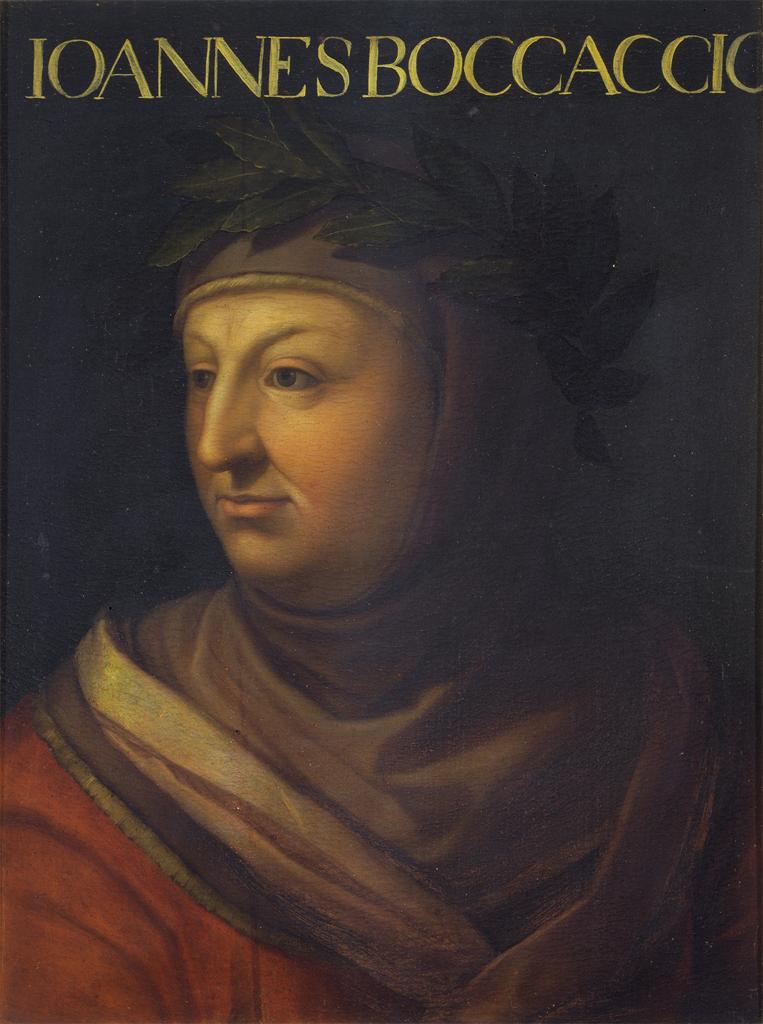
We’re not the first! Join us for a discussion of a 14th-century plague: Boccaccio’s “Decameron”! Stanford Zoom on Sunday, March 29.

Share
While we wait for the all-clear on coronavirus so we can resume our lives, maybe you’d like some historical perspective. Robert Harrison for a Zoom discussion of Giovanni Boccaccio’s Decameron this Sunday, March 29.

Links to join us are included in the notice below, from today’s Stanford Report:

Online discussionJoin a Zoom discussion of The Decameron, the 14th-century masterpiece that begins with 10 young people fleeing to the countryside as the plague of 1348 ravages the city of Florence, Italy. Robert Harrison, professor of French and Italian, will discuss what the book says to us today. The Zoom session will take place from 10:30 a.m. to noon (PST) on Sunday, March 29. Members of the Stanford community are invited to join via this LINK. Discussion will focus on the preface, introduction and first tale in the book, which was written by Giovanni Boccaccio (1313-1375). Participants are encouraged to read these in advance. The Project Gutenberg e-book of The Decameron is available at no cost here.

The announcement specifies members of the Stanford community, but Robert Harrison asked me to spread the word. Consider yourself invited. I’ll be there, too – cybernetically, of course. There is no “there” in cyberspace.

Question for the coronavirus era: What’s the opposite of loneliness? It’s not company.

Share

Arendt had the best company: herself

The business of being a writer is necessarily solitary. I’m used to it. In fact, with the current coronavirus “shelter in place” in  California and elsewhere in the country, little has changed in my work routine. One good adjustment: the rest of the world is on “pause,” so I don’t have the usual intrusion of emails, phone calls, and other interruptions.

Nevertheless, should all those fail, I have shelves of books I’ve never read. And it’s always a good day when you can reread Jane Austen, or explore The Divine Comedy again. Revisit Proust, or Stanisław Barańczak. Or finally get around to reading something by Michel Houellebecq, or the unopened novel by Ismail Kadare.

Yet all over the social media I hear complaints about loneliness and boredom during the coronavirus crisis. But the antidote to loneliness isn’t society – it’s solitude.

Hannah Arendt wrote that the ability to tolerate the solitariness of an internal space, in which one can commune with oneself and think for oneself, is central to personal responsibility. In an essay on “Personal Responsibility Under Dictatorship,” she argued such “being-with-oneself” is connected with the sustained practice of examining issues, weighing contradictory thoughts, making up one’s own mind. She observed that those who resisted the Nazi call had the habit and experience of daring to judge for themselves:

“The precondition for this kind of judging is not a highly developed intelligence or sophistication in moral matters, but rather the disposition to live together explicitly with oneself, to have intercourse with oneself, that is, to be engaged in that silent dialogue between me and myself which, since Socrates and Plato, we usually call thinking.”

It’s what  Stanford professor Robert Pogue Harrison said a decade ago at a Stanford conference on Arendt, when he made the event’s most spirited remarks in a talk on “passionate thinking.” Read the whole article here. A relevant excerpt:

Stanford’s Gerhard Casper, Robert Harrison at back (Photo: L.A. Cicero)

[Harrison] considered Arendt’s notion of friendship and thought as rooted in solitude and the ability to commune with oneself – that “plurality begins with the individual.”

The “overwhelming question” in the humanities, he said, is: “How do we negotiate the necessity of solitude as a precondition for thought?”

“What do we do to foster the regeneration of thinking? Nothing. At least not institutionally,” he said. “Not only in the university, but in society at large, everything conspires to invade the solitude of thought. It has as much to do with technology as it does with ideology. There is a not a place we go where we are not connected to the collective.

“Every place of silence is invaded by noise. Everywhere we see the ravages of this on our thinking. The ability for sustained, coherent, consistent thought is becoming rare” in the “thoughtlessness of the age.”

So do take some time to talk internally with yourself during this unusual time. We hope it will be over soon! And if you want to read what Arendt wrote to James Baldwingo here.

Postscript from George Dunn of Zhejiang University: Ursula LeGuin has a powerful story that addresses issues of injustice and scapegoating, titled “The Ones Who Walk Away From Omelas.” I’ve used it in my Ethics class more times than I can count. The title refers to the very small minority of citizens in the imaginary city of Omelas who walk away from the hedonic paradise this city represents because they are unwilling to partake of a joy that’s purchased through the torture of a child. There is one line in the story had that always struck me as somehow key to what LeGuin wants us to understand, though it is spoken so causally that its import can easily be missed. Most of the citizens of Omelas are reconciled to the horror on which their happiness is built, though some leave in their youth the moment they come face to face with that horror. Yet, reports LeGuin, “Sometimes also a man or woman much older falls silent for a day or two, and then leaves home.” The phrase “falls silent” stands out for me, indicating as it does a retreat into deep introspection. Such a retreat into silence would be quite conspicuous in Omelas, whose citizens are depicted by LeGuin as highly gregarious. LeGuin then recounts how these few leave the city, three times using the word “alone” to underscore the solitude of those who walk away. Reading these passages always puts me in mind of Arendt’s essay on “Responsibility,” also assigned a few times, with its reminder that ethics is predicated on our ability to resist the crowd, which in turn depends on having cultivated an inner space for reflection. Being highly intelligent, articulate, and quick-witted in debate is no guarantee of a capacity for reflection. To the contrary, as we’ve both seen, those with the greatest intellectual gifts will also often display the greatest ingenuity in making excuses for themselves.

Alfred Hayes’s “My Face for the World to See” at Stanford – a tough look at Hollywood, with a surprise guest, too.

Share

On October 30, Stanford’s Another Look book club took on Alfred Hayes‘s My Face for the World to See, a tough look at Hollywood by a film industry insider.

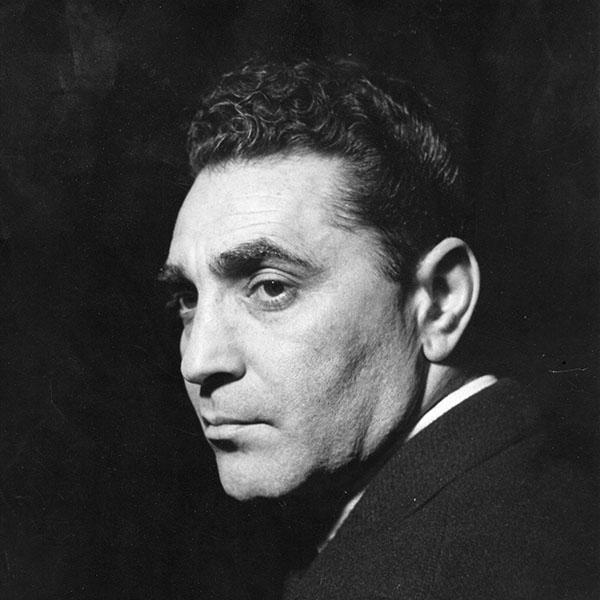
Author Alfred Hayes with friend

Photographer David Schwartz preserved the a terrific night for us – with four panelists, including David Thomson, the film critic and author who wrote the introduction to the NYRB Classics edition we were reading.

We had another surprise guest that evening, the author’s daughter, Josephine Hayes Dean, flew out to join us for the evening. David took a photo of that, too.

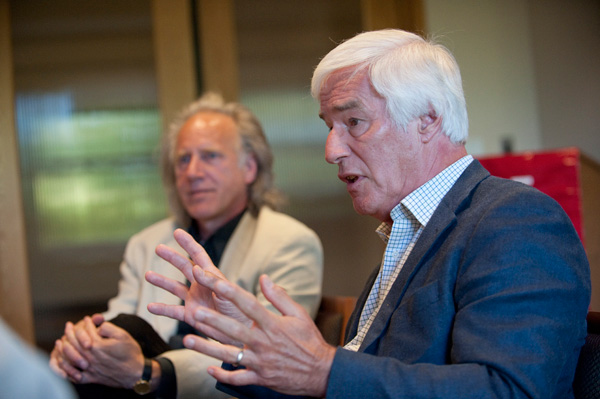
From left to right above: Another Look director Robert Harrison; the author’s daughter, Josephine Dean; novelist Terry Gamble; National Medal of Arts winner Tobias Wolff, and film critic David Thomson.

If you missed the stellar event, you can join us after-the-fact with the podcast here. It really was a lively and incisive discussion about a world where talent is chewed up and discarded, where thousands come to follow a dream that so rarely and randomly gets fulfilled.

Panelists in discussion below, from left to right: Robert Harrison, Tobias Wolff, Terry Gamble, and David Thomson.


Hollywood screenwriter rescues an actress from suicide in the Pacific. Then what happens? Come to Wednesday night’s discussion of Alfred Hayes’s book.

Share

Also a veteran of “Alfred Hitchcock Presents” and “The Twilight Zone”

Last call! Tomorrow night we celebrate screenwriter Alfred Hayes‘s My Face for the World to See. The event will take place at 7:30 p.m., Wednesday, October 30, at the Bechtel Conference Center of Encina Hall, 616 Serra Street, on the Stanford campus. As you will remember, Serra Street is now closed. Directions and parking on the are on the Another Look website here.

The narrator, a Hollywood screenwriter, rescues a young actress from suicide in the Pacific. The incident leads to an affair fueled by gin, cigarettes, and ultimately madness.

Hayes (1911-85) was also a screenwriter and television writer, as well as a novelist. The best known of his seven novels is The Girl on the Via Flaminia. He received Oscar nominations for his work on Paisà, directed by Rossellini, and Zinnemann’s Teresa. He adapted Maxwell Anderson/Kurt Weill musical Lost in the Stars for film. His television credits include Alfred Hitchcock Presents and The Twilight Zone.

Panelists include: Robert Harrison, author and professor of Italian literature; director of Another Look; Tobias Wolff, author and professor emeritus of English, founding director of Another Look; David Thomson, film critic and regular contributor to The New York Times, The New Republic, The Guardian, and Salon; and novelist Terry Gamble.

The event is free and open to the public. Please encourage your friends to join us! And visit our website for details: anotherlook.stanford.edu.

“The undulating quality of his thought”: Robert Pogue Harrison remembers Michel Serres

Share

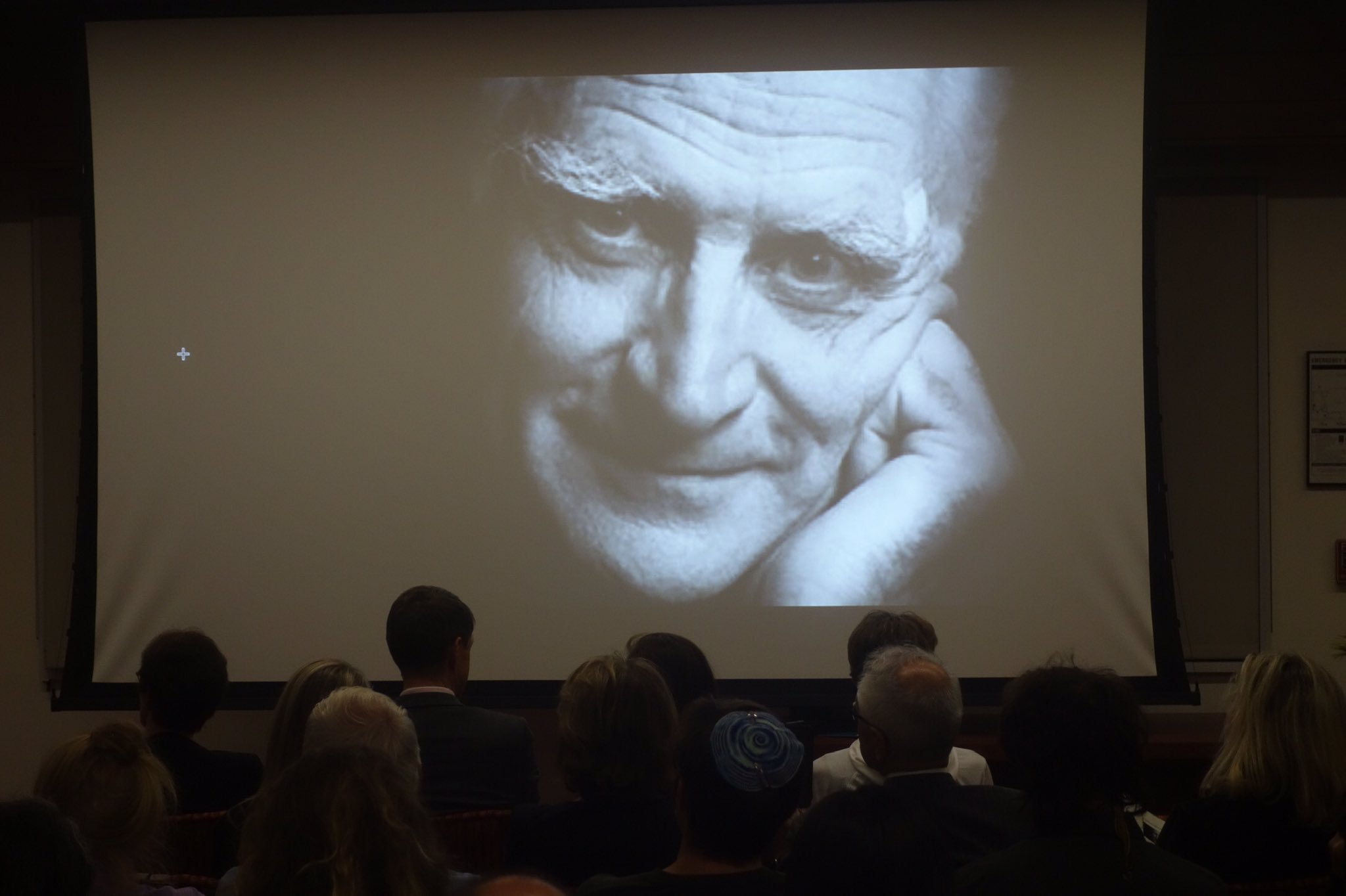
“Michel Serres is indeed Stanford’s ego ideal, even if the institution itself is largely unaware of it.” Remembering the academician at the Stanford Humanities Center on Oct. 21.

Michel Serres, a Stanford professor, a member of the Académie Française, and one of France’s leading thinkers, died on June 1 at age 88. Earlier this week, we published French Consul General Emmanuel Lebrun-Damiens‘s remarks at the memorial conference for him on Monday, Oct. 21. (Read it here.) Below, Robert Pogue Harrison‘s words on that occasion:

When I joined Stanford’s Department of French & Italian as a young assistant professor in the 1980s, I became close friends with Michel Serres. It was he who encouraged me to break out of the straightjacket of narrow academic specialization and to enlarge my conception of what it means to be a humanist. My first book offered an intensive textual analysis of Dante’s Vita Nuova. It was thanks to Michel that that I subsequently went on to write a history of forests in the western imagination, from the Epic of Gilgamesh to our own day. That book, Forests: The Shadow of Civilization, published in 1992, is dedicated to Michel Serres, yet he managed to beat me to the punch. Just before Forests came out, I received a copy of The Natural Contract, which, to my great surprise, Michel had dedicated to me. That dedication, with a quote from Livy (casu quodam in silvis natus), was for me a far bigger deal than the appearance of my book a month or two later.
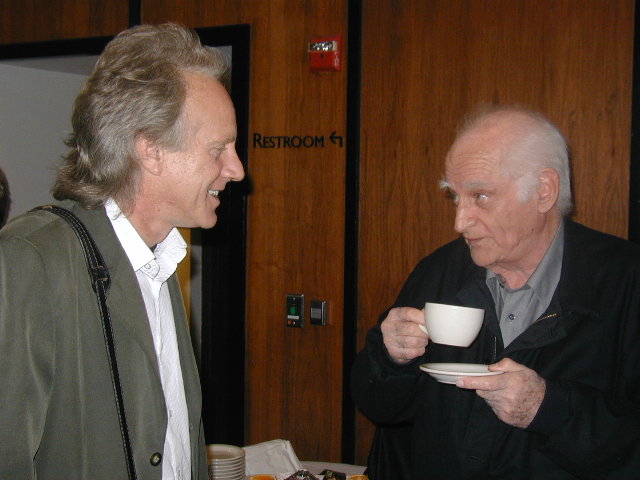
“Michel had a way of enchanting and entrancing his audience.”

In the late 80s and 90s, Michel’s seminars at Stanford were attended by a number of junior and senior faculty members. He was the only one I can remember who regularly drew other faculty to his classes. We went not only to learn but to experience the unique aesthetic flourish of his teaching. There was an Orphic quality to his seminars. Michel had a way of enchanting and entrancing his audience. His lectures were musical, operatic performances, with preludes, movements, arias, and crescendos. He created this musical effect by the lyricism of his voice; by the cadences of his sentences; by his measured use of assonance and alliteration; by the poetic imagery of his prose; and by what I would call the undulating quality of his thought. There was a distinct rhythm to his seminars that put their beginning, middle, and end in musical, rather than merely logical, relation to one another. A Michel Serres seminar was a highly stylized affair, both in content and rhetorical delivery – and the audience could not help but break into applause when he concluded with the words “je vous remercie.”

With Serres, the classroom became not only an intellectual space of illumination but also the site of revelations. In addition to what I’ve called the Orphic quality of his teaching, it also had a Pentecostal aspect. (I borrow the term from our onetime Stanford colleague Pierre Saint-Amand, who attended many of Michel’s seminars in the early years.) Michel himself speaks of that particular type of communication in his book, Le Parasite. With Michel, one had the impression at times that something was speaking through him, that he was bringing to the surface deep, long-buried sources of knowledge and wisdom. It was very close to what Hannah Arendt, with reference to Heidegger’s teaching in the 1920s, called “passionate thinking.”
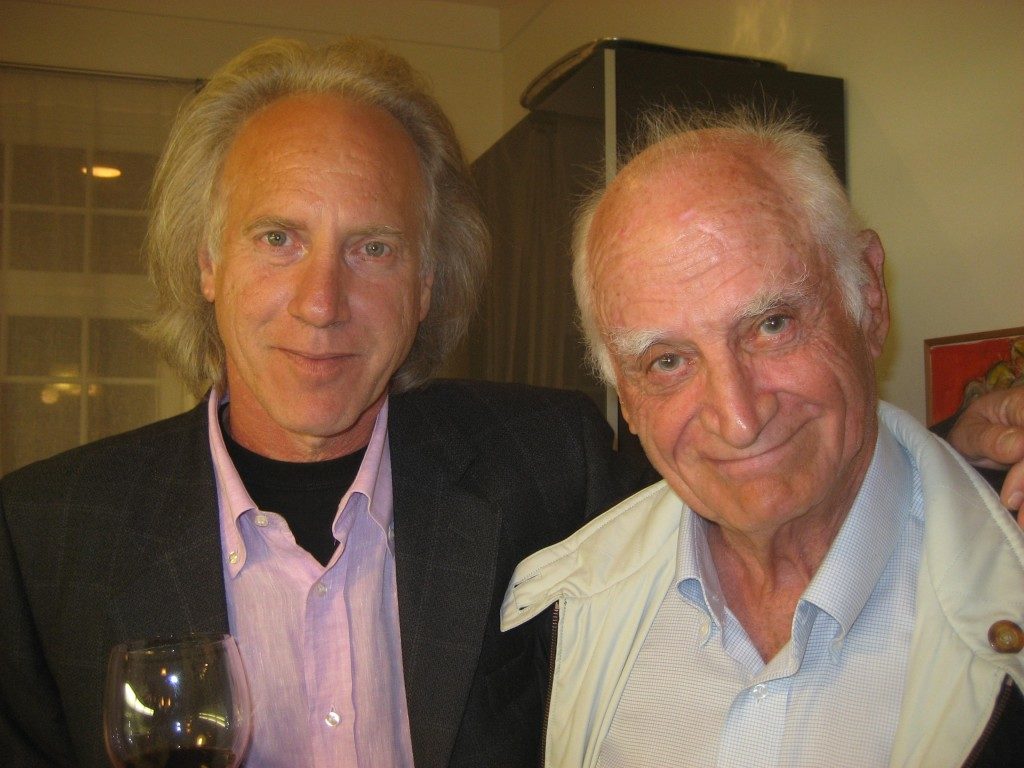
“An Orphic quality”: Sharing a glass of wine in 2010

Whether he was teaching literary works or the origins of geometry, you could be sure that Michel would bring together religion and ancient history, anthropology and mathematics, law and literature. He had a wholly new way of reading philosophy, literature, and the tradition in general. Those of us who were drawn to his thought and his seminars developed a taste for complexity. In the heyday of deconstruction, Serres taught us that textualization led to inanition. The surest way to zombify philosophy, literature, or science was to textualize them. He taught by counter-example how to bring into play a heterogeneous plurality of perspectives. Texts were not folded in upon themselves but contained different strata of historical knowledge, of cultural instantiations and practices.

Serres’s model of reading is not easily duplicated. He would bring any number of scientific, religious, and historical deliberations to bear on his reading of authors like Pascal, Balzac, or La Fontaine like Serres was able to do. Serres provided us with a model of complexity for which the word “interdisciplinarity” does not do justice. One could call it a “new encyclopedianism,” but why not call it by a term that he himself coined in his book Genese – “diversalism.”

The concept of diversalism is not opposed to universalism but represents a very different declension of it than the German metaphysical one – a declension that finds universality in multiplicity rather than unity, contingency rather than necessity, and singularity rather than generality. The confluence of different streams of knowledge, diversalism is the very lifeblood of complexity, that is to say the lifeblood of life itself, not to mention of human culture in general.
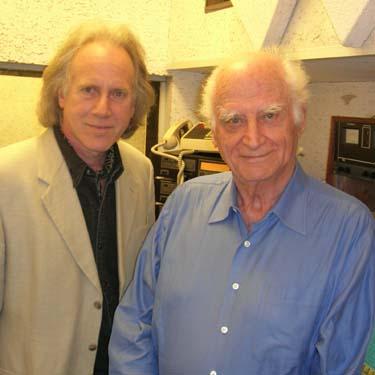
Harrison interviewed Serres on “Entitled Opinions” in 2008.

I would like to think that diversalism – as Michel understood it – defines what Stanford University stands for among institutions of higher learning. In that sense Michel Serres is the local unsung hero of Stanford’s greater ambition to bring all fields of knowledge and research into productive conversation with one another. I would go so far as to say that Serres is – without Stanford even knowing it – this institution’s ego ideal. Let me go even further and say that, in his diversalism, Serres was a very representative member of the Department of French & Italian, which by any measure has been the department of diversalism par excellence. Our colleague Elisabeth Boyi, who is here today, reminds us that diversalism also includes what her friend and fellow traveler Eduard Glissant called “diversality,” namely the admixture of languages, cultural legacies, and ethnic origins in an “archipelago” of diversity, where archipelago means interrelated associations that are not organized hierarchically but laterally.

When you think of colleagues like René Girard, Jean-Marie Apostolides, Sepp Gumbrecht, Brigitte Cazelles, Elisabeth Boyi, Jean-Pierre Dupuy, as well as the younger generation of scholars in French & Italian, many of whom are present here today, you start to wonder whether there is another universe or timeline in which Donald Trump did not win the 2016 presidential election and that the Department of French & Italian figures as the fully acknowledged, rather than discrete, crown jewel of Stanford University. I mean Stanford in its commitment to a genuine diversalistic pursuit of knowledge. But as they say, nemo profeta in patria sua.

If Michel Serres is indeed Stanford’s ego ideal, the institution itself is largely unaware of it. Stanford and Serres always had a courteous but altogether perfunctory relationship. Neither was the explicit champion of the other. That is not unusual. Stanford has a history of accommodating but not exalting some of its most creative endeavors and ventures. Maybe it’s better that way. Be that as it may, Serres was always grateful to Stanford for allowing him to visit twice a year for some three decades. He did much of his best thinking here, interacting with colleagues and walking to the Dish daily. He used to say that he had no complaints about Stanford whatsoever. “Je vie comme un moine et je suis payé come une putain.” Wherever he is now, I’m sure he’s looking on Stanford fondly. Those of us he left behind here in California miss him dearly, and it is fair to say there will never be another one like him in our midst.
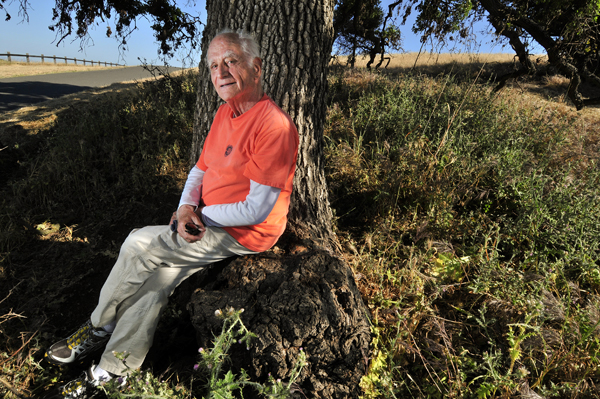
Stanford’s resident Socrates takes a break on his daily walk to “the Dish.”  (Photo: L.A. Cicero)

Alfred Hayes’s noir novella “My Face for the World to See” @Stanford on October 30. Be there!

Share

Hollywood’s underside (Photo: Hayes Estate)

Your only vice is yourself. The worst of all. The really incurable one.” 

Another Look is returning from its long summer break, launching its eighth season with Alfred Hayes‘s 1958 noir novella, My Face for the World to See. The event will take place on Wednesday, October 30, 7:30 p.m., at the Bechtel Conference Center in Encina Hall on the Stanford campus.

The narrator, a Hollywood screenwriter, rescues a young actress from suicide in the Pacific. The incident leads to an affair fueled by gin, cigarettes, and ultimately madness.

Hayes (1911-85) was also a screenwriter, television writer, as well as a novelist. He published My Face for the World to See when he was 47.

In The Los Angeles Review of Books, filmmaker Alex Harvey called the book “his most achieved portrait of male self-deception … a sharp, forensic examination of power and money…”

The discussion will be led by author Tobias Wolff, founding director of Another Look. Panelists include Stanford Prof. Robert Pogue Harrison, novelist Terry Gamble, and film critic David Thomson, who wrote the introduction for the NYRB Classics edition.