Allen Ginsberg’s “Howl”: More on “Breaking up is hard to do…”

Share

He did not live long enough to see bad lineation

It started with Billy Collins. Now Allen Ginsberg has entered the act, via Publisher’s Weekly.

In July, we discussed the searing, red-hot topic of the day: the e-book and its effect on a poem’s lineation:

Poet Billy Collins has come out decisively against the e-book. The AP story is here.

His reason:  It’s difficult to manage a poem’s line breaks on the electronic screen, which has a disturbing tendency to break lines at awkward places and slide the remaining text onto the next line flush left, as if it were a new line.  Why it’s taken Collins so long to notice this is unclear — he could have seen it in any of his online reviews.

Robert Pinsky is confident the technical problems can be fixed, but that adds that besides the problems with portable e-readers, “most word processors treat verse as though each line were a paragraph. So, for example, typing a Wallace Stevens poem with capital letters at the beginning of the lines can be mildly annoying,” Pinsky says.

Now Craig Morgan Teicher at Publisher’s Weekly is ranting about the eBook version of Ginsberg’s Collected Poems and the screwed-up lineation.  “This is not ‘Howl,'” he howls:

“Ginsberg broke his poem into what he called “strophes,” those long lines that hark back to Whitman.  The indentations you see above are meant to indicate that the line keeps going beyond the end of the page, until the next left-justified line.  Ginsberg was careful in his liniation, and part of the poem’s impact is in seeing that “who” sticking out again and again on the left side of the page.  The digital version pays no mind to this whatsoever.  What we get is not the poem itself, but a kind of poor transcription of it.”

Just like we said.  Now, if we can just get Teicher to spell “lineation,” we’re in business.  He’s setting a bad example.  Galleycat repeated the misspelling.

Happy birthday, Fulke Greville!

Share

The birthday boy

A few more hours to wish a very happy birthday to Fulke Greville, 1st Baron Brooke,  de jure 13th Baron Latimer and 5th Baron Willoughby de Broke, born this day in 1554.

Patrick Kurp has a fine tribute to him at Anecdotal Evidence here:  “He was known not as a poet but as treasurer of the navy, chancellor of the exchequer and commissioner of the Treasury. Only in the twentieth century was his accomplishment as a writer of austerely passionate verse, the peer of Herbert, Donne and Shakespeare, truly weighed.”

Kurp credits the late Thom Gunn, who edited Selected Poems of Fulke Greville in 1968.  Not surprising, since Gunn was a student of Yvor Winters, and no one exalted the obscure poet Greville more than Winters,  who rated Greville more highly than Sidney and Spenser.  Said Winters:

“How great a poet Greville is. It is my opinion that he should be ranked with Jonson as one of the two great masters of the short poem in the Renaissance”
— Yvor Winters, Forms of Discovery: Critical and Historical Essays on the Forms of the Short Poem in English, 1967

Former U.S. Poet Laureate Robert Pinsky compared him with John Donne in imaginative power.  Here’s Pinsky in The Paris Review on the subject of Greville (and Winters):

Pinsky -- a Winters protégé (Photo: Steve Castillo)

PINSKY:  Winters claimed to have read every poem by every poet of any distinction who ever wrote in English; he challenged those of us who disagreed with him to do the same. He certainly seemed able to respond to anything anybody ever alluded to. Winters resurrected Fulke Greville,  a really great poet, I am convinced; and some of the poems he pointed to, like Herbert’s “Church Monuments” and Jonson’s “To Heaven,” were influential to many of us who studied with him, like Thom Gunn, Bob Hass, Donald Justice, Phil Levine, James McMichael, John Peck.

INTERVIEWER:  Some of Winters’s favorite poems seem to have found their way into your own work, as for instance your “Poem with Refrains,” with its gobbets of Fulke Greville.

PINSKY:  Yes, “Absence my presence is, strangeness my grace. / With them that walk against me is my sun.” That’s Greville,  and he is unsurpassed at lines of that kind. What Winters showed me about the English poets of that period gave me an inkling of the level of the art, the quality of seriousness, the principles of musical language that one might hope to attain. I feel that those couple of years when I read poetry intensely with him have served me well, and I’m grateful for that.

He gets the final word

Let’s give Winters the final word on the subject, then.  Try this, from “Problems for the Modern Critic of Literature” from Winters’s 1956 The Function of Criticism:

“The language of metaphysics from Plato onward is a concentration of the theoretical understanding of human experience; and that language as it was refined by the great theologians is even more obviously so. The writings of Aquinas have latent in them the most profound and intense experiences of our race. It is the command of scholastic thought, the realization in terms of experience and feeling of the meaning of scholastic language, that gives Shakespeare his peculiar power among dramatists and Fulke Greville his peculiar power among the English masters of the short poem. I do not mean that other writers of the period were ignorant of these matters, for they were not, and so far as the short poem is concerned there were a good many great poets, four or five of whom wrote one or more poems apiece as great as any by Greville; but the command in these two men is not merely knowledge, it is command, and it gives to three or four tragedies by Shakespeare, and to fifteen or twenty poems by Greville, a concentration of meaning, a kind of somber power, which one will scarcely find matched elsewhere at such great length in the respective forms.”


Breaking up is hard to do

Share

Collins doesn't like the Kindle Effect on line breaks

Poet Billy Collins has come out decisively against the e-book. The AP story is here.

His reason:  It’s difficult to manage a poem’s line breaks on the electronic screen, which has a disturbing tendency to break lines at awkward places and slide the remaining text onto the next line flush left, as if it were a new line.  Why it’s taken Collins so long to notice this is unclear — he could have seen it in any of his online reviews.  (Or witness my unsuccessful attempts to reproduce a few lines from Christopher Smart’s “Jubilate Agno”  on wordpress here.)

From Collins:

“The critical difference between prose and poetry is that prose is kind of like water and will become the shape of any vessel you pour it into to. Poetry is like a piece of sculpture and can easily break.”

Here’s some more mixed views on poetry and the e-book from Ed Hirsch:

“I have mixed feelings about poetry and e-books,” says award-winning poet Edward Hirsch, whose The Living Fire came out in March in hardcover, but not as an electronic text. “I don’t think it’s the best way to read poetry myself and I wouldn’t want to read it on the e-book, but it also seems important to have poetry available wherever possible.”

Pinsky (Photo: Steve Castillo)

and Robert Pinsky:

“On the whole, poetry is well suited for electronic media,” says Pinsky, a frequent Slate contributor. [Slate publishes poetry and has weekly poetry podcasts.] He is confident the technical problems can be fixed, but that adds that besides the problems with portable e-readers, “most word processors treat verse as though each line were a paragraph.

“So, for example, typing a Wallace Stevens poem with capital letters at the beginning of the lines can be mildly annoying,” Pinsky says.

Poets not yet in e-form:  Lawrence Ferlinghetti, Sylvia Plath, W.H. Auden, Robert Lowell, Langston Hughes, C.K. Williams, W.S. Merwin, Charles Simic, Louise Glück, Derek Walcott, Paul Muldoon, and Robert Pinsky.

Nice review of Collins’ new Ballistics in the New York Times here.  And a 6-minute podcast of Pinsky reading “Jubilate Agno” here — listening is one way to avoid the line break controversy altogether.

Iranian fantasies, bad translations, and electric cats

Share

Leon Wieseltier

In WaPo, the New Republics controversial literary editor Leon Wieseltier responds to the “false and heartless” June 21 op-ed by Fareed Zakaria, in which  the Newsweek editor worries that too much concern for Iranian democracy will lead to war.  Wieseltier is usually unbuttoned — but this article rather takes the biscuit.  He concludes:

“The Khameini-Ahmedinejad ‘oligarchy’ represses and imprisons and rapes and tortures and murders its own citizens. It also promotes theocracy and terrorism in its region and beyond. All this is pretty plain. Why is Zakaria so fearful that American foreign policy will respond to such a government with stringency and loathing? Perhaps he believes that President Obama’s policy of respect and accommodation will solve the nuclear problem and bring a measure of decency to the rulers of Iran, but there is no empirical basis for such a belief. It is a much greater fantasy than the ‘fantasy’ that Zakaria deplores, which is no fantasy at all. Real realism consists of the recognition that nuclear peace and social peace in Iran will be reliably achieved only with the advent of democracy, and that since June 12, 2009, the advent of Iranian democracy is not an idle wish.
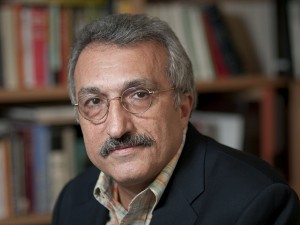
Milani (Photo: L.A. Cicero)

Morally and strategically — this is one of those perplexities in which they go serendipitously together — President Obama’s refusal to strongly support the Iranian resistance against the Iranian tyranny is not prudent, it is perverse. But when democracy comes to Iran, Fareed Zakaria will plummily assure us that this was his dream all along.”

Whew!

However, in its central contentions that democracy will resolve the nuke impasse, he sounds a bit like Abbas Milani — without Milani’s tempered patience.  No surprise: Milani contributes to the New Republic and is a friend.  But glad that the taste for democracy as a resolution for the Iranian imbroglio is contagious.  I’ve written about Milani’s views on the subject here, and also on the Book Haven here and (along with writer Shahryar Mandanipour) here.

***
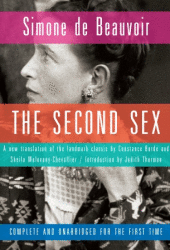
We’ve written about the new translation of Simone de Beauvoir’s Second Sex, and Marilyn Yalom’s defense of the controversial new translation.  Simone de Beauvoir herself was unhappy with the earlier translation by Smith College zoologist H.M. Parshley, who had never translated a book from the French and knew little about philosophy:  “I was dismayed to learn the extent to which Mr. Parshley misrepresented me. I wish with all my heart that you will be able to publish a new translation of it.”

In a Chronicle of Higher Education review of the new translation by Carlin Romero here, he concludes:

… it’s a shame that the Second Sex Translation Follies are turning into a well-made play in which everyone acts the role assigned by theatrical cliché. Maybe a wiser way to look at things is that it’s precisely because all have done so that we find ourselves in such a happy place. … The unabridged material before us … demands extraordinary respect for a writer and thinker who, earlier false images to the contrary, didn’t kneel to Sartre or write off the top of her head, but argued effectively and with rich evidence for a vision of women that now dominates the well-educated West.

***
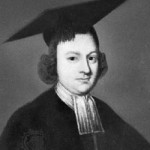
Kit Smart

And finally, for fun, a friend alerted me nearly a year late about poet Robert Pinsky’s quick write-up of Christopher Smart’s “Jubilate Agno” — a poem beloved to  all cat-lovers.  Last year’s Salon article (It includes a 6-minute reading of the poem by Pinsky — definitely worth a click — here)

A sampling for those unfamiliar with the poem — in which Kit Smart considers his cat Jeoffrey:

For by stroking of him I have found out electricity.
For I perceived God’s light about him both wax and fire.
For the electrical fire is the spiritual substance which God sends from heaven
to sustain the bodies both of man and beast.
For God has blessed him in the variety of his movements. …
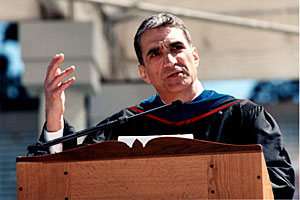
Robert Pinsky (Photo: Steve Castillo)

Ed Hirsch, too, referenced Kit Smart during his recent visit — perhaps Kit appeals to a modern sort of pantheism.

Smart was eventually consigned to a madhouse. According to Samuel Johnson, in Boswell’s work: “My poor friend Smart shewed the disturbance of his mind, by falling upon his knees, and saying his prayers in the street, or in any other unusual place…I did not think he ought to be shut up. His infirmities were not noxious to society. He insisted on people praying with him; and I’d as lief pray with Kit Smart as any one else.”

By the by, you might enjoy Pinsky’s pre-millenial commencement address at Stanford, which is here (with video link).